
Why Is Your AC Not Cooling? RAK Causes and Fixes
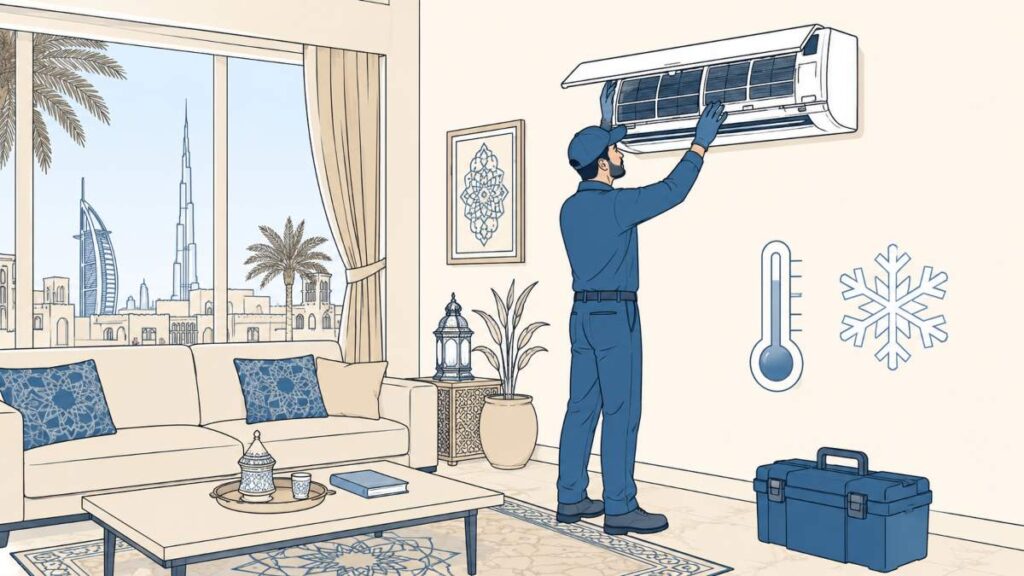
Your AC is running, but the room still feels warm. It’s one of the most frustrating problems a homeowner in Ras Al Khaimah can face, especially during peak summer months when temperatures regularly climb past 45°C.
A unit that won’t cool properly isn’t always broken beyond repair. Often, the cause is something simple: a dirty filter, the wrong remote setting, or a unit that was never sized correctly for the room. Other times, it signals a deeper mechanical issue that needs a professional’s attention.
This guide walks you through the most common reasons your AC has stopped cooling, what each symbol on your remote actually means, how to check if your unit matches your room size, and which fixes you can try yourself before calling a technician. We’ll also cover when a DIY fix simply won’t cut it, and what to expect from a professional AC repair service in Ras Al Khaimah, including typical costs in AED.
If your AC is blowing air but not cooling, running constantly without effect, or cooling unevenly across rooms, you’ll find the answer here.
Understanding Your AC’s Cooling Mode
Before assuming your AC Not Cooling, check that it’s actually set to cool. Many “not cooling” complaints turn out to be remote-setting issues rather than mechanical faults.
What Does the Cool Symbol on Your AC Remote Mean?
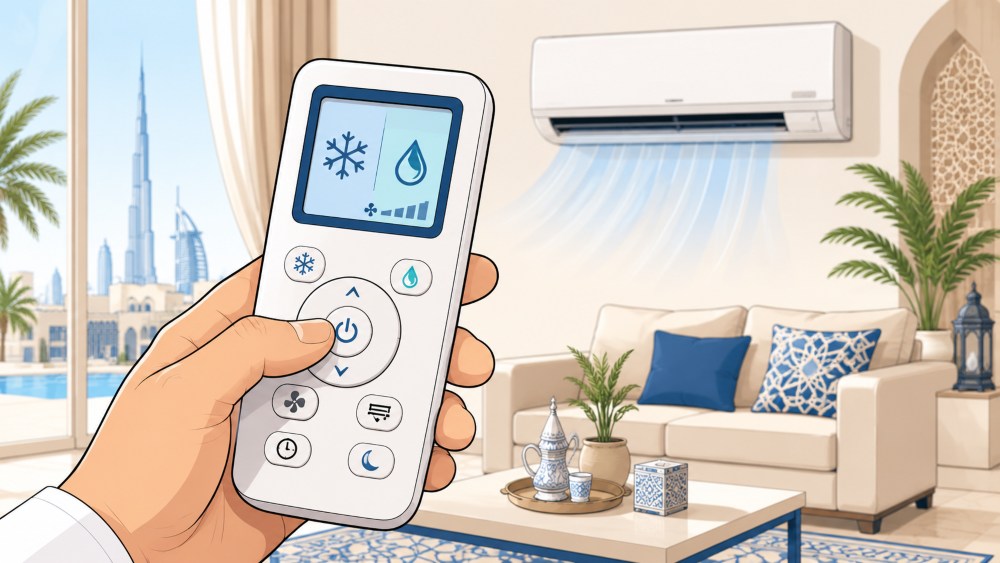
The cool mode symbol is usually a snowflake icon, sometimes paired with the Word “COOL” on the display. Selecting this mode tells the compressor to run continuously, actively removing heat from the room until it reaches your set temperature.
If your remote shows a different icon, such as a droplet (dry mode), a fan (fan-only mode), or a sun (heat mode, on units that support it), your AC will not cool the room properly even though it’s switched on. This single mix-up is one of the most common reasons people in Ras Al Khaimah call for AC repair, only to find the unit was simply set incorrectly.
Cool Mode vs Dry Mode — What’s the Difference?
Cool mode and dry mode look similar on the display but do very different jobs.
Cool mode runs the compressor at full Capacity to lower the room’s temperature as quickly as possible. It also removes some humidity as a side effect, but lowering temperature is the priority.
Dry mode (the droplet icon) runs the compressor at a reduced, intermittent pace. Its main job is pulling moisture out of the air, not dropping the temperature. This is why an AC not cooling on dry mode can feel like it’s “not cooling,” even though it’s working exactly as designed.
Best AC Mode for Maximum Cooling
For the fastest temperature drop, set the cool mode to your desired temperature (typically 22–24°C for most homes in Ras Al Khaimah) and use a high or auto fan speed for the strongest cooling performance. Avoid running dry mode expecting cooling results, and avoid setting the fan too low if the room needs to cool quickly, since this slows air circulation across the coil.
Common Signs Your AC Isn’t Cooling Properly
Not every cooling issue looks the same. The specific symptom you’re seeing is often a strong clue to what’s actually wrong, and knowing the difference can save you a wasted technician visit or help you describe the problem accurately when you do call one.
AC Running But Not Cooling the Room
If the unit is on, the fan is blowing, and you can hear the compressor working. Still, the room temperature isn’t dropping; this usually points to a refrigerant issue, a blocked outdoor condenser, or a dirty indoor coil. Air is moving, but it isn’t being properly cooled before it reaches the room.
This is different from a unit that’s switched off or unresponsive. A running-but-not-cooling AC is actively consuming power without delivering results, which also shows up as a spike on your electricity bill.
AC Cooling Then Stopping After a Few Minutes
Some units cool well for a short period, then the cold air fades, or the compressor cuts out entirely. This pattern often points to a freezing evaporator coil, which forces the system into a protective shutdown, or an electrical fault that trips the unit under load.
Short-cycling like this is hard on the compressor over time and tends to get worse rather than better if left unaddressed.
AC Blowing Air But Room Stays Humid
If air is flowing but the room feels sticky rather than cold, the AC may be struggling to remove humidity, which is common in the UAE’s coastal climate. This can result from low refrigerant, a dirty filter restricting airflow over the coil, or simply a unit that’s undersized for the room.Top Reasons Your AC AC Not Cooling.
To match the 11 causes promised in this guide’s title, here’s the full breakdown.The first five are the most common in Ras Al Khaimah homes; the remaining six are less frequent but still worth checking before calling a technician.
1. Low Refrigerant or Gas Leak
Refrigerant is the substance that actually absorbs heat from your room. If the level drops due to a leak, the system can still run and blow air, but it won’t cool effectively. Refrigerant doesn’t get “used up” during normal operation, so a low level almost always means a leak somewhere in the line, which requires a professional to locate and repair, not just a top-up.
2. Dirty Filters or Blocked Coils
A clogged filter restricts airflow over the indoor coil, reducing the amount of heat the system can absorb. Over time, this also lets dust reach the coil itself, insulating it and further weakening performance. This is one of the easiest issues to prevent with regular filter cleaning.
3. Faulty Thermostat or Sensor
If the thermostat misreads the room’s temperature, it may tell the compressor to shut off early, even though the room hasn’t actually cooled. This often shows up as inconsistent cooling or a unit that stops short of the set temperature.
4. Oversized or Undersized Unit for the Room
A unit that’s too small struggles constantly to keep up with the room’s heat load. A unit that’s too large cools too quickly and shuts off before properly dehumidifying the space, leaving the room cold but damp. Section 4 covers how to check if your unit’s Capacity actually matches your room.
5. Outdoor Unit Issues in UAE Heat
The outdoor condenser releases the heat your AC pulls from indoors. In the UAE, during extreme summer temperatures, a condenser that’s blocked by dust, positioned in direct sunlight without airflow, or surrounded by debris struggles to efficiently release heat, directly reducing indoor cooling performance.
6. Clogged Condensate Drain Line
When the drain line blocks, condensation can back up into the unit, triggering safety shutoffs on some systems or causing water damage and reduced performance on others.
7. Faulty Capacitor
The capacitor provides the compressor and fan motor with the initial surge of power they need to start. A weakening capacitor can cause the compressor to run intermittently or fail to start at all, leading to warm air or a unit that hums but doesn’t cool.
8. Frozen Evaporator Coil
Restricted airflow or low refrigerant can cause the evaporator coil to ice over. Once frozen, the coil can’t absorb heat properly, and the system may blow only mildly cool or even warm air until it’s defrosted and the underlying cause is fixed.
9. Blocked or Closed Vents
Furniture, curtains, or closed vents restrict airflow into the room, even when the unit itself is working perfectly. This is especially common after rearranging furniture or in rooms with ducted systems.
10. Compressor Issues
As the heart of the cooling cycle, a worn or failing compressor can’t pressurize refrigerant effectively. This often shows up as weak cooling that gradually worsens over weeks or months rather than failing suddenly.
11. Electrical or Wiring Faults
Loose connections, a tripped breaker, or worn wiring can cause the compressor to cycle unpredictably or stop drawing enough power to run at full capacity. This is also one of the more serious safety issues and should always be handled by a qualified technician.
How to Calculate the Right Cooling Capacity for Your Room
A unit that doesn’t match your room size will struggle to cool, no matter how well-maintained it is. This section helps you check whether Capacity, not a fault, is the real issue.
1.5 Ton AC: How Many Square Feet Can It Cool?
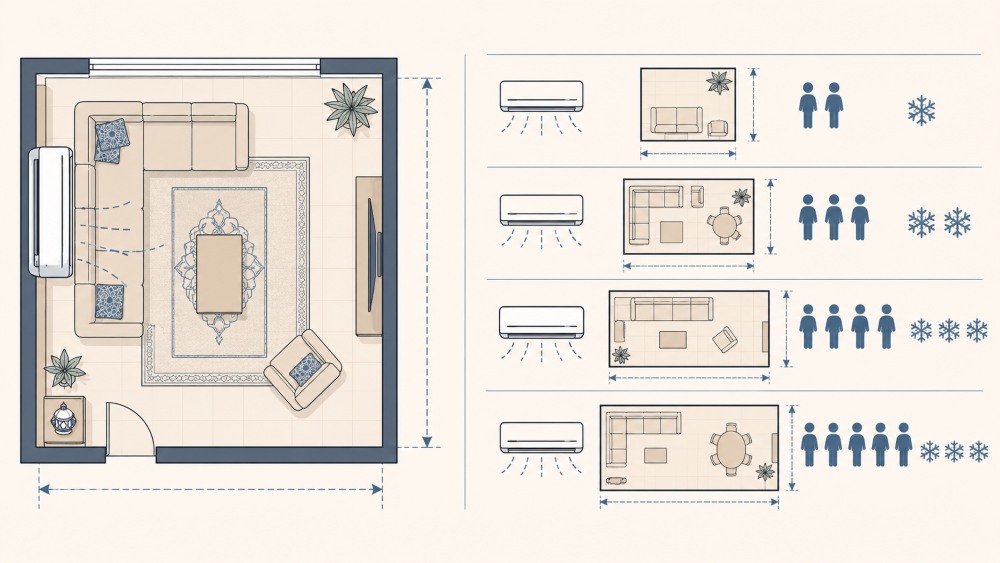
A 1.5 ton AC unit typically cools between 180 and 250 square feet under standard conditions. In the UAE, where summer heat and sun exposure are more intense than average, it’s safer to aim for the lower end of that range, closer to 180–200 square feet, especially for west-facing rooms or spaces with large windows.
Rooms with high ceilings, poor insulation, or several heat-generating appliances will need a slightly larger unit than the square footage alone suggests.
Simple AC Cooling Capacity Calculator (Room Size to Tonnage)
As a quick reference for Ras Al Khaimah homes, use the table below to estimate the recommended AC capacity based on room size.
| Room Size (sq ft) | Recommended Capacity |
|---|---|
| Up to 150 | 1.0 Ton |
| 150–250 | 1.5 Ton |
| 250–400 | 2.0 Ton |
| 400–600 | 3.0 Ton |
| 600–900 | 4.0 Ton |
These figures assume standard ceiling height and average sun exposure. Rooms with floor-to-ceiling windows, west-facing walls, or open-plan layouts often need one size up from this table.
Cooling Multiple Rooms With One AC Unit
A single split unit is designed to cool one main space effectively. Trying to cool multiple rooms or an open-plan layout with a single unit usually results in the room with the unit feeling fine while the adjacent spaces stay warm.
For multi-room cooling, a ducted system or multiple split units (one per room) gives far better, more even results than relying on airflow alone to carry cool air between spaces. If you’re noticing uneven cooling across your home, this is often a capacity-and-layout issue rather than a fault with the unit itself.
DIY Fixes Before Calling a Technician
Some cooling issues can be resolved in minutes without any tools or technical knowledge. Here’s what’s worth trying before booking a repair visit.
How to Increase Cooling Using Your Remote
Start with the basics. Confirm the unit is set to cool mode, not dry or fan mode (see Section 1), and check the set temperature is low enough, ideally 22–24°C. Set the fan speed to high or auto rather than low, since a faster fan moves more air across the coil and cools the room quicker.
If your remote has a “turbo” or “jet cool” function, it temporarily runs the compressor and fan at maximum power in Ras Al Khaimah. It can help bring a hot room down to temperature faster, particularly useful after returning home to a closed-up house in the UAE’s daytime heat.
Cleaning Filters and Vents Yourself
Switch off the unit, then slide out the air filter, usually located behind the front panel of a split unit. Rinse it under running water, let it dry fully, and reinsert it. In dusty environments or homes near construction or coastal sand, this should be done every 2 to 4 weeks during peak summer use.
While the panel is open, check that the indoor vents and louvres aren’t blocked by dust buildup, and confirm nothing indoors (furniture, curtains) is obstructing airflow into the room. Outdoors, clear away any leaves, dust, or debris around the condenser unit, and ensure it has unobstructed airflow.
When DIY Fixes Won’t Work
If you’ve checked the remote settings, cleaned the filter, and cleared the vents. However, if the unit still isn’t cooling, the cause is likely mechanical or electrical: refrigerant leaks, a failing capacitor, frozen coils, or wiring faults, all of which require proper tools, gauges, and training to diagnose safely.
Attempting to handle refrigerant or open electrical components yourself risks injury, further damage to the unit, or voiding warranties. At this point, it’s time to call a professional.
Staying Cool When Your AC Is Down
While you wait for a repair, a few simple steps can make the heat more bearable, especially in Ras Al Khaimah, where indoor temperatures can climb quickly without active cooling.
Quick Ways to Cool a Room Without AC
Close curtains or blinds during the day to block direct sunlight, which is one of the biggest sources of indoor heat gain. Use a standing or ceiling fan to keep air moving; it won’t lower the temperature, but it helps sweat evaporate faster, which makes the room feel cooler. Placing a fan near an open window in the early morning or late evening can also help push out trapped heat once outdoor temperatures drop slightly.
Switching off unnecessary heat-generating appliances such as ovens, extra lighting, or electronics also helps prevent the room from heating up further while your AC is offline.
Temporary Cooling Tips for UAE Summers
In UAE peak summer months, prioritize cooling one or two main rooms rather than trying to keep the whole home comfortable. Move portable fans into bedrooms in the evening and keep doors to unused rooms closed to limit warm-air circulation.
If the heat becomes difficult to manage, especially with young children, elderly family members, or anyone with health conditions, consider spending peak afternoon hours in a cooler part of the house or visiting an air-conditioned space until repairs are complete.
When to Call a Professional AC Repair Service in Ras Al Khaimah
Once you’ve ruled out simple fixes, settings, filters, and vents, it’s time to bring in a professional. Catching an AC cooling problem early usually means a smaller repair bill and less wear on the rest of the system.
Signs You Need Urgent AC Repair
Call a technician promptly if you notice any of the following: the unit blows warm or only mildly cool air despite correct settings, ice forms on the indoor coil or pipes, you hear unusual noises such as buzzing, clicking, or grinding from the compressor, water leaks from the indoor unit, or the AC trips the breaker repeatedly. Any of these indicate a mechanical or electrical fault that requires proper diagnostic tools to resolve safely.
What Home Fix Checks During an AC Cooling Inspection
A thorough inspection covers refrigerant pressure and levels, the condition of the capacitor and electrical connections, indoor and outdoor coil cleanliness, condensate drain flow, and overall airflow through the filters and vents. Our technicians also check that your unit’s Capacity actually matches your room size, since an undersized or oversized unit can mimic the symptoms of a mechanical fault.
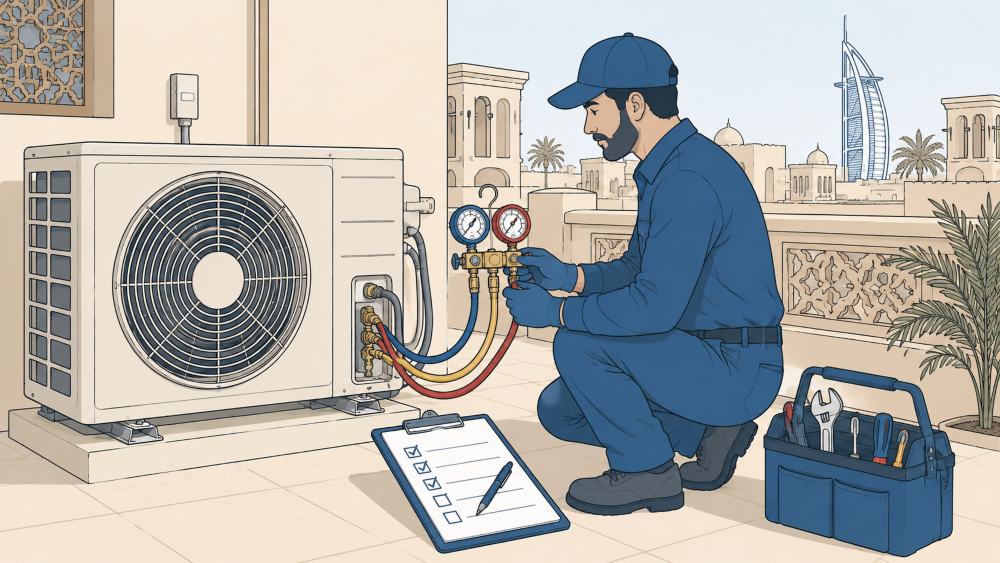
This step-by-step approach identifies the real cause rather than guessing, so AC repairs are targeted and lasting.
AC Repair Pricing in Ras Al Khaimah (AED)
| Service | Typical Price Range (AED) |
|---|---|
| General AC Inspection & Diagnosis | 100 – 200 |
| Filter and Coil Cleaning | 150 – 300 |
| Refrigerant Gas Top-Up (Per Kg) | 200 – 350 |
| Capacitor Replacement | 150 – 350 |
| Condensate Drain Unblocking | 100 – 250 |
| Compressor Repair | 600 – 1,500 |
| Compressor Replacement | 1,800 – 3,500 |
| Full AC Servicing (AMC Visit) | 150 – 350 |
Prices vary depending on unit type, AC tonnage, and the extent of the issue. Home Fix provides a clear quote after inspection, with no hidden charges.
Frequently Asked Questions (FAQs)
Why is my AC not cooling even though it’s running?
A running unit that isn’t cooling usually points to a refrigerant leak, a dirty coil restricting heat absorption, a faulty capacitor, or a blocked outdoor condenser. The fan and compressor can still operate while the actual cooling process is impaired, so “running” doesn’t mean “working correctly.”
What’s the difference between cool and dry mode?
Cool mode runs the compressor continuously to lower the room’s temperature as the main priority. Dry mode runs the compressor intermittently and focuses on removing humidity rather than dropping temperature, which can make the AC feel like it isn’t cooling even though it’s functioning as designed.
How do I know if my AC has the right cooling capacity for my room?
Match your room’s square footage against standard tonnage guidelines (roughly 150–250 sq ft per 1.5 tons), then adjust upward for high ceilings, large windows, or strong sun exposure, all common in Ras Al Khaimah homes. See Section 4 for a full capacity table.
Can low gas cause my AC to stop cooling?
Yes. Refrigerant doesn’t deplete through normal use, so a low level almost always indicates a leak. This reduces the system’s ability to absorb heat and is one of the most common causes of weak or absent cooling.
How often should I service my AC to prevent cooling issues?
In the UAE climate, filters should be cleaned every 2 to 4 weeks during peak summer, with a full professional service every 3 to 4 months. An Annual Maintenance Contract (AMC) covers this on a set schedule and helps catch small issues before they become costly repairs.