How to Fix a Warped Wooden Door | RAK Repair Guide
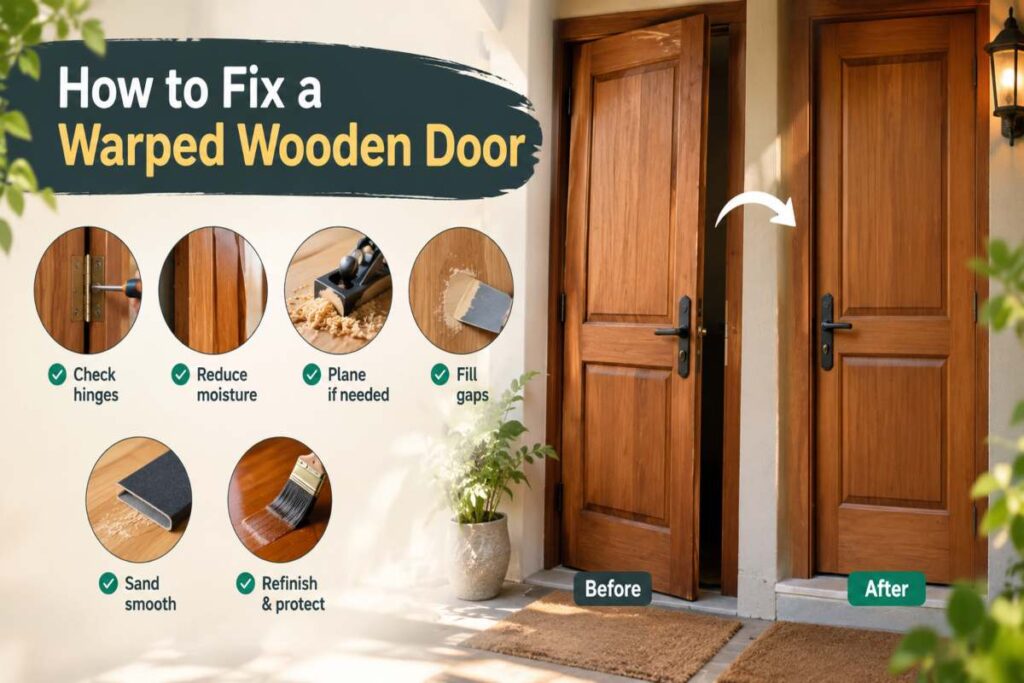
Warped wooden door can be fixed by identifying the type of warp, then applying weight, moisture or heat correction to reverse the bend or in more severe cases, planing and re hanging the door on its frame. Most warped doors in Ras Al Khaimah don’t need replacing, they need the right fix for how badly they have bent. Warping is one of the most common wood door problems homeowners across the UAE deal with and RAK’s climate makes it worse than most. Humidity levels here regularly sit above 60% for much of the year and that constant moisture swing between air conditioned interiors and hot, humid air outside is exactly what causes wood to expand, contract and eventually bow, cup or twist.
Front doors, screen doors, cabinet doors and even garage doors are all vulnerable, though the fix differs depending on the door and how far the warp has progressed. This guide walks through why wooden doors warp in RAK specifically, how to tell how bad the damage is, step by step methods to straighten or fix a warped door yourself and when it’s worth calling in a professional instead. If your carpentry needs go beyond a single warped door, Home Fix Building Maintenance carpentry works team handles everything from door repair and re hanging to full custom joinery across Ras Al Khaimah.
Why Wooden Doors Warp in Ras Al Khaimah Climate
Wooden doors warp in Ras Al Khaimah mainly because of moisture imbalance, one side of the door absorbs humidity from the air while the other stays dry and cool from air conditioning and the wood expands unevenly until it bends.

Wood is a natural material and it never fully stops reacting to the air around it. In RAK, that reaction happens fast. Coastal humidity in the region regularly climbs above 80% during summer months, while indoor spaces are kept cold and dry by AC units running almost constantly. A wooden door sitting between these two environments is absorbing moisture on its outward facing side and losing it on the inward facing side at the same time. Over weeks and months, that uneven swelling and shrinking pulls the door out of shape, bowing outward, cupping across its width or twisting along its length.
Front doors and garage doors take the worst of it because they are directly exposed to outdoor heat and sun on one face. Cabinet doors and interior doors warp more slowly, but AC vents blowing directly onto one side can speed up the same imbalance. Doors made from solid, unsealed or poorly kiln dried wood are especially at risk, since they hold more moisture to begin with. This is also why the same wooden door style can perform perfectly fine in a drier climate but warp within a year in RAK, the wood itself hasn’t changed, but the environment demands far more of it.
Types of Door Warping Bow, Cup and Twist
A warped wooden door will bend in one of three distinct patterns, bow, cup or twist and identifying which one you’re dealing with is the first step to fixing it correctly, since each type responds to a different repair method. A bowed door curves along its height, from top to bottom, so the door looks fine when viewed from the side edge but pulls away from the frame at the top or bottom corner when closed. This is the most common type on front and garage doors, where one face gets more direct heat exposure than the other.
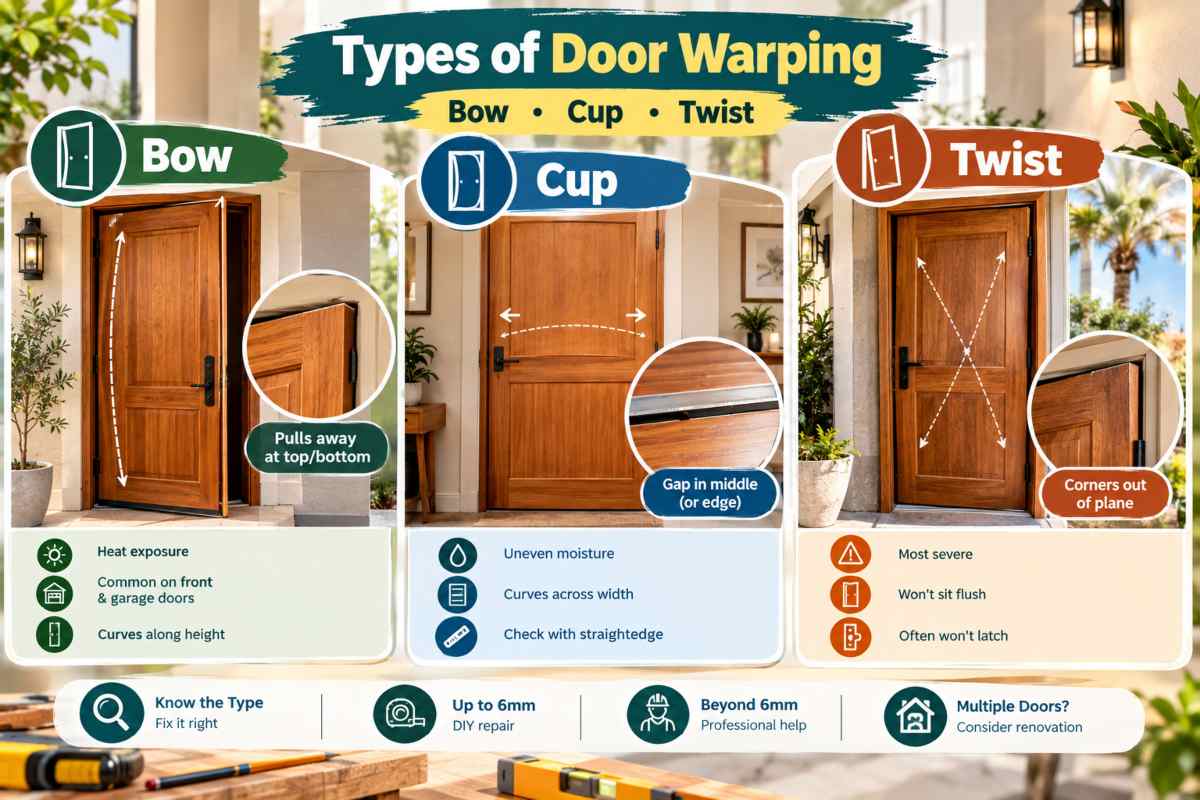
A cupped door curves across its width instead, so if you hold a straightedge horizontally against the panel, you’ll see a visible gap in the middle or along one edge, this happens when moisture penetrates unevenly across the door’s face rather than along its length. A twisted door is the most severe form, instead of bending in a single direction, opposite corners of the door move out of the same flat plane, so the door won’t sit flush against the frame at any point and often won’t latch properly at all.
Diagnosing the type matters because bows and mild cups can usually be corrected with weight, moisture or heat based methods at home, while twisted doors almost always need planing, re hanging or in advanced cases, replacement. As a rough guide, a warp of up to 6mm measured across the door’s width is generally considered repairable using DIY correction methods, while anything beyond that typically requires professional attention. If a warped door is part of a larger set of ageing doors, frames or fittings in your home, it’s often more cost effective to address them together as part of broader home renovation services rather than fixing each one in isolation.
Can a Warped Wooden Door Be Fixed?
Yes, most warped wooden doors can be fixed without replacement, the deciding factor is how far the warp has progressed and whether the door still closes and latches properly. Start by checking whether the door still shuts flush against the frame. If it closes with only slight resistance or a small visible gap at one corner, you’re likely dealing with a mild bow or cup that responds well to home correction methods.
Lay a straightedge or a taut string diagonally across the door’s face and measure the largest gap between the string and the wood, this tells you the warp depth in millimetres, which is the single most useful number for deciding your next step. A gap under 6mm is generally a straightforward fix. Between 6mm and 12mm, correction is still possible but takes longer and may need repeated attempts. Beyond 12mm or if the door has visibly twisted so that diagonally opposite corners sit in different planes, DIY methods usually fail to hold and the door will warp back within weeks.
Two other checks matter before you commit to fixing versus replacing. First, look at how the door was made, solid wood doors with mortise and tenon joints or engineered cores tend to hold a correction far better than cheaper veneered or hollow core doors, which often warp again quickly once the underlying moisture problem returns. Second, considering the door age and exposure, a front door that’s warped once in RAK’s climate is highly likely to warp again unless the root moisture issue (sun exposure, missing weatherstripping, unsealed wood) is also addressed. Fixing the warp without fixing the cause is a temporary win, not a permanent one.
How to Fix a Warped Wooden Door Step by Step Method
You can fix a warped wooden door at home by removing it from its hinges, applying targeted moisture or weight to the concave side and letting it dry flat under pressure for several days until the bend reverses. Begin by taking the door off its hinges and laying it flat across two sawhorses or a stable, level surface, trying to fix a warp while the door is still hanging rarely works because gravity keeps pulling it back into the bend. Identify the concave side, which is the side curving inward, since this is the face that needs moisture and heat to expand and match the opposite side.
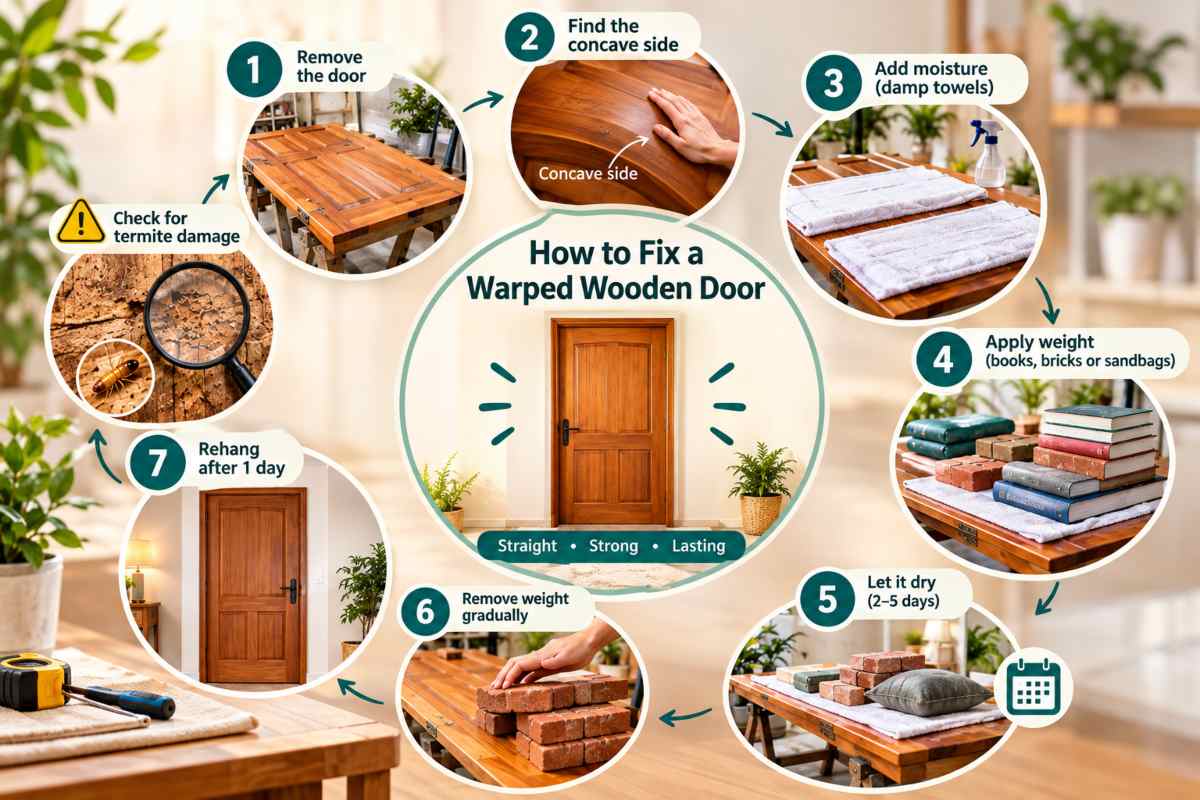
Lay damp towels along the concave face and leave them in place for a few hours, re-wetting as they dry out, on lighter bows, some homeowners speed this up carefully with a hairdryer on a low setting, moving it steadily to avoid scorching the wood. Once the wood has absorbed enough moisture to soften slightly, apply even weight across the door’s surface, heavy books, bricks or sandbags spread across the concave side work well. Leave the door under this weight for two to five days, checking progress every day with a straightedge and re wetting the towels as needed to keep the correction going.
When the door lies flat, remove the weight gradually rather than all at once and let it dry fully for another day before re hanging it, since re hanging too early often lets the warp creep back before the wood has stabilised. This method works well for moisture related warping, but it won’t fix a door that’s bending because the wood itself has been weakened or hollowed out from the inside.
If your door feels unusually light, sounds hollow when tapped or shows small exit holes near the frame, the underlying cause may be structural rather than climate related, in RAK humid conditions, this is often the result of termite activity and no amount of weighting or drying will hold a permanent fix. In that case, get a proper termite damage wood repair assessment before attempting to straighten the door again.
How to Straighten a Warped Wood Door Without Removing It
You can straighten a warped wood door while it is still hanging by adjusting the hinges, tightening the frame and applying targeted pressure or moisture to the warped section over several days, a slower method than removing the door, but useful when taking it off its hinges is not practical.
Start by checking the hinges themselves, since a door that appears warped is sometimes just sitting on loose or worn hinge screws. Tighten every screw and if the holes have worn out, replace them with longer screws that bite into fresh wood inside the frame. Next, close the door and use shims, thin wedges of wood or cardboard, pressed between the door and the frame at the point where the gap is largest. Leave the shims in place for several days, checking periodically, as this steady pressure gradually coaxes the wood back toward flat without needing to remove the door at all.
For doors with a mild bow, you can also work moisture into the equation without taking it down, dampen a towel and press it against the concave side of the door while it’s closed, holding it in place with the shims or a strip of tape at the edges. Because the door stays under the frame’s own structural pressure the entire time, this method often corrects light warps faster than free standing weight methods, since the frame itself is doing part of the straightening work. It won’t help with a twisted door, though, twisting needs the door removed and laid flat, since a door still hanging on its hinges can’t be brought back into a single flat plane while attached to the frame.
Fixing Warping by Door Type
The core fix for a warped wooden door is the same regardless of type, moisture, weight or heat correction, but how you apply it changes depending on the door’s size, exposure and hardware, so treating a cabinet door the same way as a garage door usually leads to a poor result.
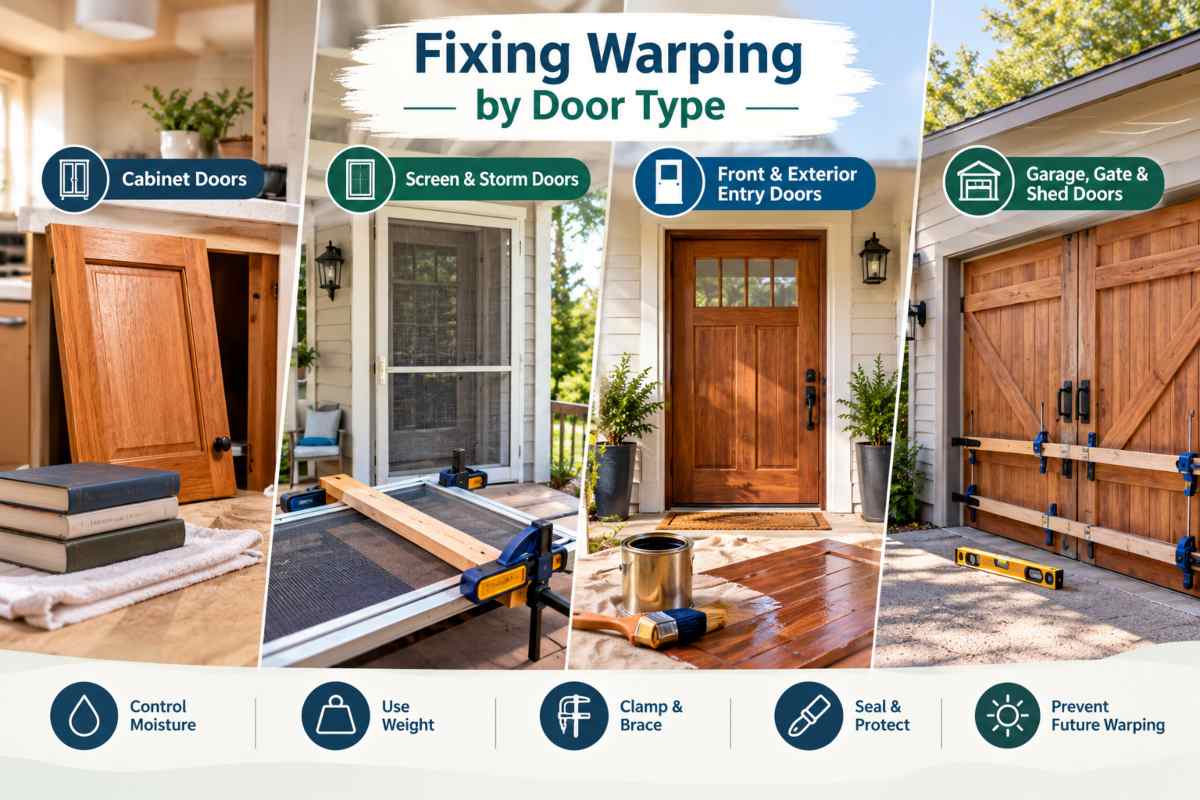
Cabinet Doors
Warped cabinet doors are the easiest to fix because of their small size and light weight. Remove the door from the cabinet frame, lay it flat and dampen the concave face with a cloth before weighting it evenly with a few heavy books for one to two days, far less time than a full sized door needs. Because cabinet doors sit close to kitchen or bathroom moisture and heat sources, check that the hinges are still square once the door dries, since a slightly warped cabinet door often gets worse quickly if it’s rehung misaligned. If the warp keeps returning, the cabinet door itself may have been made from thin or low grade veneer that can’t hold a correction long term.
Screen and Storm Doors
Screen and storm doors warp differently because of their lightweight frame and mesh or glass inserts, which don’t distribute weight evenly across the panel. Rather than laying weight flat across the whole door, focus pressure at the specific point of the bow using clamps and a straight board as a brace, tightening gradually over a few days rather than all at once. Because these doors are constantly exposed to outdoor humidity and temperature swings, re sealing the wood with a weather resistant finish after straightening is especially important, without it, a screen door in RAK climate is likely to warp again within a season.
Front and Exterior Entry Doors
Front doors take the most direct sun and heat exposure of any door type, so they’re also the most prone to repeat warping after a fix. Once straightened using the weight and moisture method, seal both faces of the door with an exterior grade varnish or paint, since an unsealed or unevenly sealed front door will keep absorbing moisture unevenly no matter how well it has been corrected. If the entry door has warped more than once, it’s often a sign the door itself isn’t rated for RAK climate and swapping it for a more suitable solid core or engineered door may be more practical than repeated fixes.
Garage, Gate and Shed Doors
Garage, gate and shed doors are usually the largest and heaviest wooden doors in a property, which makes them harder to remove and lay flat for correction. For these, in place straightening using shims, clamps and bracing across the frame is typically more practical than the remove and weight method used for smaller doors.
Because these doors also carry more structural weight and are often exposed to direct sun for most of the day, warping here can affect how well the door seals and locks, which matters for security as well as appearance. For larger properties managing multiple exterior doors alongside gates and outbuildings, it’s often more efficient to have these assessed together under broader residential and commercial services rather than fixing each door as a separate job.
How to Prevent Wood Door Warping Before It Happens
You can prevent wood door warp by sealing every face and edge of the door evenly, controlling the moisture and heat it is exposed to and choosing well built, properly dried wood from the start, prevention is far less work than repeatedly fixing the same door.
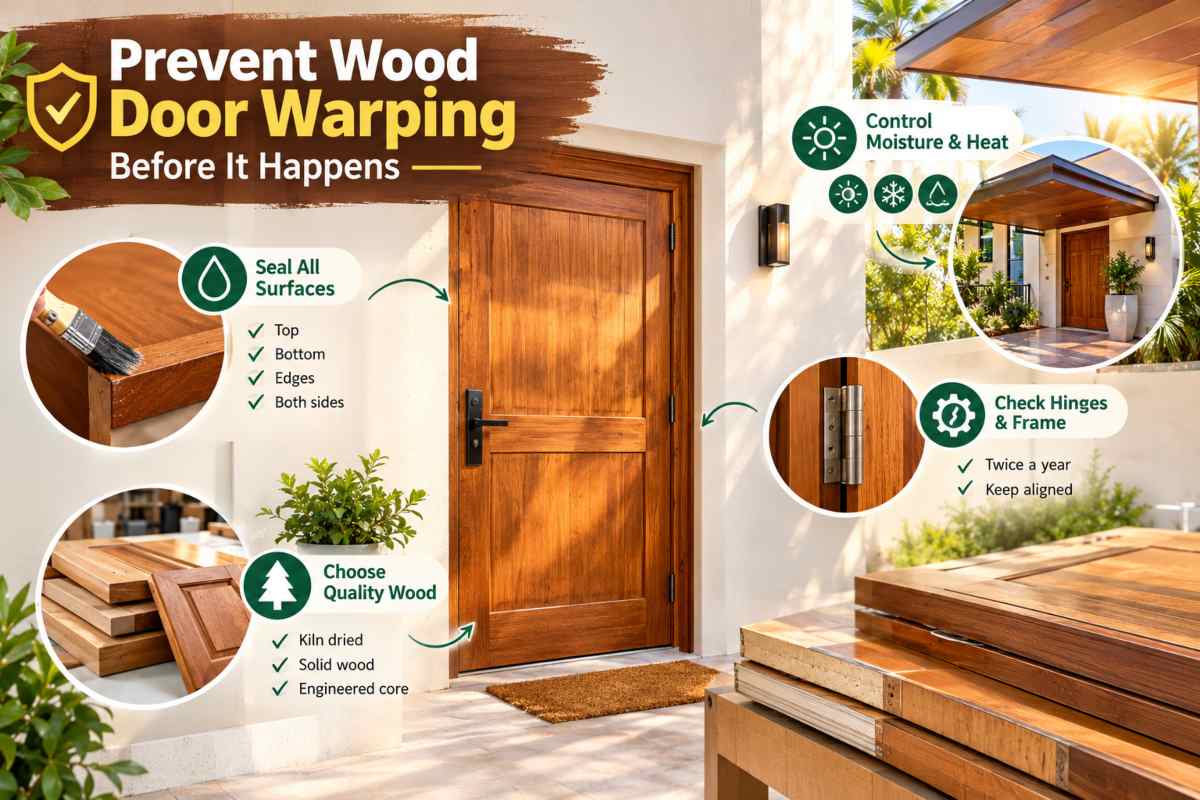
The single most overlooked cause of preventable warping is an unsealed edge. Homeowners often varnish or paint the front and back faces of a door but skip the top, bottom and side edges, assuming they don’t matter since they’re hidden. In reality, exposed edges absorb moisture fastest and that uneven absorption is exactly what starts a warp. Sealing all six surfaces of a wooden door, top and bottom included, with a matching finish keeps moisture moving in and out evenly across the entire door rather than concentrating on one side.
Reducing extreme moisture and temperature swings around the door also matters. For front and exterior doors, an overhang, canopy or shaded entryway that limits direct sun exposure can meaningfully extend how long a door stays flat, since heat build up on one face is often the trigger for bowing. Indoors, keeping air conditioning vents from blowing directly onto one side of a door, including cabinet and interior doors, helps avoid the same one sided drying effect. It’s also worth checking door hinges and frames twice a year, since a door that’s slightly misaligned puts uneven pressure on the wood every time it closes, which accelerates warping over time even in a well sealed door.
Finally, the wood quality and construction of the door itself sets the ceiling for how warp resistant it can ever be. Solid wood doors that have been properly kiln dried or engineered doors with a stable core and veneer finish, hold up significantly better in RAK’s climate than cheaper doors made from unseasoned or poorly dried timber. Spending more on quality wood or construction at installation is, in most cases, cheaper over time than repeatedly repairing or replacing a warped door.
Anti Warp Door Designs and Materials Worth Choosing
The most warp resistant wooden doors use an engineered core with a stable veneer finish or a steel reinforced flush frame, both of which resist the moisture driven expansion that causes solid, unseasoned wood to bow, cup or twist. Engineered doors, built with a composite or laminated core wrapped in a wood veneer, are far more dimensionally stable than doors made from a single solid slab.
The layered construction means moisture absorbed on one face has to pass through several bonded layers before it reaches the other side, which slows the uneven expansion that causes warping in the first place. This makes engineered doors a strong choice for RAK homes, where humidity and heat exposure are constant rather than seasonal. Reinforced steel frame flush doors take this a step further by using a rigid internal frame instead of relying on the wood alone to hold its shape, which is why they’re increasingly common for exterior and garage doors in the region.
Door thickness and joint construction also affect warp resistance. Thicker doors, generally 40mm or more, have more mass to resist bending, while doors built with proper mortise and tenon joinery hold their shape better over time than doors assembled with weaker fastening methods. When choosing wood species, teak and treated hardwoods perform noticeably better in humid climates than softer, untreated woods, since they naturally resist moisture absorption. Choosing the right door type at the outset is especially worth planning for during a full property upgrade, if you’re already renovating, it’s the ideal time to swap warp prone doors for anti warp designs as part of a broader apartment renovation rather than replacing them individually later.
DIY Fix vs Professional Repair vs Replacement
The right choice between a DIY fix, professional repair or full replacement comes down to warp severity, door value and how many times the door has already warped, mild warps favour DIY, moderate to severe warps favour professional repair and repeat warping usually points to replacement. A door with a warp under roughly 6mm, measured across its width with a straightedge, is generally safe to correct at home using moisture, weight or shimming methods, since the wood hasn’t been pushed far enough out of shape to need specialist tools.
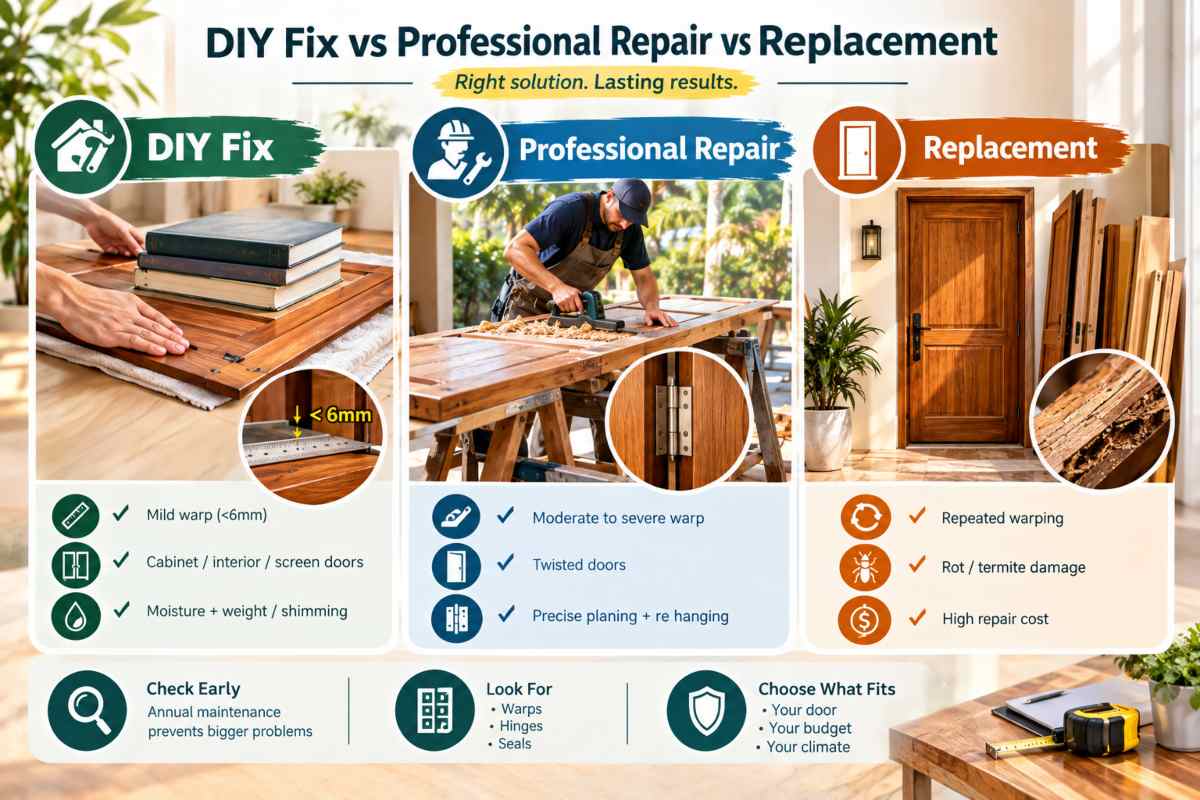
This covers most cabinet doors and many screen or interior doors. Once the warp passes that range or the door has twisted rather than simply bowed, a professional carpenter brings two advantages a DIY fix can not the ability to plane the door precisely to correct a persistent bend without weakening its structure and the experience to judge whether re hanging on adjusted hinges will solve the problem permanently or only temporarily.
Replacement becomes the more sensible option in three specific situations, when a door has warped more than once despite proper sealing and correction, when the wood itself is compromised by rot, termite damage or poor original construction or when the cost of repeated professional straightening over a year or two starts to approach the cost of a new, better suited door. As a general guide, if a single door has needed correction more than twice in 12 months, that’s a strong signal the underlying wood or design isn’t suited to RAK’s climate and continuing to fix it is treating a symptom rather than the cause.
For homeowners who’d rather catch warping early than deal with repeat fixes, routine door and hardware checks are usually bundled into an annual maintenance contract, which covers seasonal inspection and resealing before a minor bow turns into a door that needs replacing.
Conclusion
Fixing a warped wooden door in Ras Al Khaimah comes down to matching the method to the severity of the warp, mild bows and cups respond well to moisture and weight correction at home, while twisted or repeatedly warping doors need professional planing, re hanging or replacement and since RAK high humidity and constant air conditioning use put more stress on wood doors than most other climates, sealing every surface, managing sun and vent exposure and choosing engineered or treated wood from the outset all help prevent the problem from recurring and if you are dealing with a warped door now or want to get ahead of it before the next humid season, Home Fix Building Maintenance can assess, repair or replace it as part of a wider carpentry or maintenance plan tailored to your property.
Frequently Asked Questions (FAQs)
How to fix a warped wooden door yourself?
Remove the door from its hinges, lay it flat and apply moisture to the concave side with damp towels while weighting it evenly for two to five days. This corrects mild bows and cups but won’t hold on doors warped more than 6-8mm.
Can you straighten a warped wooden door without replacing it?
Yes, most warped doors can be straightened using moisture, weight or shimming rather than replaced outright. Replacement is only necessary when the warp is severe, the wood is structurally weakened or the door keeps warping repeatedly.
Why do new wood entry doors warp?
New doors often warp because the wood wasn’t fully kiln dried before installation or because one face is exposed to sun and heat while the other stays cool indoors. This moisture imbalance is especially common in RAK humid climate.
How do I keep a wood screen/gate door from warping?
Seal all six surfaces of the door, including the top and bottom edges, with a weather resistant finish. Limiting direct sun exposure and checking hinges regularly also reduces the uneven stress that leads to warping.
Is a sticking door the same problem as a warped door?
No, a sticking door is usually caused by swelling, frame misalignment or paint buildup, while warping is a permanent bend in the wood itself. A door can stick without being warped and vice versa.