
What Is Floor Trunking | Types, Sizes and Uses in RAK Homes
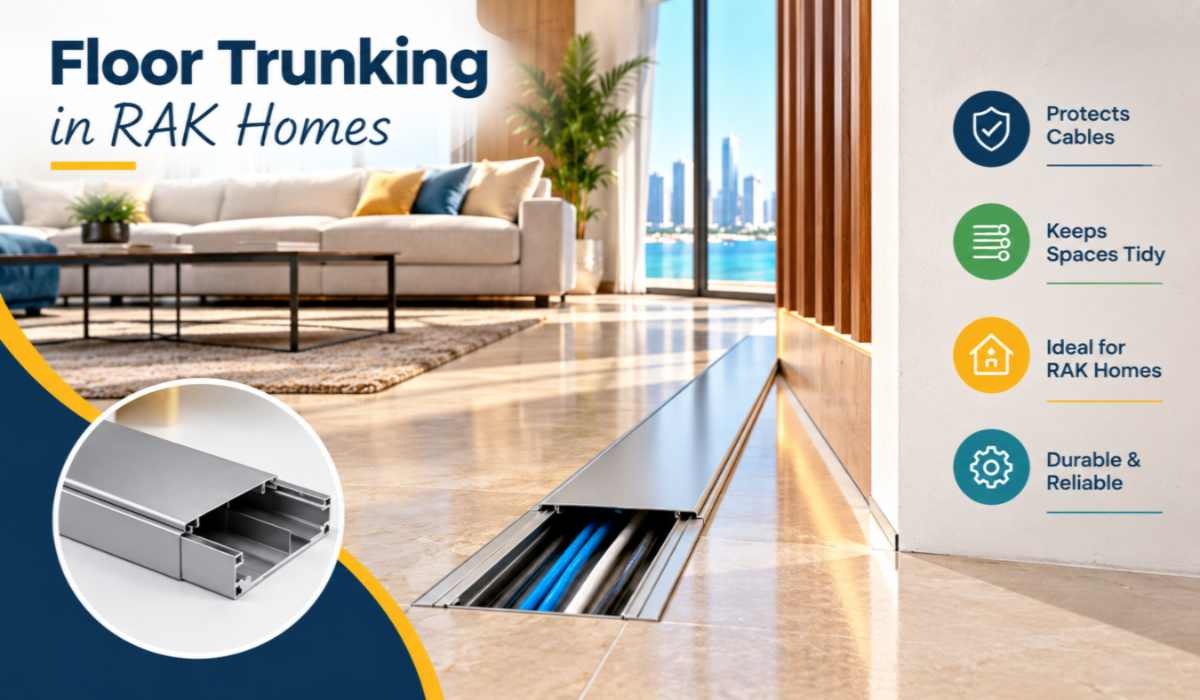
Floor trunking is a covered channel fixed on or in the floor that holds electrical, data, and TV cables, so they run safely across a room instead of lying loose on the ground.
What Is Floor Trunking? Floor trunking protects cables from feet, furniture and moisture. It comes in PVC, metal and rubber, in sizes from small 16x25mm channels to wide 75mm runs.
In Ras Al Khaimah, it is a practical fix for villas, apartments, home offices, majlis rooms and small shops where sockets sit far from the wall. Heat, dust and humidity can quickly damage exposed wiring, so the right trunking type matters. Size matters too. A common rule is to fill trunking to no more than about 45% of its space, which leaves room for heat to escape and for future cables.
This guide explains each type and size in plain language. It also shows how the Home Fix Building Maintenance electrical team in Ras Al Khaimah chooses and fits floor trunking for local homes.
What Is Floor Trunking in Electrical Wiring?
In electrical wiring, floor trunking is a protective channel that carries cables along or under a floor, from a wall point or distribution box to sockets placed away from the wall. It keeps power, data and TV cables tidy, covered and out of harm’s way. The three parts below explain what it is, how the system works, and how it differs from wall trunking and conduit.
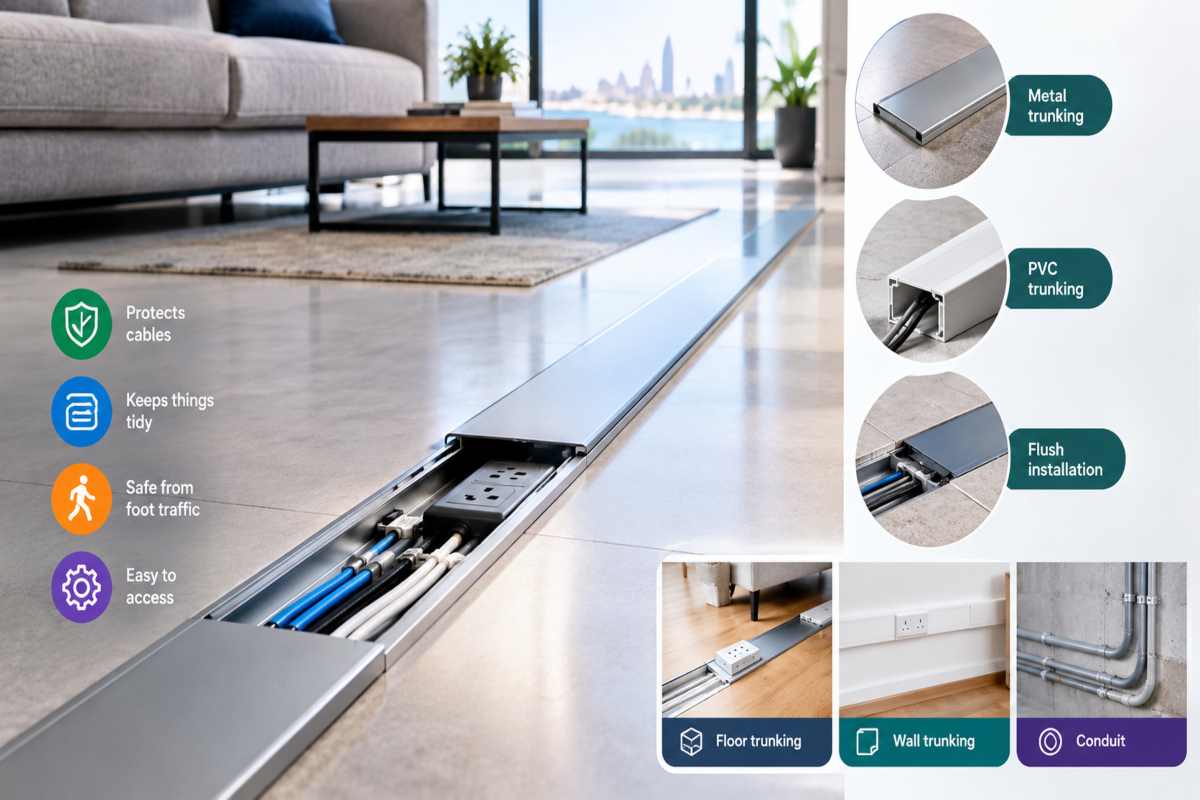
Floor trunking meaning in simple words
Floor trunking is a long, narrow cover that hides cables lying on or inside a floor. Think of it as a small tunnel for wires. The cables sit inside, and the lid stops people, chairs and cleaning equipment from touching them.
The channel can be made of PVC, metal or rubber. Some types sit on top of the floor, while others are built into it before the final finish goes down. In a Ras Al Khaimah home, you will most often see it where a sofa, desk or island counter sits in the middle of a room and needs power without a trailing extension lead.
How a floor cable trunking system works
A floor cable trunking system carries cables from one fixed point to another through a continuous, covered route. An electrician first plans the path, then fixes the base channel, lays the cables inside and snaps on the lid. Fittings such as bends, end caps and socket boxes keep the route closed and neat.
Space inside the trunking is limited on purpose. As a rule of thumb, electricians fill a trunking channel to no more than about 45% of its internal area. That spare room lets heat escape and leaves space for extra cables later. Electricians usually keep power and data cables in separate compartments to avoid interference.
Some systems sit flush with the floor. Install these before the screed or tiles go down, so the finished surface covers the channel and only the access lids show. If you are planning new tiles or wood, coordinate this work with your flooring and roof services so the trunking route is set before the finish is laid.
Floor trunking vs wall trunking vs conduit
Floor trunking runs along floors and must handle foot traffic. Wall trunking runs along walls and skirting and is not built to be walked on. Conduit is a round tube, often hidden inside walls or concrete, which protects individual cable runs rather than a bundle.
The right choice depends on where the cable needs to go. Use wall trunking for tidy surface runs on walls, conduit for hidden or buried routes, and floor trunking when cables must cross an open floor. Floor trunking is also easier to open later because the lid lifts off, making it much simpler to add or replace cables than buried conduit.
Why Use Floor Trunking in a RAK Villa, Apartment or Office?
Use floor trunking in Ras Al Khaimah to carry cables safely across an open floor, prevent trips, and protect them from damage and heat. It is the tidy, code-friendly alternative to extension leads and loose wires. The three parts below cover safe cable routing, trip and damage prevention, and the rooms where it helps most.
Safe routing of power, data and TV cables across a floor
Floor trunking gives power, data, and TV cables a fixed, covered route from the wall to wherever you need a socket. In a villa living room, this might be a socket by the sofa. In an apartment, it could feed a TV unit in the center of an open-plan space. In an office, it often serves desks away from the walls.
A proper route also keeps cables in order. Electricians can place power and data cables in separate compartments, reducing interference and making faults easier to trace. Because everything sits inside a rated channel, the wiring is protected from dust, spilled water and the daily wear of cleaning.
Trip hazards and cable damage prevention
Loose cables are a real trip risk, and they are easily crushed by chairs, furniture legs and vacuum cleaners. Floor trunking covers the cable with a low, firm lid that people can step over safely. Rubber types add a gentle slope, which also helps with trolleys and wheelchairs.
Workplace data backs the safety case. In Great Britain, about 30% of employer-reported non-fatal injuries in 2024/25 involved slips, trips or falls on the same level. That is a UK workplace figure, not a UAE one, but the lesson applies anywhere. Trailing cables are among the easiest trip hazards to remove.
Trunking also prevents hidden damage. Cables that are pinched, stepped on or dragged can overheat, and RAK’s high temperatures make that risk worse. A covered channel keeps the insulation intact and reduces the chance of a hidden fault.
Home offices, majlis, shops and workshops
Floor trunking suits any room where furniture, counters, or workstations sit away from the wall. In a home office, it feeds a desk, monitor and router without a tangle of leads. In a majlis, it can bring power to a central table or lighting feature without cutting into the floor finish.
Small shops use it to power till points and display stands, while workshops use tougher metal or heavy-duty rubber types to protect cables from tools and foot traffic. The type you choose depends on the load, the traffic and how the floor will be finished, so it is worth planning the route before the final flooring goes down.
Types of Floor Trunking
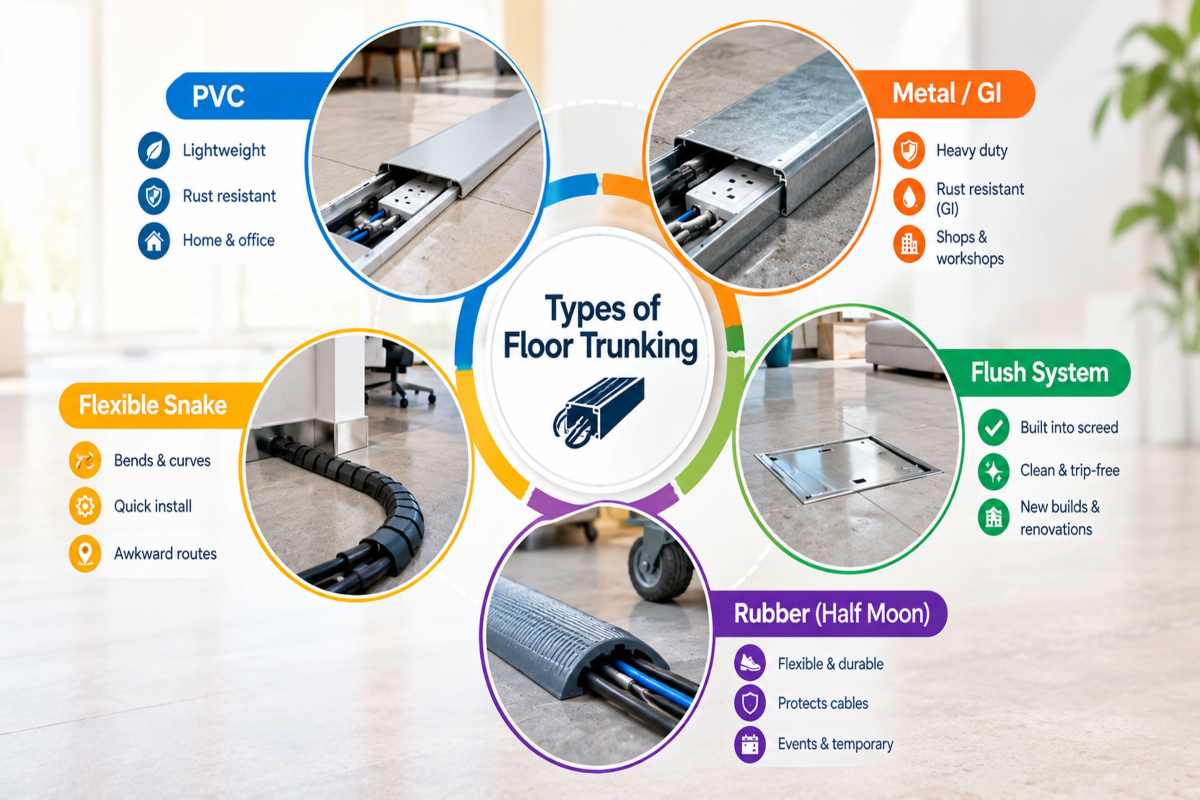
The main types of floor trunking are PVC, metal (including GI), flush systems cast into the screed, half moon rubber, and flexible snake trunking. Each suits different floors, loads and budgets. The sections below explain each type, where it works best, and what to watch for in Ras Al Khaimah.
PVC floor trunking (including PVC arc floor trunking)
PVC floor trunking is a lightweight plastic channel with a snap-on lid, fixed to the surface of a finished floor. It is the usual choice for homes and light-duty offices because it is easy to cut, simple to fit and does not rust, which helps in RAK’s humid coastal air.
PVC arc floor trunking has a rounded, arc-shaped lid instead of a flat one. That curved profile lets feet and light trolleys pass over more smoothly and looks neater on tiles or wood. PVC is not built for heavy loads, so it suits living rooms, bedrooms and home offices rather than workshops or vehicle areas.
Metal floor trunking and GI floor trunking
Metal floor trunking is a rigid steel channel made for places where cables face heavy foot traffic, equipment or knocks. GI floor trunking uses galvanised iron, which has a zinc coating that slows rust. That coating makes it a sensible metal choice along the shoreline, where the salty air accelerates the corrosion process.
Metal trunking must be properly earthed and bonded by a qualified electrician, because a metal case can become live if a cable fault occurs. Cut edges should also be treated so the zinc coating stays protected. It costs more than PVC, but it is the stronger option for shops, workshops and busy offices.
Flush floor trunking system (cast into screed)
A flush floor trunking system is built into the floor itself. The channels are laid before the screed is poured, so the finished floor covers them and only small access lids or socket boxes show on the surface. The result is a clean, trip-free floor with no raised covers.
This type must be planned early, because it cannot easily be added once the flooring is complete. It suits new villas, major renovations and open-plan offices where sockets are needed in the middle of a room. As a proof point of its flexibility, many flush systems let you add or move outlets later by opening an access lid, so you do not have to break up the floor.
Rubber floor trunking for cables in UAE (half moon type)
Rubber floor trunking is a soft, grippy cover that sits on top of the floor and protects cables from feet, chairs and wheels. The half moon type has a domed top and a flat base, which creates a gentle ramp that is easy to step or roll over. A common size is 50x50mm with two compartments, so power and data cables can sit apart.
It is popular in the UAE for events, temporary setups, shops and home offices, because it needs no cutting into the floor and can be moved or removed. Grey is a common colour because it blends with most floors. Rubber is not a permanent fixed solution, so it suits short to medium-term runs rather than built-in wiring.
Flexible floor cable trunking snake
Flexible floor cable trunking, often called snake trunking, bends around corners and curves where rigid channels cannot go. It is a good fit for awkward routes, such as around furniture legs, columns or curved walls, and for quick fixes where a straight run is not possible.
Because it is made for flexibility rather than strength, it is best kept for light-duty or short runs. It is not the right choice for heavy traffic or long-term main wiring, where a rigid PVC, metal or flush system gives better protection.
Floor Trunking Sizes Explained
Floor trunking sizes are quoted in millimetres as width by height, for example 16×25 or 50×50, and the right size depends on how many cables you need to carry. Small channels such as 16×25 suit one or two thin cables, while 50x50mm and 75mm runs suit bundles of power and data cables. The sections below explain the common sizes, with inch conversions, and show how to choose by cable count.
Floor trunking 16×25 in inches and mm
Floor trunking 16×25 means a channel about 16mm by 25mm, which is roughly 0.63 by 0.98 inches, or close to 5/8 by 1 inch. It is one of the smallest common floor sizes. Manufacturers differ on which number is width and which is height, so check the product drawing before you buy.
This size suits short, light runs, such as a single socket feed or a TV and data cable across a home office floor. Its internal space is small, so it fills up quickly and should not be used for heavy bundles.
Floor trunking 16×65 and 35x10mm
Floor trunking 16×65 is about 0.63 by 2.56 inches. It is low and wide, which keeps the cover close to the floor while giving more room for several thin cables side by side. It works well for a power cable and one or two data or TV leads in a living room or office.
Floor trunking 35x10mm is about 1.38 by 0.39 inches, so it is very shallow. It is meant for flat, thin cables and tidy surface runs where height matters, such as under a rug edge or along a doorway. It is not meant for standard round power cables.
50x50mm 2-compartment half moon rubber trunking
A 50x50mm half moon rubber trunking is about 1.97 by 1.97 inches, with a domed top and a divider that makes two compartments. One side can carry power and the other data, which keeps the two apart and tidier. Because the top is rounded, the usable space inside is smaller than a full 50x50mm square would suggest.
It suits shops, events and home offices where you need moveable protection over several cables. The domed shape also forms a gentle ramp, so feet, trolleys and wheelchairs can cross it more safely.
Cable trunking floor 75mm and larger runs
A 75mm cable trunking floor channel is about 2.95 inches wide and is used for larger bundles, such as the main power and data feeds in an office or workshop. Depth varies by product, so the 75mm figure alone does not tell you the capacity. Check the full dimensions.
Larger runs are usually metal or heavy-duty PVC, and they often need divider walls, bends and proper earthing. Because the stakes are higher with more cables, a qualified electrician should size and fit them.
How to choose a size by cable count
Start with the cables you have today, then leave room for more. A common wiring guideline is to fill no more than about 45% of a trunking channel’s internal area, which allows heat to escape and leaves space to add cables later. As a simple example, a 16x25mm channel has about 400 square millimetres of internal area, so only about 180 should be taken up by cables.
The table below is an indicative guide only. An electrician should confirm the final size against your actual cable types.
| Trunking size | Approx. inches | Best for |
| 16x25mm | 0.63 x 0.98 | 1 to 2 thin cables, short runs |
| 35x10mm | 1.38 x 0.39 | Flat, thin cables, shallow routes |
| 16x65mm | 0.63 x 2.56 | A few thin cables side by side |
| 50x50mm (half moon, 2 compartments) | 1.97 x 1.97 | Mixed power and data over a floor |
| 75mm and larger | 2.95 and up | Bundles, offices and workshops |
If you are unsure, choose the next size up. A slightly larger channel costs little more, and it avoids overfilling later.
PVC vs Metal vs Rubber Which Floor Trunking Is Best?
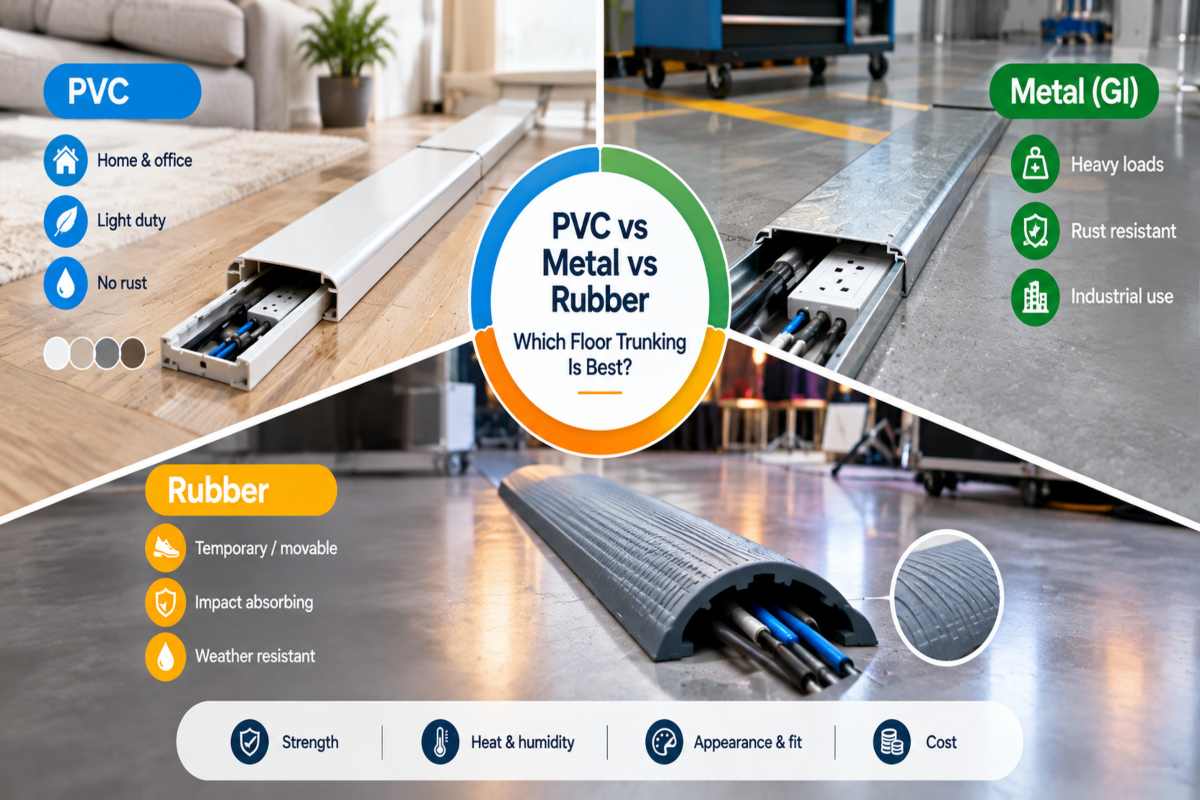
Metal floor trunking is best for heavy loads, PVC is best for everyday home and office use, and rubber is best for temporary or movable cable cover. No single material wins everywhere, so the right choice depends on traffic, budget and how permanent the setup needs to be. The sections below compare strength, heat and humidity performance, looks and fit, and then put it all in one table.
Strength and load capacity
Metal is the strongest floor trunking material. Steel and GI channels resist crushing from heavy equipment, trolleys and constant foot traffic, which is why they are used in workshops, shops and busy offices. PVC handles normal household and light office traffic well, but it can crack or dent under heavy weight or sharp knocks.
Rubber sits in the middle. It absorbs impact and spreads the load, so it copes well with wheels, chairs and people walking over it. It is not rigid, though, and it is made to protect cables on top of a floor rather than to carry very heavy loads. For vehicle or machinery areas, metal is the safer choice.
Heat and humidity performance in RAK
Ras Al Khaimah’s summers often pass 40°C, and the coastal air is humid and salty, so material choice matters. Galvanised (GI) metal resists rust thanks to its zinc coating, but cut or scratched edges need treating, because exposed steel can corrode near the coast. PVC does not rust and shrugs off humidity, though cheap or thin grades can warp or turn brittle in strong sun or heat, so use it indoors and away from hot surfaces.
Rubber handles heat and moisture well and stays flexible, but it can soften or fade if left in direct sunlight for long periods. For outdoor or semi-outdoor areas, such as garages or covered terraces, GI metal or heavy-duty rubber usually lasts longer than basic PVC.
Appearance, colour options (grey rubber covers) and fit
PVC gives the neatest finish for most homes. It comes in white, ivory, grey and wood-effect shades, and it can be cut to fit neatly at corners and doorways. Metal looks more industrial, and it is usually painted or left in a plain finish, so it suits shops, workshops and technical areas better than living rooms.
Grey rubber covers are a popular, practical choice because the colour blends with most floors and hides scuffs. The domed, ramp-like shape also keeps the cover easy to step over and roll across, although it is more visible than a flush or built-in system. If looks matter most, a PVC arc profile or a flush system gives the cleanest result.
| Feature | PVC | Metal (GI) | Rubber |
| Strength | Light to medium | Highest | Medium, impact absorbing |
| Best for | Homes, home offices, light offices | Workshops, shops, busy offices | Temporary runs, shops, events |
| Humidity and salt air | Good, no rust | Good if coating is intact | Very good |
| Heat | Fine indoors, avoid strong sun | Excellent | Good, avoid long direct sun |
| Appearance | Neat, many colours | Industrial | Practical, often grey |
| Fixing | Fixed to surface | Fixed, needs earthing | Loose or lightly fixed |
| Relative cost | Low | Highest | Low to medium |
A qualified electrician should confirm the final choice, especially for metal trunking, which must be properly earthed. If you would like help choosing and fitting the right type for your villa, apartment or office, see our electrical services in Ras Al Khaimah.
Floor Trunking vs Raised Floor Trunking
Standard floor trunking is a channel fixed on or in a normal floor, while raised floor trunking is a cable tray or channel system hidden in the gap beneath a raised access floor. The first suits ordinary homes and small offices. The second belongs to large commercial spaces built on a raised floor. The two parts below explain when under-floor trunking applies and why most homes use surface or flush types.
Under raised floor trunking when it applies
Raised floor trunking applies only when the building already has a raised access floor, meaning a false floor made of panels held up on adjustable pedestals, with an open void underneath. Cables, trays and trunking run through that void, and the panels lift out when someone needs access. A common proof point of how standardised these floors are is the panel size, which is usually 600 x 600mm.
You will find this setup in data rooms, control rooms, call centres and large corporate offices in RAK, where hundreds of cables must be moved and changed often. Because the void is already there, the trunking sits out of sight and can be reorganised without touching the visible floor. It is a building-level design choice, so it is planned with the structure, not added later to an ordinary room.
Why most homes use surface or flush types
Most homes in Ras Al Khaimah have solid concrete floors finished with tiles, wood or laminate, so there is no void to hide cables in. Creating one would raise the floor height, add cost and make doors, steps and ceiling levels harder to manage. For a villa or apartment, that is rarely worth it.
Surface floor trunking, in PVC, metal or rubber, is the simple answer. It is fixed on top of a finished floor and works well for renovations and quick upgrades. A flush floor trunking system, set into the screed before the final finish, gives a cleaner, trip-free result in new builds and major refurbishments. Both cost far less than a raised floor, and both keep the floor level and the room layout unchanged. If you are unsure which suits your property, an electrician can check the floor build-up and recommend the best option.
How Floor Trunking Is Installed Step by Step
Floor trunking is installed by planning the cable route, fixing the base channel to the floor (or setting it into the screed), laying the cables, and closing it with the lid, followed by safety checks. The exact method depends on whether you use a surface or a flush system. The parts below walk through each stage. Because it involves live wiring, the work should be done or signed off by a qualified electrician.
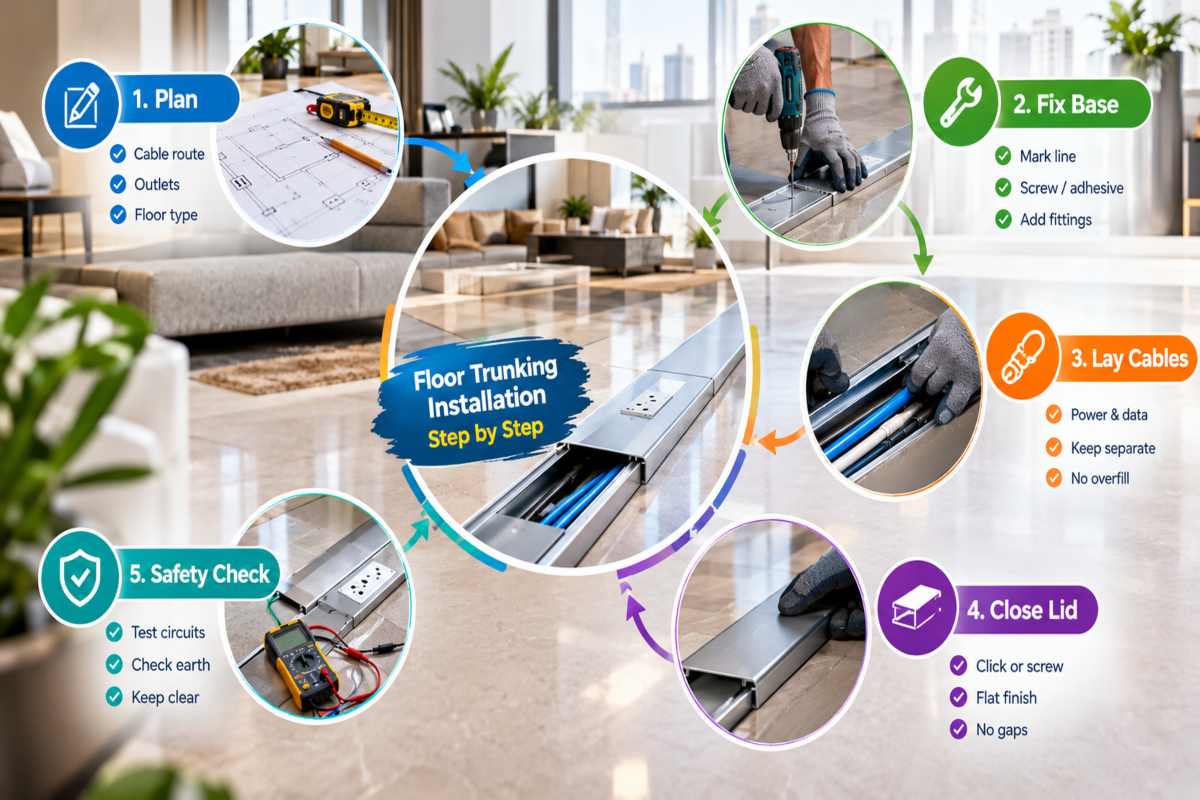
Planning the cable route
Good installation starts with a short, simple route. Mark where the cables will start, where each socket or outlet will sit, and where the trunking will cross the room. Keep the path as direct as possible and avoid busy doorways, where feet and doors can damage the cover.
Next, count the cables and choose a size that leaves a spare room. Power and data cables should be kept in separate compartments, so pick a divided channel if you need both. Also check the floor type and finish, since tile, wood and concrete need different fixings. Planning at this stage saves the most time, because moving trunking later means redoing the work.
Surface mounted installation
Surface-mounted trunking is fixed on top of a finished floor, so it suits renovations and quick upgrades. The electrician cuts the base channel to length, fixes it along the marked line with screws or strong adhesive, and fits bends, end caps and socket boxes at the corners and ends.
The cables are then laid inside without being stretched or pinched, and the lid is clicked or screwed on. Rubber covers are simpler still. They are laid over the cables and may only need light fixing. After fitting, the cover should sit flat, with no gaps where a foot could catch or water could collect.
Flush installation before screed or flooring
A flush floor trunking system is installed during construction or a major refurbishment, before the screed is poured or the final floor goes down. The channels are fixed to the slab and levelled so that their lids will sit flush with the finished floor. Cables are often pulled through after the structure is set, and the access boxes are positioned to match the planned furniture layout.
Because the trunking is covered by the screed, mistakes are expensive to fix. Open ends are sealed to stop screed entering the channels, and the exact route is recorded on a drawing for future work. Flooring contractors then lay tiles, wood or carpet to the edge of the access lids.
Common mistakes and safety checks
Typical mistakes include overfilling the channel, mixing power and data cables without a divider, leaving sharp edges that cut cable insulation, and fixing the trunking where doors or heavy furniture will crush it. As a rule of thumb, keep cables to no more than about 45% of the channel’s internal area, so that heat can escape.
Before the system is used, check that the lid is secure, that bends and joints are tight, and that any metal trunking is properly earthed and bonded. Test the circuits, confirm that no cable is stretched or trapped, and keep the access points clear. Any sign of a warm cover, a burning smell or cracked trunking is a reason to switch off the supply and call an electrician.
Floor Trunking in Ras Al Khaimah Climate and Local Tips
In Ras Al Khaimah, the best floor trunking is the type that handles heat, humidity, salt air and dust, and that is sized for your home’s electrical load. Galvanised (GI) metal or good-quality PVC and rubber usually perform best, provided they are fitted correctly. The parts below cover the coastal climate, dust and moisture protection, and how to check your load with the EtihadWE supply in mind.
Heat, humidity and salt air near Al Marjan Island, Mina Al Arab and Al Hamra
Homes close to the sea, such as those around Al Marjan Island, Mina Al Arab and Al Hamra, face salty, humid air for much of the year. That air speeds up rust on ordinary steel, so GI metal trunking with an intact zinc coating, or PVC and rubber, which do not rust, are the safer choices. Any cut or scratched metal edge should be treated, because exposed steel can start to corrode quickly near the coast.
Heat matters too. Summer temperatures in RAK often pass 40°C, and cables carry less current safely when they run hot. Keep trunking away from direct sun, hot pipes and equipment exhausts, and avoid overfilling it, because a crowded channel traps heat. Cheap, thin PVC can warp in strong sun, so choose a good grade and keep it indoors or in shade.
Dust and moisture protection
Fine desert dust finds its way into every gap, and it can build up inside poorly closed trunking. Choose a channel with a tight-fitting lid, fit end caps and bend pieces properly, and seal any open ends. This keeps dust out and stops it holding moisture against the cables.
Moisture is a bigger risk near kitchens, bathrooms, balconies and mopped floors. Trunking should never sit in standing water, and floor covers should be wiped dry rather than flooded when cleaning. If your floor is timber, damp can also harm the wood itself, so it helps to read our guide on how to protect wood from humidity before choosing a route across wooden or laminate flooring.
Checking your electrical load with EtihadWE supply in mind
Ras Al Khaimah’s electricity is supplied by EtihadWE, and homes in the UAE normally run on a 230V single-phase supply, or 400V three-phase in larger villas. Floor trunking does not add to your load, but it often brings new sockets, and those can lead people to plug in more equipment than the circuit was designed for.
Before adding outlets, check what the circuit and distribution board can safely carry. Count the appliances that will use the new points, such as a desk setup, a TV unit or a small appliance, and compare them with the breaker rating. If the board is old, crowded or already tripping, have an electrician review it first. Your supply connection and approved load are matters for EtihadWE, so confirm any upgrade needs with them or with a licensed electrician before work begins.
Common Problems and When to Call an Electrician
Call an electrician whenever floor trunking is cracked, lifting, warm to the touch, overfilled, or has exposed or damaged cables inside. Minor cosmetic wear can wait, but anything that exposes wiring or causes heat is a safety issue. The parts below explain the common problems, the overheating risk, and why this work belongs to a qualified technician.
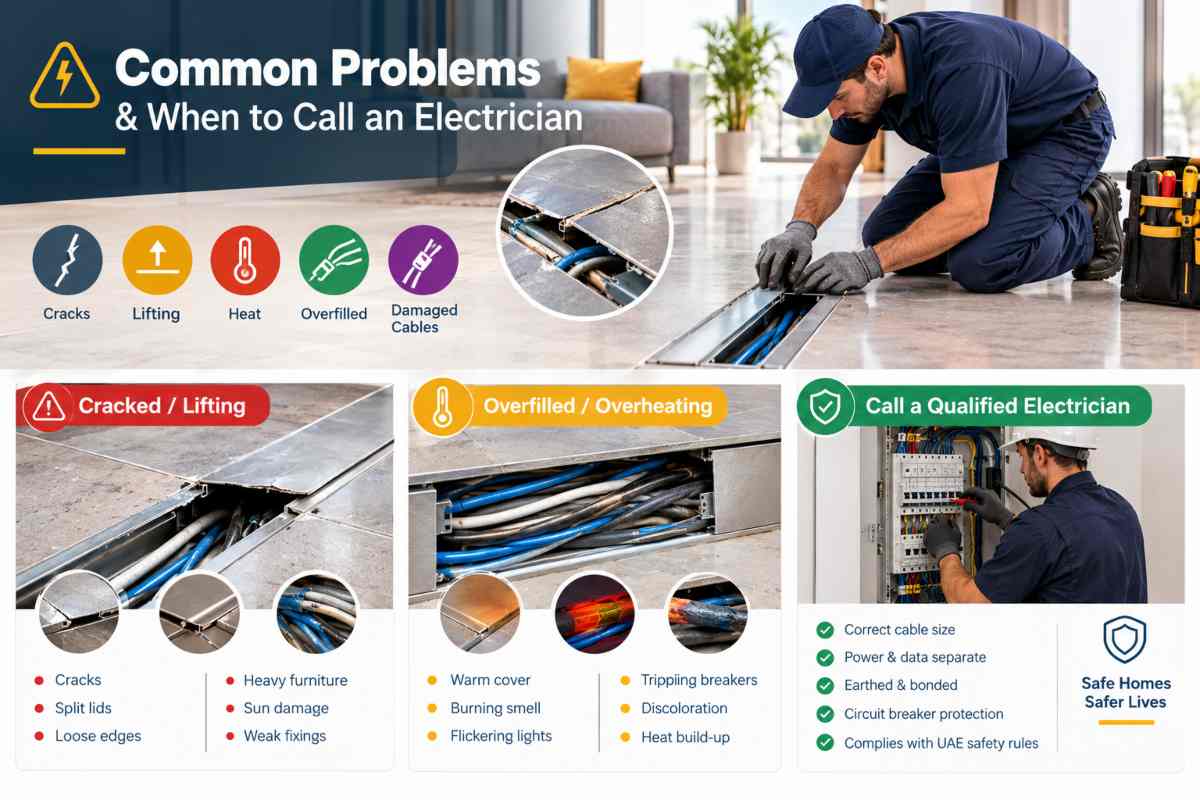
Cracked, lifting or damaged trunking
Cracks, split lids and lifting edges are the most common faults. They usually come from heavy furniture, repeated knocks, sun damage to cheap PVC, or weak fixings that have loosened over time. A cracked lid leaves cables exposed, and a lifting edge becomes a trip hazard.
If the damage is only to the cover and no cable is visible, a replacement lid or section is often enough. If you can see cable insulation, bare wire, scorch marks or water inside, stop using the sockets on that run and have the trunking checked before you use it again. Damaged cables can fail without any warning.
Overfilled trunking and overheating risk
Overfilled trunking is a hidden problem. It happens when extra cables are added over the years until the lid will not sit flat. Cables packed tightly cannot shed heat, and the heat builds up inside the channel.
The physics explains why this matters. The heat a cable produces rises with the square of the current, so doubling the load quadruples the heat. Add Ras Al Khaimah’s summer temperatures, and an overcrowded channel can run hot quickly. Warning signs include a warm or discoloured cover, a burning smell, flickering lights or breakers that trip often. If you notice any of these, switch off the supply and call an electrician.
Why electrical work needs a qualified technician
Floor trunking looks simple, but the wiring inside it is not a do-it-yourself job. A qualified technician checks that the cable size matches the load, that power and data are kept apart, that metal trunking is earthed and bonded, and that the circuit breaker protects the whole run. Mistakes in these areas often stay invisible until a fault happens.
In the UAE, electrical work is expected to follow local safety rules and be carried out by licensed professionals, particularly for changes to circuits or the distribution board. A qualified electrician also tests the finished work and can advise on safer routing and a suitable size. That protects your family, your property and your insurance position.
Get Floor Trunking Installed in Ras Al Khaimah
To get floor trunking installed in Ras Al Khaimah, contact a licensed local electrical team who can survey your floor, recommend the right type and size, and fit it safely. Home Fix Building Maintenance is based in Ras Al Khaimah and handles this work for villas, apartments, offices and small shops. The parts below explain what the service covers and how to request a visit.
What Home Fix Building Maintenance electrical services cover
Home Fix Building Maintenance is a Ras Al Khaimah property maintenance company, and its electrical team handles floor trunking as part of everyday wiring work. A visit starts with a look at the room, the floor finish and the sockets you need, so the route and size are right from the start.
The work can include choosing between PVC, metal or rubber trunking, fitting the channel and lid, laying and labelling the cables, and adding socket points where you need them. The technician also checks the circuit load and the distribution board, makes sure metal trunking is earthed, and tests the finished run before handing it over.
If the trunking is part of a wider renovation, the team can coordinate the route with your flooring, so a flush system is set in place before tiles or wood are laid. You get one team handling the wiring, the fitting and the safety checks, instead of several contractors working separately.
Request a visit (phone or service areas)
You can request a visit by calling +971 52 511 2254 or by emailing info@homefix-uae.com. It helps to share the room type, the rough length of the cable route, the floor finish and a photo of the area, so the team can advise on the right trunking before arriving.
Home Fix Building Maintenance covers homes and properties across Ras Al Khaimah, including Al Marjan Island, Pacific Al Marjan Island, Mina Al Arab, Bab Al Bahr, Al Hamra, Al Riffa and Al Jazeera Al Hamra. The office is at Al Jazeera Business Center in Ras Al Khaimah, so local call-outs are quick to arrange. Tell the team about any planned flooring work when you book, because that affects whether a surface or flush system makes more sense.
Frequently Asked Questions (FAQs)
What is floor trunking in wiring?
Floor trunking is a covered channel that carries electrical, data and TV cables along or inside a floor. It protects the cables from feet, furniture and moisture, and keeps them tidy. It is made in PVC, metal or rubber.
What does 16×25 floor trunking mean in inches?
It means a channel about 16mm by 25mm, which is roughly 0.63 by 0.98 inches. Brands differ on which number is width and which is height, so check the product drawing. It suits one or two thin cables on short runs.
Is PVC or metal floor trunking better?
Metal is better for heavy traffic, workshops and busy shops, while PVC is better for homes and light offices. GI metal resists rust well if the coating stays intact. PVC costs less and does not rust, but it is less strong.
Can floor trunking be used over tiles or carpet?
Yes. Surface PVC or rubber trunking can be fixed over tiles, and rubber covers are the usual choice over carpet. For the cleanest finish, a flush system can be set in before the flooring goes down.
How much cable can a 50x50mm trunking hold?
A standard guide is to fill no more than about 45% of the internal area, which is roughly 1,100 square millimetres for a full 50x50mm channel. Half moons and divided types hold less. An electrician can confirm the exact count for your cable types.
Do I need an electrician to install it?
Yes. The wiring inside needs the right cable size, separation of power and data, earthing for metal trunking and testing afterwards. A licensed electrician makes sure the work is safe and meets local rules.