Home Electrical Panel Guide RAK 2026 | Costs and Fixes
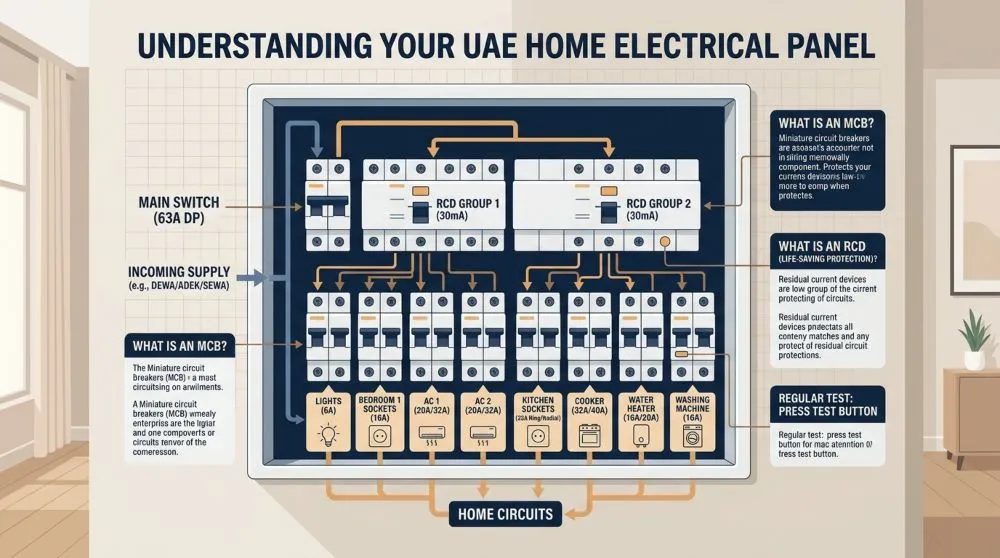
Every home in Ras Al Khaimah relies on one small metal box to keep its electrical system safe and organised: the electrical panel. It controls power to every room, protects your wiring from overload, and shuts circuits off automatically when something goes wrong. Most homeowners never think about it until a breaker trips, a room loses power, or a technician mentions it needs to be replaced.
This guide explains everything you need to know about your home electrical panel in plain language. You’ll learn what a panel actually is, the parts inside it, the different types used in Ras Al Khaimah apartments and villas, and how to recognise warning signs before they become safety hazards. We also cover realistic AED repair and upgrade costs, a simple maintenance checklist, and safe ways to style or cover a panel without violating electrical code.
Whether you’re dealing with a breaker that won’t stop tripping, planning a renovation, or simply want to understand the box on your wall, this guide gives you a clear, Ras Al Khaimah-specific answer grounded in local wiring standards, climate demands, and villa/apartment realities.
If you notice buzzing, burning smells, or repeated tripping while reading this, treat it as an urgent jump straight to the safety section or contact a licensed electrician.
What Is a Home Electrical Panel? (And Why It Matters)
A home electrical panel is the central point where electricity entering your property is split, controlled, and protected before it reaches individual rooms and appliances. Think of it as the traffic controller for your home’s power: every circuit lighting, sockets, AC units, kitchen appliances passes through it first.
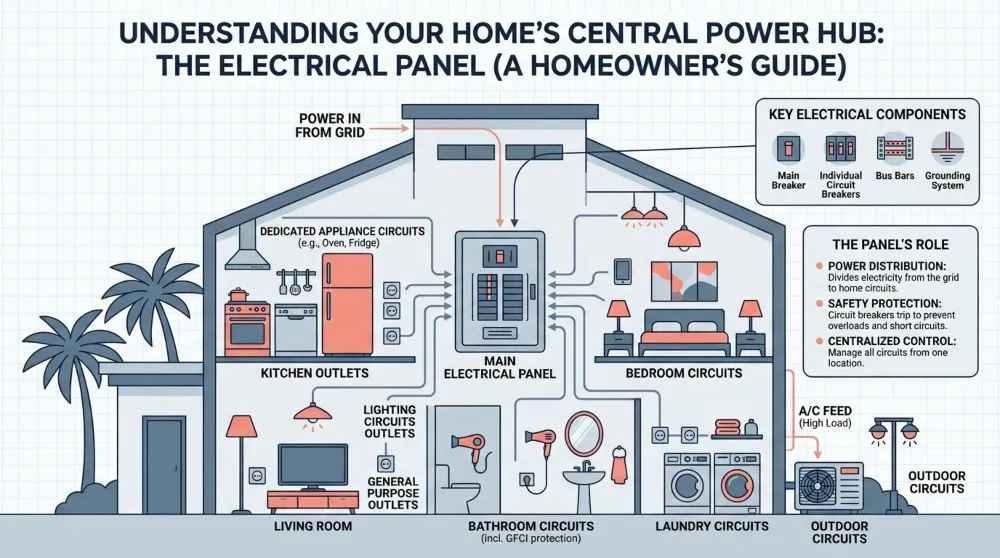
Inside, the panel houses a main switch and a series of breakers, each one guarding a specific circuit. If a circuit draws too much current, overheats, or develops a fault, its breaker trips and cuts power automatically, stopping damage before it starts. Without a properly functioning panel, your home would have no defence against overloads, short circuits, or electrical fires.
Understanding your panel matters for three practical reasons:
- Safety a well-maintained panel is your first line of defence against electrical fire and shock
- Diagnosis knowing what’s inside helps you describe problems accurately to an electrician, saving time and callout costs
- Renovation planning any Ras Al Khaimah home renovation, extension, or AC upgrade needs the panel assessed for capacity first.
Main Panel vs Sub Panel vs Distribution Board
These three terms are often used interchangeably, but they describe slightly different roles:
- The main panel is the primary panel where utility power (DEWA, FEWA, or your local authority) enters the property. It houses the main isolator switch and the primary breakers for major circuits.
- Sub panel a secondary panel fed from the main panel, used in larger villas to serve a specific zone (e.g., a separate floor, a majlis extension, or an outdoor kitchen). Subpanels reduce cable runs and make it easier to isolate a section of the home during repairs.
- Distribution board (DB) the broader technical term for the enclosure holding the breakers, whether it’s acting as a main panel or a subpanel. In everyday UAE usage, “DB” and “panel” mean the same thing.
Apartments typically have a single main panel. Villas, especially larger properties in Ras Al Khaimah, often have one main panel plus one or more subpanels to manage additional loads.
Common Names You’ll Hear (DB Box, Breaker Panel, Consumer Unit)
The same box goes by several names depending on who you ask:
- DB box / DB panel short for distribution board, the most common term used by UAE electricians and contractors
- Breaker panel emphasises the circuit breakers inside; common in everyday homeowner conversation
- Consumer unit a term more familiar to UK-trained electricians and expats, referring to the same equipment
- Electrical panel board the formal name often used in technical documentation and inspection reports
- Main switch box an informal term some residents use, referring loosely to the main isolator and panel together
If your electrician mentions any of these, they’re almost certainly talking about the same box on your wall.
Key Parts of an Electrical Panel Board
Open any home electrical panel, and you’ll find a handful of core components working together to distribute power safely. Knowing what each part does makes it far easier to explain a problem to your electrician and to understand what you’re paying for during a repair or upgrade.
Breakers, MCBs, and the Main Switch
- Main switch (main isolator) the master control for the entire panel. Flipping it off cuts power to every circuit in the home at once. This is the first thing an electrician isolates before doing any work.
- MCBs (Miniature Circuit Breakers) the small switches lined up inside the panel, each one protecting a single circuit (a room, the AC unit, the kitchen sockets, etc.). When a circuit overloads or short-circuits, its MCB trips and cuts power to that circuit only, leaving the rest of the home unaffected.
- RCD/RCCB (Residual Current Device) often installed alongside MCBs, this detects current leaking to earth, a key protection against electric shock, especially in bathrooms, kitchens, and outdoor sockets.
- The bus bars the internal metal strips that carry current from the main switch to each breaker.
A panel with too few MCBs, or MCBs rated too low for the circuit they protect, is a common issue found during inspections of older Ras Al Khaimah properties and a frequent cause of nuisance tripping.
Panel Door, Cover, and Enclosure
- Enclosure the outer casing that houses all internal components, shielding them from dust, moisture, and accidental contact. Enclosures in Ras Al Khaimah should be rated appropriately for the installation location (higher protection for outdoor, garage, or plant-room panels exposed to heat and humidity).
- Panel door/cover the hinged or removable front panel that conceals the breakers. It should always close and lock securely; a door that won’t shut properly is a common finding during electrical audits and should be repaired promptly.
- Gasket/seal a rubber seal around the enclosure that keeps dust and moisture out, particularly important in coastal RAK properties where humidity is higher.
- Lock many Ras Al Khaimah panels, especially in villas with children or in shared apartment corridors, include a lockable cover to prevent unauthorised access to the main switch and breakers.
Labels, Nameplates, and Why They’re Required
Every circuit inside the panel should be clearly labelled “Living Room Sockets,” “Kitchen AC,” “Majlis Lighting,” and so on. This isn’t just good practice; it’s essential for safety.
- Circuit labels let anyone homeowner, tenant, or electrician isolate the correct circuit quickly during a repair or emergency, without guesswork.
- Nameplates on the panel itself typically show the manufacturer, rated voltage, current capacity, and certification details, which inspectors and electricians reference when assessing whether the panel meets current load demands.
- Missing or faded labels are among the most common issues found in older Ras Al Khaimah homes and among the simplest to fix during a routine maintenance visit.
A clearly labelled panel isn’t just tidier, it can save critical time during an emergency, when knowing exactly which breaker to cut matters most.
Types of Electrical Panels in Ras Al Khaimah Homes
Not every home electrical panel is built the same way. The right type depends on the property’s size, power demand, and how many high-load appliances like multiple AC units it needs to run at once. Choosing or upgrading to the correct panel type is one of the most common recommendations from a Ras Al Khaimah home electrical inspection.
Single-Phase vs Three-Phase Panels
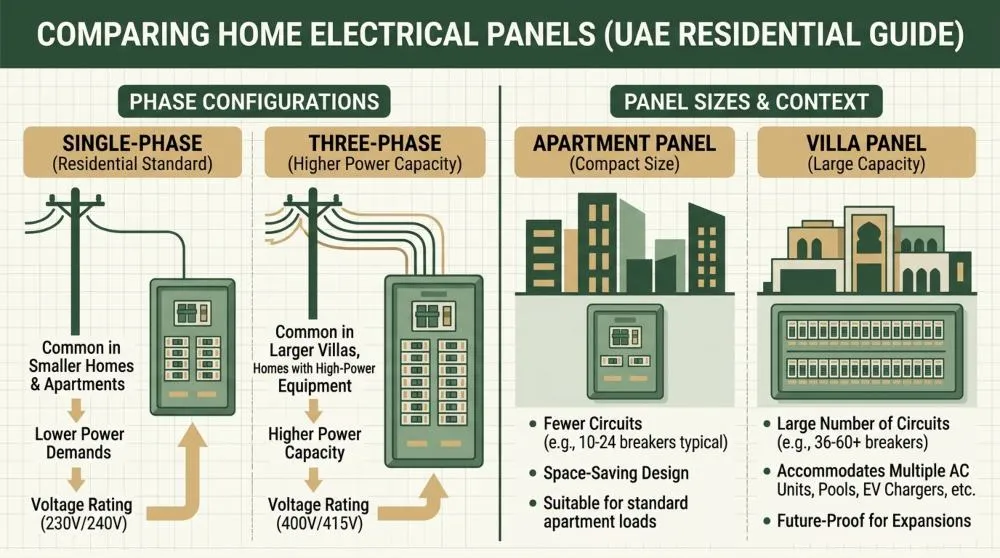
- Single-phase panels supply power through a single live conductor and are standard in most apartments and smaller villas. They comfortably handle everyday loads, lighting, sockets, a couple of AC units, and standard kitchen appliances.
- Three-phase panels distribute power across three separate live conductors, balancing the load and supporting much higher total capacity. They’re typically required in larger villas with multiple AC units, pools, elevators, or extensive outdoor lighting features common in premium properties in Ras Al Khaimah.
- How to tell which you have: a three-phase panel will show three sets of incoming cables and often a larger main breaker rated well above what a single-phase setup would need. If you’re unsure, this is a quick check for a licensed electrician rather than a DIY inspection.
Upgrading from single-phase to three-phase is a common request during villa renovations or when adding a second/third AC unit, since the existing single-phase supply often can’t handle the extra load without tripping repeatedly.
Panel Sizes for Apartments vs Villas
- Apartments generally use a compact panel with 8–16-way capacity (the number of MCB slots), sufficient for lighting, sockets, one or two AC units, and kitchen circuits.
- Small- to mid-size villas typically need a 16–24-way main panel, often paired with a small subpanel for an extension, majlis, or outdoor area.
- Larger villas with multiple floors, several AC units, and outdoor entertaining areas often require a 24+-way main panel plus one or more subpanels, particularly where a three-phase supply is in place.
Undersized panels are among the most common causes of recurring tripped breakers in growing households as more appliances are added over the years, the original panel simply runs out of capacity.
Choosing the Right Material and Enclosure Rating
UAE’s climate high heat, humidity, and dust, especially in coastal areas like RAK makes enclosure material and rating especially important:
- Metal enclosures (powder-coated steel) offer high durability and fire resistance and are commonly used for main panels in villas.
- Insulated plastic enclosures are lighter and corrosion-resistant, often used for indoor apartment panels, away from moisture.
- IP rating (Ingress Protection) indicates how well the enclosure resists dust and water. Panels installed outdoors, in garages, or in plant rooms should carry a higher IP rating than those installed in a dry indoor utility cupboard.
- Ventilation matters too; panels installed in enclosed, poorly ventilated spaces can run hotter than ideal in UAE summers, which is why some properties add small cooling fans or louvered covers to high-load panels.
Getting the material and rating right at installation avoids premature corrosion, overheating, and recurring faults that are far more expensive to fix later than to prevent upfront.
Signs Your Panel Has a Problem
A home electrical panel rarely fails without warning. Most problems show themselves gradually through tripping patterns, unusual sounds, or visible changes long before a serious fault develops. Recognising these signs early is the difference between a routine repair and an emergency callout.
Why Does My Breaker Keep Tripping?
A tripping breaker is doing exactly what it’s designed to do cutting power before damage occurs but frequent tripping usually points to an underlying issue rather than a one-off fault:
- Circuit overloads too many appliances running on one circuit, especially common in kitchens and rooms with multiple AC units or heat-generating appliances plugged into the same outlet run.
- Short circuit a fault where live and neutral wires touch, often from damaged insulation, causing an immediate, forceful trip.
- Earth fault current leaking to earth, often picked up by an RCD/RCCB, commonly linked to moisture ingress or a faulty appliance.
- Ageing or undersized MCB an MCB rated too low for the circuit it protects will trip well before genuine overload occurs.
- Faulty appliance A single failing appliance (a fridge compressor, an old AC unit) can repeatedly trip its circuit even when the panel itself is healthy.
If a breaker trips once and then resets normally, it’s often due to a minor overload. If it trips repeatedly, immediately, or won’t reset at all, that points to a fault that needs a proper diagnosis rather than repeated resets.
Warning Signs of an Overloaded or Failing Panel
Beyond tripping, watch for these physical warning signs:
- Discolouration or scorch marks around breakers, sockets, or the panel cover a clear sign of past overheating
- A burning smell near the panel, even faint, which should never be ignored
- Flickering lights across multiple rooms, especially when large appliances switch on
- Breakers that feel warm to the touch shortly after being reset
- Corrosion or rust inside or around the enclosure, particularly in coastal RAK properties exposed to humidity
- A panel that’s visibly too small for the number of circuits crammed into it, with wiring bent or forced to fit
Any one of these on its own warrants an inspection; several appearing together suggest the panel needs attention soon rather than later.
When a Warm or Buzzing Panel Is Dangerous
Some signs cross the line from “needs attention” to “needs immediate action”:
- A panel that’s noticeably warm or hot to the touch on its outer cover electrical panels should run at ambient temperature, not warm.
- A buzzing or humming sound coming from inside the panel, which often indicates a loose connection arcing under load
- Visible sparking when a breaker is switched, or a burning smell that intensifies
- A breaker that won’t stay off, or a main switch that feels loose
If you notice any of these, switch off the main isolator if it’s safe to reach, avoid touching the panel further, and contact a licensed electrician immediately rather than waiting for a scheduled visit. These are the clearest indicators of a developing fire risk, and they’re not something to monitor over a few days.
Repair, Upgrade or Replace? A Ras Al Khaimah Homeowner Decision Guide
Not every panel problem means a full replacement. Understanding the difference between a repair, an upgrade, and a replacement helps you avoid overpaying and helps you recognise when a “quick fix” isn’t actually a safe long-term solution.
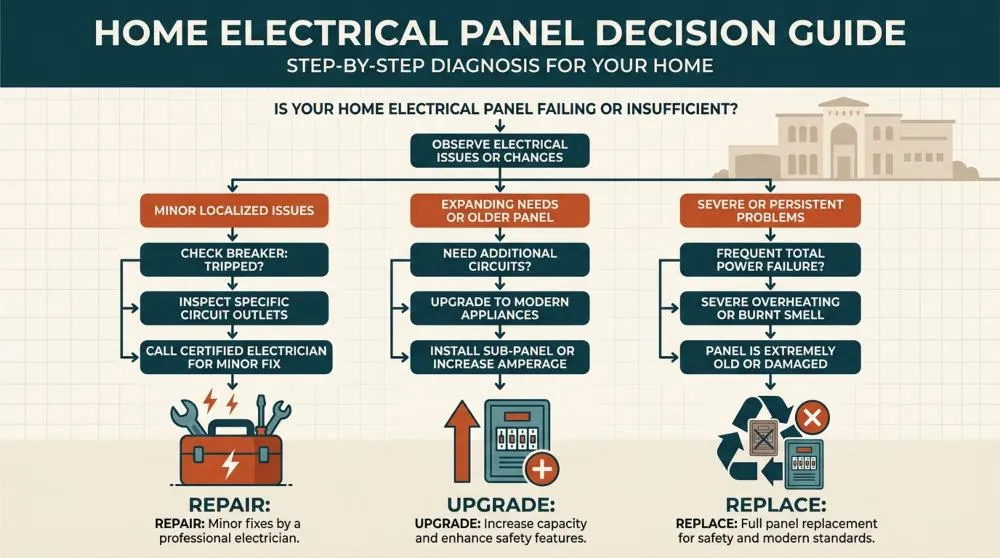
Electrical Panel Repair What It Typically Involves
Repairs address a specific fault without replacing the whole panel. Common repair work includes:
- Replacing a faulty MCB or RCD that trips unnecessarily or won’t reset
- Tightening loose connections on bus bars or breaker terminals a frequent cause of buzzing or warm panels
- Fixing a damaged door, cover, or lock so the enclosure closes and seals properly
- Re-labelling circuits where labels are missing, faded, or incorrect
- Cleaning corrosion from terminals and enclosures in humid, coastal properties
- Resolving a single overloaded circuit by redistributing loads across existing MCBs
A repair is usually the right call when the panel itself is structurally sound, correctly sized for the home’s current load, and the fault is isolated to one component rather than the system as a whole.
When an Upgrade Makes Sense
An upgrade means adding capacity or improving protection without necessarily replacing the entire panel. This is worth considering when:
- You’re adding a new AC unit, extension, or outdoor kitchen, and the panel is running near full capacity.
- You’re converting from a single-phase to a three-phase supply to support a higher household load.
- The panel lacks RCD/RCCB protection on circuits where it’s now considered standard (bathrooms, kitchens, outdoor sockets)
- You want to add a subpanel to serve a new zone of the villa, rather than overloading the main panel further.
- Ways (MCB slots) are full, but the enclosure and main switch are otherwise in good condition. Sometimes a larger enclosure with more capacity solves this without touching the main incoming supply.
Upgrades are common during renovations, and it’s worth having the panel assessed at the same time as any AC installation or room addition, since retrofitting capacity later is more disruptive than planning for it up front.
Cost to Replace an Electrical Panel in Ras Al Khaimah (AED pricing table)
Full replacement is usually recommended when the panel is undersized beyond what an upgrade can fix, shows signs of internal damage or corrosion, or is old enough that parts are no longer reliably available.
| Service | Typical Cost Range (AED) | Notes |
|---|---|---|
| MCB/RCD Replacement (Single Unit) | 150 – 350 | Per breaker, including labour |
| Panel Door/Cover Repair | 200 – 500 | Depends on the extent of damage |
| Re-Labelling and Minor Tidy-Up | 150 – 300 | Flat callout for smaller panels |
| Panel Upgrade (More Ways, Same Phase) | 800 – 2,000 | Apartment to mid-size villa panel |
| Sub Panel Installation | 1,200 – 3,000 | Depends on distance from the main panel and load |
| Single-Phase to Three-Phase Conversion | 3,000 – 8,000+ | Villa-dependent; may require utility authority approval |
| Full Main Panel Replacement (Apartment) | 1,500 – 3,500 | Includes enclosure, breakers, and labour |
| Full Main Panel Replacement (Villa) | 3,500 – 9,000+ | Higher for larger, three-phase, or multi-sub-panel setups |
Prices are indicative for Ras Al Khaimah as of 2026 and vary based on panel size, property access, and whether coordination with the utility authority is required. Always request a site visit for an accurate quote.
A general rule: if the cost of repeated repairs starts approaching 40–50% of a full replacement, replacement is usually the more cost-effective long-term choice.
Electrical Panel Maintenance and Inspection
A home electrical panel doesn’t need constant attention, but a little regular maintenance can catch problems while they’re still cheap and easy to fix. The key is knowing what you can safely check yourself and what should always be left to a licensed electrician.
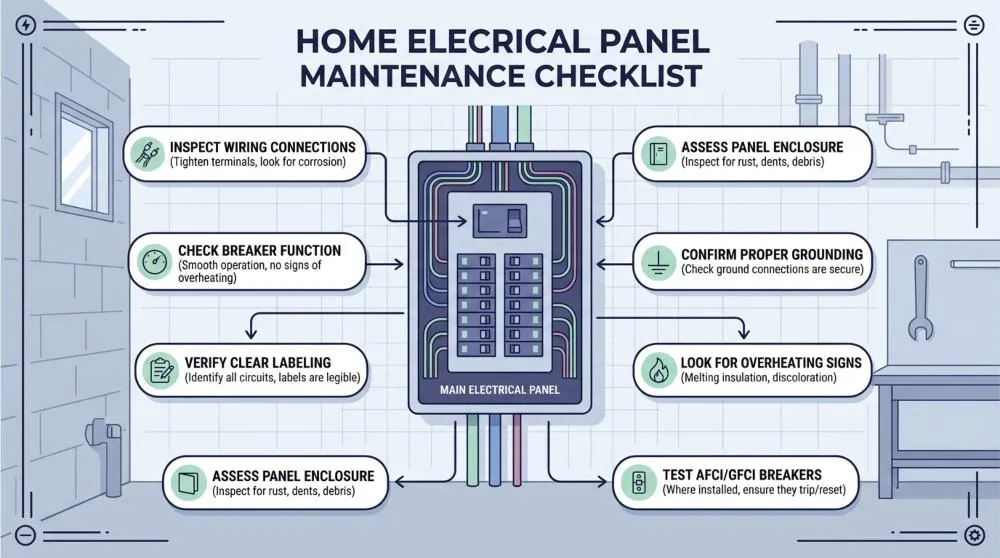
DIY Checks You Can Safely Do
These checks require no tools and no opening of the panel’s internal compartment:
- Look at the outer cover for discolouration, scorch marks, or visible damage
- Feel the outer casing (never the breakers themselves) for unusual warmth
- Listen for any buzzing or humming near the panel
- Check that the door closes and locks properly, with no gaps or looseness
- Note tripping patterns which breaker trips, when, and under what circumstances (useful information for an electrician)
- Check that labels are legible and match the circuits they describe
- Ensure clear access nothing stored or stacked in front of the panel that would block quick access in an emergency
If any DIY check reveals warmth, buzzing, scorching, or a burning smell, stop there and call a licensed electrician; these are not DIY repair territory.
Professional Inspection Checklist
A qualified electrician’s inspection goes further, typically covering:
- Thermal check of breakers and connections to detect early overheating before it’s visible externally
- Tightness of all terminal connections on bus bars and breakers
- Testing RCD/RCCB function to confirm it trips correctly when tested
- Load assessment confirming the panel’s rated capacity against the home’s actual current draw
- Corrosion inspection inside the enclosure, particularly relevant for coastal RAK properties
- Verification of correct MCB ratings for each circuit they protect
- Enclosure and seal condition, confirming dust/moisture protection is intact
- Labelling accuracy, cross-checked against actual circuits
- Earthing and bonding check, confirming the panel’s earth connection meets safety standards
This is the kind of inspection worth booking before a renovation, before adding a major appliance like a new AC system, or simply as part of routine home maintenance.
Recommended Inspection Frequency
- Apartments with moderate load: every 2 years
- Villas, especially with three-phase supply or multiple AC units: annually
- Coastal or high-humidity properties (including much of RAK): annually, with closer attention to corrosion
- Older properties (10+ years since last panel work): inspection recommended regardless of the above, since ageing components and outdated MCB ratings become more likely over time
- Before any major renovation or appliance addition, always, regardless of when the last inspection took place
Pairing a panel inspection with your Annual Maintenance Contract (AMC) visit is the simplest way to stay ahead of problems without needing to schedule a separate callout.
Electrical Panel Safety Essentials
Beyond diagnosing faults, a home electrical panel needs to be treated as a safety-critical fixture not just a maintenance item. Proper clearance, fire prevention, and access control around the panel protect both the household and the panel itself.
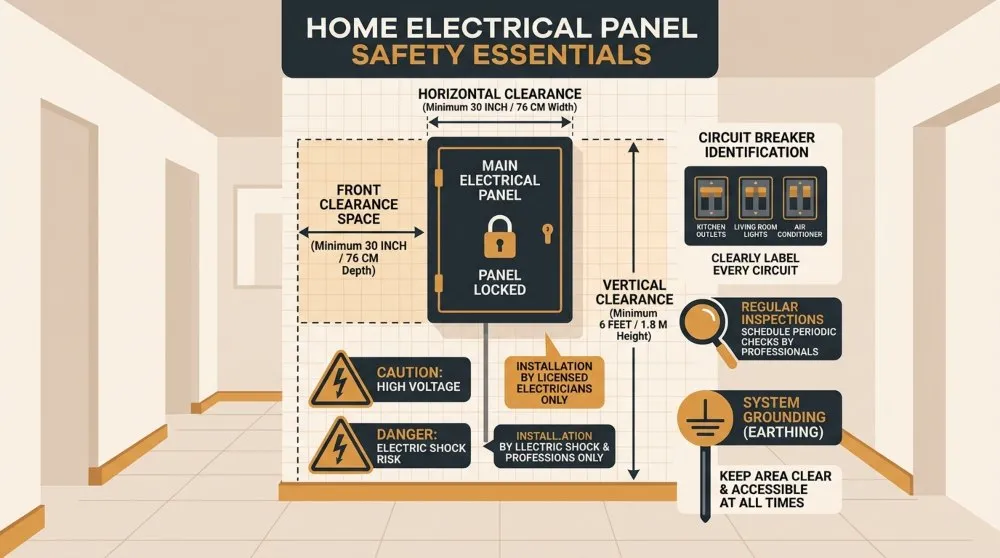
Clearance Space Requirements
Electrical panels need clear, unobstructed space around them at all times:
- Keep at least 1 metre of clear floor space directly in front of the panel, allowing an electrician or a household member in an emergency to reach the main switch quickly without first moving furniture or storage.
- Never store flammable items near the panel, including cleaning products, cardboard boxes, or fabric storage, which is a common issue in utility cupboards and storage rooms.
- Avoid covering the panel with furniture, shelving, or wall art that would need to be removed before the panel could be accessed.
- Keep the area dry, panels installed near laundry rooms or bathrooms should have adequate clearance from water sources and any plumbing that could leak onto the enclosure.
- Ensure the panel door can open fully without obstruction, since a partially blocked door slows down access during a fault.
Clearance requirements apply even when the panel is neatly enclosed or hidden behind a decorative cover accessibility always takes priority over appearance.
Fire Risk and Prevention
Electrical panels are a recognised fire risk point in any home, and most panel fires develop gradually rather than suddenly:
- Loose connections generate heat over time through arcing, which is why professional inspections specifically check terminal tightness.
- Overloaded circuits run hotter than intended, degrading insulation and increasing fire risk the longer they go unaddressed.
- Poor ventilation around the panel, especially in small utility cupboards during UAE summers, can allow heat to build up rather than dissipate.
- Aging or damaged insulation on internal wiring becomes more fire-prone over time, particularly in properties where the panel hasn’t been inspected in many years.
- DIY modifications adding circuits or appliances without professional assessment of the panel’s capacity are a common contributor to panel-related fire risk
Addressing warning signs promptly (see the earlier section on tripping, warmth, and buzzing) is the most effective fire prevention step any homeowner can take, alongside scheduled professional inspections.
Warning Signs and Access Restrictions for Homes with Children
In villas and family homes, the panel needs to balance emergency accessibility with restricting casual access:
- Lockable panel covers prevent children from opening the panel or operating breakers as if they were switches, while still allowing adults quick access in an emergency.
- Warning signage on or near the panel is standard practice, clearly marking it as an electrical hazard area rather than a storage or play space.
- Position matters panels installed at a height and location that’s naturally out of easy reach for young children add a layer of passive safety.
- Educate household members on what the panel is and that it isn’t to be touched, especially in homes with domestic staff or multiple family members who may not be familiar with electrical safety practices.
- Never let decorative covers compromise the lock or access mechanism; a cover that looks nice but leaves the panel door unsecured defeats the purpose.
A locked, clearly marked, and properly clearanced panel protects the household without sacrificing the fast access needed in a genuine electrical emergency.
St access needed in a genuine electrical emergency.
What NOT to Do When Hiding a Panel
Some common mistakes turn a simple styling choice into a genuine safety or compliance issue:
- Don’t seal the panel behind a fixed, screwed-on cover; anything that needs a screwdriver to remove defeats the purpose of having quick emergency access.
- Don’t wallpaper or paint directly over the panel door; even a “temporary” coat of paint can, over time, fuse the door shut and hide the panel’s presence from anyone unfamiliar with the home.
- Don’t build airtight enclosures around the panel, such as a fully boxed-in unit with no ventilation gaps; this traps heat and can accelerate wear on breakers already running warm.
- Don’t hang heavy or fragile décor on the cover itself; mirrors, artwork, or shelving fixed to the cover add weight, obstruct fast opening, and risk damage if the cover needs to be opened quickly.
- Don’t block the cover with furniture sofas, bookshelves, or wardrobes positioned in front of a “hidden” panel are one of the most common issues found during home inspections.
- Don’t remove or paint over hazard signage just because it looks unattractive, relocate it discreetly onto the cover instead of eliminating it.
- Don’t attempt a recessed, in-wall cover yourself cutting into drywall without understanding clearance and ventilation requirements can create a fire risk that’s invisible until it’s too late.
- Don’t assume a professionally installed cover means no more clearance is needed; the 1-metre clearance rule still applies in front of any cover, decorative or not.
The simplest test: if a household member unfamiliar with the panel’s exact location couldn’t find and open it within a few seconds during an emergency, the covering method needs to be reconsidered.
Styling Your Panel Without Compromising Safety
An exposed electrical panel isn’t the most attractive feature in a living room, hallway, or majlis and, understandably, homeowners want to soften its appearance. The good news is this can be done safely, as long as accessibility and ventilation are never sacrificed for looks.
How to Cover an Electrical Panel in a Living Room
- Use a hinged or removable cover, never a fixed one anything that conceals the panel must open or lift away instantly, without tools, screws, or furniture-moving
- Choose a shallow-depth cover that sits flush or near-flush against the wall, avoiding a bulky box-like protrusion that draws more attention than the panel itself.
- Matching the cover to the wall finish with a painted MDF panel, a framed insert, or a fabric-wrapped board that blends into the surrounding wall colour is far less noticeable than an obvious “box on the wall” treatment.
- Avoiding built-in furniture directly over the panel, a bookshelf, media unit, or wardrobe positioned in front of the panel is a common mistake that turns a five-second fix into a furniture-moving exercise during an emergency.
- Keeping decorative items off the cover itself mirrors, framed art, or shelving fixed onto the cover can obstruct quick opening even if the cover technically still swings open.
- Maintain the required clearance in front of the cover, exactly as if the panel were left exposed.
The goal is a cover that looks intentional and blends with the room, while still functioning as though the panel were in plain sight.
Decorative Panel Covers That Stay Code-Compliant
- Ventilated designs if the panel or breakers generate any warmth under normal load, the cover should include ventilation slots or louvres rather than sealing the panel in an airtight box, which can trap heat
- Non-combustible or fire-rated materials are preferable for the cover itself, particularly for panels with a history of running warm or in properties where the panel sits in a high-traffic living space.
- No permanent locks or fixings that require a key or tool to open a decorative cover should never be harder to access than the original panel door
- Professional installation for recessed covers cutting into drywall to recess a cover flush with the wall should be done by someone who understands the clearance and ventilation requirements, not as a general DIY carpentry job
- Signage retained if the original panel had hazard signage, a decorative cover shouldn’t hide it entirely; a small, discreet marking on or near the cover keeps the warning visible.
If in doubt, a professional assessment before installing any cover confirms that the panel has adequate ventilation and clearance for the chosen covering method. This five-minute check prevents a cosmetic improvement from becoming a safety issue.
Frequently Asked Questions (FAQs)
Why does my electrical panel keep tripping?
Repeated tripping usually points to a circuit overload, a short circuit, an earth fault picked up by the RCD/RCCB, an MCB rated too low for its circuit, or a single faulty appliance. If a breaker trips once and resets normally, it’s often minor. If it trips repeatedly, immediately, or won’t reset, the circuit needs a proper diagnosis rather than continued resetting.
How much does it cost to replace an electrical panel in Ras Al Khaimah?
Full main panel replacement typically costs AED 1,500–3,500 for an apartment and AED 3,500–9,000+ for a villa, depending on panel size, phase type, and the number of subpanels involved. Smaller fixes, such as an MCB replacement (AED 150–350) or a panel upgrade (AED 800–2,000), are often enough if the panel itself is structurally sound.
Can I paint or cover my electrical panel?
Yes, but only with a hinged or removable cover that opens instantly without tools, never a fixed, screwed-on, or painted-shut cover. The cover must maintain ventilation, keep hazard signage visible or relocated discreetly, and preserve the 1-metre clearance rule in front of it, exactly as if the panel were left exposed.
How often should a home electrical panel be inspected?
Apartments with moderate load should be inspected every 2 years. Villas, three-phase properties, and coastal or high-humidity homes (including much of RAK) should be inspected annually. Properties with no panel work in 10+ years should be inspected regardless of the above, and any renovation or the addition of a major appliance warrants an inspection first.
Is a buzzing sound from my panel dangerous?
Yes a buzzing or humming sound often indicates a loose connection arcing under load, which generates heat and is a recognised fire risk. If accompanied by warmth, sparking, or a burning smell, it should be treated as urgent: switch off the main isolator if safe to reach, avoid touching the panel further, and contact a licensed electrician immediately.