
Carpentry Repair | Smart Fixes, Real Costs & Advice for UAE Homes
Carpentry repair is the most overlooked maintenance need in UAE properties. Every villa and apartment across Ras Al Khaimah and Dubai contains wooden doors, fitted cabinets, built-in wardrobes, shelving, and decorative joinery and every one of those components faces daily punishment from the Gulf climate.
The combination of extreme heat, coastal humidity, rapid air conditioning cycling, and hard water does not just age carpentry it attacks it. What looks fine today develops visible problems within months if the right materials were not used at installation and the right maintenance is not carried out year-round.
This article covers the most common carpentry repair problems in UAE properties, why they happen specifically in the Gulf climate, what each repair realistically costs in 2026, when repair is the right call and when replacement is smarter, and how to choose a qualified carpentry contractor in RAK and Dubai who will fix the problem correctly rather than temporarily.
What Is Carpentry Repair?
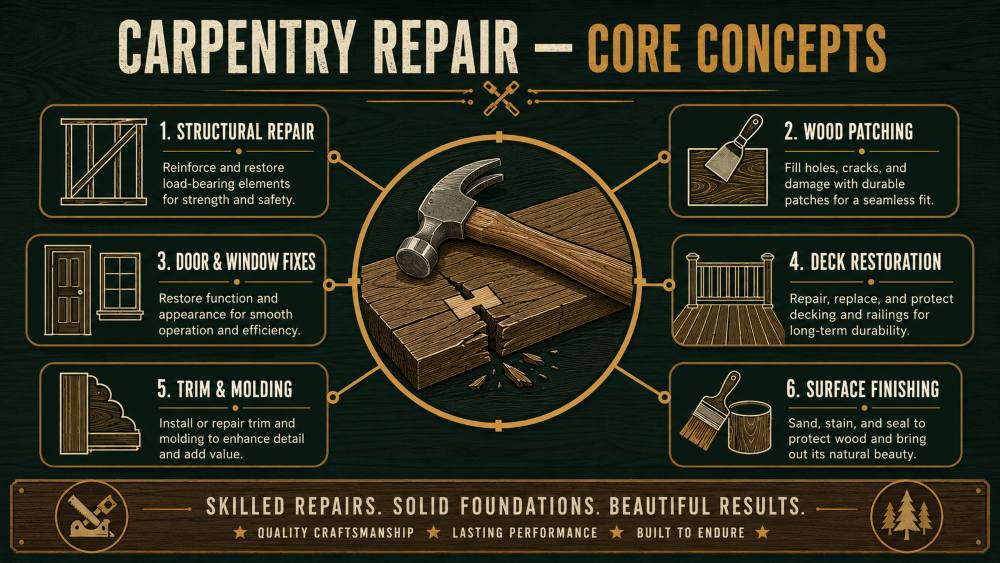
Carpentry repair is the process of diagnosing, fixing, and restoring timber, MDF, and engineered wood components in a property including doors, cabinets, wardrobes, shelving, frames, flooring, and decorative joinery without fully replacing the installation.
In the UAE, carpentry repairs cover a wider range of problems than in most other regions because the Gulf climate degrades wood-based materials more quickly and aggressively than in temperate climates in Europe or Asia.
Carpentry repair is different from carpentry replacement. Repair restores an existing component to working condition. Replacement installs an entirely new component in its place. The right choice between the two depends on the condition of the core material, the extent of the damage, and the cost comparison between the two options, which covers in full.
First Fix vs Finish Carpentry What Is the Difference?
First-fix carpentry is all structural timberwork completed before walls and floors are closed up door frames, structural linings, floor battens, and ceiling frameworks. First-fix work is hidden within the building fabric and is rarely repaired unless structural movement or water ingress has directly damaged it.
Finish carpentry is all visible timber and joinery work installed after the building is plastered and finished doors, skirting boards, architraves, cabinet doors, wardrobe fronts, shelving, and all decorative timber elements. Finish carpentry is what most property owners see, touch, and use every day. It is also what the UAE climate damages most visibly and most frequently.
What Is Bespoke Carpentry and Does It Need Different Repair?
Bespoke carpentry refers to custom-designed and workshop-fabricated joinery built to specific dimensions, materials, and finish specifications for a particular space. In UAE villas and luxury apartments, bespoke carpentry includes custom kitchen cabinet sets, fitted dressing rooms, hand-crafted door sets, and unique decorative joinery elements.
Bespoke carpentry requires specialist repair because the components were made to non-standard dimensions and finishes. A bespoke cabinet door cannot be replaced with an off-the-shelf panel; the replacement must be fabricated to match the original specification. This increases repair cost compared to standard carpentry but remains significantly less expensive than replacing an entire bespoke installation.
Why Carpentry Repair Is More Urgent in the UAE Than Anywhere Else
UAE properties need carpentry repair more frequently than properties in most other parts of the world. This is not a coincidence, it is a direct result of three climate conditions that simultaneously and continuously attack timber and engineered wood.
Heat Splits and Warps Every Timber Component
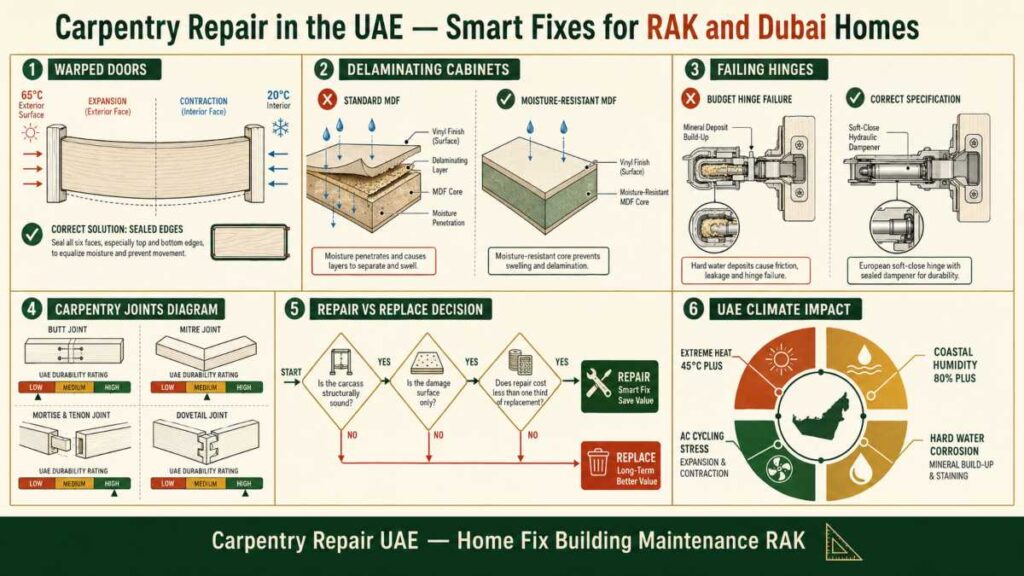
Summer temperatures in Ras Al Khaimah and Dubai regularly exceed 45°C. South and west-facing doors and window frames reach surface temperatures of 65 to 70°C in direct sun. Timber and MDF expand when heated and contract when cooled. In a UAE property where the interior is air-conditioned to 20°C while the exterior face of a front door reaches 65°C, the temperature differential across a single door panel exceeds 45 degrees. This daily cycle of expansion and contraction stresses joints, splits panels, and progressively warps frames. Without repair, the damage worsens each summer.
Coastal Humidity Causes MDF to Swell and Delaminate
Coastal areas of Ras Al Khaimah including Mina Al Arab, Al Marjan Island, Pacific Al Marjan Island, and Bab Al Bahr experience relative humidity levels that regularly exceed 80 percent during July, August, and September. Standard MDF absorbs atmospheric moisture, which can cause it to swell. The surface finish paint, vinyl wrap, or melamine then delaminates from the swollen substrate. Once delamination starts, it cannot be reversed by surface treatment. The affected panel must be replaced with moisture-resistant MDF manufactured with a waterproof resin binder that resists swelling in humid conditions.
Air Conditioning Cycles Stress Every Joint
UAE properties cycle their air conditioning on and off throughout the day. When AC runs, the interior is cool and dry. When it is off or when doors open, warm, humid air enters. This rapid alternation between hot-humid and cool-dry conditions causes timber and MDF to expand and contract repeatedly. This repeated movement is more damaging to carpentry joints than sustained heat or sustained humidity alone. It loosens glued joints, opens mitre corners on skirting boards and architraves, and causes veneer faces to lift from their substrate over time.
Carpentry vs Woodworking: What Is the Difference in UAE Property Repair?
Carpentry and woodworking are related but distinct disciplines. Understanding the difference is helpful when commissioning repair work on a UAE property.
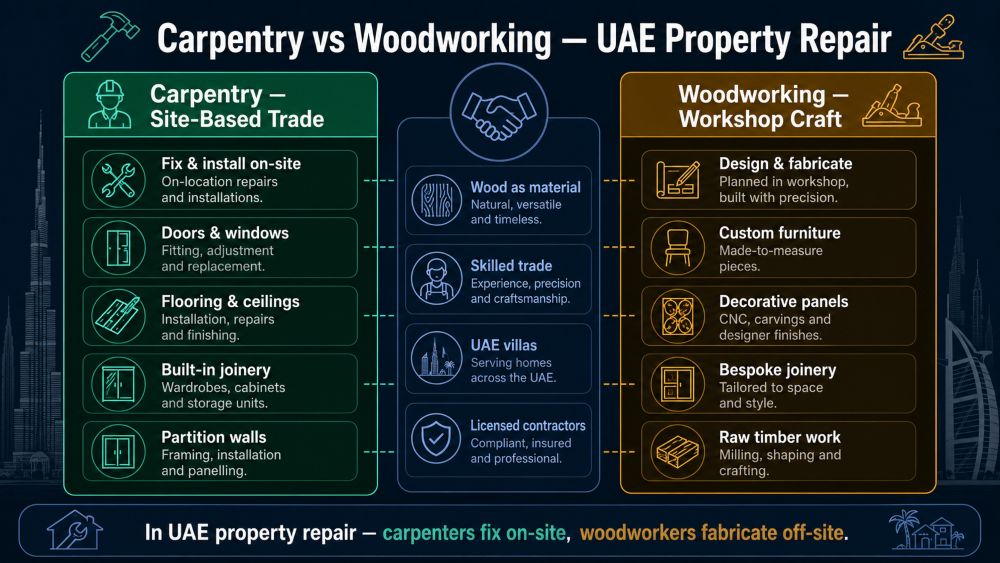
Carpentry is site-based work fitting, installing, and repairing timber and board-based components in a building. A carpenter works on site, using hand and power tools to cut, fix, and adjust components that are either pre-fabricated or fabricated on site. Carpentry covers doors, frames, skirting boards, shelving installation, and on-site fitting of kitchen and wardrobe units.
Woodworking is workshop-based fabrication designing and making timber components with precision machinery. A woodworker produces cabinet carcasses, door blanks, furniture components, and bespoke joinery elements in a controlled workshop environment where temperature, humidity, and dust can be managed. The best UAE carpentry repair contractors combine both they fabricate replacement components in a workshop and install them on site, rather than attempting to fabricate complex components in the conditions of an occupied UAE property.
For UAE property owners, the practical implication is clear. When you need a door hinge replaced or a shelf bracket adjusted, a skilled on-site carpenter is all you need. When you need a delaminated kitchen cabinet door replaced to match the existing finish, you need a contractor with workshop fabrication capability who can produce a matching panel before attending the site.
Carpentry Joints Why They Matter in UAE Repair
Every piece of carpentry in your UAE property from door frames to wardrobe carcasses to skirting board corners relies on joints to hold its components together. Understanding basic carpentry joints helps you assess the quality of existing joinery and the proposed repair work.
Most Common Carpentry Joints Used in UAE Properties
The butt joint is the simplest joint of two pieces of timber or board fixed together at their ends, typically with screws, nails, or adhesive. It is used in the construction of cabinet carcasses and frame assemblies. It is the weakest joint type and relies heavily on the fixing or adhesive for its strength.
The mitre joint joins two pieces at a 45-degree angle to create a clean corner used on skirting boards, architraves, and picture frame mouldings throughout UAE properties. Mitre joints are the first to open when timber contracts due to air-conditioning cycling in the UAE. A gap appearing at a skirting board corner in a UAE property is almost always a mitre joint that has been stressed by repeated expansion and contraction cycles.
The mortise-and-tenon joint is a traditional, strong joint used in solid timber door frames, staircase construction, and high-quality bespoke furniture. A rectangular peg on one component fits into a matching rectangular socket on the other. This joint handles structural loads and movement far better than butt joints and is the mark of quality carpentry in UAE doors and frames.
The dowel joint uses cylindrical wooden pegs inserted into matching holes in both components to align and strengthen the connection. It is widely used in flat-pack and workshop-fabricated furniture and cabinet carcasses across properties in the UAE at all price points.
The dovetail joint is a precision joint used in high-quality drawer construction, an interlocking trapezoidal arrangement that resists pulling apart. In UAE kitchens and wardrobes, dovetail-jointed drawer boxes outlast dowelled or stapled alternatives by a significant margin because the joint relies on the drawer box itself rather than adhesives or mechanical fastenings that can fail under the thermal stress of the UAE climate.
How Joint Quality Determines Carpentry Lifespan in the UAE
The quality of the joint is the single biggest determinant of how long carpentry lasts in UAE conditions. A mortise and tenon door frame joint will outlast a butt-jointed alternative by decades in the same UAE property. A dovetail drawer box will outlast a stapled drawer box by ten years of daily use. When commissioning new carpentry repair work, ask specifically what joint type will be used for each component a qualified contractor will answer this question precisely.
Carpentry Materials What Works and What Fails in UAE Conditions
The wrong material choice is the root cause of most carpentry repair needs in properties in the UAE. The table below shows exactly which materials are correct for which applications in the UAE climate.
Material Correct Application in UAE, Incorrect Application, Lifespan Correct Use
| Material | Correct Application in UAE | Incorrect Application | Lifespan (Correct Use) |
|---|---|---|---|
| Moisture-resistant MDF | Kitchen cabinets, bathroom vanities, wardrobes | Outdoor or unair-conditioned spaces | 10 to 20 years |
| Standard MDF | Interior shelving in dry, air-conditioned rooms only | Kitchens, bathrooms, utility rooms | 5 to 10 years |
| Marine Plywood | Outdoor storage, utility rooms, wet areas | Not needed in dry interior applications | 15 to 25 years |
| Solid Hardwood | Doors, frames, staircases, flooring, outdoor decking | Not cost-effective for carcass construction | 20 to 40 years |
| Melamine Board | Cabinet carcasses, shelving in dry areas | Wet or high-humidity locations | 10 to 15 years |
| PVC Board | Outdoor covered storage, bathroom trim | Interior finish joinery | 15 to 20 years |
| Composite Board | Outdoor decking, pergola cladding | Interior joinery where unnecessary cost is involved | 15 to 20 years |
Painting and Carpentry Finishing Repaired Surfaces in UAE Properties
Painting and carpentry repairs in UAE properties require preparation steps that many budget contractors skip and those skipped steps are precisely why the same repair fails again within 12 months.
Every repaired or replaced timber surface must be sanded back to a clean substrate before priming. All joints and filled areas must be primed with a solvent-based primer before topcoat application water-based primer raises the grain of MDF and causes surface roughness in the UAE climate. All edges, particularly the top and bottom edges of doors and the cut edges of MDF panels must receive at least two coats of primer before the finish coat is applied. These edges are the entry points for moisture and the origins of virtually all delamination and warping problems in UAE carpentry. A contractor who paints only the face surfaces and leaves edges bare is guaranteeing a return repair visit within two years.
Most Common Carpentry Repair Problems in UAE Properties
1. Warped and Sticking Doors
Warped doors are the most common carpentry repair call in properties across the UAE. A door that closes perfectly at installation begins to stick, bind, or fail to latch within 1 to 3 years sometimes sooner in sun-exposed locations.
Cause: Incomplete sealing of door edges at installation allows moisture to penetrate the end grain. The door swells unevenly and warps. Solid timber doors warp due to heat-driven grain movement. Standard MDF doors swell permanently when moisture penetrates unsealed edges.
Repair: Minor warp plane the binding edge, seal all exposed edges with two coats of solvent primer, refinish, and adjust hinge positions if required severe warp full door replacement in correct material with all six faces sealed before finishing.
Cost in RAK 2026: AED 150-500 for planning and resealing. AED 800 to AED 2,500 for full door replacement, including supply, sealing, finishing, and installation.
2. Delaminating Cabinet and Wardrobe Panels
Cabinet door panels and wardrobe faces that show bubbling, peeling surface finish, or visible separation between the finish and the board beneath are delaminating and cannot be repaired by surface treatment alone.
Cause: Standard MDF was used where moisture-resistant MDF was required poor bonding between the finish and the substrate during manufacture. Unsealed panel edges allow moisture penetration from below the finish.
Repair: Individual delaminated panels are removed and replaced with correctly specified moisture-resistant MDF panels finished to match the existing installation. When multiple panels are affected, full refacing of the cabinet or wardrobe is more cost-effective than replacing individual panels.
Cost in RAK 2026: AED 200-600 per panel for individual replacement. AED 1,500 to AED 6,000 for full kitchen or wardrobe refacing.
3. Failing Cabinet Hinges and Drawer Runners
Soft-close hinges that have lost their damping action, hinges that squeak or bind, and drawer runners that stick, judder, or have collapsed under load are among the most frequently reported carpentry hardware failures in UAE kitchens and wardrobes.
Cause: Budget hinges and runners degrade faster under UAE heat and hard water mineral deposits. Hydraulic soft-close mechanisms in budget hinges fail within two to four years of UAE family kitchen use. Plastic components in budget runners warp or become brittle under sustained heat.
Repair: Replace failed hinges with European-manufactured soft-close hinges rated for 200,000 opening cycles. Replace failed runners with full-extension steel runners in the correct length and load rating. Clean all remaining hardware annually with a dry cloth and apply a small amount of dry lubricant to runner tracks and hinge pivots.
Cost in RAK 2026: AED 50-150 per hinge, including supply and fitting. AED 150 to AED 400 per drawer runner pair, including supply and fitting.
4. Sagging Shelves
Shelving in wardrobes, kitchen wall units, and bookshelves that have visibly bowed downward under stored items is a structural failure that worsens progressively without intervention.
Cause: Under-specification. Standard 18mm MDF begins to deflect at spans greater than 600mm under normal household loads. UAE wardrobes and kitchen wall units are frequently specified with maximum shelf spans to reduce cost, leaving shelves underspecified for the loads they carry.
Repair: Minor sag adds a mid-span support bracket or rail. Significant bow replace shelf with 25mm MDF, 18mm plywood, or solid timber board in the same span. Add a solid timber lipping to the front edge of the replacement shelf for additional rigidity and a quality finish.
Cost in RAK 2026: AED 100-300 for bracket addition. AED 200 to AED 600 per shelf for full replacement in upgraded material.
5. Damaged Door Frames and Architraves
Door frames with loose corner joints, separation from the wall at the architrave edges, splitting at fixing points, or paint cracking along the frame-to-wall junction are among the most common finish carpentry repair needs in UAE villas and apartments.
Cause: Building movement in newer UAE developments as structures settle. Moisture penetration at the frame-to-wall junction, where sealant has aged and cracked. Steam exposure at the bathroom and utility room door frames is causing sustained moisture uptake in the timber.
Repair: Loose joints re-glue and pin with a panel pin. Separated architrave re-fix with appropriate fixings and reseal the junction with paintable decorator’s caulk. Deteriorated frame timber full frame replacement in correctly specified and sealed material.
Cost in RAK 2026: AED 200 to AED 600 for joint re-gluing, re-fixing, and resealing. AED 600 to AED 1,500 for full door frame replacement.
6. Split and Cracked Timber Flooring
Engineered or solid hardwood flooring in UAE villas that develops gaps between boards, surface cracking, or cupping where board edges rise higher than the board centre is experiencing classic timber flooring failure driven by moisture and temperature fluctuation.
Cause: Insufficient expansion gap at perimeter of floor at installation a common error in UAE properties leaves boards with nowhere to expand when humidity rises. Boards buckle or cup as a result. Solid hardwood is more susceptible than engineered hardwood due to its less stable construction.
Repair: Minor surface cracking and small gaps colour-matched timber filler and refinish cupped boards where moisture issue has been resolved sand flat and refinish. Individual damaged boards lift and replace without disturbing the surrounding floor. Full replacement is rarely required unless the installation was fundamentally incorrect from the outset.
Cost in RAK 2026: AED 500 to AED 2,000 for filler and refinishing a room. AED 60 to AED 150 per square metre for sanding and refinishing. AED 100 to AED 300 per board for individual board replacement.
Estimated Carpentry Repair Costs in the UAE (2026)
Repair Type Cost Range AED Duration
| Repair Type | Cost Range (AED) | Estimated Duration |
|---|---|---|
| Warped door plane and reseal | 150 – 500 | 2 to 4 hours |
| Door full replacement | 800 – 2,500 | 1 day |
| Cabinet panel delamination (per panel) | 200 – 600 | 2 to 4 hours |
| Full kitchen or wardrobe refacing | 1,500 – 6,000 | 2 to 4 days |
| Hinge replacement (per hinge) | 50 – 150 | 30 to 60 minutes |
| Drawer runner replacement (per pair) | 150 – 400 | 1 to 2 hours |
| Shelf bracket addition | 100 – 300 | 1 to 2 hours |
| Shelf full replacement | 200 – 600 | 2 to 4 hours |
| Door frame repair and reseal | 200 – 600 | 2 to 4 hours |
| Door frame full replacement | 600 – 1,500 | 1 day |
| Floor sanding and refinishing | 60 – 150 per sqm | 2 to 5 days |
| Individual floorboard replacement | 100 – 300 per board | Half to 1 day |
| Skirting board mitre repair | 80 – 200 | 1 to 2 hours |
| Mud kitchen carpentry repair | 300 – 1,200 | 1 to 2 days |
Repair vs Replace How to Decide in UAE Properties
Repair is correct when:
- The structural carcass of a cabinet or wardrobe is sound, and only the face panels or hardware have failed.
- A door has minor warping at one edge, but the door blank is structurally intact.
- Hardware failure is isolated to specific hinges or runners, while the surrounding joinery is undamaged.
- The existing installation was correctly specified with moisture-resistant materials, and the failure is maintenance-related rather than material-related
Replace is correct when:
- Standard MDF has absorbed moisture through its full thickness and swollen permanently it cannot be repaired or refinished reliably.
- Multiple panels across a kitchen or wardrobe are simultaneously delaminating; the root cause is a specification failure, not isolated damage, and repairing individual panels will not prevent further failures.
- The existing installation was built from under-specified materials that will continue to fail in the same UAE conditions, regardless of how well individual repairs are carried out.
- The cost of repair exceeds one-third of the cost of replacement with correctly specified materials.
The one-third rule is the most practical guide for UAE property owners. If fixing what is broken costs more than one-third of installing it correctly, install it correctly.
Smart Carpentry Repair Ideas That Prevent Future Failures
These are not decorative ideas, they are practical carpentry decisions that eliminate the root causes of the most common repair problems in the UAE.
Replace standard MDF kitchen doors with moisture-resistant MDF during any refacing project. The cost difference between standard and moisture-resistant MDF at the panel level is small. The difference in lifespan in a UAE kitchen is ten years versus three years.
Upgrade budget hinges to European soft-close hardware during any kitchen repair visit. If a contractor is already on site replacing one failing hinge, replace all kitchen hinges during the same visit. The incremental cost is small, and the alternative is multiple return visits as the remaining budget-hinging failures occur sequentially.
Add edge lipping to all existing MDF shelving during any wardrobe repair. A solid timber lipping on the front edge of a shelf prevents future sagging, protects the edge from moisture penetration, and simultaneously improves the finished appearance.
Seal all door edges during any door repair visit. When a door is removed for planing or hinge adjustment, seal all six faces with solvent-based primer before reinstallation. This single step eliminates the primary cause of future warping.
Install mud kitchen carpentry in outdoor UAE spaces only with marine plywood or composite board. Mud kitchen carpentry compact outdoor play kitchen units is increasingly popular in family villas in the UAE. Any outdoor mud kitchen in the UAE must be built from marine plywood or composite board standard MDF or untreated timber will deteriorate within one summer season in direct sunlight and high humidity.
Carpentry Safety in UAE Repair Works
Carpentry repair in UAE properties involves cutting, sanding, and finishing activities that generate dust, fumes, and physical hazards. Any qualified carpentry contractor operating in the UAE follows these safety precautions as standard practice.
Dust control. MDF dust generated by cutting and sanding is a respiratory hazard. All MDF cutting must be carried out with dust extraction equipment or in a ventilated area. Sanding of existing painted surfaces in UAE properties built before 2000 must be preceded by a lead paint assessment.
Chemical safety. Solvent-based primers and paints used for sealing and finishing carpentry in UAE conditions contain VOCs that require adequate ventilation during application. In occupied properties, affected areas should be vacated during application and for at least 2 hours after completion.
Physical safety. Door and frame work involves heavy components that require correct manual handling. Ladder and scaffold use for ceiling-height wardrobe work must comply with UAE site safety requirements. All power tools must be in a safe working condition with guards in place.
UAE contractor requirements. A licensed carpentry contractor in the UAE must hold a valid trade licence from RAK Municipality or the relevant DED authority, carry public liability insurance, and be able to produce both documents on request before work begins.
How to Choose a Carpentry Repair Contractor in the UAE
Check the trade licence first. Ask for a copy of the contractor’s UAE trade licence before discussing any work. A licensed contractor has legal accountability. An unlicensed one does not.
Ask specifically what material they will use for each repair. Standard MDF or moisture-resistant MDF? Which hinge brand and model? What primer specification? A contractor who cannot answer these questions precisely is planning to use whatever is cheapest on the day.
Request a fully itemised written quotation. Every carpentry repair quotation must specify the scope of work, the materials to be used, including their grade and specifications, the labour costs broken out separately, the timeline, and the warranty on artistry. A single lump sum figure is not an acceptable quotation for any repair of value.
Ask about workshop capability. Replacement panels, doors, and bespoke components must be fabricated in a workshop to achieve a quality finish that matches existing joinery. A contractor who has no workshop and fabricates everything on site is limited in what they can produce to a matchable standard.
Understand the warranty. A qualified carpentry contractor provides a minimum of one year’s warranty on all repair artistry. Get this in writing before work begins.
Conclusion
Carpentry repair in the UAE is not simply a maintenance task, it is a material science decision made in one of the world’s most demanding climates. The Gulf heat splits timber, the coastal humidity swells standard MDF, the air conditioning cycles open every joint, and the hard water corrodes every metal component faster than almost any climate on earth.
The good news is that every common carpentry repair problem in a UAE property has a clear, proven solution. Warped doors can be planed and resealed. Delaminated panels can be replaced with correctly specified moisture-resistant alternatives. Failing hinges can be upgraded to European hardware that withstands a decade of use by UAE families. Sagging shelves can be replaced with a board thickness specified correctly for the span. None of these repairs requires expensive intervention if caught early and all of them become significantly more costly if left until the damage progresses through another UAE summer.
The single most effective thing any UAE property owner can do is commission an annual carpentry inspection as part of a broader property maintenance programme. Early identification of developing problems: a door beginning to bind, a cabinet edge beginning to lift, a shelf showing the first sign of deflection costs a fraction of the emergency repair bill that results from ignoring the same problem for twelve months.
Home Fix Building Maintenance provides professional carpentry repair services across Ras Al Khaimah, covering warped doors, delaminated cabinets, failing hardware, sagging shelves, damaged frames, and all finish carpentry repair and replacement work. Our team assesses every carpentry problem honestly, provides a fully itemised written quotation before any work begins, uses only climate-appropriate materials, and backs all artistry with a clear warranty.
If your property has a carpentry problem today, however small it appears, contact Home Fix before the UAE climate makes it significantly larger and more expensive.
Phone: +971 52 511 2254 Email: info@homefix-uae.com Website: homefix-uae.com Areas Served: Ras Al Khaimah Mina Al Arab Al Marjan Island Pacific Al Marjan Island Bab Al Bahr Al Riffa Al Jazeera Al Hamra Qaryat Al Hamra
Frequently Asked Questions (FAQs)
What is carpentry repair, and what does it include?
Carpentry repair includes the diagnosis and restoration of any timber, MDF, or engineered wood component in a property doors, cabinets, wardrobes, shelving, frames, flooring, and decorative joinery. It covers both the physical repair of damaged components and the replacement of components that are beyond economical repair.
Why do my kitchen cabinet doors keep warping in the UAE?
Kitchen cabinet door warping in UAE properties is caused by the use of standard MDF where moisture-resistant MDF is required, combined with incomplete edge sealing during installation. Steam and humidity from cooking penetrate the unsealed edges, causing uneven swelling. The correct fix is to replace with moisture-resistant MDF panels and seal all edges before finishing.
Can a warped door be fixed without replacing it?
Yes, if the warp is minor. A door that binds at one edge can be planed back, resealed on all edges, and rehung with adjusted hinge positions. A door with severe bowing of the face, or one that cannot be closed at all, requires replacement.
What is finished carpentry, and why does it fail faster in the UAE?
Finish carpentry is all visible timber and joinery work in a property doors, skirting boards, architraves, cabinet doors, wardrobe fronts, and shelving. It fails faster in the UAE because it is exposed daily to the combination of extreme heat, humidity fluctuation from air conditioning cycling, and UV radiation all of which accelerate material degradation compared to temperate climates.
What is the difference between carpentry and woodworking?
Carpentry is site-based installation and repair work. Woodworking is the fabrication of timber components in a workshop. Quality carpentry repair contractors in the UAE combine both fabricating replacement components in a workshop and installing them on site.
How long does carpentry last in UAE properties?
Solid hardwood doors and frames last twenty to forty years with periodic refinishing. Moisture-resistant MDF kitchen cabinets last ten to twenty years. Standard MDF in a kitchen or bathroom typically lasts 3 to 7 years before significant problems develop. European soft-close hinges last ten to fifteen years. Budgets in UAE family homes for the last 2 to 5 years.
What is mud kitchen carpentry, and does it work in outdoor spaces in the UAE?
Mud kitchen carpentry refers to compact outdoor play kitchen units built for children. In outdoor spaces in the UAE, mud kitchen carpentry must be built from marine plywood or composite board not standard MDF or untreated timber, which deteriorates within one summer season in the UAE's heat and humidity.
What are the basic carpentry joints, and which ones last longest in UAE conditions?
The most common joints in UAE carpentry are butt joints, mitre joints, mortise-and-tenon joints, dowel joints, and dovetail joints. Mortise-and-tenon and dovetail joints last longest in UAE conditions because they rely on mechanical interlocking rather than adhesive or fixings alone, making them more resistant to thermal expansion and contraction, which stresses weaker joints.
How much does small carpentry work cost in Ras Al Khaimah?
Small carpentry repairs in RAK a single hinge replacement, a shelf bracket addition, a minor door adjustment, or a skirting board mitre repair typically cost between AED 80 and AED 400, including materials and labour. Home Fix provides a fully itemised written quotation before any work begins, with no hidden charges.
What safety precautions should a carpentry contractor follow in a UAE property?
A UAE carpentry contractor must use dust extraction during all MDF cutting and sanding, ensure adequate ventilation during paint and primer application, follow correct manual handling procedures for heavy door and frame components, comply with UAE site safety requirements for ladder and scaffold use, hold a valid UAE trade licence, and carry public liability insurance.