Villa Renovation in Ras Al Khaimah | Plan Before You Start
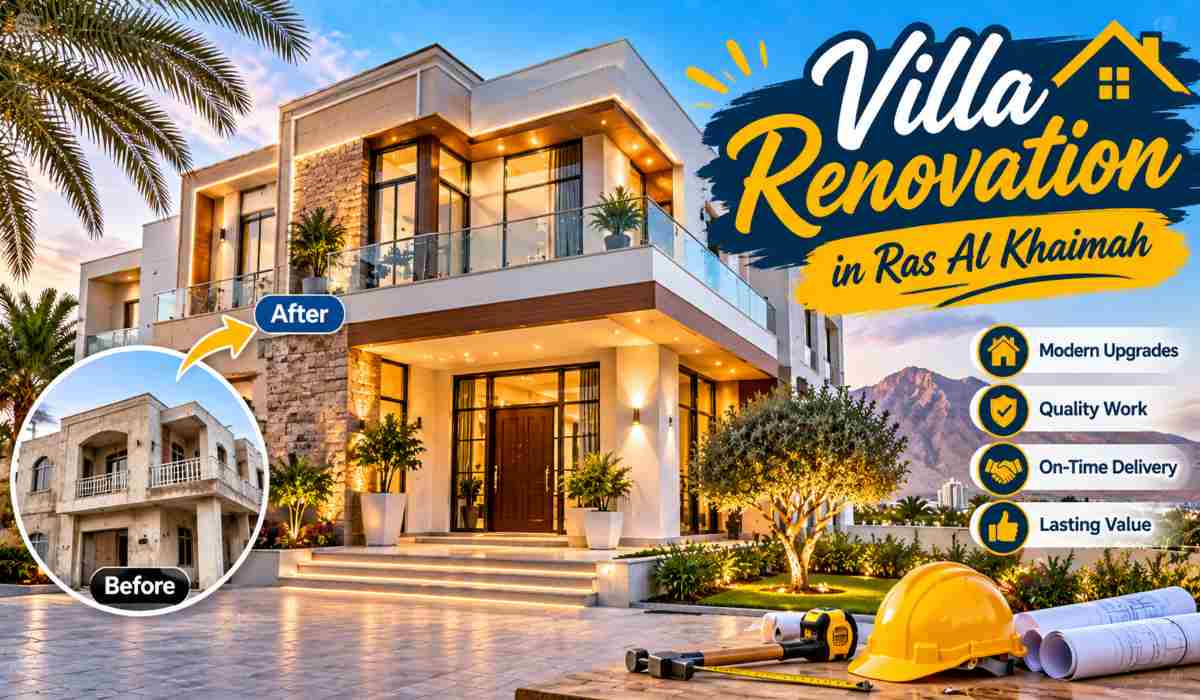
What is villa renovation? Villa renovation is the process of repairing, upgrading or reshaping an existing villa to improve its condition, comfort, layout and long term value. In Ras Al Khaimah, a sound plan sets the scope, budget, approvals and climate suited materials before any work begins.
A villa renovation works best when you decide the goal first (repair, upgrade or reshape) and then build the scope, budget and approvals around it. Each goal leads to a different timeline and cost, so settling it early prevents most of the expensive changes that happen halfway through a project.
Climate shapes almost every choice. Summer heat, humidity and salt laden coastal air wear down roofs, paint, joinery and cooling equipment faster than many owners expect. Abu Dhabi’s Department of Energy says air conditioning accounts approximately 60 to 70 percent of electricity use in UAE buildings, so a renovation is also your best chance to cut that load while refreshing the look of the house.
This guide covers the types of villa renovation, what drives the cost, the approvals to expect in Ras Al Khaimah, the stages of a typical project and the mistakes that cause delays. Whether you are updating a single floor or taking on a wider home renovation, the same planning logic applies, define the scope, price it honestly and choose materials that suit the local climate.
What Counts as a Villa Renovation?
A villa renovation is any project that restores an existing villa to good condition or improves how it looks, performs or works, without knocking it down and starting again. The scope can run from refreshing worn finishes to reworking the floor plan. The word you choose for the project matters, because it shapes the approvals, the order of work and what you can fairly expect from the result.
Renovation vs Modification vs Upgrade
A modification changes something that already exists, an upgrade replaces it with a better performing version and a renovation can include both. Enclosing a covered terrace or adding a room is a modification. Swapping an old air conditioner for an efficient inverter unit, adding wall insulation or fitting double glazed windows is an upgrade. The distinction affects paperwork as much as budget, changes to a villa’s footprint, structure or outside appearance usually need approval before work starts, while surface work usually does not. Check the current rules with the local municipality and your community’s management before you commit to a plan.
Why Villas in Ras Al Khaimah Age Differently
Villas in Ras Al Khaimah age mainly because of long, intense heat, summer humidity and, near the coast, salt in the air. Average temperatures in July run from about 29 °C to 43 °C and humidity is usually high through the summer. That daily swing makes roof membranes, terrace waterproofing and sealants expand and contract until they crack. Strong sun fades and peels exterior paint and cooling equipment works for most of the year, so it wears out earlier than its warranty suggests. Close to the sea, as in Al Hamra or Al Marjan Island, salt laden air also corrodes metal window frames, railings and outdoor light fittings. Rain is rare, so drainage faults often stay hidden until a winter shower exposes them. Because of this, a villa renovation here should fix the roof, waterproofing and cooling first and leave the cosmetic finishes until last.
Types of Villa Renovation
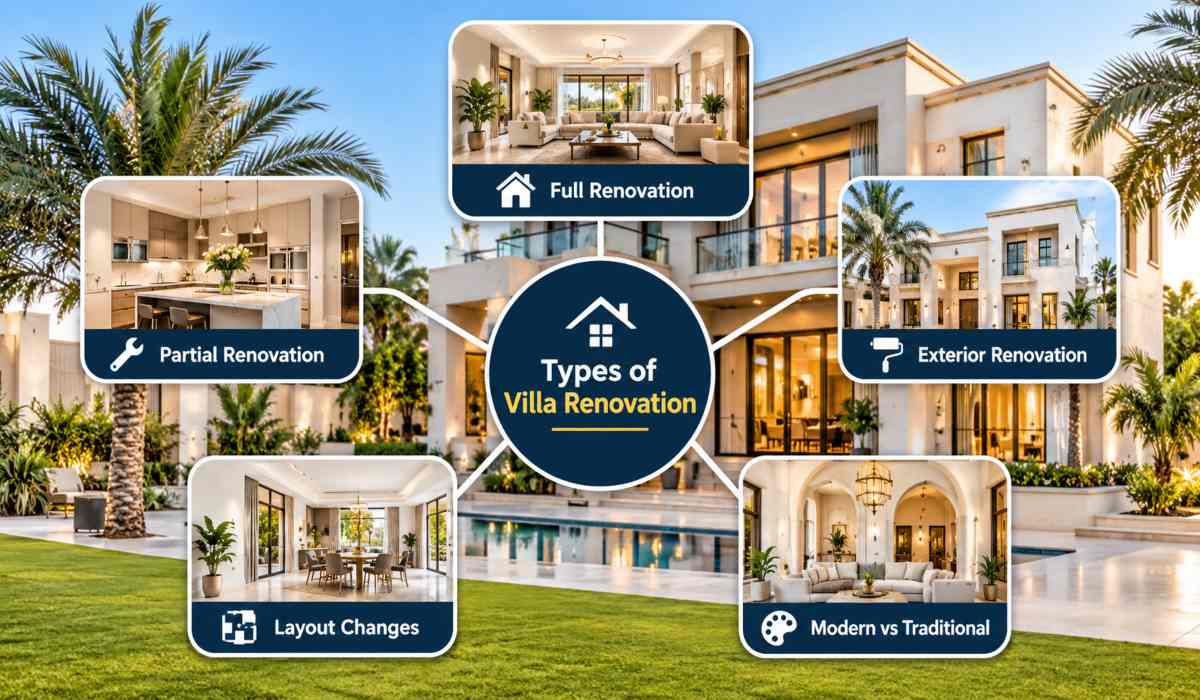
Villa renovations fall into five practical types, full renovation, partial or room by room work, exterior renovation, layout changes and style led updates. The right one depends on the villa’s condition, how much disruption you can accept and whether you want to fix problems or change how the house works.
Full (Whole Villa) Renovation
A full villa renovation renews most or all of the interior and usually the exterior and building systems, in one coordinated project. It suits older villas, newly bought ones or houses where problems such as ageing pipes, tired wiring, weak cooling and worn finishes are spread throughout. As the largest form of house renovation, its main advantage is sequencing. Work hidden behind walls and floors is finished first and the visible finishes go on last, so nothing gets broken open twice. The trade off is disruption. It takes the longest and many families move out while the work is under way.
Partial and Room by Room Renovation
Partial renovation updates selected rooms or systems and leaves the rest of the villa alone, which makes it the usual choice when problems are limited to certain areas. Kitchens, bathrooms, the master suite and the majlis are the most common starting points, because they see the heaviest use and date fastest. The main risk in an older villa is what sits behind the walls. Shared pipes, circuits and AC ducts often run through several rooms, so a sensible approach is to map the whole villa’s hidden systems first and then renovate the finishes one room at a time.
Villa Exterior Renovation
Villa exterior renovation covers everything outside the main living space, the facade, roof, terraces, windows, boundary walls, pool area and landscaping. In Ras Al Khaimah this is often where the damage is greatest, because strong sun, humidity, windblown sand and coastal salt all hit these surfaces first. The outside also affects comfort indoors. One UAE study reported by The National found that cooling focused changes could cut villa air conditioning bills by around 40 percent and the same coverage notes that large window panes push cooling demand up. Facade finishes, glazing and shading are therefore worth planning as part of the villa’s cooling, not just its appearance.
Layout Changes and Property Reconfiguration
Layout changes and property reconfiguration alter how a villa’s spaces are arranged, for example by removing walls, merging rooms, moving a kitchen or giving a room a new purpose. They are usually driven by how the household lives now, such as a growing family, a home office or a need for a bigger entertaining space. Three questions decide whether a change is simple or complex. Is the wall structural or just a partition? Will plumbing, ducts or wiring have to move with it? Do the municipality or community rules require approval? It is also worth checking that the new layout keeps enough daylight and airflow for every room.
Modern vs Traditional Villa Styles
A modern villa renovation favours open plans, clean lines, large glazing and a neutral palette, while a traditional one keeps or recreates Arabic and classical details such as arches, carved joinery and decorative plaster. Each style brings its own practical needs. Modern glazing needs good solar control in the Ras Al Khaimah sun and traditional detailing needs skilled finishing and regular care to stay sharp. Many owners blend the two, keeping a few signature features like arches or screens and simplifying everything around them. Choose the style that fits how you live and how much upkeep you accept, not whichever is fashionable.
When Is the Right Time to Renovate Your Villa?
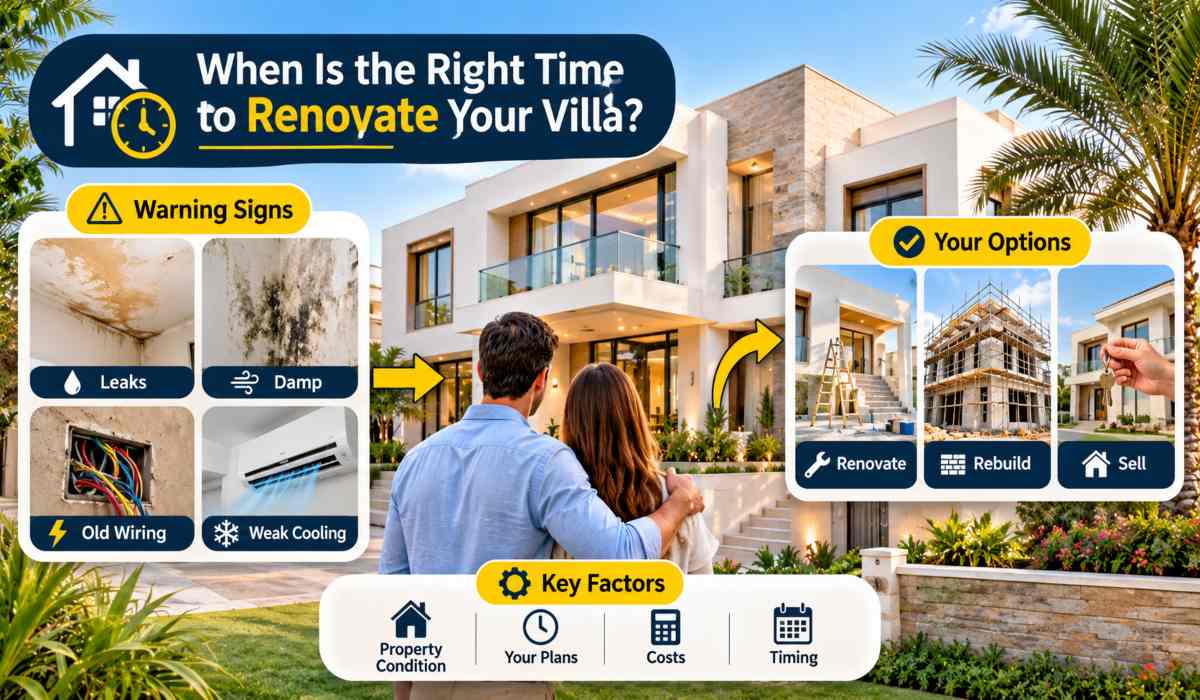
The right time to renovate a villa is when leaks, damp, ageing wiring or weak cooling begin to affect safety, comfort or running costs or when a natural handover point, such as buying the villa or before a big household change, lets you work in an empty house. Waiting for a system to fail usually brings more disruption and more damage than acting on the early signs.
Warning Signs Leaks, Damp, Old Wiring, Weak Cooling
Four problems tell you most clearly that a villa needs attention, leaks, damp, ageing wiring and weak cooling. Leaks show up as stained ceilings, bubbling paint or water around window frames and they usually point to failing roof or terrace waterproofing, so they are best dealt with before the next rain. Damp shows up as a musty smell, peeling paint, white salt deposits on walls or patches of mould. The source is often a leaking pipe, a blocked AC condensate line or poor external sealing, so it is worth finding the cause before repainting.
Old wiring shows up as breakers that keep tripping, lights that flicker, warm sockets or a burning smell. Treat any sign of overheating as urgent and have a qualified electrician inspect the villa straight away. Weak cooling means rooms that stay hot even when the AC runs constantly or bills that keep climbing. Abu Dhabi’s Department of Energy estimates that many cooling systems in UAE buildings are oversized by around 25 to 35 percent, so a struggling system is not always too small. Leaky doors and windows, poor ducting and missed maintenance are common causes, which makes a proper diagnosis the right first step.
Renovating Before You Move In vs After Years of Living There
Renovating before you move in is usually quicker and easier to coordinate, while renovating after years of living in the villa lets you decide based on how your household actually uses it. An empty villa lets the work follow one clean sequence, with floors, walls and ceilings opened up once, systems replaced and finishes applied last and no furniture to move or protect. Once you live there, the work needs staging, dust control and often a temporary move out, but you know which rooms run hot, where storage falls short and which spaces go unused. If you are buying, a practical split is to complete the essential work first, meaning roof, waterproofing, wiring, plumbing and cooling and to leave style and layout decisions until you have lived in the villa through a full summer.
Renovate, Rebuild or Sell?
Renovate when the structure is sound and the problems are in finishes and systems, rebuild when the structure or layout is beyond sensible repair and sell when the villa no longer suits your plans and the move makes more sense than the project. A structural survey is the best starting point, because it tells you whether the frame, foundations and roof are worth keeping. Rebuilding usually means fresh design, approvals and a longer programme than renovation and it leaves you without a home for the duration. Selling makes sense if the villa’s location, size or layout no longer fits your life or if the work needed would take it well beyond what you want to invest. In each case, compare the options on the same basis, time, disruption, approvals and how long you plan to stay.
Villa Renovation Cost Explained
The cost of a villa renovation depends mainly on the villa’s size, how much of it you renovate, the finish level and whether the structure or building systems change. Published UAE guides put a basic villa renovation at roughly AED 120 to 250 per square foot, with premium finishes and structural changes starting around AED 450 per square foot.
What Drives the Cost of a Villa Renovation
Five factors set the price of a villa renovation, the area being worked on, the scope, the quality of finishes, the amount of structural and systems work and the site conditions. Area matters first, because most work is priced per square foot and the renovated area is often smaller than the full built area. Scope comes next. Repainting and replacing floors costs far less than moving walls, rewiring or replacing pipework. Finish quality can move the budget more than anything else, since porcelain tile and marble can sit at very different price points. In Ras Al Khaimah, climate grade choices also add cost up front. Better waterproofing, insulation and corrosion resistant fittings near the coast cost more at the start, but they avoid repeat repairs.
Estimated AED Ranges for Villas in Ras Al Khaimah
Treat these figures as planning ranges, not quotes. They are estimates drawn from published UAE market guides and only a site survey can fix a real number for your villa.
| Item | What it usually covers | Estimated range (AED) |
| Basic refresh | Paint, floor finishes, fittings, minor repairs | 120–250 per sq ft |
| Mid range renovation | Kitchen and bathroom upgrades, better materials, some design changes | 250–450 per sq ft |
| Premium or structural renovation | High end finishes, layout or structural changes, upgraded systems | 450+ per sq ft |
| Single bathroom | Tiles, fixtures, plumbing upgrades, fittings | 30,000–80,000 per bathroom |
| Basic landscaping | Soil preparation and lawn laying | 50–100 per sq m |
The bathroom range comes from the same UAE guide as the per square foot tiers. Basic landscaping such as lawn laying and soil preparation is listed at AED 50 to 100 per square metre. As a worked example, a basic refresh across 3,500 square feet comes to roughly AED 420,000 to 875,000, while the same area at mid range sits near AED 875,000 to 1.6 million. Most published figures are UAE wide market guides rather than Ras Al Khaimah specific, so local quotes may differ.
Hidden Costs Homeowners Often Forget
The costs most often missed are approval and NOC fees, problems found behind walls, temporary accommodation, storage and protection, waste removal and snagging. Opening a wall or floor in an older villa can reveal corroded pipes or undersized circuits that have to be fixed before the finishes go back on. Design and engineering drawings, utility connection upgrades and long lead items such as custom joinery or imported stone also tend to appear late. If the work is delayed, living elsewhere longer adds up quickly. A common rule of thumb is to hold back 10 to 15 percent of the budget as a contingency for surprises.
How to Read a Renovation Quote
A good renovation quote breaks the work down by room and by trade, with quantities, units and named materials, so you can compare it with other quotes line by line. Check whether materials are specified or only given as an allowance, because allowances often rise once you choose actual products. Look at what is excluded. Permits, waste removal, design fees and electrical or plumbing upgrades are the usual gaps. The payment schedule should follow completed milestones rather than large upfront sums and the quote should state a timeline, a defects period and how variations are priced and approved. A much lower quote usually means a narrower scope, not a bargain.
Ways to Keep the Budget Under Control
The most effective way to control a villa renovation budget is to fix the scope before you ask for prices and avoid changing it mid project. Spend first on what protects the house, meaning roof, waterproofing, wiring, plumbing and cooling and phase decorative upgrades for later. Keep wet areas such as kitchens and bathrooms where the plumbing already runs, because moving them is expensive. Choose durable mid range materials for high wear areas and save premium finishes for a few visible spots. Order long lead items early, compare itemised quotes on the same scope and settle design decisions before work starts, since every change during construction costs more than the same change on paper.
Permits, NOCs and Regulations
A villa renovation in Ras Al Khaimah can involve up to three separate approvals, RAK Municipality for building work, your community developer if the villa sits in a managed community and EtihadWE if the electricity or water connection changes. Which ones apply depends on the type of work, so confirm each before anything starts on site.
Municipality Approvals vs Master Community Developer NOCs
A municipality approval is a legal permit for building work, while a developer NOC is a community’s own permission to make changes within its rules and one never replaces the other. RAK Municipality is the permit authority for building work in the emirate. For modification permits, the consultant and the contractor both have to be registered in Ras Al Khaimah and hold the relevant classification certificate from the municipality. Applications are normally opened through a registered consultancy office on the RAK government portal. A developer NOC works differently. If your villa is in a gated or master planned community, the developer or management company usually controls what can change on the outside of the villa, when contractors can work and how materials are delivered and waste removed. Many projects need both and it is usually sensible to get the developer’s position in writing before you submit drawings to the municipality.
Works That Usually Need Approval (and Those That Don’t)
Work that changes a villa’s structure, footprint, outside appearance or utility load usually needs approval, while surface work usually does not. Typical approval triggers include removing or altering load bearing walls, adding rooms or floors, enclosing terraces or balconies, changing the facade, building a pool and reconfiguring layouts that move plumbing or ducts.
Work that normally stays outside the permit process includes repainting, replacing floor finishes, swapping fixtures and fittings, updating non structural joinery and replacing appliances like for like. Treat this as a guide rather than a rule, because community regulations can still restrict visible changes or contractor access even for light work. Confirm your specific scope with RAK Municipality’s customer service centre and with your community’s management where one applies, before you fix a start date.
Utility Notes EtihadWE in Ras Al Khaimah
EtihadWE, not DEWA, supplies electricity and water in Ras Al Khaimah, so any renovation that changes your connection goes through it. EtihadWE was set up in 2020 under federal law and took over the northern emirates’ work from FEWA, so older documents may still use that name. A renovation affects the connection when it adds significant load, such as larger air conditioning, a pool pump, a second kitchen or an EV charger.
EtihadWE’s extra load application asks for a municipality NOC, a Civil Defence NOC and a load card stamped by an EtihadWE approved electrical contractor. Connection fees are largely set by the load you request, so work out the new total before finalising the design. If a meter has to move, EtihadWE lists a charge of AED 300 per meter per request plus actual equipment costs for transfers. Fees and requirements change, so check the current EtihadWE service page before applying.
Villa Renovation Step by Step
A villa renovation follows six stages, survey and scope, design and budget, approvals, materials, construction and snagging. Doing them in this order protects the budget and the schedule, because every decision made late on site costs more to change.
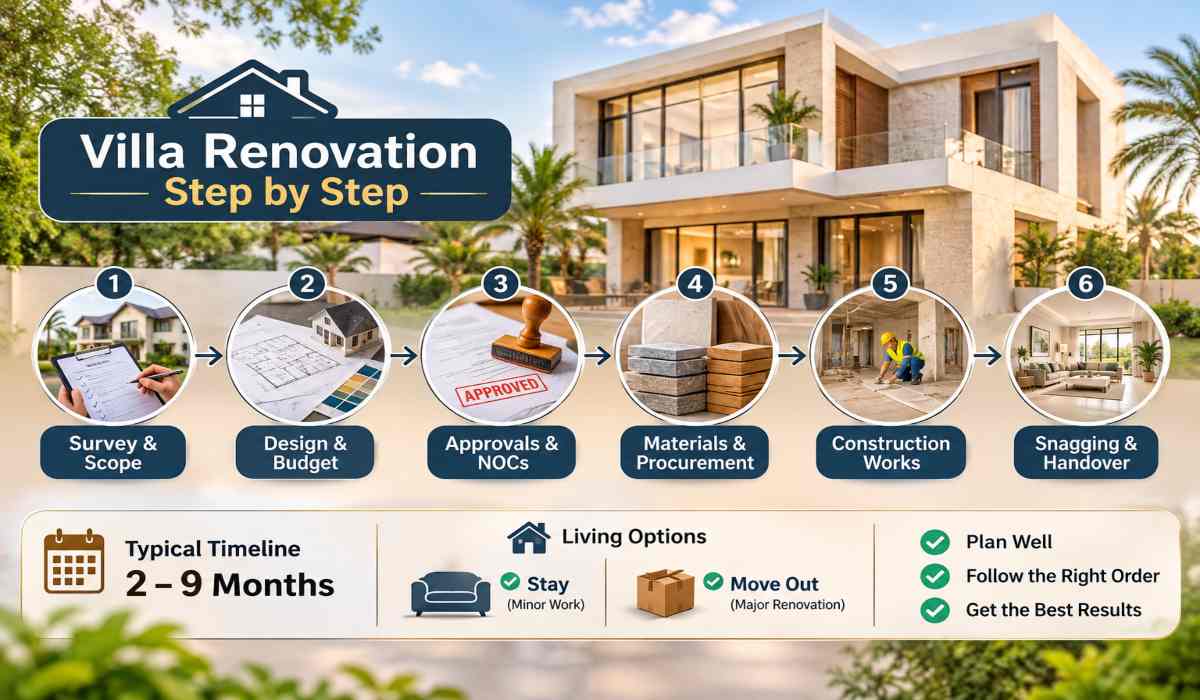
Step 1 Survey and Scope
A survey records the villa’s real condition and the scope turns that record into a room by room list of what will and won’t be done. The survey should cover the roof and terraces, waterproofing, moisture levels, plumbing, wiring, AC ducting and the structure itself, with photographs and measurements. Sort the findings into must fix items, such as leaks, unsafe wiring and failed waterproofing and nice to have upgrades. A fixed scope at this stage prevents most disputes and price surprises later.
Step 2 Design and Budget
The design stage turns the scope into drawings, finish choices and a priced breakdown that you can check line by line. This is the cheapest time to change your mind, since moving a wall on paper costs nothing and moving it on site costs a great deal. Settle the layout, the material specifications and the lighting and joinery details before approvals are submitted. Build a contingency into the budget and treat the figure as protection for hidden problems rather than as spare money.
Step 3 Approvals and NOCs
The approvals stage collects the permissions the work needs before it starts, RAK Municipality for building work, your community developer where one applies and EtihadWE if the electricity or water connection changes. Drawings normally go through a registered consultant and the community NOC is usually worth securing first. Approvals can take anything from a few weeks to a couple of months, so it makes sense to use that time to confirm materials and book deliveries. Do not start work that needs a permit before it is issued.
Step 4 Materials and Procurement
Procurement means ordering and checking the materials in time for the programme and the items with the longest lead times should go first. Custom joinery, imported stone, glazing and AC units often take weeks to arrive and a missing item can hold up everything behind it. In Ras Al Khaimah, prioritise materials made for heat and humidity, such as proper waterproofing membranes, heat reflective exterior paint and corrosion resistant fittings near the coast. Approve physical samples before ordering in bulk, confirm delivery rules with your community and store materials out of direct sun, since heat damages adhesives and timber.
Step 5 Construction Works
Construction follows a fixed sequence, protect and strip out, complete structural work, install hidden services, waterproof, then finish surfaces last. Plumbing, electrical wiring and AC ducting go in before walls and floors are closed and waterproofed areas should be water tested before anything is laid over them. Painting, joinery fitting and final flooring come at the end, so that dust and trades do not damage finished work. Heat affects curing in summer, so screeds, adhesives and paints need careful timing. A weekly site meeting, with every change confirmed in writing, keeps the work on scope.
Step 6 Snagging and Handover
Snagging is a room by room inspection that lists every defect to be fixed before the project is accepted as complete. Walk the villa in daylight and test everything, AC cooling, taps and drainage, sockets and switches, doors, windows and the waterproofing. Record each issue with a photograph, agree a date for the fixes and hold back a final payment until they are done. At handover, collect warranties, product manuals, as built drawings and any completion documents the authorities require.
How Long Does a Villa Renovation Take?
Most villa renovations take between two and nine months, depending on how much is being changed. Interior focused upgrades can be finished in roughly two to three months, medium projects that include kitchens and bathrooms often take four to six months and structural or whole villa projects commonly run six months or more. One published UAE guide puts most medium to extensive renovations at six to nine months. Approvals, custom materials, design changes mid project and community working hour limits are the usual causes of delay. These are general UAE estimates, so a written programme based on your own scope is the only reliable timeline.
Living in the Villa During Renovation vs Moving Out
Moving out is usually the better choice for a full or structural renovation, while staying is workable for room by room work if the kitchen, one bathroom and the AC stay usable. Dust, noise and planned water or power shutdowns are the main problems of staying and they matter more with young children, older relatives or pets. A good rule is to move out whenever the work touches the AC, the main plumbing or electrics or the kitchen and bathrooms at the same time. In Ras Al Khaimah summer heat, living in a house with no working cooling is not safe or realistic. If you do stay, seal off the work areas, agree the working hours in advance and phase the work so that one bathroom is always available.
Choosing Materials for the UAE Climate
The best materials for a villa in the UAE climate are those that resist heat, moisture and salt without cracking, fading or corroding and that help the villa stay cool. In Ras Al Khaimah this usually means heat stable finishes, reliable waterproofing, proper insulation and corrosion resistant fittings, chosen together as one system rather than item by item.
Heat, Humidity and Coastal Salt Air in Ras Al Khaimah
Three stresses wear down a villa’s materials in Ras Al Khaimah, intense heat, summer humidity and, near the sea, salt in the air. Heat makes materials expand and contract daily, which cracks sealants, fades paint and weakens adhesives. Humidity pushes moisture into walls and timber, causing mould, swelling and peeling. Salt is the hardest on metal and masonry, since it corrodes fixings and frames and leaves white deposits on walls. The effect is strongest close to the coast and weaker inland, so the right specification depends on how near your villa is to the water.
Flooring and Wall Finishes That Last
The longest lasting floors in this climate are dimensionally stable, low absorption materials such as porcelain tile and properly sealed stone, especially on ground floors and in wet areas. Timber and wood based flooring can work in air conditioned rooms, but they move with humidity, so it pays to understand how to protect wood from humidity before choosing it. For walls, use quality washable, mould resistant paint and well cured cement render and keep paper or vinyl wallcoverings out of damp prone rooms. In bathrooms and kitchens, high performance grout and sealant matter as much as the tile itself. A villa left empty with the AC off through summer often develops humidity damage, so plan for ventilation if the house will be unoccupied.
Waterproofing and Damp Protection
Waterproofing is the first line of defence against damp and it matters most on roofs, terraces, balconies, bathrooms and planters. A proper membrane system needs correct falls to the drains, upturns at wall edges, sealed joints and flashing and it should be flood tested before any tiles or screed cover it. Damp that has already appeared needs its source found first. It may be a leaking pipe, a blocked AC condensate line, failed external sealing or condensation and repainting over it only hides the problem. Choose breathable repair products for damp walls and make sure bathrooms and kitchens have working extraction.
Insulation, Windows and Cooling Efficiency
Insulation is the most effective materials upgrade for cooling efficiency and it usually comes before windows. A modelling study of UAE public housing villas found that upgrading wall insulation saved up to about 21 percent of annual electricity, roof insulation up to about 12 percent and glazing alone only about 3 percent. Doing all three together saved up to about 37 percent. These are simulated figures for particular villa models, so real savings will vary. In practice that means external wall insulation systems and a well insulated, reflective roof first. Then add low emissivity double glazing, tight door and window seals and external shading to cut heat gain and air leakage. Once the envelope is improved, the AC can be sized to the new, lower load.
Outdoor Materials for Terraces, Facades and Pools
Outdoor materials should be light coloured, non slip and resistant to UV, salt and temperature swings. For terraces, outdoor rated porcelain or light, sealed stone stays cooler underfoot than dark surfaces in full sun and expansion joints and good drainage prevent cracking and standing water. For facades, cement render finished with UV stable exterior paint holds colour better than cheaper coatings. Near the coast, specify marine grade stainless steel, anodised or powder coated aluminium and galvanised fixings in place of ordinary steel. Pool surrounds need chemical resistant tile and coping and a pool treated with salt systems needs materials that are compatible with it. Check each product technical datasheet against hot, humid and coastal conditions before you order.
Common Problems in Older Villas
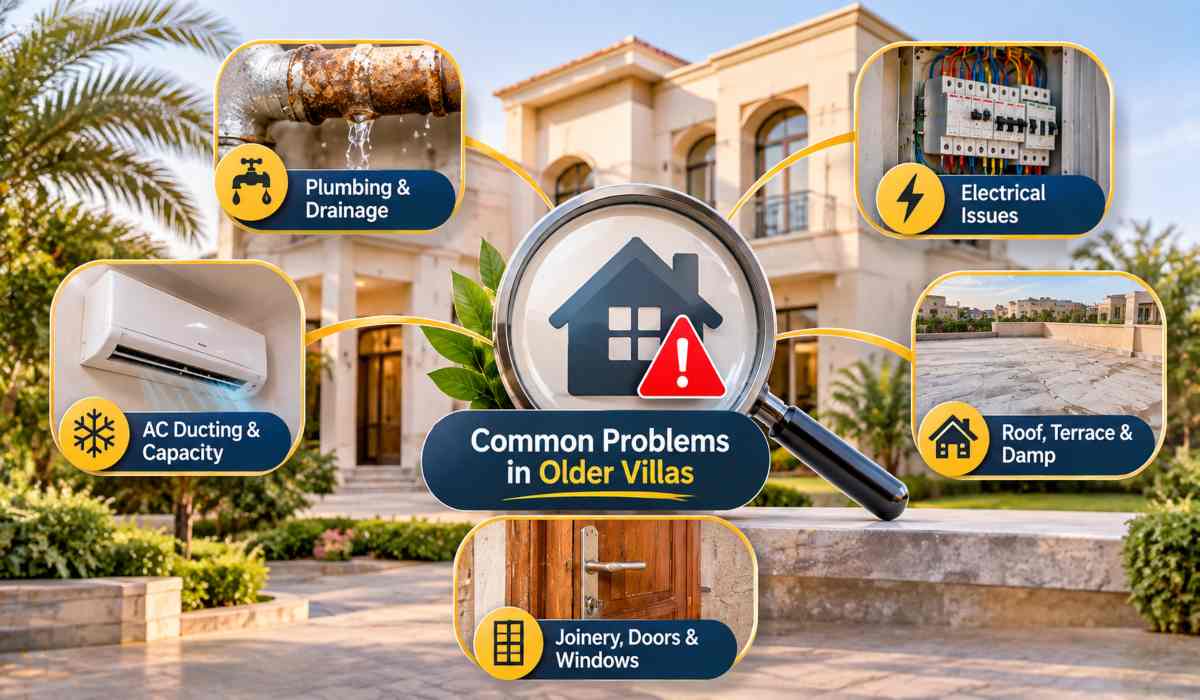
Older villas in Ras Al Khaimah most often develop problems with their plumbing, electrics, air conditioning, roof and terraces and wooden joinery. Most of these faults build up slowly and stay hidden until they cause damage, so a full condition check before renovation is the safest way to find them. A building maintenance team such as Home Fix Building Maintenance can inspect all five areas in one visit, which helps because the faults often overlap.
Ageing Plumbing and Drainage
Ageing pipes and drains mainly fail through corrosion, scale build up, leaking joints and blocked or poorly sloped drainage. Older villas may still have steel or early plastic pipework that corrodes or turns brittle with time. Hidden leaks show up as damp patches, low water pressure, musty smells or a water bill that creeps upwards without explanation. Slow drains, sewage smells and gully traps that dry out point to drainage faults. Pressure testing the supply pipes and surveying the drains before renovation shows what must be replaced while the walls and floors are open. Regular checks under AMC services also catch slow leaks before they damage walls.
Electrical Load and Outdated Wiring
Older villas often have wiring and distribution boards designed for much lower loads than today air conditioning, kitchen appliances and chargers, which shows up as tripping breakers, warm sockets and flickering lights. Extra AC units and extensions are frequently added to existing circuits over the years and heat makes old cable insulation brittle. Missing or outdated safety devices are another common finding. A proper inspection includes insulation and earth tests and a load calculation and any sign of overheating should be treated as urgent. Villas that now double as home offices or shared accommodation often carry more load than their original design allowed and residential and commercial services can assess both uses in one calculation.
AC Ducting and Capacity
Older villas often have air conditioning that is past its working life, wrongly sized for how the villa is used now or connected to leaking, uninsulated ducts. An Ajman based AC specialist advises replacing units older than about 15 years and a UAE property expert notes that sun, sand, salt and moisture mean parts need replacing along the way even in well kept systems. Capacity problems often follow changes to the house, such as an enclosed terrace, a new extension or extra glazing, which raise the cooling load without any change to the equipment. Before replacing anything, check duct leakage and insulation, coil cleanliness, condensate drains and the room by room load. Our ac repairs and installation services page covers what a full AC assessment involves.
Roof, Terrace and Damp Issues
Roof and terrace problems usually come from worn waterproofing, cracked screed, blocked drains and failed sealants and they appear inside as stains, peeling paint and damp patches. Heat cycles crack old waterproofing layers and windblown sand blocks outlets, leaving water standing on flat roofs. Rain is rare in Ras Al Khaimah, so faults often stay hidden until the first heavy winter shower. Other causes of damp include irrigation beds against external walls and salt in coastal air. The cause has to be repaired before any repainting and re-laying terrace tiles is best done over new waterproofing rather than on top of the old layer. Flooring and roof services can advise on when a terrace needs to be lifted and waterproofed again.
Joinery, Doors and Windows
Wooden doors, cabinets and window frames in older villas fail mostly through humidity swelling, heat drying and worn hinges and seals. A sticking or twisting door can often be corrected if it is caught early, which is why a warped wooden door is worth acting on before the frame is damaged. A door that sags or will not latch may only need door hinge repair. Kitchen cabinets near the sink often swell, peel at the edges or lose their hinges and kitchen cabinet repair is usually more economical than replacement while the carcasses are sound. Windows lose their seals and aluminium frames corrode near the coast, letting in air and heat that push the AC harder. To protect wood from humidity, keep it sealed, ventilated and away from damp walls. When timber is rotten or twisted beyond repair, replacing it with new carpentry works is the better route.
Villa Renovation Ideas That Add Comfort and Value
The renovation ideas that add the most comfort and value to a villa are those that improve how the house is used and how it handles heat, smarter layouts, upgraded kitchens and bathrooms, well planned storage and shaded outdoor living. Start with the changes that fix everyday frustrations, because those are the ones you will notice daily and that future buyers or tenants tend to value.

Open Plan and Layout Ideas
The most effective layout idea is to open the link between the kitchen, dining area and living space, while keeping enough separation to control heat, noise and cooking smells. A fully open plan gives a bigger area for the AC to cool and carries cooking odours through the whole house. Wide openings, glazed screens or sliding partitions give you the open feel and still let you close spaces off when you need to.
Other layout ideas that work well in villas include merging two small rooms into one family room, adding a laundry or utility room, creating a home office and moving the majlis nearer the entrance so guests do not pass through private areas. Spacious sliding doors that lead out to the garden bring in light and cross ventilation, but they need shading, since big areas of glass raise the cooling load. Check whether any wall is structural before you plan to remove it.
Kitchens and Bathrooms
Kitchens and bathrooms add the most everyday comfort when their layout, ventilation and surfaces are upgraded together. In kitchens, good ideas include a clear working triangle between sink, hob and fridge, an island where space allows, strong extraction and moisture resistant cabinet carcasses. Many villa households also benefit from a separate prep or wet kitchen that keeps heavy cooking away from the main living area. If your existing cabinets are structurally sound, kitchen cabinet repair combined with new doors and handles can refresh the room without a full replacement. In bathrooms, walk in showers, wall hung fittings, anti slip tiles and proper extraction make the biggest difference, while waterproofing underneath the finishes protects everything above it. Water efficient taps and showerheads reduce running costs without changing how the room feels.
Custom Joinery and Storage
Built in storage is one of the most useful upgrades for a villa, because many older villas lack organised space for clothes, shoes, linen and household goods. Popular ideas include walk in or fitted wardrobes, entrance shoe and coat storage, under stair cupboards, a pantry, laundry cabinets and display units for the majlis. Plan each unit around how the room is actually used and measure carefully around AC vents, sockets and switches so the joinery does not block them. In a humid climate, choose moisture resistant boards with sealed edges and quality hinges and avoid placing solid timber against damp external walls. Well fitted joinery also makes rooms look larger and tidier, which is part of why it adds value.
Outdoor Living and Shading
Outdoor living works in Ras Al Khaimah when shade, airflow and surfaces are planned first. A shaded terrace, pergola or covered seating area can be used for more of the year and the same shade reduces the heat reaching the villa. A University of Sharjah modelling study of a UAE villa found that insulation, shading and ventilation together cut electricity use by about 42 percent in August, although shading on its own had a smaller effect than insulation.
That makes shade a useful part of a package, not a replacement for it. Good outdoor ideas include a louvred pergola or shade sails, deep overhangs over west facing windows, trees and hardy planting near the walls and light coloured paving that stays cooler underfoot. An outdoor kitchen or barbecue corner and soft evening lighting make the space usable once the heat drops and shaded pool edges are more comfortable for longer.
Common Villa Renovation Mistakes to Avoid
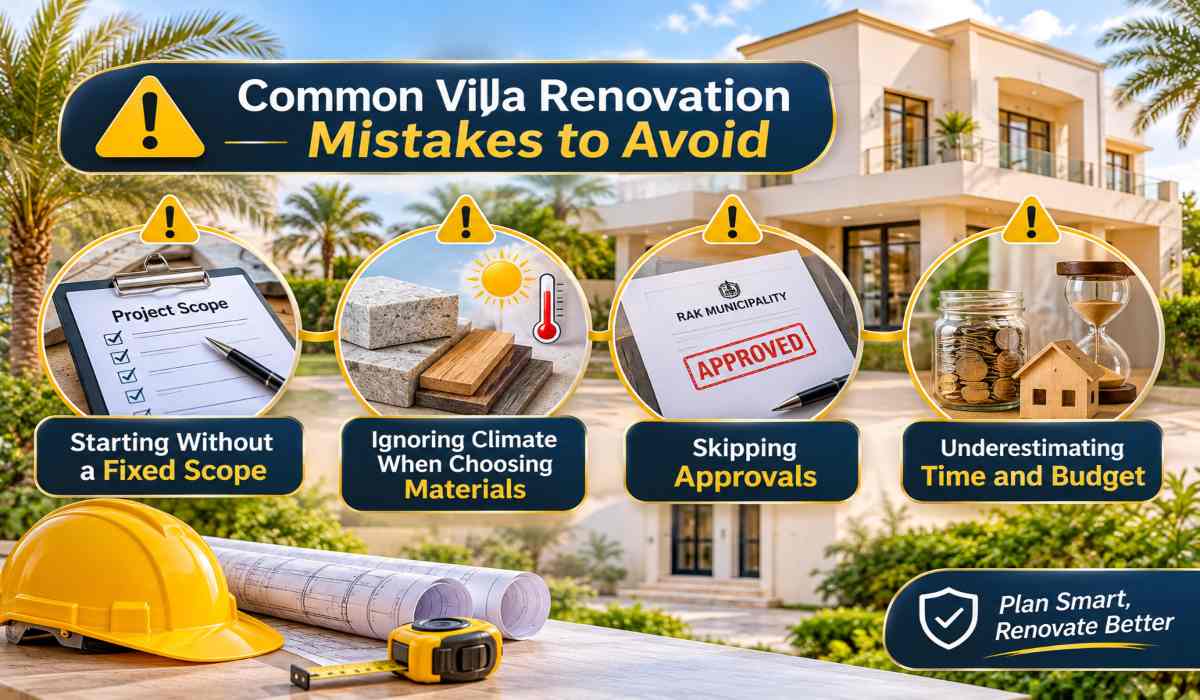
The most common villa renovation mistakes are starting without a fixed scope, ignoring the climate when choosing materials, skipping approvals and underestimating time and budget. Each one can be avoided with planning done before the first day on site. Addressing existing Building Maintenance Issues before renovation begins also helps prevent recurring problems and unexpected repair costs.
Starting Without a Fixed Scope
Starting work without a fixed scope is the costliest mistake, because every change made on site costs more than the same change made on paper. A written scope lists what is being repaired, replaced or left alone in each room, with specifications for the main materials. One UAE design and build firm reports that projects without a finalised design lost two to three months to rework, change orders and reselect materials on site. Complete the survey, write the scope and lock the design before you apply for approvals.
Ignoring Climate When Choosing Materials
Choosing materials without thinking about heat, humidity and coastal salt leads to early repairs, such as cracked sealants, faded paint, swollen timber and corroded fittings. Indoor grade products used outdoors, dark paving in full sun and ordinary steel near the sea are the usual culprits. Match each material to its exposure and check product datasheets for temperature, moisture and corrosion ratings. A slightly better specification at the start usually costs less than repeating the work.
Skipping Approvals
Skipping approvals risks stop work orders, fines and problems when you later sell or insure the villa. Changes to a villa structure, footprint or outside appearance generally need RAK Municipality approval and many communities also require a developer NOC. For modification permits, the consultant and contractor must be registered in Ras Al Khaimah, so ask to see their registration before you agree to anything. Never let work that needs a permit start before it is issued.
Underestimating Time and Budget
Underestimating time and budget usually happens because hidden problems, approvals and late decisions are left out of the plan. Walls opened in older villas often reveal pipes or wiring that need replacing and custom items can take weeks to arrive. A common rule of thumb is to hold back 10 to 15 percent of the budget as contingency and to add buffer time for approvals and deliveries. Decide finishes early and avoid scheduling curing sensitive work in the hottest weeks if you can.
Keeping Your Villa in Good Condition After Renovation
A renovated villa stays in good condition with two short checks a year, one before summer and one after the rains, plus a simple annual review of the systems the renovation touched. Catching small faults early protects the new finishes.
Seasonal Checks Before Summer and After Rain
Before summer, the priority is cooling and heat protection, service the AC and clean filters, check ducts for leaks, clear sand from roof and terrace drains and inspect waterproofing and sealants for cracks. Also check window seals and any shading and test pool pumps and irrigation. After rain, which is rare in Ras Al Khaimah and usually in winter, look for ceiling stains, damp patches and water pooling on roofs and terraces. Clear any blocked drains, check outside walls and joints for cracks and test outdoor sockets and lights. Rain is the quickest way to expose a hidden fault, so treat any leak as urgent.
A Simple Annual Maintenance Checklist
An annual check should cover the main systems the renovation changed, so it is worth doing on the same date each year.
- AC full service, filter and coil cleaning, duct and drain check
- Plumbing inspect for leaks, check water pressure, test shut off valves
- Electrical press the test button on safety devices and check for warm sockets or tripping breakers
- Roof and terrace inspect waterproofing, sealants, falls and drains
- Exterior check paint, render, joints and metal fittings for cracks or corrosion
- Joinery tighten hinges, check doors, windows and cabinets for swelling or sagging
- Wet areas inspect grout, sealant and extraction fans in kitchens and bathrooms
- Outdoor areas check shading, paving, pool equipment and irrigation
Conclusion
A successful villa renovation in Ras Al Khaimah comes down to planning before building. Decide the scope first, price it honestly with room for surprises, secure the right approvals and choose materials that can handle heat, humidity and coastal salt. Fix the roof, waterproofing, wiring, plumbing and cooling before the cosmetic finishes, and plan simple seasonal checks afterwards so the new work lasts. With a clear scope and realistic expectations, a villa renovation improves daily comfort, cuts avoidable repairs and protects the value of your home for years.
Frequently Asked Questions (FAQs)
What Is Villa Renovation?
Villa renovation is the process of repairing, upgrading or reshaping an existing villa to improve its condition, comfort, layout and long term value. It ranges from refreshing finishes to reworking the layout and building systems. It differs from rebuilding because the main structure stays in place.
How Much Does It Cost to Refurbish a Villa in Ras Al Khaimah?
Published UAE guides suggest roughly AED 120 to 250 per square foot for a basic refresh, AED 250 to 450 for mid range work and AED 450 or more for premium or structural projects. These are planning estimates, not Ras Al Khaimah quotes. A site survey and an itemised scope are needed to get a real figure.
How Long Does a Full Villa Renovation Take?
Most villa renovations take between two and nine months. Interior focused upgrades can take two to three months, medium projects with kitchens and bathrooms four to six months and structural or whole villa work six months or more. Approvals, custom materials and mid project design changes are the most common causes of delay.
Do I Need a Permit to Renovate a Villa in Ras Al Khaimah?
Work that changes a villa structure, footprint or outside appearance generally needs a permit from RAK Municipality before it starts and many communities also require a developer NOC. Light work, such as repainting, usually does not. Confirm your scope with RAK Municipality and your community management first.
How Do I Choose Materials That Suit the UAE Climate for My Villa Renovation?
Choose materials that resist heat, humidity and salt, porcelain tile or sealed stone for floors, mould resistant paint, proper waterproofing membranes, wall and roof insulation, low emissivity glazing and corrosion resistant fittings near the coast. Select them as one system and check each product’s datasheet against local conditions.
Is It Cheaper to Renovate a Villa in Phases?
Phasing spreads the spending over time and eases cash flow, but it is not always cheaper overall. Repeated site set ups, reworked finishes and opening walls twice can raise the total. If you phase, do the hidden work first, meaning roof, waterproofing, plumbing and wiring and leave decorative rooms for later.
Can I Live in My Villa During Renovation?
You can live in the villa during a partial, room by room renovation if the kitchen, one bathroom and the AC stay working. For full or structural projects, moving out is usually safer and faster because of dust, noise and utility shutdowns. In summer, living without working cooling is not realistic.
What Is the Difference Between Renovation and Refurbishment?
Renovation is the broad term for restoring or improving a villa, including structural and layout changes. Refurbishment is narrower, it freshens what is already there, such as paint, floors and fittings, without changing the structure or layout. In everyday UAE usage the two words are often swapped, so define the scope in writing.