
Apartment Renovation in RAK | Rules, Steps and Risks

What is apartment renovation in Ras Al Khaimah? It means upgrading or reworking the inside of an apartment, from a light refresh to a full renovation. Most projects need written approval from building management before any work starts, and some changes also need a municipality permit. The order matters, approvals first, then hidden works, then finishes.
Renovating an apartment is not the same as renovating a villa, because you share walls, pipes and entrances with your neighbours. In Ras Al Khaimah, that means your building’s rules often matter as much as your design. Building management may set working hours, ask for contractor passes and decide how materials travel through the lift. The municipal step looks short by comparison: RAK Municipality lists a decoration permit at AED 300, with a maximum processing time of four days and a permit to add a wall is issued within five days.
This guide explains how an apartment renovation works in RAK, from the approvals you need before work starts to the order the work should follow. It also covers older apartments, where hidden wiring, pipework and balcony waterproofing change the plan. If your project grows into a wider home renovation, one contractor can manage the whole scope as a single job. The goal is simple, you will know what to ask, what to confirm in writing and what to settle before the first tile comes off.
What counts as an apartment renovation?
An apartment renovation is any project that upgrades, repairs or reshapes the inside of an apartment beyond routine upkeep, from repainting to stripping the unit back and rebuilding it. What separates one type from another is how much of the apartment and how much of its hidden systems, the work touches.
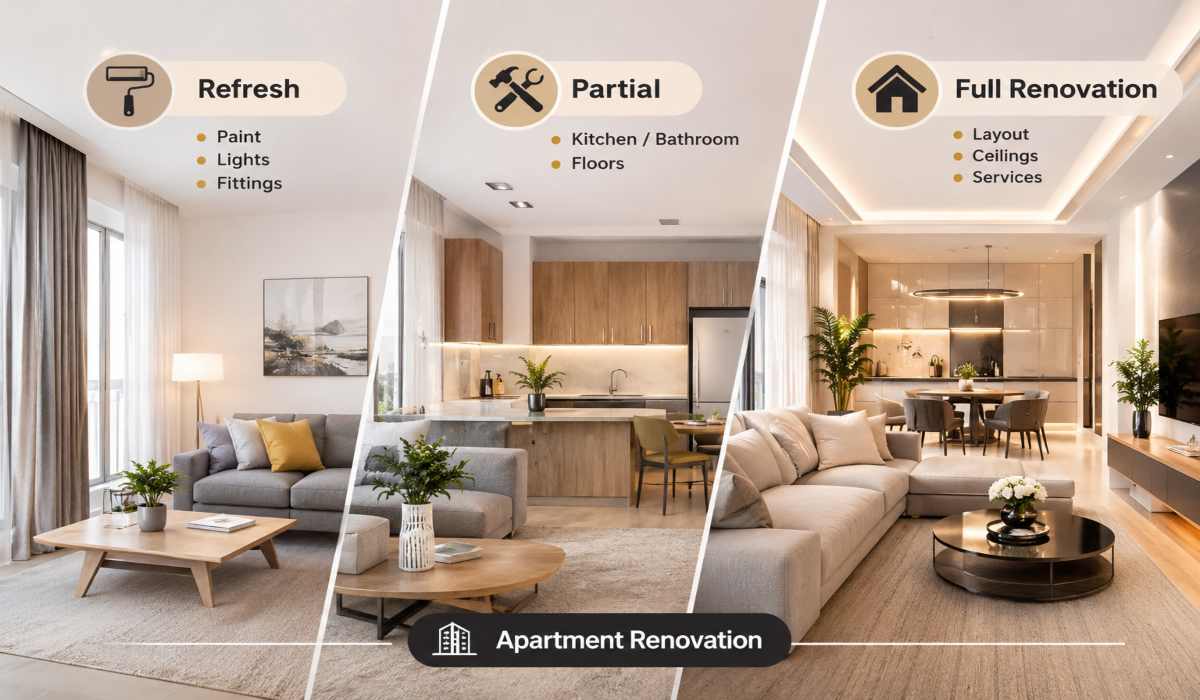
Light refresh, partial and full apartment renovation
A light refresh changes surfaces only, a partial renovation rebuilds selected rooms or systems and a full apartment renovation reworks the whole unit, including what sits behind the walls. A refresh covers paint, lighting, fittings and window dressings and it leaves walls, pipes and wiring alone. A partial renovation focuses on one or two areas, most often the kitchen, a bathroom or the floors and it usually reaches into the plumbing or electrics in those rooms. A full renovation treats the apartment as one project. Layout, ceilings, floors, wet areas and services are renewed together, so nothing has to be opened twice.
The line matters for approvals as well as scope. In RAK, the municipality’s decoration permit service lists a plan of the renovation among its required documents where internal divisions are involved. In practice, moving or adding walls places a project in a different approval category from a refresh, so decide which type you are doing before you speak to building management.
Flat, apartment unit (same job, different words)
Flat, apartment and unit all describe a self contained home inside a larger building, so a flat renovation and an apartment renovation are the same kind of project. “Flat” is the usual word in British English, “apartment” is common on UAE property listings and “unit” tends to appear in building rules and management paperwork. People also search the same idea in different word orders, such as renovating an apartment or the renovation of an apartment. The wording does not change the work or the rules. What does change them is that your unit shares walls, risers and entrances with others, which is why building management is part of the process in a way it is not for a standalone house.
Apartment renovation approval in Ras Al Khaimah
Most apartment renovations in Ras Al Khaimah need written permission from building management or the developer before work starts and work that changes walls or electrical load can also involve the municipality or EtihadWE. Surface only work usually needs far less, but every building sets its own rules, so check yours before you hire anyone or order materials.
Building management and developer permission
Building management or the developer’s community team, is the first approval to ask about, because the building controls what can change inside its walls and when contractors may work. A municipal permit, where one is needed, does not replace that permission. Start by asking for the building’s renovation guidelines and application form. Then describe your scope in plain terms, which rooms, which systems and whether any wall, wet area or balcony changes. Wait for approval in writing before you order materials or book trades. If you look after both residential and commercial services, ask whether one approval can cover them or whether each unit needs its own.
Changes that usually need approval and ones that don’t
Moving or adding walls, relocating wet areas, changing a balcony or windows and moving outdoor AC units usually need approval, while like for like surface work usually does not. Walls come first. RAK Municipality has a separate permit for adding a wall and an engineer should confirm whether a wall is only a partition before you plan to remove it. Relocating a kitchen or bathroom changes drainage and waterproofing for the neighbour below, so building management will want to know and it is sensible to have the existing pipework inspected by a plumbing specialist first.
Balconies, windows and outdoor AC units affect how the building looks from outside, which is why the building or developer usually controls them. If an AC unit has to move, an AC installation specialist can advise where the new position can go. By contrast, painting, new floor services , like for like fittings and lighting changes normally stay inside the unit, though some buildings set rules on flooring, so ask first.
Contractor passes, working hours, deposits and protecting common areas
Managed buildings commonly ask contractors for access passes, restrict noisy work to set hours and require protection for lifts, corridors and shared areas and some also ask for a deposit. The details differ from building to building, so ask for the contractor rules in writing and pass them to your contractor before the work is priced. Also ask how materials and waste will move through the building, whether the lift can be booked and who is responsible for damage to common areas. On licensing, RAK regulates the contracting profession by law, so ask for your contractor’s licence details at the start, because the building may want to see them.
Extra electrical load and EtihadWE (not DEWA)
Ras Al Khaimah’s electricity and water come from Etihad Water and Electricity (EtihadWE), not DEWA, so an extra load request goes through EtihadWE. The UAE government portal lists EtihadWE as the provider of electricity and water connections to housing units in Ras Al Khaimah and the other northern emirates. Extra AC units, a larger oven or a new kitchen layout can all push your load up. For an extra load application, EtihadWE lists a municipality no objection certificate, a Civil Defence no objection certificate and a load card stamped by an EtihadWE approved electrical contractor among the required documents.
In an apartment, the supply also usually runs through shared risers and a meter room, so ask building management early whether the building can take the extra load. Confirm every approval with RAK Municipality and your building management before work starts, because requirements, fees and processing times can change and differ between buildings.
How an apartment renovation works step by step
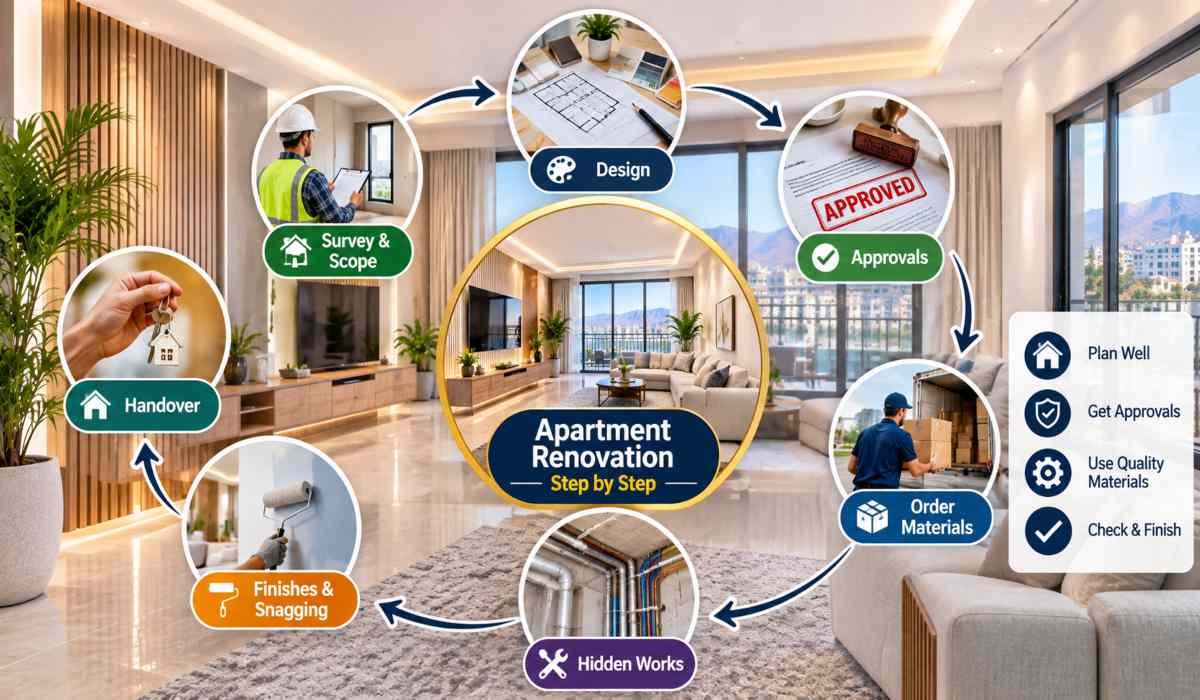
An apartment renovation follows a fixed order, survey and scope, design, approvals, ordering long lead items, hidden works, finishes, then snagging and handover. Getting approvals before you order anything and finishing hidden works before any finish goes on, prevents most of the delays and rework owners run into.
Survey and scope
A survey records the apartment’s real condition and the scope turns that record into a written list of what will and will not be done in each room. Check the walls and ceilings for damp, the wiring and distribution board, pipework, AC performance, windows, balcony and floors and take dated photos as you go. Then split the findings into must fix items and wish list items. If the survey turns up faults left by years of deferred upkeep, deal with those first, because new finishes will not last over an unresolved leak or failing circuit. A fixed scope at this stage is what keeps the later steps cheap and predictable.
Design and specification
Design fixes the layout, finishes and fittings on paper and the specification names the exact materials, sizes and products so every quote covers the same thing. In an apartment, also check that large items will physically fit through the entrance, lift and doorways before you choose them. Choose finishes that cope with RAK’s humidity, especially in bathrooms and near balcony doors. If the plan moves a wall or a wet area, the drawings will be needed for approval, so settle them before you apply. Changing your mind on paper costs nothing, while changing it on site costs time and money.
Approvals
Approvals come after design and before any ordering or strip out, because the building and where needed the municipality, review the scope you have fixed. File with building management first, add a municipal permit if walls or similar changes are involved and start any EtihadWE request early if your electrical load will rise. Ask building management how long its review takes, because the slowest approval sets your start date. Do not begin demolition until you hold written approval and keep copies of every permit and pass for handover.
Ordering long lead items
Order made to order items as soon as the specification and approvals are settled, because delivery lead times can hold up the whole programme. Kitchens, made to order joinery, stone, glazing and AC units are the usual candidates. Apartments add a practical limit, deliveries usually need a lift booking and there is little room to store boxes on site. Ask suppliers to deliver in stages close to installation and check each delivery against the lift’s size and the building’s delivery rules.
Hidden works before finishes
Hidden works are the plumbing, electrical, AC pipework and waterproofing that sit behind walls, floors and ceilings and they must be installed and tested before any finish goes on. In an apartment, shutting off water or power can affect neighbours, so book those shutdowns with building management ahead of time. Do the noisiest work, such as breaking out and chasing walls, first and inside the permitted hours. Pressure test the pipes, test the circuits and flood test wet area waterproofing before closing up, because a leak found later can reach the unit below as well as your own.
Finishes, snagging and handover
Finishes go on from the top down, starting with ceilings and ending with final paint and fittings, so later trades do not damage completed work. Snagging is your room by room check for defects and it is best done in daylight with everything switched on and tested. Write the list down, agree a date for fixes and confirm that lifts, corridors and shared areas have been left undamaged, which may matter if you paid a deposit. At handover, ask for warranties, product details and a simple note of where pipes and cables run behind tiles and walls, which saves guesswork when you hang a shelf later.
How long does an apartment renovation take?
A full apartment renovation typically takes an estimated 8–14 weeks, depending on size, finish level and how long approvals take. Apartment specific delays add to that, building management’s review time, restricted working hours that cut the productive days in a week, lift bookings for deliveries and waste removal and the fact that a small space limits how many trades can work at once. Partial renovations take less time, but the same building rules apply. Treat the range as an estimate and ask your contractor for a written programme, because that is the only reliable timeline for your own scope.
Living in the apartment during renovation
You can stay in the apartment during a partial renovation if one bathroom, a working kitchen and cooling remain usable, but a full renovation is usually faster and less stressful if you move out. Apartments are small, so dust and noise reach every room and shared walls mean your neighbours feel the work too. These are common Building Maintenance Issues to consider before starting renovation. If you stay, seal off the work area, agree the working hours in advance and phase the work so one bathroom is always available. In RAK’s long summers, living without working AC is not realistic, so plan a temporary stay for any stage that takes cooling offline.
Renovating an old apartment in RAK
Renovating an old apartment in Ras Al Khaimah starts with what you cannot see, ageing wiring, pipework, AC equipment and balcony waterproofing, all worn faster by coastal humidity and salt. Because your unit shares risers and walls with neighbours, you also need to know which parts you can change and which belong to the building.
What age and coastal humidity do to wiring, pipes, AC and balcony waterproofing
Age and coastal humidity wear the hidden parts of an apartment first and the damage often shows only once a finish is removed. Older circuits were sized for fewer appliances and heat and damp air harden cable insulation and loosen connections, which is why tripping breakers and warm sockets are common warnings. Pipes scale up and corrode and joints start to weep behind walls.
AC systems clog with dust and outdoor units suffer from salt on the coils. Balcony membranes and sealants crack as the sun heats and cools them, letting water through to the ceiling below. Salt is a real factor on this coast, a study of buildings in Jazirat Al Hamra, on the RAK coast, investigated damage from salt weathering, which breaks down surface materials through processes such as crystallisation.
Shared risers and neighbours’ units
In most apartment buildings you can change what is inside your unit, but the risers, structure, external walls and balcony slab usually belong to the building, so you should not cut into them without permission. Your ownership documents and the building’s rules set the exact boundary, so ask building management for it in writing. Finishes, fittings and branch pipework inside your unit are normally yours to renew, with approval where walls or wet areas move. Main water and drainage stacks, shared ducts, structural walls and the façade are not. Neighbours matter too, a leak from your unit reaches the one below and water or power shutdowns can affect others, so tell them before noisy or disruptive work begins.
What to inspect and fix before any finishes
Before any finish goes on, have each hidden system inspected and fix what fails, because new tiles and paint will hide problems rather than solve them. An electrician should test insulation and earthing and check that the distribution board can handle your planned load. A plumber should pressure test the supply, check drains and confirm that an isolation valve works for your unit.
The AC should be serviced, with drain lines, ducting and capacity checked against the rooms as they are now. Check the balcony and wet areas for damp and failed waterproofing and look at window seals. Humidity also swells timber, so test doors and joinery, a sticking door may only need door hinge repair and a twisted one can sometimes be corrected, as explained in this guide to a warped wooden door. Keep dated photos and the written reports, as building management may want them.
Refresh or full renovation?
Choose a refresh when the hidden systems pass inspection and only the surfaces look tired and choose a full renovation when the inspection finds failing wiring, pipes or waterproofing or when you want to change the layout. A middle route often works best, repair the systems that failed, then refresh the rest. Painting and new fittings over a failing system is how owners end up opening the same wall twice. Layout changes tend to push a project into full renovation, because moving walls or wet areas brings extra approvals and shared building checks. How long you plan to stay also matters, since systems you renew should outlast your ownership of the unit.
Apartment renovation ideas that work in RAK
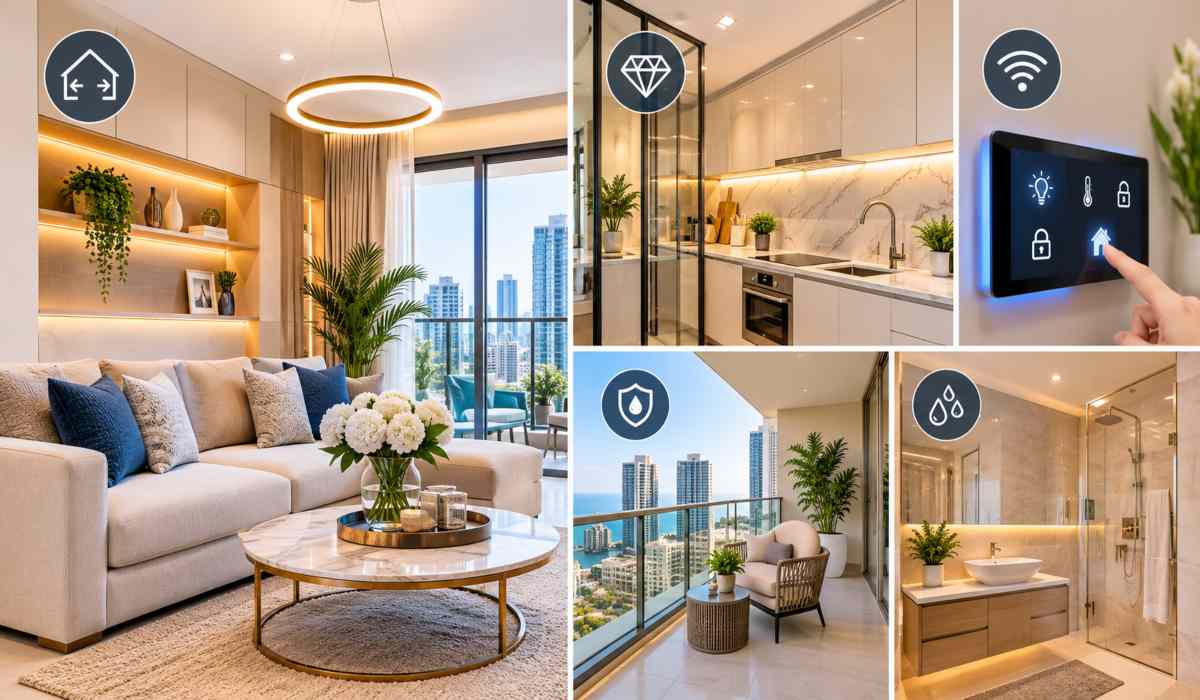
The apartment renovation ideas that work best in RAK make a compact home feel larger, cooler and easier to look after, smart use of space, a few well chosen luxury finishes, practical lighting controls and materials that cope with humidity. Pick ideas that suit your building’s rules and your unit’s size, not ones borrowed from larger homes.
Space saving layouts and built in storage
The most effective space saving layout keeps the plan open where light and air matter and puts storage along walls that would otherwise be wasted. A semi open kitchen with a glazed or sliding partition keeps cooking smells out of the living area and avoids cooling more open space than you need. Full height built in wardrobes, a bed with drawers beneath it and a slim storage unit by the entrance use vertical space well and sliding doors save the floor area a swinging door needs. Well planned built in storage should be measured around AC vents, sockets and switches. If your existing kitchen cabinets are sound, kitchen cabinet repair with new doors and handles can refresh the room without changing its layout.
Luxury finishes (lighting, stone, joinery)
In an apartment, luxury comes from a few high quality surfaces and good light, not from expensive finishes in every room. Put the best materials where you see and touch them daily, such as a stone or large format tile feature wall, a worktop, door handles and taps. Bespoke joinery with concealed handles and integrated lighting makes a small room look calmer and more custom.
Layered lighting does much of the work, warm cove lighting, wall washers and focused accent lights make finishes look richer after dark. Keep the palette tight, with two or three materials repeated through the home, so the apartment feels designed rather than decorated. Sealed natural stone needs more care in a humid coastal climate, so ask for the finish’s maintenance needs before you commit.
Smart home and lighting upgrades
The most practical smart upgrades in a RAK apartment are lighting scenes, AC scheduling and leak or humidity sensors. Smart lighting lets one button switch between bright, dinner and night settings and schedules save you from leaving lights on. If your AC supports it, a smart controller can cool the apartment before you arrive instead of running all day. Leak sensors under sinks and near the AC drain are especially useful in a building, because a small leak can reach the neighbour below. Plan wiring and conduit for these features before walls are closed, since adding them afterwards usually means opening finished surfaces again.
Balcony and humidity proof materials
Balconies and wet areas in RAK apartments do best with low absorption, UV stable and corrosion resistant materials laid over sound waterproofing. Humidity is the reason to be careful indoors too, the US Environmental Protection Agency advises keeping indoor humidity below 60 percent and ideally between 30 and 50 percent.
On the balcony, choose outdoor rated, slip resistant porcelain in a lighter shade and use stainless steel or powder coated aluminium for railings and frames, since salt attacks ordinary steel. Indoors, use moisture resistant boards with sealed edges in wardrobes, kitchens and bathrooms and mould resistant paint on external walls. Leave a small gap behind wardrobes against outer walls so air can move and keep extractor fans working. For balcony floors and waterproofing, ask flooring and roof services specialists to check the membrane before any new tiles go down.
Common apartment renovation mistakes
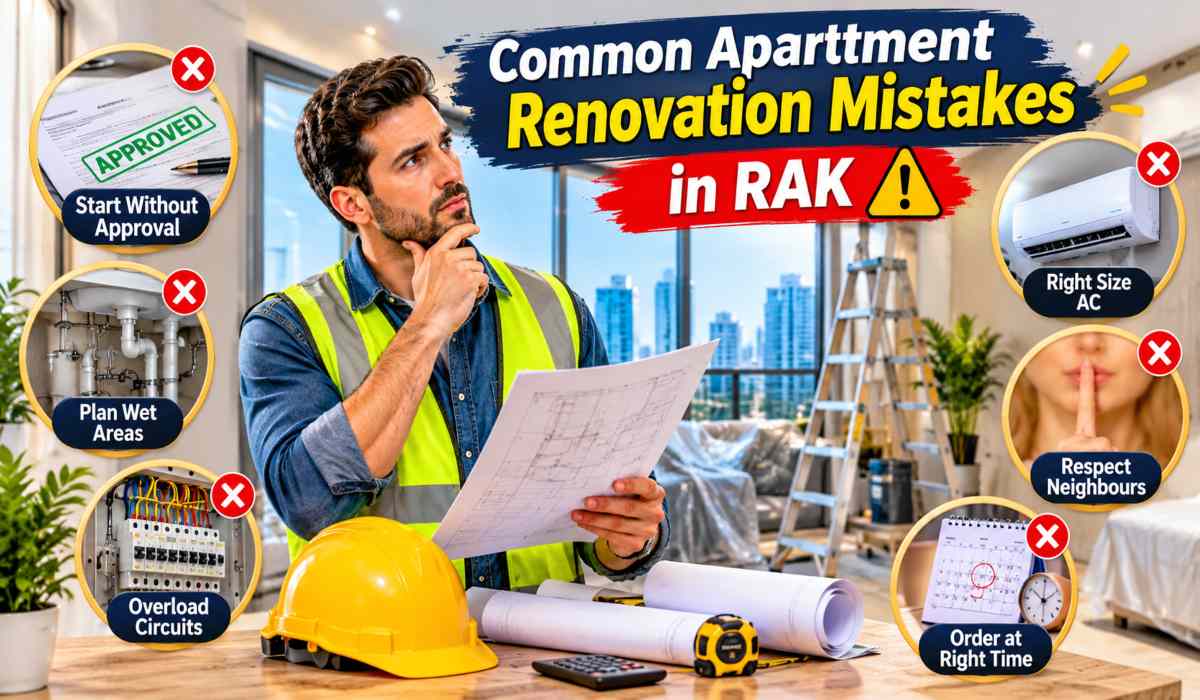
The most common apartment renovation mistakes are starting before approval, moving wet areas without a plan, overloading circuits, undersizing the AC, ignoring neighbours and working hours and ordering at the wrong time. Most come from treating an apartment like a standalone house when it shares a building with other people.
Starting before written approval
Starting before you hold written approval can lead the building to ask you to stop and to undo work it has not cleared. Wait for written permission for your full scope, keep copies and only then book trades and strip out.
Moving wet areas without a plan
Moving a kitchen or bathroom changes drainage routes, floor falls and waterproofing and a mistake can reach the unit below. Agree the new drainage route with a plumber and building management before the design is fixed or keep wet areas where they are.
Overloading circuits
New ovens, extra AC units and a bigger kitchen can overload circuits that were wired for a lighter use. Have an electrician calculate the new load and check the distribution board before you plan appliances, rather than after they arrive.
Undersized or mismatched AC
Opening up a layout, enclosing a balcony or changing windows alters how much cooling a room needs, so the old AC may no longer suit it. Have the capacity checked against the finished layout instead of assuming the existing units will cope.
Ignoring neighbours and noise hours
Noisy work outside permitted hours is a quick way to cause complaints and delays. Ask for the building’s rules in writing, tell neighbours the dates and do the loudest tasks, such as breaking out, early in the programme.
Ordering too late or too early
Ordering late holds up the programme, while ordering before approval risks buying items you cannot use. Order made to order items as soon as the specification and approvals are settled and confirm lift bookings for each delivery.
Final Thought
A renovated apartment stays in good shape with a few simple habits, keep a record of what was installed, check for leaks and service the AC on a regular schedule. Store the warranties, product details and a note of where pipes and cables run, so any future repair uses matching parts and avoids drilling into hidden lines. Test leak sensors and check under sinks and around balcony drains from time to time, because a small leak can reach your neighbour as well as your own floors. The US Environmental Protection Agency advises drying wet areas within 48 hours to prevent it from mould growth, so wipe up spills and check wet rooms regularly. If you would rather not track all this yourself, Annual Maintenance Contracts can schedule inspections and servicing for you.
Frequently Asked Questions (FAQs)
What is apartment renovation?
Apartment renovation is the process of upgrading, repairing or reshaping the inside of an apartment, from a light refresh to a full rebuild of the layout and hidden systems. It goes beyond routine upkeep and because the unit sits inside a shared building, most projects also involve building management approval.
Do I need permission to renovate my apartment in RAK?
In most cases, yes. Apartments in Ras Al Khaimah usually need written permission from building management or the developer and work that moves walls, changes wet areas or raises the electrical load can also need a municipality permit or an EtihadWE request. Surface only work usually needs less, so confirm your scope with RAK Municipality and your building management first.
How long does an apartment renovation take?
A full apartment renovation typically takes an estimated 8–14 weeks. The time depends on size, finish level and how long approvals take and building rules such as working hours and lift bookings can stretch it. Partial renovations are shorter. A written programme from your contractor is the most reliable timeline for your own apartment.
Can I change the layout or remove a wall?
You can often change the layout, but any wall change usually needs approval first. Non structural partitions can sometimes be moved or removed with permission, while structural walls, risers and the façade belong to the building and should not be altered without an engineer’s advice and written consent. Confirm with building management and RAK Municipality before you plan around a wall.
What should I check first in an old apartment?
Check the hidden systems first, wiring and the distribution board, pipework and drains, AC performance and drain lines, balcony and wet area waterproofing and window seals. Fix what fails before any new finish goes on, because tiles and paint over a faulty system only hide the problem. Keep dated photos and written reports in case building management asks for them.
Can I live there during work?
You can stay during a partial renovation if one bathroom, a working kitchen and cooling remain available, but a full renovation is easier and faster if you move out. Apartments are small, so dust and noise reach every room and shared walls affect neighbours. In RAK’s summer heat, avoid staying through any stage that takes the AC offline.