How Much Does a House Renovation Cost in Ras Al Khaimah?

How much does house renovation cost in Ras Al Khaimah? House renovation cost in Ras Al Khaimah is estimated at AED 50–135 per sq ft for a light refresh, AED 120–315 for a mid range job and AED 280–540+ for a premium renovation. A 2 bedroom apartment typically costs an estimated AED 60,000–648,000 in total and older homes add roughly 15–30%.
House renovation cost range is wide because no two houses cost the same to renovate. A repaint and new fixtures sit at one end, while stripping a villa back to its shell and rebuilding it sits at the other. Kitchens and bathrooms usually take the biggest share and the hidden work behind the walls (AC, electrical and plumbing) typically adds an estimated 20–30% of the total budget. Property age, material choices and location also move the price and in coastal Ras Al Khaimah, humidity and salt air often push owners towards more durable materials.
This guide breaks the numbers down so you can plan with confidence. You will find estimated costs per sq ft by property type and room, plus what drives them up or down and how to build a realistic budget. If you are planning a full home renovation and want a site specific quote, a visit will always be more accurate than any published range. All figures here are estimated planning ranges, not fixed prices.
What counts as a house renovation
A house renovation is any project that upgrades or changes the condition, layout or finish of a home, going beyond fixing something that has broken. Cosmetic updates, new kitchens and bathrooms, rewiring and full strip outs all count. A one off repair, such as replacing a tap, does not. The distinction matters for budgeting, because renovation costs scale with scope, while repairs are priced as single jobs.
Renovation vs refurbishment vs remodel vs repair
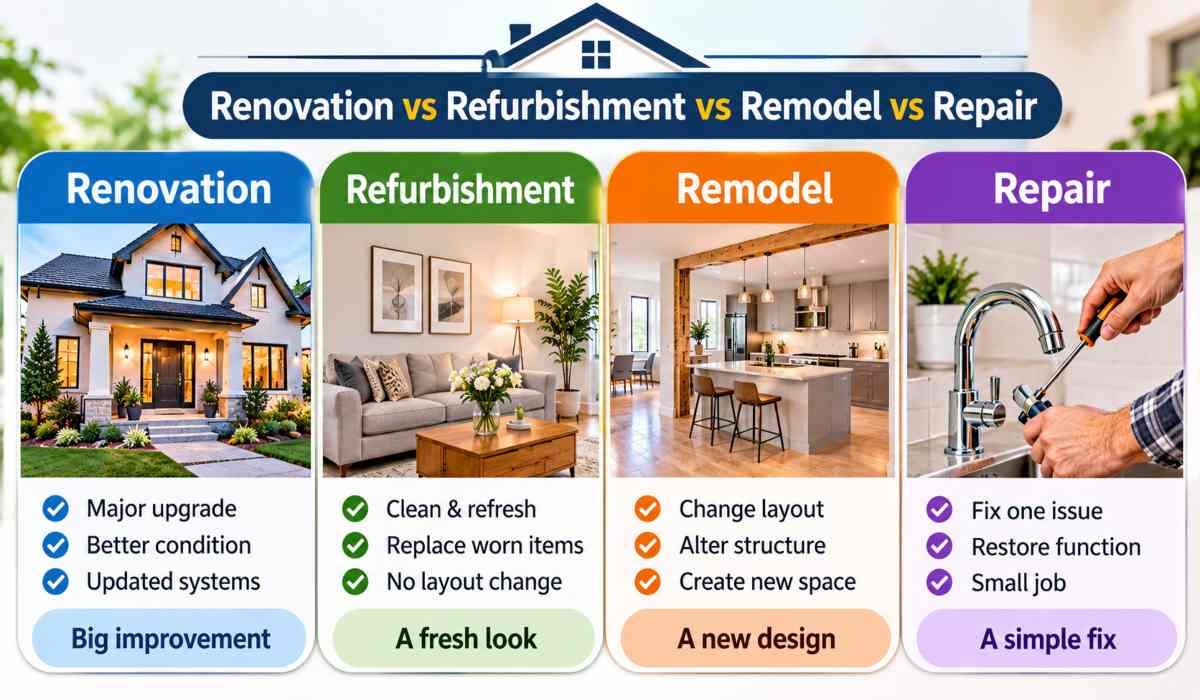
Renovation, refurbishment, remodel and repair describe different levels of work, even though people often use them interchangeably.
- Renovation is the broadest term. It means bringing a tired or outdated home back to a better condition, often with updated finishes and systems.
- Refurbishment is the term UK English speakers favour. It usually means cleaning up, redecorating and replacing worn items without changing the layout.
- Remodel means changing the structure or layout, such as removing a wall to open up a kitchen.
- Repair means fixing one specific fault and returning it to working order. It is priced per job, not as part of a project budget.
Light refresh, mid range and full renovation (the three tiers every price below uses)
Every cost in this guide falls into one of three tiers. Each tier describes how much of the home you change and how high you set the finish level.
| Tier | What it typically covers | Estimated AED per sq ft |
| Light refresh | Paint, fixtures, lighting and minor repairs | 50–135 |
| Mid-range | New kitchen, bathrooms and flooring, with some AC, electrical or plumbing changes | 120–315 |
| Premium | Full strip-out, layout changes and high-end finishes | 280–540+ |
A light refresh keeps the layout and the main systems as they are. Walls, fixtures and lighting change and the budget stays modest. A mid range renovation replaces the rooms that work hardest, which are the kitchen and the bathrooms and often the floors, with moderate upgrades to the AC, electrical and plumbing behind them. A premium renovation strips the property back, changes the layout and uses higher end materials throughout.
These rates are estimated planning ranges based on published UAE market guidance and adjusted for Ras Al Khaimah, not fixed prices. Your quote will depend on the size of the home, the materials you choose and its condition. As a rough guide, the hidden systems behind the walls (AC, electrical and plumbing) typically take an estimated 20–30% of a mid range or premium budget. That is why a full renovation can cost far more than finishes alone suggest.
Villa, townhouse and apartment how scope differs
The type of home you own changes what a renovation involves, so the same tier costs different amounts per square foot across villas, townhouses and apartments.
Apartments are usually smaller and share structure, risers and external walls with neighbours. The work stays inside the unit, but you will need building management approval for most changes and noisy work is often restricted to set hours. Apartment budgets run lower per square foot and estimated tier rates tend to sit at the lower end of the ranges above.
Townhouses sit in between. They offer more floor area and sometimes a small garden or roof terrace. They also share party walls, which limits structural changes and may require community or developer approval.
Villas give the most freedom and carry the widest range of costs. They have larger floor areas, more bathrooms, outdoor space and a roof to maintain. Estimated villa tier rates run higher per square foot, at roughly AED 80–180 for a light refresh, AED 160–360 for mid range and AED 320–630+ for premium. Villas also bring extra items that apartments lack, such as boundary walls, external waterproofing and landscaping. In coastal areas such as Ras Al Khaimah, humidity and salt air also make it worth budgeting for more durable materials.
How much does it cost to renovate a house in Ras Al Khaimah?
Renovating a house in Ras Al Khaimah costs an estimated AED 50–135 per sq ft for a light refresh, AED 120–315 for a mid range job and AED 280–540+ for a premium renovation. Most owners land in the mid range tier, which for a 2 bedroom apartment means an estimated AED 144,000–378,000 in total.
Estimated cost per sq ft and per sqm
Renovation is priced by floor area and by tier and the tier matters more than the size. Each rate below is an estimated planning range, not a fixed price.
| Tier | What it covers | Estimated AED per sq ft | Estimated AED per sqm |
| Light refresh | Paint, fixtures, minor repairs | 50–135 | 520–1,450 |
| Mid-range | Kitchen, bathrooms, flooring, some MEP | 120–315 | 1,300–3,400 |
| Premium | Strip-out, layout changes, premium finishes | 280–540+ | 3,050–5,850+ |
Planning ranges based on published UAE market guidance, adjusted for Ras Al Khaimah. Your quote will vary.
To convert between the two columns, remember that one square metre is about 10.76 square feet. Multiply your built up area by the rate for your tier for a first estimate, then add a contingency of about 10–15% for surprises. The spread between tiers is large because published Dubai planning guides themselves range from about AED 60 per sq ft for limited cosmetic work to AED 500 or more per sq ft for extensive premium renovations. That is nearly a ninefold gap, so choosing your tier honestly is the most important step in any budget.
Total cost for a full house renovation
A full house renovation in Ras Al Khaimah has an estimated total of AED 60,000–648,000 for a 2 bedroom apartment and AED 280,000–2,205,000+ for a 3,500 sq ft villa, depending on tier. These totals come from multiplying the per sq ft rates by typical floor areas, so they work as planning figures rather than quotes.
For a 2 bedroom apartment of about 1,200 sq ft, the estimated mid range total is AED 144,000–378,000. For a villa of about 3,500 sq ft, the estimated mid range total is AED 560,000–1,260,000. Villas cost more per sq ft than apartments because they have more bathrooms, outdoor areas and a roof and because the work usually spans more floors and systems.
A “full” renovation is not always a premium one. A mid range project can cover every room in the house and still cost far less than a premium project on one floor. What you pay depends on the tier you choose for each space, not simply on how many rooms you touch.
Why quotes for the same house can differ by 30% or more
Two contractors can quote the same house and land more than 30% apart, because quotes rest on assumptions that are not always written down. The gap usually comes from a handful of differences in what each quote includes.
Specification is the biggest factor. A quote that prices imported stone and branded fittings will sit well above one that assumes locally available porcelain and standard fixtures, even if the plans are identical. Scope is the second factor. One quote may include strip out, waste removal, approvals and snagging, while another leaves them out and adds them later as variations. Contractors also price risk differently. Older homes hide faulty wiring, ageing pipework and damp and a careful contractor allows for these in the price, while a low quote may not.
Timing, labour rates and project management fees add the remaining difference. When you compare quotes, ask each contractor to price the same written specification and check which items are listed as provisional sums or exclusions. A lower total is only cheaper if it covers the same work.
How RAK costs compare with Dubai and other emirates
Dubai is usually the highest and northern emirates such as RAK are often 10–20% lower for similar specifications (estimate, confirm with a site quote).
In practice, a mid range renovation estimated at AED 150–350 per sq ft in Dubai could fall at an estimated AED 120–315 per sq ft in Ras Al Khaimah, which is the baseline used throughout this guide. The saving comes mainly from labour rates and project overheads, not from materials, because most suppliers serve the whole UAE. Abu Dhabi often sits close to Dubai for comparable work, while Sharjah and the northern emirates fall lower.
Use these gaps as a rough guide only. A villa in a premium Ras Al Khaimah development with imported finishes, bespoke joinery or a resort community specification can still cost more than a modest apartment in Dubai. The specification and the condition of the property matter more than the emirate, so always confirm your budget with a site visit before committing.
Climate and local factors that shape RAK renovation costs
Renovation in Ras Al Khaimah (RAK) is shaped by its coastal climate, which changes which materials last and where money is best spent. Humidity and salt air wear down metal, joinery and waterproofing faster near the sea and RAK costs are often an estimated 10–20% lower than Dubai for similar specifications. Choosing climate suited materials at the start usually costs less than replacing failed ones within a few years.

Coastal humidity and salt air materials that last
Humidity and salt are the two forces that shorten the life of a finish in RAK, especially within a short distance of the coast. Moisture swells untreated wood and loosens paint, while salt in the air corrodes exposed metal and speeds up wear on seals and fixings.
Materials that cope well include porcelain tiles in wet areas, moisture resistant boards and sealed or engineered wood in place of untreated solid timber, marine grade or powder coated metalwork and stainless steel or other corrosion resistant fittings. Good waterproofing membranes behind tiles and on roofs and balconies matter more here than in a dry inland home. Ventilation helps too, because extractor fans and a properly sized AC system keep indoor moisture from settling into walls and joinery. As a planning allowance, choosing corrosion resistant fittings and moisture resistant materials may add an estimated 3–8% to a mid range finish budget, but it typically reduces repair costs later.
Common issues in RAK villas and apartments
Homes in coastal communities such as Al Marjan Island, Al Hamra and Mina Al Arab and in established neighbourhoods such as Al Riffa, tend to show the same handful of problems and they are worth checking before you set a budget. These are patterns that coastal owners commonly report, not findings about any particular building.
- Damp and mould in bathrooms, wardrobes and corners with poor airflow, particularly in rooms that are closed up while the owner is away.
- Corroded metalwork, including balcony railings, window frames, door hardware and outdoor light fittings.
- Worn waterproofing on balconies, terraces and roofs, which allows water into ceilings below.
- Swollen or warped joinery, such as doors, skirting and kitchen units, where moisture has entered the wood.
- Overworked AC systems in homes with thin insulation or ageing glazing, which struggle through the long summer.
Apartments in managed developments add a further step, because many changes need building management or developer approval before work begins. Villas have fewer shared rules but more exposed surfaces, including roofs, boundary walls and gardens.
Utilities in RAK EtihadWE, not DEWA
In Ras Al Khaimah, electricity and water are supplied by Etihad Water and Electricity (EtihadWE), not by DEWA, which serves Dubai. The difference matters for renovation because connections, load changes and any meter or supply request go through the provider that serves your property.
If your project adds major electrical load, such as extra AC units, an induction kitchen or an EV charger, check the process and any requirements with EtihadWE and your building or community management before work starts. Ask your contractor to confirm who submits each request and how long approval is expected to take. Do not copy Dubai guidance on utilities into a RAK budget without checking, because the processes and documents can differ.
What drives renovation cost
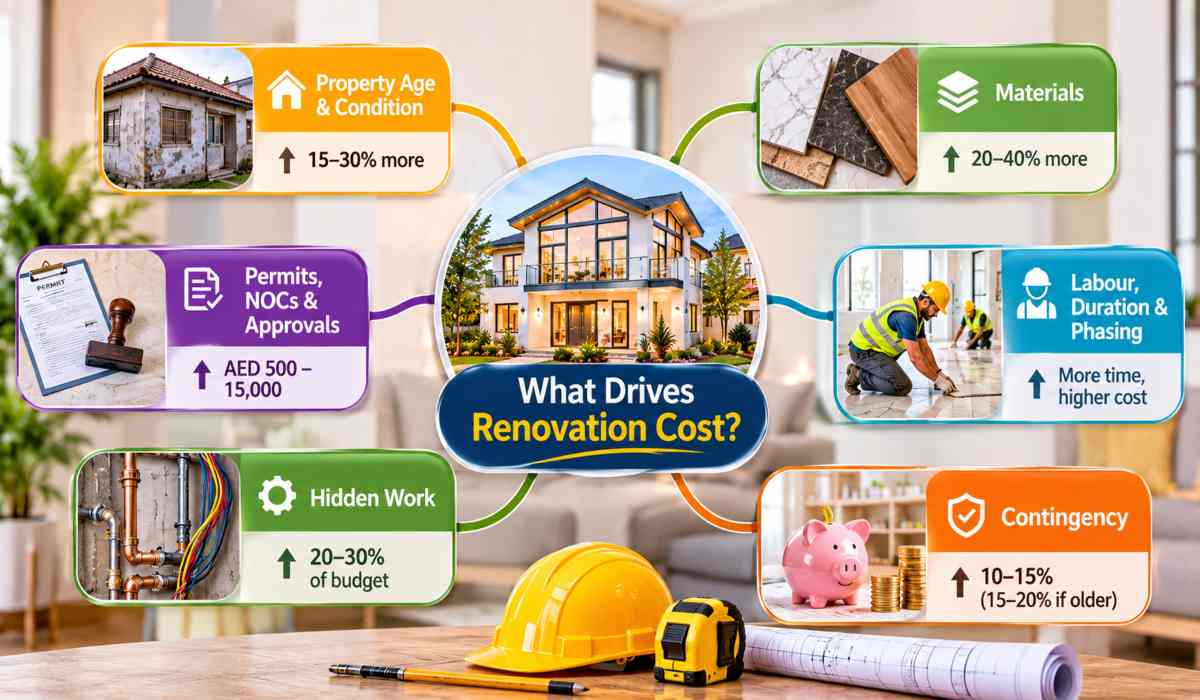
Six factors drive most of the difference in renovation cost, the age and condition of the property, the materials you choose, how long and how complex the labour is, the approvals you need, the hidden work behind the walls and the contingency you hold back. The first and last matter most. An older home with concealed faults can cost an estimated 15–30% more than a newer one with the same finishes.
Property age and condition
An older or poorly maintained property usually costs more to renovate because the work starts with fixing what time has damaged. Ageing wiring, worn pipework, damp walls and failing waterproofing all need attention before new finishes go on top. A villa that has been lived in for twenty years rarely behaves like a handover condition apartment, even when the finished result looks the same.
As a planning guide, an older home adds an estimated 15–30% to the mid range figures. The uplift comes from extra preparation, not from the finishes. A newer property in good order lets most of the budget go on visible upgrades. An older one sends part of it into the walls, floors and roof first.
Materials imported vs locally available
Material choice sets the finish level and finish level is the quickest way to move a budget up or down. Locally stocked porcelain, standard fittings and off the shelf joinery are generally cheaper and arrive faster. Imported stone, designer fixtures and made to order cabinetry cost more and often add weeks of lead time.
Lead time affects cost as well as price. A delayed delivery can hold up the trades that follow it, which stretches the project and its labour bill. Where a premium look matters, many owners splurge on one visible feature, such as a kitchen worktop or a feature wall and use locally available materials elsewhere. As a rough guide, switching a whole home from locally stocked to imported finishes can move the budget by an estimated 20–40%.
Labour, duration and phasing
Labour is a major share of any renovation and it grows with project length and complexity. A project that runs for months carries more supervision, site management and running costs than one finished in weeks. Complex layouts, tight access and work in occupied homes all slow progress.
Phasing can spread the cost but rarely lowers it. Renovating one floor or one set of rooms at a time eases the cash flow and lets you live in the home meanwhile. It can also mean repeated mobilisation and repeated site cleaning, which adds to the total. Doing everything in one continuous phase is usually cheaper per square foot, provided you can move out or accept the disruption.
Permits, NOCs and developer or building management approvals
Approvals add both cost and time and they depend on what you are changing. Cosmetic work often needs only a simple notice. Modifying walls, adjusting plumbing, changing electrical systems or changing the exterior usually requires formal permission and apartments and gated communities often need a no objection certificate (NOC) from the developer or building management first.
Published Dubai guides quote permit costs from about AED 500 to AED 15,000, depending on the type of work (estimated range). Fees, rules and required documents differ between emirates and communities. In Ras Al Khaimah, confirm the current requirements with the relevant Ras Al Khaimah authority and your building or community management before work begins and ask your contractor to state who handles each approval.
Hidden structural, plumbing and electrical work
The work you cannot see is often the most expensive part of the project. AC, electrical and plumbing systems typically take an estimated 20–30% of a mid range or premium budget and they are the items most likely to change once walls are opened.
Common surprises include undersized electrical boards, old or corroded pipes, uneven floors, hidden moisture and structural cracks. None of these shows up in a visual inspection. A pre project survey reduces the risk but cannot remove it. This is why quotes for the same house can differ and why a fixed price that excludes hidden work is not truly fixed.
Contingency set aside 10–15% and 15–20% for older homes
A contingency is a reserve held back for costs you cannot predict and it is a normal part of any sound renovation budget. For a typical home, set aside an estimated 10–15% of the total project cost. For an older home, where hidden faults are more likely, set aside an estimated 15–20%.
Treat the contingency as separate from the main budget and spend it only on genuine unknowns, not on upgrades. If it is not needed, it stays in your pocket. If it is used, you have avoided a stalled project. When comparing quotes, check whether a contractor has already built a contingency into the price, so you do not pay for the same protection twice.
Villa renovation cost vs apartment renovation cost
A villa renovation costs more than an apartment renovation in Ras Al Khaimah, both in total and per sq ft. An estimated mid range villa job runs AED 160–360 per sq ft, against AED 120–315 for an apartment. That makes a 3,500 sq ft villa an estimated AED 560,000–1,260,000 project, while a 2 bedroom apartment of about 1,200 sq ft is an estimated AED 144,000–378,000.
Apartment budgets by size
Apartment renovation budgets scale with floor area and tier and most of the spend goes on the kitchen and bathrooms, whether the flat sits on Al Marjan Island or elsewhere in the emirate. The totals below are estimated planning ranges, not quotes and they multiply the per sq ft rates for each tier by a typical built up area.
| Size | Light refresh | Mid-range | Premium |
| 1 bedroom (~700 sq ft) | 35,000–95,000 | 84,000–220,000 | 196,000–378,000+ |
| 2 bedroom (~1,200 sq ft) | 60,000–162,000 | 144,000–378,000 | 336,000–648,000+ |
| 3 bedroom (~1,800 sq ft) | 90,000–243,000 | 216,000–567,000 | 504,000–972,000+ |
All figures are estimated, in AED. Treat the tier as the main lever. A mid range 1 bedroom apartment and a light refresh 3 bedroom apartment can cost a similar amount, even though the second one has far more floor space. Remember to add an estimated 10–15% contingency on top of these totals and confirm building management approvals before work begins.
Villa budgets by size
Villa budgets are easiest to plan per sq ft of built up area, because villas vary far more in size than apartments do. The example total below uses a 3,500 sq ft villa, similar to many family villas in communities such as Al Hamra and shows how the estimated ranges stack up by tier.
| Tier | Estimated AED per sq ft | Example 3,500 sq ft villa (estimated, AED) |
| Light refresh | 80–180 | 280,000–630,000 |
| Mid-range | 160–360 | 560,000–1,260,000 |
| Premium | 320–630+ | 1,120,000–2,205,000+ |
All figures are estimated, in AED. To estimate your own villa, multiply your built up area by the rate for your tier. Then allow separately for external items that apartments do not have, such as boundary walls, roof waterproofing and landscaping, because these sit outside the built up area rate and can move the final figure noticeably. Older villas should carry a higher contingency, at an estimated 15–20%.
Which costs more per sq ft and why
Villas generally cost more per sq ft and published Dubai planning guides back this up. They put apartment renovation at roughly AED 50–200 per sq ft and villa renovation at roughly AED 150–600, which means the villa range starts where the apartment range is close to ending.
Several things push villa rates up. Villas have more bathrooms, longer pipe and cable runs, larger AC systems and often more than one floor, so the hidden work behind the walls is bigger. They also have roofs, external walls and outdoor areas that need their own upkeep and their wider choice of finishes tends to lift specifications.
Apartments have their own cost pressure, though. Kitchens and bathrooms take up a large share of a small floor area and these are the most expensive rooms to renovate. That is why a compact apartment can cost more per sq ft than the figures suggest, while a large apartment with few wet areas costs less. Building rules add a second effect, because limited working hours and approval requirements can slow work and add to labour time.
In short, a villa costs more in total and usually more per sq ft because there is more to build and maintain. An apartment costs less overall but can be expensive per sq ft when wet rooms dominate the plan. Confirm any budget against a site visit before committing.
Room by room renovation cost
Renovation costs vary most by room and the kitchen and bathrooms are the most expensive spaces. An estimated AED 20,000–250,000+ covers a kitchen, AED 10,000–150,000+ covers a bathroom and living areas and bedrooms usually fall between an estimated AED 5,000 and AED 105,000, depending on size and finish. Kitchens and bathrooms together typically take an estimated 25–45% of a mid range whole house budget, because they combine joinery, plumbing, tiling and fixtures in a small area.
Kitchen
A kitchen renovation costs an estimated AED 20,000–50,000 for a basic update, AED 50,000–120,000 for a mid range upgrade and AED 120,000–250,000+ for a luxury finish. The basic tier usually means new doors, worktops and fittings on the existing layout. The mid range tier replaces cabinets, surfaces and appliances and the luxury tier changes the layout and uses premium materials.
Cabinetry is the biggest variable. Bespoke cabinets are estimated from about AED 2,200 per linear metre upwards, so a long kitchen run can move the budget quickly. Choosing standard cabinet sizes, keeping the plumbing and gas points where they are and spending on the worktop and hardware you touch every day usually gives the best value. If you are planning bespoke units, ask a joinery specialist to advise on the options before you set a budget.
Bathroom
A bathroom renovation costs an estimated AED 10,000–30,000 for a small bathroom, AED 30,000–70,000 for a standard one and AED 70,000–150,000+ for a high end finish. Size matters, but the finish level matters more. A small guest bathroom with standard tiles and fittings sits at the bottom of the range, while a large master bathroom with a freestanding bath and natural stone sits at the top.
The fixtures sit inside those totals, not on top of them. They include the vanity, bathtub, shower, toilet and faucets and their style and brand set much of the final figure. Waterproofing, tiling and plumbing connections take a large share of the rest and they are the parts that cannot be skimped on.
You will often see the term “bathroom fit out cost”. In plain English, a fit out means supplying and installing everything inside the room, from waterproofing and tiles to sanitaryware, plumbing, lighting and the vanity. The fit out cost is therefore close to the full renovation cost, not just the price of the fittings. When you compare quotes, check whether each one includes the strip out and the waterproofing.
Living room
A living room costs an estimated AED 18,000–45,000 for a refresh and AED 45,000–105,000 for a mid range renovation. A refresh covers paint, lighting and minor finishes. A mid range job adds new flooring, feature walls, ceiling work and better lighting. These figures assume a room of about 300 sq ft, so a larger open plan space will cost proportionally more.
Foyer
A foyer costs an estimated AED 5,000–12,000 for a refresh and AED 8,000–28,000 for a mid range upgrade. The space is small, but it is the first thing visitors see, so owners often spend a little more per square foot on flooring, lighting and a console or storage unit. These figures assume an entrance area of about 80 sq ft.
Bedrooms and guest room
A bedroom or guest room costs an estimated AED 10,000–27,000 for a refresh and AED 30,000–65,000 for a mid range renovation. The higher range typically adds built in wardrobes, new flooring and ceiling lighting. The figures assume a room of about 180 sq ft, so a master bedroom with a dressing area will land higher. A guest room is usually the cheapest place to save, because it sees the least daily use.
Home office
A home office costs an estimated AED 7,000–18,000 for a refresh and AED 18,000–42,000 for a mid range renovation. The budget goes on lighting, built in shelving or desks, cable management and noise reduction. These figures assume a room of about 120 sq ft.
The living room, foyer, bedroom and home office figures are derived from per sq ft rates and typical room sizes, so they are less precise than the kitchen and bathroom ranges. Unlike the tier rates earlier in this guide, these room ranges are not adjusted for Ras Al Khaimah, because fixtures and materials cost about the same across the country.
How to estimate your own room
To estimate any room, multiply its floor area in sq ft by the tier rate, then add a contingency. The estimated tier rates are AED 50–135 per sq ft for a light refresh, AED 120–315 for mid range and AED 280–540+ for premium.
For example, a 200 sq ft bedroom at the mid range tier works out at an estimated AED 24,000–63,000 before contingency. Add an estimated 10–15% on top for surprises or 15–20% for an older home. This method works well for dry rooms such as bedrooms, offices and living areas. Kitchens and bathrooms are better priced from the ranges above, because their cost depends more on fixtures and plumbing than on floor area.
Where the money goes cost by element
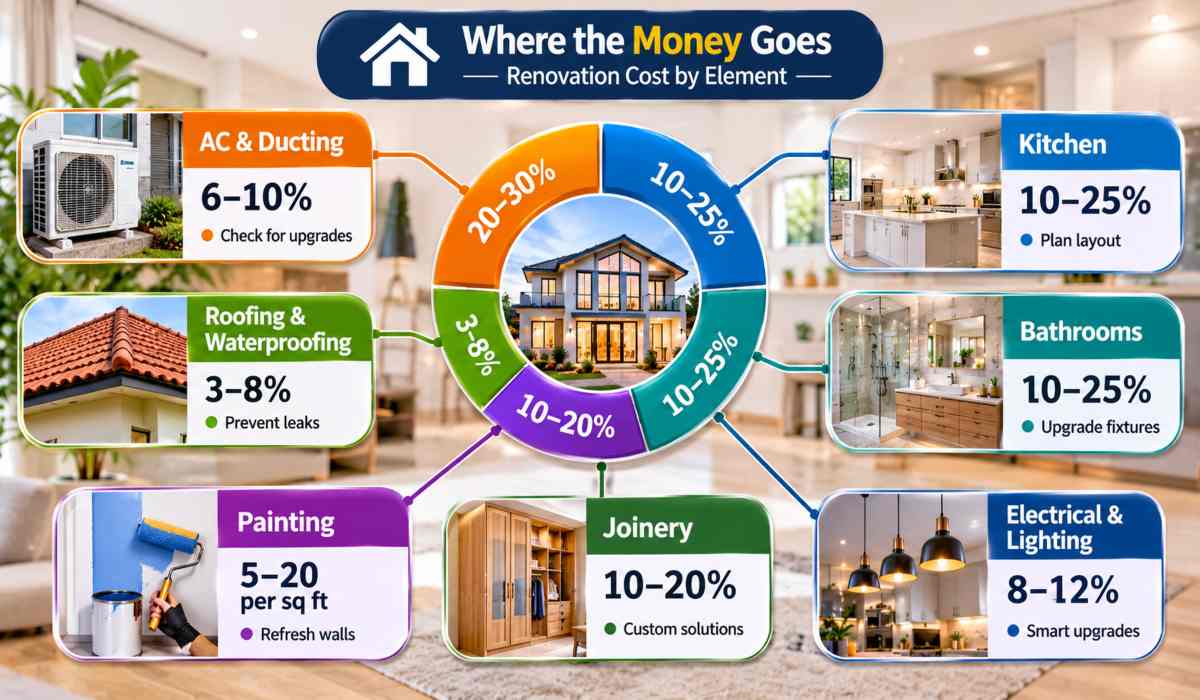
Most of a renovation budget goes to four things, the kitchen, the bathrooms, flooring and joinery, which each take an estimated 10–25% of the total. The hidden systems behind the walls (AC, electrical and plumbing) add an estimated 20–30% combined. The figures below are estimated budget shares and material rates for planning, not prices for individual jobs.
Flooring and tiling
Flooring and tiling take an estimated 10–20% of a typical budget and the material you choose sets most of the cost. Estimated installed rates are AED 100–250 per sqm for ceramic or porcelain, AED 150–350 per sqm for wood and AED 300–700+ per sqm for marble or natural stone. For the tiles alone, UAE tile guides put porcelain at roughly AED 70–180 per sqm before installation (estimated).
Large format porcelain is a popular middle route in Ras Al Khaimah because it handles heat and foot traffic well. Natural stone looks richer but needs sealing and more care. For help matching a floor type to your property, the team behind these flooring and roof services can advise on suitability.
Electrical, lighting and smart home wiring
Electrical work, including lighting, typically takes an estimated 8–12% of the budget. Smart home wiring adds roughly an estimated AED 10–30 per sq ft on top of standard wiring, depending on how many rooms and controls you connect.
Older homes often need extra capacity, such as a larger distribution board or new circuits, before new kitchens and AC units can run safely. It is cheaper to plan wiring and lighting positions before the walls are closed than to change them afterwards. Owners who want the layout reviewed first can speak to a specialist in electrical services.
Plumbing
Plumbing typically takes an estimated 6–10% of the budget. Most of that goes into the bathrooms and the kitchen, where supply lines, drains and waterproofing are renewed together. Old or corroded pipework is the most common reason the share rises, so it is worth checking the condition before you settle on a figure and a plumbing specialist can inspect ageing pipework before the walls are closed.
AC and ducting
AC and ducting typically take an estimated 6–10% of the budget. The share rises when a layout change means moving ducts or adding capacity and it falls when the existing system is kept. A renovation is a good moment to check that the system still suits the new layout, particularly after you open up rooms. For advice on upgrades and replacements, see these AC repairs and installation services.
Roofing and waterproofing
Roofing and waterproofing typically take an estimated 3–8% of a villa budget. The range is wide because roofs vary so much in size, age and condition, so get a roof inspection before fixing a figure.
This category is easy to underbudget because the work is invisible once finished. Failing waterproofing can damage new interior finishes within a season or two, which makes it poor value to skip.
Painting
Painting is priced by wall area. Standard paint costs an estimated AED 5–20 per sq ft of wall and premium finishes cost an estimated AED 30–80. Painting is one of the cheapest ways to change how a home feels, which is why it dominates light refresh budgets. Preparation matters as much as the paint, so budget for patching and priming on older walls.
Joinery
Custom wardrobes cost an estimated AED 1,200–3,500 per linear metre, depending on materials, internal fittings and finish. Joinery typically takes an estimated 10–20% of the budget and kitchens and wardrobes account for most of it.
In humid coastal homes, solid wood and poorly sealed boards can swell, so material choice affects how well joinery lasts. If a piece of existing joinery is simply tired, repairing it can be far cheaper than replacing it. A warped wooden door can often be corrected and a guide to kitchen cabinet repair can show when cabinets are worth keeping. For new built in work, explore carpentry works.
Typical budget split
The table below shows the estimated share of a typical mid range renovation budget that each element takes.
| Element | Share of total budget (estimated) |
| Kitchen | 15–25% |
| Bathrooms | 10–20% |
| Flooring and tiling | 10–20% |
| Joinery | 10–20% |
| MEP (AC, electrical, plumbing) | 20–30% combined |
| Painting and finishes | 5–10% |
| Roofing and waterproofing | 3–8% |
These shares are approximate and overlap, because kitchens and bathrooms contain flooring, plumbing and joinery. Use them to check that no single line is swallowing your budget, not as a quote for any one job.
Renovating an old house in Ras Al Khaimah
Renovating an old house in Ras Al Khaimah usually costs an estimated 15–30% more than the same mid range job in a newer home, because the first part of the budget goes on the ageing wiring, pipework and insulation behind the walls. Applied to the mid range rate, that is an estimated AED 140–410 per sq ft or about AED 166,000–491,000 for a 1,200 sq ft apartment and AED 644,000–1,638,000 for a 3,500 sq ft villa.
What is different in an older villa or apartment
An older villa or apartment hides most of its extra cost inside the walls, floors and roof. As a rough guide, homes that are 15–20 years old or more start to show the wear that newer ones do not.
Wiring is the first concern. Older electrical systems were designed for fewer appliances, so modern kitchens, multiple AC units and smart controls can overload them. Warning signs include frequent tripping, warm sockets and flickering lights. Pipework is the second. Older supply lines can corrode or scale up and drains may be slow or cracked, so leaks often appear once new tiles and fittings are installed. Insulation and glazing are the third. Older buildings often lose cool air through thin walls, single glazing and worn seals, which raises AC running costs and makes the cooling system work harder after you renovate.
In coastal areas such as Ras Al Khaimah, salt air and humidity add wear to metalwork, joinery and waterproofing. Doors and fittings are often the first to show it and a tired door hinge can sometimes be repaired more cheaply than replaced.
Budget uplift add roughly 15–30% to the mid range figures above
Budget an estimated 15–30% on top of the mid range figures for an older property. The uplift covers extra preparation, repair and compliance work that newer homes rarely need. It does not pay for better finishes.
| Property (mid-range) | Newer home (estimated, AED) | Older home with uplift (estimated, AED) |
| Per sq ft | 120–315 | 140–410 |
| 2 bedroom apartment (~1,200 sq ft) | 144,000–378,000 | 166,000–491,000 |
| Villa (~3,500 sq ft) | 560,000–1,260,000 | 644,000–1,638,000 |
All figures are estimated planning ranges, not quotes. Hold a separate contingency of an estimated 15–20% as well, because older homes are more likely to reveal faults once walls and floors are opened. The uplift is a planning allowance for known risks, while the contingency covers the unknown ones.
How to renovate an old house, step by step
Renovating an old house works best in a fixed order, because the hidden systems must be fixed before the visible finishes go on top.
- Survey first. Have the structure, wiring, pipework, roof and damp checked before you set a budget, so the uplift reflects real conditions.
- Confirm approvals. Check the current Ras Al Khaimah requirements and get any developer or building management no objection certificate before work starts.
- Strip out and open up. Remove worn finishes and expose the hidden systems so problems are visible rather than guessed.
- Repair the structure and waterproofing. Fix cracks, damp and roof or wet area waterproofing first, because new finishes will fail on a failing base.
- Renew the systems. Replace or upgrade the wiring, plumbing and AC before the walls are closed and have a specialist review the electrical load against your new layout.
- Finish and snag. Fit the floors, joinery and paint, then check every room for defects before final payment.
Skipping or reordering these steps is the most common way old house budgets overrun. Closing walls over unchecked pipes or wires is cheap on the day and expensive a year later.
Old house to new look house what is realistic
A well planned renovation can make an old house look and feel almost new, but it cannot change what the building is. New finishes, kitchens, bathrooms and lighting transform the interior and renewed wiring, pipework and waterproofing remove the reliability problems that come with age. What stays the same is the structure, the floor plan and the plot, unless you pay for structural changes.
For most owners, the realistic goal is a home that works like a newer one at a lower cost than rebuilding. Keep the layout where possible, because moving walls, wet rooms and AC runs pushes a project from mid range towards premium. Spend first on the hidden systems, then on the rooms you use most. A tight budget is better used renewing what is behind the walls than on finishes that will hide a failing system.
The renovation process and timeline
A typical Ras Al Khaimah renovation runs through four stages, planning and sign off, hidden works, finishing, then snagging and handover. The estimated time depends on scope, from 2–3 weeks for a bathroom to 4–8 months for a full villa. The stage that most often decides whether a project finishes on time is the first one, because changes after work starts cost both money and weeks.
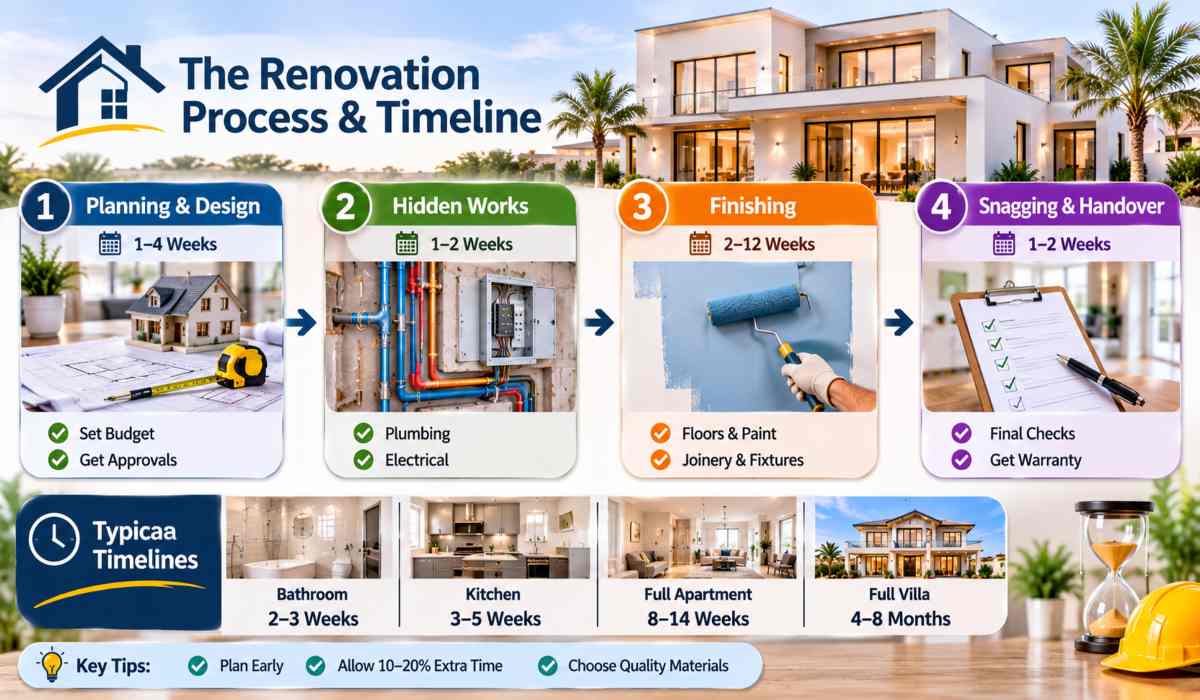
Planning, design and budget sign off
Planning sets the scope, the finish level and the budget before any work starts and it is where most delays are prevented. A sound plan fixes the layout, the specification of each room, the approvals needed and a written budget with a contingency. Approvals can take an estimated 1–4 weeks, depending on the building and the type of work, so apply early. Check the current Ras Al Khaimah requirements and obtain any developer or building management no objection certificate first.
Order long lead items such as imported stone, bespoke joinery and appliances during this stage, not after the build begins. A late delivery can stall the trades that follow it. Owners with several properties to coordinate may find it useful to compare options for residential and commercial services when planning the work.
Hidden works water and electrical first fix and the materials needed
First fix is the installation of everything that will end up behind walls, floors and ceilings and it must be finished and tested before any finish is applied. It covers the water supply and drainage lines, electrical conduits and cabling and any AC ducting or pipework. Once the walls are closed, these systems are expensive to reach again.
The materials depend on the system. Water lines typically use PPR, CPVC or copper pipe, with waterproofing membranes in wet areas such as bathrooms and balconies. Electrical work uses cable of the right rating, conduits, back boxes and a distribution board sized for the new load. Pressure test the plumbing and test the circuits before closing up. Many costly defects start here, which is why the hidden stage deserves more of your attention than its low visibility suggests.
Finishing, snagging and handover
Finishing is where the visible result appears, in the order of ceilings, wall finishes, floors, joinery, fixtures and final paint. Doing it in this sequence limits damage to completed work, such as scuffed floors or marked paintwork.
Snagging is the room by room check for defects such as uneven grout, chipped paint, doors that stick and fittings that do not work. Make a written list, agree a date for the fixes and keep a final payment back until they are complete. At handover, ask for the warranty details, the product and finish information for future maintenance and any approval or completion documents. A short walk through with the contractor before signing off is the best protection you have.
Typical timelines
Timelines vary with size, finish level and approval waiting times, so treat these as estimated planning ranges.
| Project | Typical duration (estimated) |
| Bathroom | 2–3 weeks |
| Kitchen | 3–5 weeks |
| Full apartment | 8–14 weeks |
| Full villa | 4–8 months |
Several things lengthen these ranges. Older properties, structural changes, imported materials and phased work in an occupied home all add time. A project that overruns also costs more, because labour and supervision run for longer. Ask any contractor for a written programme with milestones and build a margin of an estimated 10–20% of the duration into your own plans.
Budget smart renovation ideas by spend level
The best renovation idea depends on your budget. Under AED 50,000 (estimated), repainting, new lighting, updated fixtures and one small bathroom refresh give the biggest visible change. Between AED 50,000 and 150,000 (estimated), a kitchen update, new flooring or a standard bathroom renovation becomes realistic. Above AED 150,000 (estimated), layout changes and full finishes come into play. Kitchens and bathrooms together take an estimated 25–45% of a mid range whole house budget, so they are where spending changes the home most.
Under AED 50,000 paint, lighting, fixtures, one bathroom refresh
An estimated AED 50,000 or less is enough to refresh the rooms you see most, not to renovate a whole home. A full light refresh of a 1 bedroom apartment is estimated at AED 35,000–95,000, so this budget suits part of a small apartment or a few chosen rooms in a larger one.
The best value comes from changes that alter how the home looks and feels without touching the walls or the hidden systems. Repainting in lighter tones, swapping dated light fittings for modern LED ones, replacing door handles and switches and updating curtains or blinds all work well. If one bathroom is the weak point, a small bathroom refresh is estimated at AED 10,000–30,000, which fits inside this budget if you keep the layout and choose standard tiles and fittings. Hold back an estimated 10–15% for surprises.
AED 50,000–150,000 kitchen update, flooring, bathroom
An estimated AED 50,000–150,000 buys one or two major upgrades, but rarely all three. A mid range kitchen is estimated at AED 50,000–120,000, a standard bathroom at AED 30,000–70,000 and new flooring depends on the area and the material.
A sensible approach is to pick the two upgrades that cause the most daily frustration and finish them well, rather than spreading the money thinly across everything. A tired kitchen and a leaking bathroom usually come first. If the floors are in decent shape, a kitchen and bathroom pairing will often use most of this budget. If the floors are worn throughout, new porcelain or engineered wood can lift the whole home at once and is often worth more than a cosmetic kitchen refresh.
AED 150,000+ layout changes and full finishes
Above an estimated AED 150,000, you can start changing how the home works, not only how it looks. A mid range renovation of a 2 bedroom apartment is estimated at AED 144,000–378,000 and a premium one at AED 336,000–648,000+.
At this level, the typical moves include opening up the kitchen to the living area, adding or relocating bathrooms, replacing ceilings, upgrading the wiring and AC for a new layout and finishing every room to a consistent standard. Layout changes raise costs quickly, because moving walls, wet areas and AC runs adds hidden work, approvals and time. If budget is tight, keep the existing layout and spend on finishes. If the layout genuinely does not suit your family, changing it is the upgrade with the longest lasting benefit.
Villa renovation ideas that add the most value
For villas, the upgrades that add the most value tend to be the ones that make the house more comfortable and more durable, not just more fashionable. A mid range villa renovation is estimated at AED 160–360 per sq ft, so priorities matter.
- Kitchen and bathrooms. These are the rooms buyers and tenants judge first and they are where modern layouts and fittings are most noticeable.
- Roof, terrace and external waterproofing. Invisible when done well, but it protects everything else you spend on.
- AC efficiency and insulation. Better sealing and glazing lower running costs through the long summer.
- Built in storage. Wardrobes and utility storage make bedrooms feel larger and more finished.
- Outdoor living space. Shade, lighting and tidy landscaping extend usable space, particularly in the cooler months.
Avoid over specifying one room beyond the standard of the rest of the house. A luxury kitchen in an otherwise tired villa rarely earns back its cost.
Where to save and where not to cut
Save money on things that are easy to change later and protect the things that are expensive to repair. Cosmetic items fall into the first group and anything behind a wall or under a floor falls into the second.
It is usually safe to save on guest room finishes, standard size cabinets in place of bespoke units, locally stocked tiles in place of imported stone and decorative extras that can be added later. Keeping the existing layout is often the single largest saving.
Do not cut waterproofing, wiring, plumbing, AC sizing, ventilation, required approvals or your contingency. Failures in these areas show up months later and cost far more to fix than they saved. A reserve of an estimated 10–15% (15–20% for older homes) is the cheapest insurance in any renovation.
How to plan and control your renovation budget
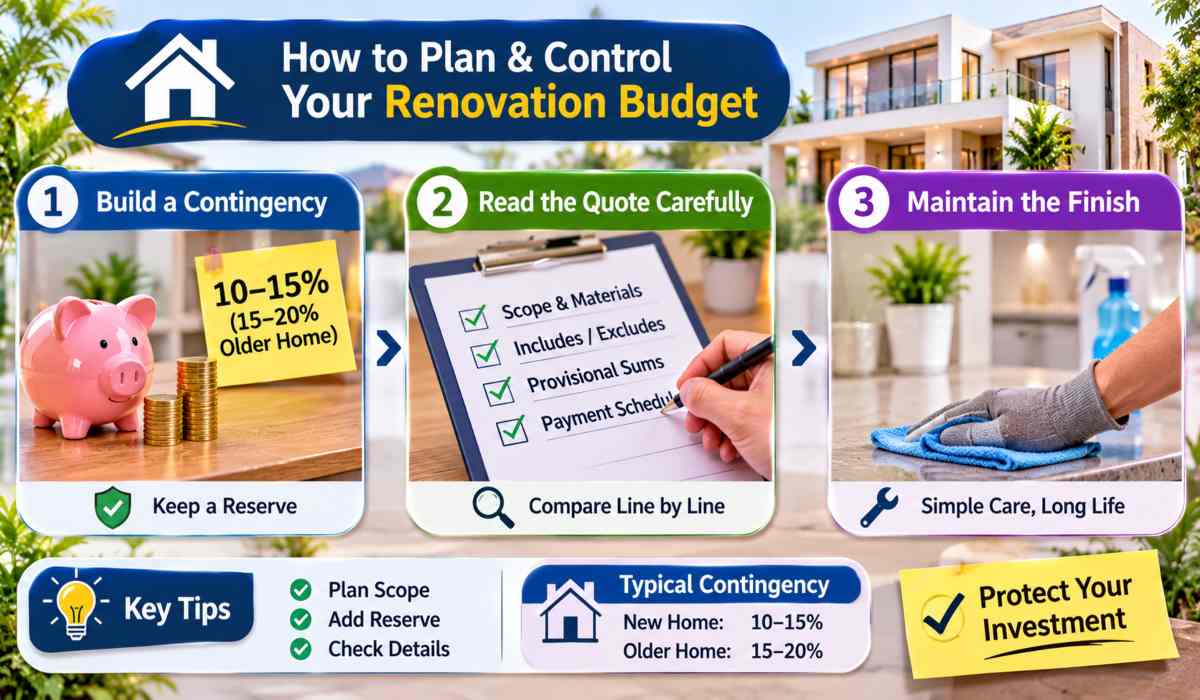
Plan a renovation budget by fixing the scope and finish level first, adding a contingency of an estimated 10–15% (15–20% for older homes) and comparing quotes on the same written specification. Then protect the finished work with routine upkeep. Most overruns trace back to three things, an unclear scope, a reserve that was too thin and a quote that left items out.
Building a contingency
A contingency is a reserve held back for costs you cannot predict and it belongs in every renovation budget. For a typical home, set aside an estimated 10–15% of the total project cost. For an older home, where hidden faults are more likely, set aside an estimated 15–20%.
On a mid range 2 bedroom apartment estimated at AED 144,000–378,000, that reserve is roughly an estimated AED 14,400–56,700 for a newer home and AED 21,600–75,600 for an older one. Keep the contingency separate from the main budget and spend it only on genuine unknowns, such as a corroded pipe found behind a wall, not on upgrades you decide you want halfway through. If it is not used, it stays with you. Also check whether a contractor has already built a reserve into the price, so you are not paying for the same protection twice.
Reading a quote line by line
A good quote lets you see exactly what you are paying for and a vague one hides the gaps. Ask every contractor to price the same written specification, then compare the quotes line by line instead of by total.
Check first that the scope is complete. The quote should name each room, the materials and finish level and whether it includes strip out, waste removal, approvals, protection of existing surfaces and snagging. Then look for provisional sums, which are placeholder amounts for work the contractor has not priced yet and for exclusions, which are items left out and added later as variations. A quote that looks 20–30% cheaper (estimated) is often cheaper because it leaves out items another quote includes. Finally, check the payment schedule. Payments should follow completed stages, with a final amount held back until snagging is finished and any change to the scope should be agreed in writing before the work happens.
Looking after the finished work
A renovation protects its value only if it is maintained, because climate, humidity and daily wear start acting on new finishes straight away. In coastal areas such as Ras Al Khaimah, salt air and moisture make this more important.
Simple habits go a long way. Service AC units on a regular schedule, ventilate wet rooms, reseal grout and silicone when they wear and check balconies, roofs and external joints for water entry after heavy rain. Small faults caught early are far cheaper than damage found a year later. Keep the handover documents, warranty details and product information for every fitting, so future repairs use matching materials. Owners who prefer not to track this themselves can arrange AMC services, an annual maintenance contract, to keep inspections and servicing on a regular schedule.
Conclusion
House renovation cost in Ras Al Khaimah depends mainly on the tier you choose, which is estimated at AED 50–135 per sq ft for a light refresh, AED 120–315 for mid range and AED 280–540+ for premium. Older homes add an estimated 15–30% and a contingency of an estimated 10–15% (15–20% for older homes) keeps surprises from stalling the project.
The best budgets start with scope, not finishes. Decide which rooms matter most, protect the hidden work behind the walls (waterproofing, wiring, plumbing and AC, which together take an estimated 20–30% of a mid range budget) and compare quotes on the same written specification. In Ras Al Khaimah, add climate suited materials to that plan and expect costs that are often an estimated 10–20% below Dubai for similar work (estimate, confirm with a site quote).
Every figure in this guide is an estimated planning range, not a quote, so the most reliable next step is a site visit. If you would like a quote based on your own property, Home Fix Building Maintenance can assess the space and give you a written scope and price.
Frequently Asked Questions (FAQs)
How much does it cost to renovate a 2 bedroom apartment in Ras Al Khaimah?
Renovating a 2 bedroom apartment of about 1,200 sq ft in Ras Al Khaimah costs an estimated AED 60,000–648,000+ in total, depending on the tier. A light refresh is estimated at AED 60,000–162,000, a mid range renovation at AED 144,000–378,000 and a premium renovation at AED 336,000–648,000+. The finish level and how many rooms you change matter more than the size of the flat.
What does it cost to renovate a villa in Ras Al Khaimah?
Mid range villa renovations in Ras Al Khaimah often run an estimated AED 160–360 per sq ft of built up area. For a 3,500 sq ft villa, that is an estimated AED 560,000–1,260,000. A light refresh is estimated at AED 80–180 per sq ft and a premium renovation at AED 320–630+. External items such as boundary walls, roof waterproofing and landscaping sit on top of these figures.
How much does a bathroom renovation cost in Ras Al Khaimah?
A bathroom renovation costs an estimated AED 10,000–150,000+, depending on size and finish. A small bathroom is estimated at AED 10,000–30,000, a standard one at AED 30,000–70,000 and a high end one at AED 70,000–150,000+. Fixtures such as the vanity, bathtub, shower, toilet and faucets sit inside these totals, along with waterproofing, tiling and plumbing connections.
Is renovation cheaper per sq ft than rebuilding?
Renovation is usually cheaper per sq ft than rebuilding, unless the renovation is a full premium strip out. A mid range villa renovation in Ras Al Khaimah is estimated at AED 160–360 per sq ft. Published Dubai guides, by comparison, put new villa construction at roughly AED 300–1,000 per sq ft depending on specification, before land and external works. The gap narrows when the existing structure is poor, so get a survey first.
How do I estimate my own renovation cost in Ras Al Khaimah?
To estimate your own renovation cost, multiply your floor area in sq ft by the rate for your tier, then add a contingency. The estimated rates are AED 50–135 per sq ft for a light refresh, AED 120–315 for mid range and AED 280–540+ for premium. Add an estimated 10–15% for surprises or 15–20% for older homes. Price kitchens and bathrooms from their own ranges, because fixtures drive them more than area does.
What hidden costs should I plan for?
Hidden costs usually come from what sits behind walls and outside the quote, ageing wiring and pipework, damp or failing waterproofing, uneven floors, approvals and no objection certificates, waste removal and protection of common areas. Older homes carry an estimated 15–30% uplift for this kind of work. Hold an estimated 10–15% contingency (15–20% for older homes) and ask contractors to list exclusions and provisional sums in writing.