
How to Choose and Fit Wooden Skirting in Ras Al Khaimah
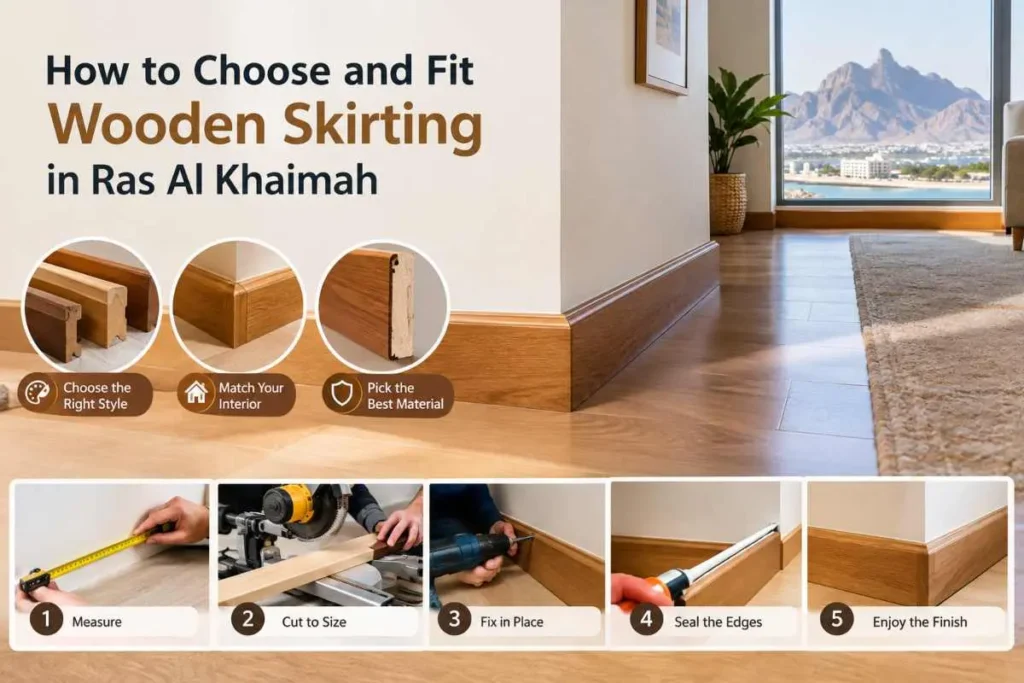
Wooden skirting in most of homes in Ras Al Khaimah suit between 100mm and 150mm high and 125mm is a popular choice for rooms with standard ceilings. Taller boards look grand in large villa rooms, while slimmer ones keep smaller rooms neat and balanced.
Size is only part of the decision. Wooden skirting protects the base of your walls from knocks, mops and vacuum cleaners and it hides the gap where the wall meets the floor. It also has to cope with local conditions. Average humidity in Ras Al Khaimah is reported to swing from about 46% in May to 65% in January and damp coastal air can make poor quality boards swell, warp or peel over time.
This guide explains the sizes, types, fitting methods and AED prices, so you can choose the right skirting for your home. If you want it fitted neatly, Home Fix handles skirting as part of our carpentry works across Ras Al Khaimah.
What Is Wooden Skirting?
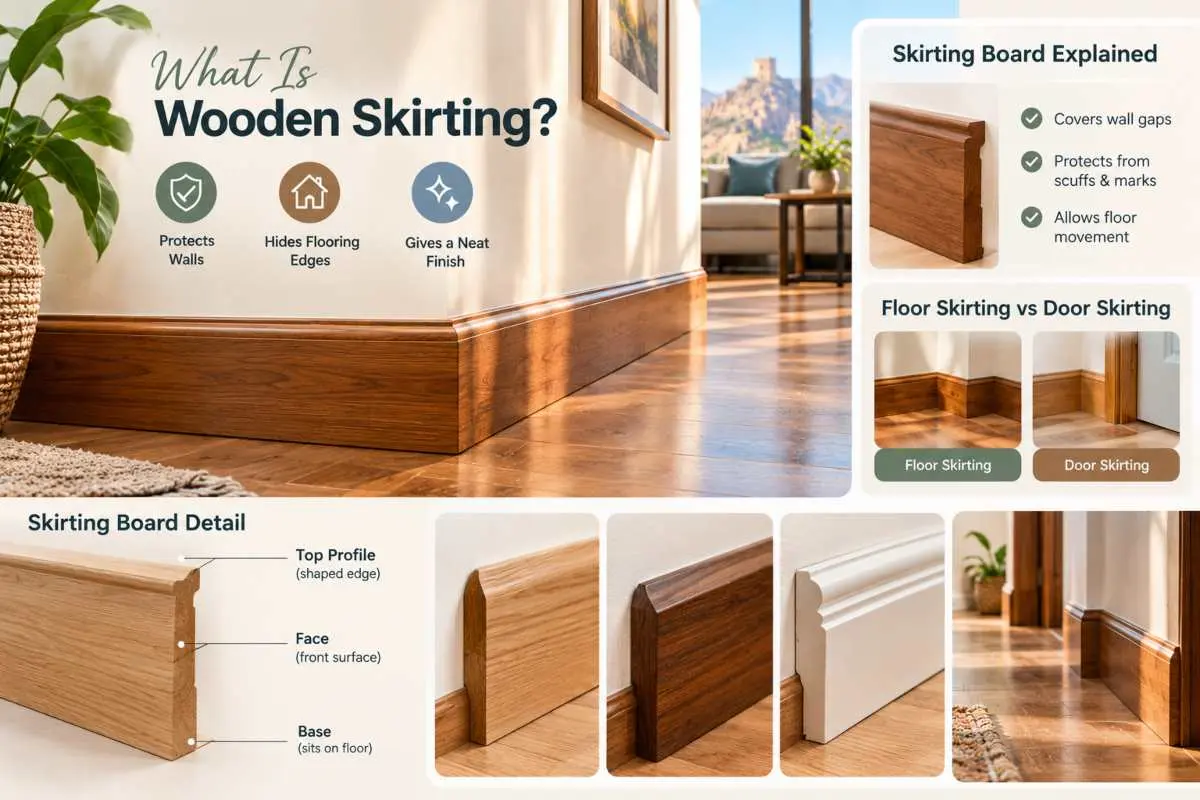
Wooden skirting is a strip of timber or wood based board fixed along the bottom of an interior wall where the wall meets the floor. It hides the edge of the flooring, protects the wall from scuffs and cleaning marks and gives a room a neat, finished look.
Skirting Board Explained
A skirting board, also called a baseboard, is the trim that runs around the base of a room. Its first job is practical. Walls are rarely perfectly straight and floors move slightly with temperature changes, so a small gap often remains at the edge. Skirting covers that gap and lets the floor settle without leaving a rough line on show.
It also takes the daily knocks from furniture, shoes, mops and vacuum cleaners, which would otherwise mark your paint. Wood is a popular material in Ras Al Khaimah homes because it can be painted, stained or cut to fit uneven walls and it feels more solid than many plastic trims.
Wooden Floor Skirting vs Door Skirting
Wooden floor skirting is the board that runs along the open lengths of a room’s walls, while door skirting is the part of that same trim that meets a door frame. The material is usually the same. The difference lies in where the board ends and how it finishes.
Along a wall, floor skirting simply runs from corner to corner. Near a door, the skirting has to stop neatly against the frame or architrave, sometimes with a small plinth block to make the joint cleaner. Matching the height and profile at both points keeps the whole room looking consistent.
Wooden Skirting Detail Top Profile, Face and Base
Every wooden skirting board has three visible parts and each one affects how it looks and performs. The top profile is the shaped upper edge, which can be flat, bevelled or curved and it decides how the board catches the light. The face is the front surface you see, which can be smooth or textured and is where paint or stain goes. The base is the bottom edge that sits against the floor. It should sit close and straight, with a thin sealed line where the floor needs room to move.
Understanding these three parts makes it easier to compare boards, read a quote and tell your fitter exactly what you want.
What Size of Wooden Skirting Is Best for Your Room?
For most rooms in Ras Al Khaimah, wooden skirting between 100mm and 150mm high works best, with 125mm a safe middle choice. Slimmer boards suit small rooms, taller boards suit large, high ceilinged spaces and the right size is the one that looks in proportion with the wall above it.
Common Heights, Including 125mm
Wooden skirting is usually sold in three broad height bands. Slim boards of around 70mm to 100mm give a light, modern look and suit compact rooms such as small bedrooms or studio apartments. Mid height boards of 100mm to 150mm cover most homes and 125mm sits comfortably in this band because it is tall enough to protect the wall and hide the floor edge without dominating the room. Tall boards above 150mm add a more traditional, statement feel and work best in grand villa living rooms and hallways.
Choosing Height by Ceiling Height
The more heightened the ceiling the taller the skirting can be without looking heavy. A simple rule is to start at about 5% of the ceiling height and adjust by eye. On a standard 2.7m ceiling, that points to roughly 125mm to 140mm, while a double height hallway can carry a much taller board.
Room size matters too. A tall board in a small room can make it feel tight, while a very slim board in a large room can look lost. If you are unsure, put a strip of masking tape on the wall at your chosen height and step back to judge it.
Thickness and Depth for a Neat Finish
Most wooden skirting is about 15mm to 20mm thick. Thickness matters at the points where boards meet other trims. Skirting should not stick out further than the door architrave beside it or the joint looks awkward and catches the eye. Thicker boards also hide small wall gaps and feel more solid, but they need a straighter wall to sit flush.
If you are laying new wood flooring, plan the skirting at the same time. The floor needs a small expansion gap at the edges and the skirting should cover it fully, so the board needs enough height and depth to hide that line.
Skirting Size for Doors, Stairs and Open Plan Areas
Doors, stairs and open plan spaces each need a little extra thought. Near doors, the skirting should stay slightly lower than the architrave is wide, so the trims finish cleanly against each other. On stairs, the board follows the slope of the staircase and most people keep the same height as the landing skirting or go slightly lower for a tidy line. In open plan areas, one consistent height across living, dining and kitchen zones makes the whole space look planned rather than pieced together.
Which Types of Wooden Skirting Suit Ras Al Khaimah Homes?
Solid wood, MDF and engineered wood skirting all work in Ras Al Khaimah, but the best choice depends on where the board sits. Solid wood suits dry, high end rooms, MDF suits painted interiors on a budget and moisture resistant boards are the safer pick near the coast or in humid spaces.

Solid Wood Skirting
Solid wood skirting is cut from a single piece of timber, such as oak, teak, meranti or pine. It has a rich natural grain, holds crisp profiles and can be sanded and refinished many times, which makes it a strong choice for stained finishes and premium villas. It is also the heaviest and usually the most expensive option.
Solid timber reacts to moisture. It takes in water vapour and gives it back, so it can expand and shrink slightly through the year. In an air conditioned room with steady conditions this causes little trouble, but in poorly ventilated or damp areas it can lead to gaps, warping or cracked paint. Sealing every face of the board before fitting reduces this risk.
MDF and Engineered Wood Skirting
MDF skirting is made from compressed wood fibre and resin, then shaped and usually primed ready for paint. It is smooth, consistent and cheaper than solid wood and it does not have knots or grain to show through a painted finish. That makes it a popular choice for white and painted skirting in apartments and rental properties.
Standard MDF has one clear weakness, water. If moisture gets into a cut edge or a chipped patch, the fibres swell and the board crumbles. Engineered wood skirting, which bonds a wood veneer or layers to a stable core, handles movement better than solid timber and looks more natural than painted MDF. It is a good middle path for living rooms and bedrooms where you want a wood look without the cost of solid boards.
Moisture Resistant Options for Coastal Humidity
Moisture resistant skirting is worth considering in coastal areas, ground floor rooms, kitchens and any space that is mopped often. Moisture resistant MDF, sometimes sold with a green tinted core, is made with extra resin and water repellent additives so it swells far less than standard board. Treated hardwoods also hold up well and waterproof polymer or PVC skirting is a sensible alternative where wooden skirting would be at risk, though it is not true wood.
Whichever material you choose, fitting matters as much as the board itself. Seal the cut ends, prime the back and the bottom edge and use flexible paint grade sealant at the joints. If a board has already started to swell or lift, it is often a job for carpentry repair rather than a full replacement, as long as the damage has not spread through the board.
What Are the Best Wooden Skirting Designs and Textures?
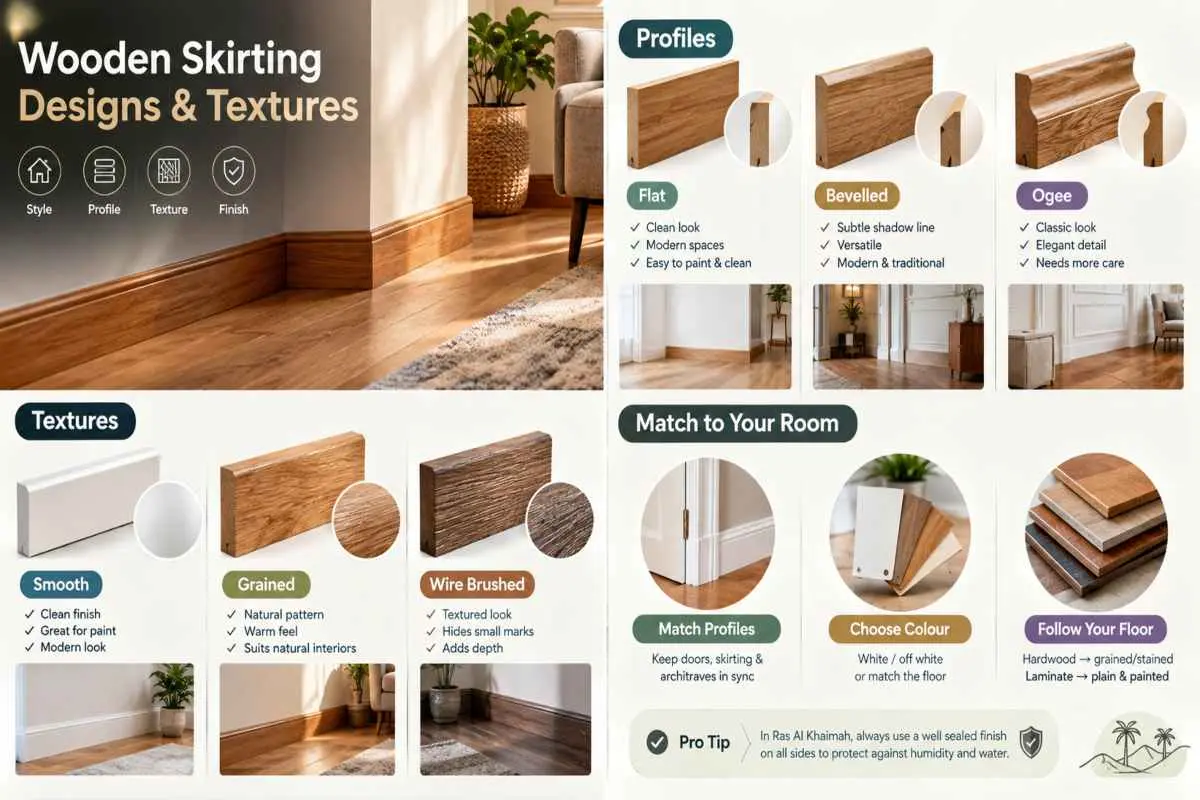
The best wooden skirting design is the one that matches the style of your room: flat profiles suit modern homes, bevelled edges suit transitional spaces and ogee curves suit classic interiors. Texture then sets the mood, with smooth boards looking clean, grained boards looking natural and wire brushed boards adding depth.
Flat, Bevelled and Ogee Profiles
A flat profile, also called a square or plain profile, has a straight face and sharp edges. It looks crisp and minimal and it is easy to paint and clean, which is why it is common in modern apartments and contemporary villas.
A bevelled profile has an angled cut along the top edge. It adds a soft shadow line without feeling decorative, so it sits well in most homes and works with both modern and traditional furniture.
An ogee profile has an S shaped curve, which gives a more detailed, traditional look. It suits formal living rooms, hallways and homes with panelling or cornices, but the curves collect dust more easily and need a little more care when painting and cleaning.
Smooth, Grained and Wire Brushed Textures
Smooth skirting has an even surface that takes paint cleanly, so it is the usual choice for white or coloured finishes. Grained skirting keeps the natural pattern of the timber under a stain or clear coat and it suits warm, natural interiors. Wire brushed skirting is scrubbed with a wire brush to lift the softer wood and leave a textured, slightly raised grain. It adds depth and hides small marks well, though the dips in the surface need more effort to clean.
In a climate like Ras Al Khaimah, a well sealed finish matters more than the texture itself. Whichever look you pick, make sure every face of the board is sealed, so that humidity and cleaning water don’t enter the wood.
Matching Skirting to Doors and Flooring
Skirting looks best when it relates to the rest of the room rather than competing with it. The simplest approach is to match the profile to your door frames and architraves, so the trim in the room feels like one family. Colour is the next choice. White or off white skirting is a safe pick that works with almost any floor, while skirting stained to match the floor creates a continuous, blended edge.
Your floor type can guide the style. Rich, natural boards from hardwood flooring pair well with grained or stained skirting in a similar tone. A uniform finish from laminate flooring often looks sharper with a plain, painted profile. If you are unsure, take a floor sample and a skirting sample to the wall together and judge them in your own room light before you decide.
Is White Wooden Skirting the Right Choice?
White wooden skirting is the right choice for most homes in Ras Al Khaimah, because it suits almost any wall colour and floor type and keeps rooms looking bright and clean. It is less suitable if you want a bold, blended or dramatic look, in which case a natural or darker finish may work better.
Why White Skirting Stays Popular
White skirting remains popular because it is flexible. It frames the floor without drawing attention to itself and it reflects light, which helps rooms feel more open. That matters in apartments and villas with limited natural light or in rooms with dark flooring.
It is also easy to live with. If you change your wall colour, floor or furniture later, white skirting rarely needs replacing. Scuffs and marks can be touched up with a small pot of paint, which keeps long term upkeep simple. The main drawback is that white shows dirt more easily, especially near entrances and in busy hallways, so a washable, semi gloss or satin paint is a practical choice.
Pairing White Skirting with Wall and Floor Colours
White skirting works well with soft neutrals such as cream, beige and light grey walls, where it adds a subtle, clean edge. Against deep walls in navy, green or charcoal, it creates a sharp contrast that looks deliberate and crisp. If you prefer a gentler effect, off white or warm white shades sit more softly next to cream walls and timber floors.
Floors matter too. White skirting lifts dark wood and grey tiles and it keeps pale floors looking fresh and airy. One small tip is to match the white across skirting, door frames and architraves, because even slight differences in tone can look uneven in bright light.
Other Finishes: Natural, Dark and Painted
White is not the only option. A natural or clear coated finish shows the grain of the timber and suits warm, wood led interiors, especially when it matches the flooring. Dark stained or deep painted skirting in black, charcoal or navy gives a bolder, more modern look and it can hide scuffs better than white. Painted finishes in muted colours, such as soft grey or sage, can tie a room together when they pick up a shade from the walls or furnishings.
Whatever finish you choose, a good paint job depends on good preparation and quality materials. If you are updating several rooms at once, it often helps to plan skirting alongside other home renovation services, so that flooring, painting and trim are finished in the right order.
How Is Wooden Skirting Fitted?
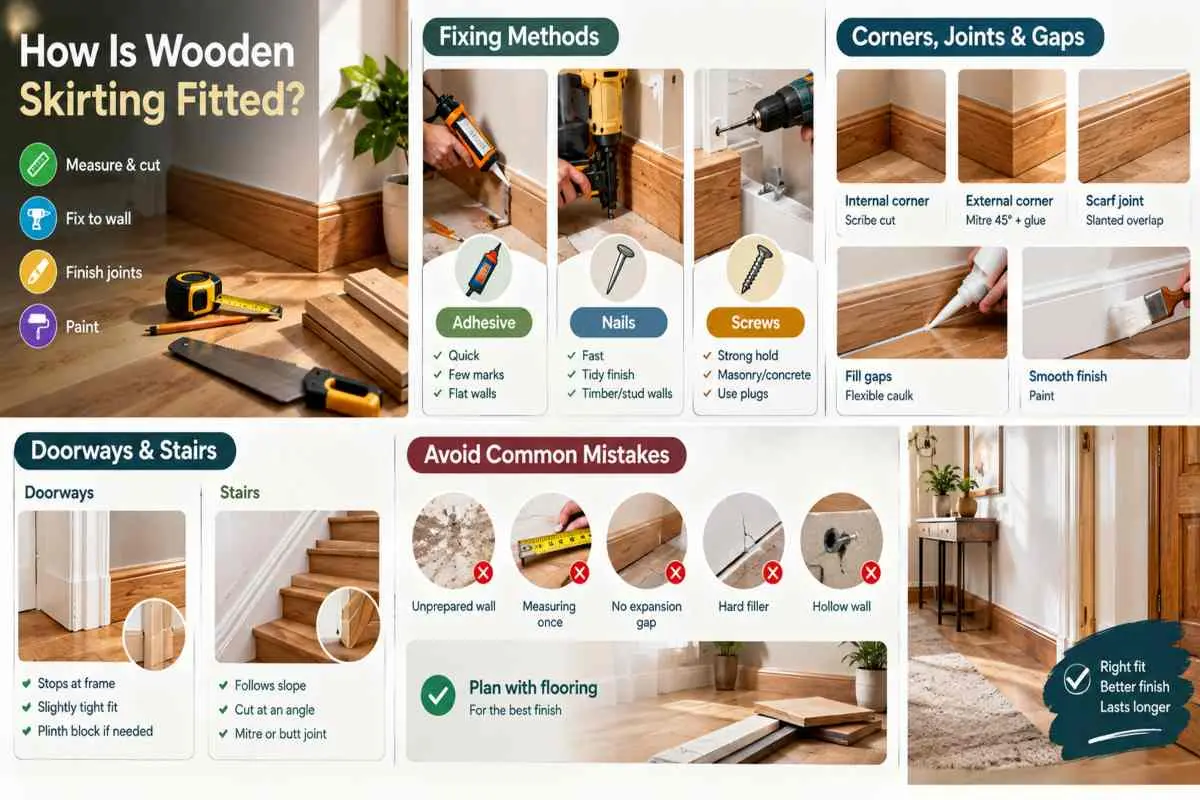
Wooden skirting is fitted by measuring and cutting each board to length, fixing it to the wall with adhesive, nails or screws and finishing the joints and gaps with filler and paint. A neat result depends less on the fixing method than on straight cuts, tight corners and a flat, clean wall behind the board.
Fixing Methods Adhesive, Nails and Screws
Three methods are used to hold skirting in place and the right one depends on your wall. Grab adhesive is quick and leaves few marks, so it suits flat plaster and drywall, though the board often needs a few pins to hold it while the glue sets. Nails, usually driven through the board with a nail gun, are fast and tidy on timber battens and stud walls. Screws grip best on solid masonry and concrete, where the board is fixed with wall plugs and the screw heads are then covered with filler.
Many fitters combine methods, using adhesive for a continuous hold and nails or screws for extra grip. In Ras Al Khaimah, where many homes have block or concrete walls, screws and plugs are often the most secure choice for heavier solid wood boards.
Corners, Joints and Gaps
Corners are where fitting skill shows most. Internal corners, where two walls meet inwards, are usually scribed, which means cutting one board to follow the shape of the other so they meet without a gap. External corners, which stick out into the room, are normally mitred at 45 degrees and glued together so the joint stays closed.
Along a straight wall, long runs are joined with a scarf joint, a slanted overlapping cut that hides the seam better than a straight butt joint. Any small gaps between the board and wall or floor are then filled with flexible decorators’ caulk before painting. A flexible filler is better than a hard one, because boards move slightly with temperature and humidity and a rigid filler can crack.
Fitting Skirting at Doorways and on Stairs
At a doorway, the skirting stops against the door frame or architrave. Each board is cut square and slightly tight so that it butts neatly against the frame, without leaving a gap or covering the trim. If the board is thicker than the architrave, a plinth block at the base gives a clean finish.
On stairs, the board follows the slope of the staircase, so each end is cut at an angle to match the incline. It is marked directly against the wall for a close fit, because stair walls are rarely perfectly straight. Landings are fitted like normal rooms and the angled stair boards are then joined to them with a neat mitre or butt joint.
Common Fitting Mistakes to Avoid
The most common mistake is fitting boards onto a wall that has not been prepared. Dust, loose paint and bumps stop adhesive from holding and leave visible gaps. The second is measuring only once, which leads to short boards and wasted material, so measure twice and cut slightly long before trimming to fit.
Other frequent errors include forgetting the small expansion gap near new flooring, using hard filler in moving joints and fixing into hollow wall areas where nothing holds the board. If you are fitting skirting at the same time as new floors, it helps to plan both jobs together and our flooring and roof services team can coordinate the order of work so the trim sits correctly against the finished floor.
Can You Use Wooden Skirting in a Bathroom?
Yes, you can use wooden skirting in a bathroom, but only if the board is moisture resistant and fully sealed. In a bathroom, untreated timber or standard MDF will swell and peel within months, so water resistant materials and careful sealing are essential.
Humidity and Splash Risks
Bathrooms put skirting under more pressure than any other room. Steam from showers raises humidity for long periods and water splashes and mop water reach the base of the walls, which is exactly where skirting sits. Wood takes in moisture through its surface and especially through cut ends and the bottom edge, so a board that looks fine on top can be absorbing water from below.
The first signs are usually small. Paint bubbles or flakes near the floor, the board starts to lift slightly from the wall or dark marks appear along the base. If the moisture continues, the wood can warp, swell or develop mould and in standard MDF the fibres can break down completely. Rooms with poor ventilation and no extractor fan face the highest risk, so good airflow protects your skirting as much as the material does.
Best Materials and Sealing for Wet Areas
The safest choices for a bathroom are moisture resistant MDF, treated hardwood or a waterproof alternative such as PVC or tile skirting. Moisture resistant MDF is a practical option for painted finishes, while tile skirting often works better in showers and wet rooms, where water reaches the wall base every day.
Whichever material you choose, sealing makes the difference. Prime and paint every face of the board, including the back, the bottom edge and the cut ends, before it goes on the wall. Use a water resistant paint, such as an enamel or a moisture resistant satin finish and seal the gap where the board meets the floor and wall with a flexible, mould resistant sealant. Keeping the bottom edge a few millimetres above wet tiles, with the gap sealed, helps stop water from being drawn upwards into the wood.
How Do You Repaint or Spray Paint Wooden Skirting?
To repaint wooden skirting, clean the boards, sand the old finish lightly, fill any damage, apply a primer and then add two thin coats of paint, leaving each coat to dry fully. You can use a brush for control or a spray gun for a smoother finish, but good preparation matters more than the tool.

Preparing and Sanding the Surface
Start by washing the skirting with a mild detergent and little warm water to remove dust, grease and cleaning residue, then let it dry completely. Paint will not stick well to dirty or damp surface and bathroom or kitchen boards often carry a thin film of grease that you cannot see.
Next, sand the board lightly with fine grit sandpaper, around 180 to 220 grit, just enough to dull the old gloss and give the new paint something to grip. Fill chips, nail holes and small gaps with wood filler, sand them flat once dry and wipe away dust with a wet cloth. Run masking tape along the wall and floor edges and cover the floor with dust sheets. If the old paint is flaking or the board has swollen, treat that first, because new paint will only hide the problem for a short time.
Apply a coating of primer before painting, specifically if you are changing colour, painting bare wood or covering stains. Primer improves grip and gives the topcoat an even base.
Brush vs Spray Finish
A brush is the simplest choice for most homes. It gives you control along edges, needs little equipment and works well for a single room or a few boards. Use a good quality angled brush and paint in thin, even strokes along the length of the board, finishing with a light pass in one direction to reduce brush marks.
Spray painting gives the smoothest, most even finish and is faster over long runs, which makes it popular for whole home repainting and new unpainted boards. It does need more preparation. Walls, floors and doors must be masked carefully, the room should be well ventilated and you should wear a suitable mask. Spray in light, overlapping passes rather than one heavy coat to avoid drips. Boards that can be removed and sprayed off the wall give the cleanest result, but most homeowners find a brush easier for boards already fixed in place.
How Often to Repaint in RAK’s Climate
Most painted skirting in Ras Al Khaimah homes needs repainting every three to five years, though the right timing depends on the room. Busy hallways, kitchens and children’s rooms may need a refresh sooner because of scuffs and cleaning, while quiet bedrooms can last longer. Boards near coastal humidity, bathrooms or strong sunlight may show peeling or fading earlier.
Check your skirting once a year. If you see chipped paint, yellowing, bubbles or a rough texture, a light sand and fresh coat now will prevent the damage from spreading into the wood. If the board itself has swollen or cracked, fix or replace it before you repaint.
How Much Does Wooden Skirting Cost in Ras Al Khaimah?
Wooden skirting in Ras Al Khaimah typically costs from about AED 10 to AED 40 per linear metre for painted MDF boards and from around AED 75 per linear metre for solid oak, before fitting. The final price depends mainly on the material, the board height, the finish and the labour needed to fit it.
AED Pricing Table by Type, Size and Finish
As a real reference point, one UAE flooring supplier lists a 100mm solid oak skirting board at AED 74 per linear metre including VAT. Other materials cost less or more depending on quality. The ranges below are typical supply only prices per linear metre and your actual quote will vary by supplier and stock.
Skirting type Size Finish Typical supply price AED per linear metre
| Skirting type | Size | Finish | Typical supply price (AED per linear metre) |
|---|---|---|---|
| Primed MDF | 100mm | Ready to paint | 10 – 20 |
| Primed MDF | 125mm to 150mm | Ready to paint | 15 – 35 |
| Moisture-resistant MDF | 100mm to 150mm | Primed or painted | 20 – 40 |
| Engineered wood | 100mm to 150mm | Veneer or stained | 35 – 65 |
| Solid oak | 100mm | Natural or stained | From about 74 |
| Solid wood (hardwood) | 125mm to 150mm | Stained or painted | 90 – 150 |
| PVC or waterproof polymer | 100mm to 150mm | Pre-finished | 8 – 20 |
What Affects the Cost Material, Length, Labour and Finish
Material is the biggest factor. Solid wood costs several times more than MDF and moisture resistant boards sit slightly above standard MDF. Height matters next, because taller boards use more material and detailed profiles such as ogee cost more than flat ones.
Length affects both the price per metre and the labour. Longer, simple runs are cheaper to fit than small rooms with many corners, door frames and stairs. Finish also adds cost. Pre primed boards need painting on site, while stained or factory finished boards cost more upfront but save time. Labour then depends on the wall type, the number of corners and how much preparation is needed and fitting on concrete or block walls usually takes longer than on drywall.
Supply and Fit vs Fit Only
A supply and fit price covers the boards, cutting, fixing, filling and usually basic finishing, so you pay one quote and one team is responsible for the result. This is easier to manage and it makes sure the board suits the wall and floor. A fit only price covers labour alone and you buy the skirting yourself. That can save money if you find a good deal on boards, but you take on the risk of ordering the wrong quantity, size or type.
For most homeowners, supply and fit is the safer choice. Ask whether the quote includes painting, sealing, waste and removal of old skirting, because these are the items most often left out. Measuring the total wall length first and adding about 10% for cuts and waste, gives you a more accurate budget.
Where Can You Find Wooden Skirting Fitters Near You in RAK?
You can find wooden skirting fitters in Ras Al Khaimah through local carpentry and home maintenance companies that handle fitting, finishing and repairs in one visit. The best choice is a team based in RAK that can show previous work, give a clear written quote and fit boards suited to the local climate.
RAK Neighbourhood Coverage
Wooden skirting work is needed across every type of home in the emirate, from apartments to family villas. Home Fix, based in Ras Al Khaimah, covers Al Marjan Island, Mina Al Arab, Bab Al Bahr, Al Hamra, Al Riffa and Al Jazeera Al Hamra. Coastal communities such as Al Marjan Island, Mina Al Arab and Bab Al Bahr often need moisture resistant boards and careful sealing because of sea air, while villa areas such as Al Hamra, Al Riffa and Al Jazeera Al Hamra tend to involve larger rooms, taller boards and longer runs. A fitter who works regularly in your area will already know these conditions and can recommend the right material before you buy.
What to Ask Before Hiring a Fitter
A few simple questions will show you how reliable a fitter is. Ask whether the quote is for supply and fit or fit only and whether painting, sealing and removal of old skirting are included. Ask which material they recommend for your room and why, particularly for bathrooms, kitchens and ground floor spaces. It also helps to ask how they handle corners and gaps, whether they can show photos of recent skirting jobs and how long the work will take. Finally, check that the price is written down and lists the board type, height and total length, so that you can compare quotes fairly.
Home Fix Carpentry and Fitting Service
Home Fix supplies and fits wooden skirting as part of our carpentry works, so one team can measure, supply, cut, fix and finish the boards. If you are laying new floors at the same time, our wood flooring service lets us plan the floor and skirting together, so the finished edge sits neatly against the floor. For landlords, homeowners and property managers who want regular upkeep of trims, doors and other fittings, our AMC services cover planned maintenance visits across the year.
Conclusion
The right wooden skirting for a Ras Al Khaimah home is usually a 100mm to 150mm board in a material that suits the room, such as moisture resistant MDF or engineered wood for humid areas and solid wood for dry, premium spaces. Height should follow the room and ceiling, the profile and texture should match your doors and flooring and a well sealed, neatly fitted board will resist humidity and keep its finish for years. For budgeting, one UAE supplier lists 100mm solid oak skirting at AED 74 per linear metre including VAT, so measure your walls and compare supply and fit quotes before you decide. If you would like help choosing, supplying and fitting your skirting, Home Fix Building Maintenance can measure your rooms, recommend the right material for your area and finish the job in one visit. Call +971 52 511 2254 or email info@homefix uae.com for a quote.
Frequently Asked Questions (FAQs)
Which wooden skirting size is most common?
Most homes use wooden skirting between 100mm and 150mm high and 125mm is a popular middle choice. Slimmer boards suit small rooms, while taller boards suit large rooms with high ceilings.
Can wooden skirting be used in bathrooms?
Yes, but only if the board is moisture resistant and sealed on every face, including the back and cut ends. Moisture resistant MDF, treated hardwood or waterproof PVC skirting are safer choices than standard MDF or untreated timber.
Can I repaint wooden skirting myself?
Yes. Clean the board, sand it lightly, fill any damage, apply primer and then add two thin coats of paint, let each coat dry totally. Good preparation matters more than whether you use a brush or a spray.
Does wooden skirting suit stairs?
Yes. The board follows the slope of the staircase, with each end cut at an angle to meet the wall neatly. Most homes keep the stair skirting at the same height as the landing or slightly lower, for a tidy line.
How much does wooden skirting cost in Ras Al Khaimah?
Painted MDF skirting typically costs from about AED 10 to AED 40 per linear metre, while solid oak starts from around AED 74 per linear metre including VAT, based on one UAE supplier listing. Fitting is extra, so ask for a supply and fit quote.