
Plumbing Fittings Guide | Types, Names and RAK Prices
Plumbing fittings are the components that hold every water system in a UAE property together. Every pipe junction, every direction change, every connection between a supply line and a tap, every joint between a drain and a soil stack, all of these rely on the correct fitting, correctly specified, correctly installed.
Yet plumbing fittings are one of the most misunderstood elements of property maintenance in Ras Al Khaimah. Property owners approve plumbing works without knowing what materials are being used. Contractors install fittings that are inappropriate for the UAE climate. Buildings develop leaks, pressure loss, and corrosion problems within years of a new installation, not because the artistry was poor, but because the wrong fitting was specified for the application.
The UAE presents conditions that no fitting specification guide written for a European or Asian market fully addresses. Summer temperatures that regularly exceed 45°C cause standard plastic fittings to soften and deform. Coastal humidity levels above 80 percent accelerate corrosion in metal fittings that perform reliably in drier climates. Hard water with high mineral content deposits scale inside fittings progressively, reducing flow and eventually causing blockage or failure. The rapid cycling between air-conditioned interiors and extreme exterior temperatures stresses every joint and seal in the system daily.
Getting the fitting specification right from the outset is the single most effective way to prevent plumbing failures, which account for the majority of emergency repair calls in residential and commercial properties in the UAE every year.
Plumbing fitting used in UAE properties, including the types, materials, correct names, appropriate applications for each, their costs in the UAE market in 2026, and how to ensure the fittings specified for your property are correct for the Gulf climate. Whether you are a property owner reviewing a contractor quotation, a facility manager specifying materials for a maintenance programme, or simply trying to understand what is inside your walls, this is the complete resource.
What Are Plumbing Fittings? Definition and Scope in UAE Properties
Plumbing fittings are the connecting components that join pipes, change flow direction, regulate pressure, and link the supply and drainage network to every fixture in a building. Without fittings, a plumbing system is simply a collection of unconnected pipes. Fittings make the system work as a single, continuous, leak-free network from the municipal connection point to every tap, shower, toilet, and appliance on the property.
In UAE residential and commercial buildings, plumbing fittings are installed inside walls, beneath floors, above ceilings, and in concealed service ducts, which is precisely why the correct specification matters so much. A fitting that fails inside a wall in a Ras Al Khaimah villa does not announce itself with a visible drip. It announces itself weeks later as a damp patch on a finished surface, a mold problem in a bedroom wall, or a water-damage claim on a ground-floor ceiling. By that point, the repair cost has multiplied many times over the cost of using the correct fitting from the start.
What Is Plumbing Fitting and What Does It Do?
A plumbing fitting is any component used to connect, join, redirect, reduce, seal, or isolate sections of a plumbing pipe network. Fittings serve six core functions in a UAE plumbing system.
The first function is connection, joining two or more pipes together to create a continuous flow path. The second is direction change, redirecting the pipe route around structural elements, through walls, and between floors using elbow and bend fittings. The third is branch creation, splitting one supply line into two or more branches using tee and cross fittings. The fourth is a size transition connecting pipes of different diameters using reducer and adapter fittings. The fifth is isolation, allowing sections of the system to be shut off for maintenance or repair using valve fittings. The sixth is termination, capping the end of a pipe run using end cap fittings.
Every plumbing fitting in a UAE property performs one or more of these six functions. The choice of fitting type, material, and size for each function determines how reliably the system performs over its service life in the Gulf climate.
Pipes and Fittings: What Is the Difference?
Pipes and fittings are distinct components that work together to form a complete plumbing system. Understanding the difference helps property owners review contractor quotations accurately and identify when substandard components are being proposed.
A pipe is the straight run of tubing that carries water or waste between two connection points. It is specified by its material, external diameter, wall thickness, and pressure rating. In UAE properties, the most common materials for hot and cold water supply pipes are PPR, copper, and PEX, and for drainage and soil systems, UPVC and HDPE.
A fitting is the component that connects two pipes, changes the direction of a pipe run, or connects a pipe to a fixture. Fittings are specified by material, connection type, size, and pressure rating. In UAE plumbing systems, the fitting material must match or be compatible with the pipe material: a brass fitting on a copper pipe, a PPR fusion fitting on a PPR pipe, a solvent-weld fitting on a UPVC pipe. Mixing incompatible materials at connection points is one of the most common causes of premature fitting failure in properties in the UAE.
The critical rule in the UAE plumbing specification is that pipes and fittings must be specified together, not selected independently. A high-quality PPR pipe connected with a substandard fitting degrades at the connection point regardless of the pipe quality. A correctly specified fitting on a substandard pipe fails at the pipe body regardless of the fitting quality. Both components must meet the correct specification for the application.
Plumbing Fixtures and Fittings: How They Work Together in UAE Buildings
Plumbing fixtures and plumbing fittings are frequently confused, but they refer to different things. Understanding the distinction matters when commissioning plumbing works or reviewing a contractor’s bill of quantities.
Plumbing fixtures are the end-use appliances and sanitary ware that consume or discharge water, such as taps, showers, toilets, washbasins, bathtubs, kitchen sinks, water heaters, and dishwashers. Fixtures are visible, accessible, and directly used by the building’s occupants.
Plumbing fittings are the connecting components within the pipe network that deliver water to those fixtures and remove waste from them. Fittings are typically concealed within the building fabric and are not directly accessed during normal building use.
In a UAE bathroom, the washbasin is the fixture. The hot and cold supply pipes that feed it are the pipes. The elbow fittings that turn the supply pipes from vertical to horizontal behind the wall, the isolation valves that allow the basin supply to be shut off independently, the flexible connectors that link the rigid supply pipes to the basin taps, and the bottle trap and waste pipe that drain the basin to the soil stack are all fittings. Every fixture in a UAE property requires multiple fittings to connect it to the supply and drainage systems, and the quality of those fittings determines how reliably the fixture performs throughout the installation’s service life.
Plumbing Materials and Fittings Full Scope in UAE Properties
Plumbing materials are the collective term for all components used in a plumbing installation, including pipes, fittings, valves, sealants, supports, and fixings. In the UAE, residential and commercial properties use plumbing materials across a wide range of product categories, each specified differently for Supply, drainage, hot water, and external or exposed applications.
The full scope of plumbing items used in a UAE property installation includes supply pipes and their associated fusion, compression, or push-fit fittings; drainage pipes and their solvent-weld or rubber-seal fittings; isolation valves and pressure reducing valves; trap assemblies for every sanitary fixture; pipe clips and support brackets; thread sealant tape and jointing compounds; flexible connectors between rigid pipework and fixtures; and insulation wrapping for supply pipes in locations exposed to temperature extremes.
In the UAE specifically, the selection of plumbing materials is more consequential than in most other markets because the climate simultaneously attacks every material type through different mechanisms. Heat softens standard plastics. Humidity corrodes unprotected metals. Hard water scales all internal pipe and fitting surfaces progressively. UV radiation degrades all polymer materials in exposed locations. A complete plumbing materials specification for a UAE property must address all four of these attack mechanisms, not just one or two, to deliver a system that performs reliably throughout its intended service life.
Types of Pipe Fittings Used in UAE Plumbing Systems
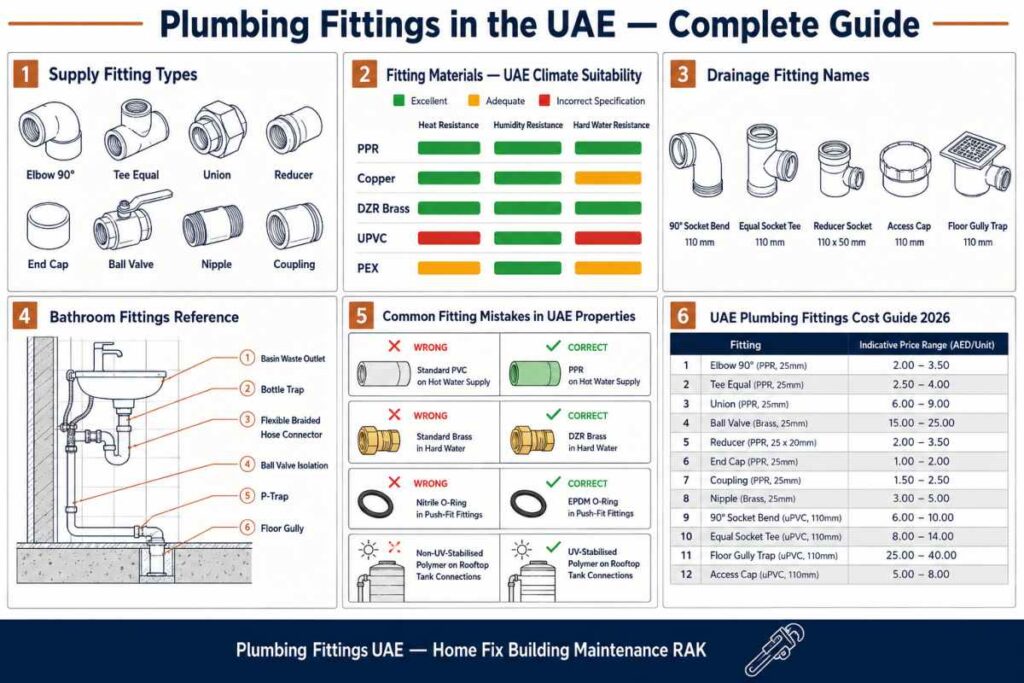
UAE plumbing systems use eleven core fitting types across Supply, drainage, and sanitary applications. Each fitting type serves a specific function in the pipe network; using the wrong type in any location creates a weak point that the Gulf climate will find and exploit.
Union Fitting and Pipe Union: What They Are and Where They Are Used
A union fitting is a three-piece connector that joins two pipes and allows them to be separated and reconnected without cutting the pipe. It consists of a male end, a female end, and a threaded nut that draws both ends together to create a watertight seal.
In UAE plumbing systems, union fittings are installed at every point where a component, such as a pump, water heater, pressure-reducing valve, or water meter, needs to be removed for servicing without dismantling the surrounding pipework. A plumbing installation that does not include union fittings at serviceable components forces the contractor to cut live pipework every time maintenance is required, adding unnecessary cost and risk of damage to every future service visit.
Types of pipe unions used in UAE installations include standard threaded unions for steel and copper pipework, PPR fusion unions for hot and cold supply systems, and dielectric unions at the connection point between copper pipe and steel components such as water heater tanks. A dielectric union electrically isolates two dissimilar metals, preventing galvanic corrosion that occurs when copper and steel contact directly in the presence of UAE hard water. This reaction corrodes the steel component from the inside within 3 to 5 years if an unprotected joint is used.
Adapter Fitting and Faucet Adapter Types and Applications
An adapter fitting connects two pipes or components of different connection types, a threaded male connection to a push-fit female, or a compression end to a solvent-weld socket. Adapters are transition fittings used wherever two different pipe systems or material types meet in the same installation.
A faucet adapter connects rigid supply pipework to the threaded inlet of a tap or mixer valve. In UAE bathrooms and kitchens, faucet adapters are typically brass with a chrome finish and include a flexible braided hose section, called a flexi hose, that absorbs small misalignments between the fixed pipe position and the tap inlet that are common in tile-finished UAE wet rooms.
The quality of the braiding and the end fittings on flexi hoses determines their service life. Low-quality flexi hoses fail at the crimp connection between the braided body and the brass end fitting, a failure mode responsible for a significant number of domestic flood incidents in UAE apartments annually. Specifying a flexi hose with a stainless steel braid and a double-crimped brass end is the correct approach for residential installations in the UAE.
Plumbing Tee Fitting: How It Works in UAE Supply Systems
A tee fitting is a T-shaped connector that branches from a main pipe run. The two straight-through ports carry the main flow, and the branch port diverts a portion of that flow to a secondary line. In UAE plumbing systems, tee fittings appear at every point where the main supply riser branches to serve an individual floor and where the floor distribution pipe branches to serve each bathroom, kitchen, or appliance.
Equal tees have all three ports at the same diameter. Reducing tees have a smaller branch port than the two main ports. The correct specification is for the branch to serve a single fixture from a larger distribution main. Using an equal tee where a reducing tee is required creates unnecessary turbulence and pressure loss at the branch point, reducing flow to the fixture and accelerating wear at the connection under UAE supply pressure conditions.
Plumbing Compression Fittings: Correct Use in UAE Properties
A compression fitting creates a watertight seal by compressing a soft metal or plastic ring called an olive or ferrule against the outer surface of the pipe as the fitting nut is tightened. No soldering, fusion welding, or solvent cement is required; the seal is entirely mechanical.
Compression fittings are the correct choice in UAE plumbing installations where heat-fusion welding is impractical inside confined ceiling voids, in retrofit situations where existing pipework cannot be drained, and for connecting copper pipe to valve bodies and appliance inlets. They are not the preferred primary connection method for new UAE PPR supply systems; heat-fusion joints are stronger, more thermally stable, and better suited to the daily thermal cycling that UAE supply pipes experience. Compression fittings are used for maintenance and repair situations, providing a fast, reliable connection without specialist equipment.
Push Fit Plumbing Fittings Fast Connection Systems for UAE Installations
A push fit fitting creates an instant connection by inserting the pipe end into the fitting body until it locks into an internal grab ring. A built-in O-ring creates the water seal. No tools, heat, or adhesive are required, and the fitting can be disconnected and reconnected multiple times using a simple release collar.
Push-fit plumbing fittings are widely used in the UAE for maintenance and repair applications due to their speed and ease of use. A leaking joint inside a ceiling void can be replaced with a push-fit fitting in minutes, without draining large sections of the system. For new hot water installations in the UAE, the O-ring seal specification is critical. Standard O-rings rated to 60°C are not appropriate for UAE hot-water supply systems where the water temperature at the point of generation reaches 85°C. Only push-fit fittings with EPDM O-rings rated to 95°C or above are suitable for UAE hot-water supply applications.
Flexible Plumbing Fittings Where They Are Required in UAE Buildings
Flexible plumbing fittings accommodate movement, vibration, or misalignment between two fixed points in the pipe system. In UAE plumbing installations, flexible fittings are required at three specific locations.
At pump connections, the pump motor’s vibration is transmitted directly into the rigid pipework, leading to joint cracks over time. At water heater connections, thermal expansion of the tank body causes small, repeated movements at the inlet and outlet connections. At appliance connections, the appliance position does not align precisely with the fixed pipe outlet after tiling and finishing works are complete.
Flexible fittings used in UAE properties include braided stainless steel flexible connectors for tap and appliance supply connections, rubber expansion joints for pump inlet and outlet connections, and corrugated flexible metal hoses for water heater connections, where higher temperature and pressure ratings than those of braided hoses are required.
Nipple Plumbing Fittings Types and Applications
A nipple is a short length of pipe with external threads at both ends, used to connect two female-threaded components at a fixed distance. Nipples appear throughout UAE plumbing systems at valve outlets, water heater connection ports, pressure gauge ports, and wherever a threaded pipe needs to be extended to reach a fitting body.
Close nipples have threads running the full length with no unthreaded section. Barrel nipples have a short unthreaded centre section. Reducing nipples have different thread sizes at each end, connecting components of different pipe sizes in the same fitting. All nipples used in UAE hot water and supply systems must be brass or stainless steel. Galvanised steel nipples corrode rapidly in UAE water conditions, with the combination of hard water minerals and elevated supply temperatures attacking the zinc coating and contaminating the Supply with rust particles within two to three years.
Basin Coupling and Drain Fittings Bathroom Plumbing Connections
A basin coupling connects the waste outlet of a washbasin to the drainage pipe below. The assembly includes a chrome or white waste outlet body fitted into the basin waste hole, a Rubber sealing washer beneath the basin surface, and a back nut that draws the assembly watertight. The outlet connects to either a bottle trap or a P-trap before joining the drainage pipe run to the soil stack.
Plumbing drain fittings in UAE bathrooms extend beyond the basin to include floor gully traps that collect water from shower areas and wet room floors, shower waste assemblies that integrate a trap with a linear or point drain cover, and bath trap assemblies that connect the bath waste and overflow outlets to a single drainage connection. Every drain fitting in a UAE property must maintain a water seal of at least 50mm depth at all times. The sealed water column is the only barrier between the building’s interior and sewer gas. Traps with inadequate seal depth or dry traps that allow the seal to evaporate in the UAE heat are a direct issue for building health and safety.
Plumbing Mixer Fitting Hot and Cold Supply Connections
A mixer fitting combines a hot and cold water supply into a single blended outlet at the point of use. In UAE properties, mixer fittings are used at every shower, bath, and washbasin where a single blended temperature is required rather than separate hot and cold flows from individual taps.
Thermostatic mixer valve TMVs are the correct specification for UAE shower installations. A TMV maintains a constant outlet temperature regardless of fluctuations in supply pressure or temperature on either the hot or cold side, preventing scalding when cold supply pressure drops momentarily. In UAE properties where the cold water supply comes from a rooftop storage tank heated by direct sun exposure, cold water supply temperatures in peak summer regularly exceed 40°C, making a thermostatic mixer an essential safety fitting rather than a specification upgrade. A conventional pressure-balancing mixer valve cannot compensate for a cold supply that is nearly as hot as the hot supply in UAE summer conditions.
Water Tank Fittings Correct Specification for UAE Rooftop Tanks
Rooftop water storage tanks are standard in UAE residential properties and require five core fittings: an inlet ball float valve, an outlet tank connector with isolation valve, an overflow pipe connection, a warning pipe connection, and a base drain fitting.
The inlet ball float valve automatically closes when the tank reaches its fill level and reopens as water is drawn off. The outlet fitting includes a tank connector, a brass gate or ball valve for isolation, and the pipe connection to the down-feed distribution system. The overflow pipe carries surplus water away. If the float valve fails, it must discharge to a visible external location so that float valve failure is immediately apparent to the building occupant. The base drain allows the tank to be fully emptied for the annual cleaning required by UAE building regulations.
All fittings used on UAE rooftop water tanks must be UV-stabilised and rated for temperature extremes. Standard plastic tank connectors and float valves that are not UV-stabilised become brittle and crack within two to three summer seasons on an exposed UAE rooftop, causing tank leaks that flood the ceiling of the floor below. Brass tank connectors and UV-stabilised high-density polyethylene float valves are the correct specification for all rooftop tank applications in the UAE.
Hose Pipe Connector and Hose Tap Fittings
A hose pipe connector is a push-on or screw-on fitting that connects a flexible garden or utility hose to a tap outlet or to another hose section. In UAE villas with landscaped gardens, swimming pools, and outdoor wash areas, hose connectors are in constant outdoor use. They are exposed year-round to intense UV radiation and temperatures that regularly exceed 50°C at ground level in summer.
Standard plastic hose connectors degrade rapidly in the UAE’s outdoor conditions. UV exposure causes the locking collar to become brittle and crack, making it the most common point of failure within one to two seasons of outdoor use. Heavy-duty UV-stabilised polymer or solid brass hose connectors are the correct specification for outdoor plumbing applications in the UAE.
Hose tap fittings are the threaded or push-fit connectors that attach the hose assembly to the external tap outlet. All outdoor tap fittings in UAE properties must include an isolation valve on the supply side. Leaving outdoor hose connections permanently pressurised in UAE summer temperatures where pressure fluctuations in the municipal supply are common accelerates wear at every connection point. It increases the risk of hose-body failure, leading to undetected water loss at an unoccupied outdoor location.
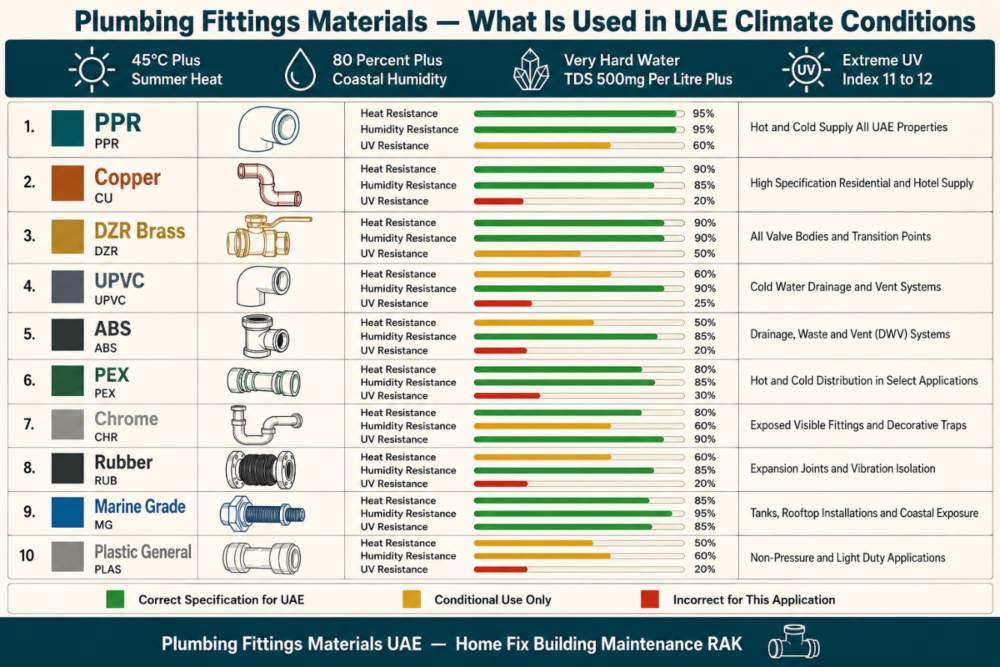
Plumbing Fittings Materials: What Is Used in the UAE Climate Conditions
The material a plumbing fitting is made from determines how long it lasts in the UAE climate. Nine core materials are used across UAE plumbing installations, each with specific applications where it performs correctly and specific locations where it fails prematurely if misused.
PVC Pipe Fittings Types, Names, and UAE Applications
PVC pipe fittings are solvent-weld or rubber-seal connectors used with polyvinyl chloride (PVC) pipe in drainage, waste, and cold-water supply applications. In UAE properties, PVC fittings are the standard specification for all above-ground drainage systems, soil pipes, waste pipes, and overflow pipes, where they perform reliably within the temperature range encountered in air-conditioned interior drainage systems.
The most common PVC pipe fittings used in UAE drainage installations are the socket bend, which changes the pipe direction at 45 or 90 degrees, and the equal socket tee, which creates a branch connection. This reducer socket connects pipes of different diameters, the access cap, which provides a cleanout point in the drainage run, and the pipe coupling which joins two straight pipe lengths end to end. All of these fittings are joined to PVC pipe using solvent cement, which chemically welds the fitting socket to the pipe end, creating a joint that is stronger than the pipe body itself when applied correctly.
PVC fittings are not suitable for hot water supply applications in UAE properties. Standard PVC softens at temperatures above 60°C, which the UAE hot water supply regularly exceeds, causing the fitting to deform at the joint and leak. Any contractor who specifies PVC fittings on a UAE hot water supply line is using the wrong material for the application.
PPR Plumbing Fittings: Why They Dominate UAE Hot Water Systems
PPR fittings made from polypropylene random copolymers are heat-fusion welded to PPR pipe using a socket fusion tool that simultaneously heats both the pipe end and the fitting socket to 260°C before joining. The molten polymer surfaces fuse as they cool, creating a monolithic joint with no mechanical connection, no sealant, and no potential leak path at the joint face.
PPR plumbing fittings dominate hot water supply systems in the UAE for three reasons. First, they are rated for continuous operation at 95°C and up to 20 bar pressure conditions that the UAE hot water supply regularly approaches at the point of generation. Second, the heat-fusion joint eliminates the most common failure point in all other fitting types, the mechanical connection between fitting and pipe. Third, PPR has a thermal expansion coefficient that closely matches its pipe body, so the fitting and pipe expand and contract together under UAE temperature cycling without stressing the joint.
The complete range of PPR fittings used in UAE supply systems mirrors the PVC drainage fitting range in function, including elbows, tees, reducers, couplings, end caps, and union connections. Still, it adds fitting types specific to supply systems, including ball valve connections, pressure gauge ports, and transition fittings that connect the PPR supply system to the brass or chrome fittings at the point of fixture connection.
Brass Plumbing Fittings Durability and Correct Use in UAE Properties
Brass plumbing fittings are alloy metal connectors used at high-stress points in UAE plumbing systems, including valve bodies, tap bodies, pressure-reducing valves, union connections, tank connectors, and transition points between plastic supply pipes and metal fixtures. Brass is an alloy of copper and zinc that offers excellent corrosion resistance in normal water conditions, high mechanical strength, good machinability for threaded connections, and a service life in UAE plumbing applications that routinely exceeds twenty years when correctly specified.
The critical specification point for brass fittings in the UAE’s hard water conditions is the alloy’s zinc content. Standard brass with zinc content above 15 percent is susceptible to dezincification, a corrosion process in which the zinc is selectively leached from the alloy by hard water, leaving a porous copper structure that lacks mechanical strength and eventually crumbles. Dezincification-resistant brass marked DZR or CR on the fitting body uses a modified alloy composition that resists this process and is the correct specification for all brass fittings used in UAE potable water supply systems.
Brass fittings used in UAE properties include compression fitting bodies and nuts, threaded nipples and connectors, ball valve bodies, pressure-reducing valve housings, gate valve bodies, tank connectors, and male threaded adapters that connect plastic supply systems to chrome fixture fittings.
Copper Pipe Fittings Applications in UAE Residential and Commercial Buildings
Copper pipe fittings are solder-joint or compression connectors used with copper tubes in hot- and cold-water supply applications. In UAE properties, copper fittings are used in high-specification residential installations, luxury villas, hotels, and high-end apartment developments where the premium cost of copper is justified by its exceptional durability, natural antimicrobial properties, and the confidence that comes from a material with a proven track record in UAE plumbing applications stretching back decades.
Solder-joint copper fittings, also called capillary fittings, are joined to copper tube by heating the assembled fitting and pipe with a gas torch until solder flows into the annular gap between the fitting socket and the pipe by capillary action. The solder solidifies as the joint cools, creating a strong, leak-free connection. End-feed fittings require solder to be fed into the joint during heating. Solder-ring fittings, also called Yorkshire fittings, contain a pre-measured ring of solder inside the fitting socket that flows automatically when the correct temperature is reached, making them faster and more consistent for site application.
Compression copper fittings use the same olive-and-nut compression principle as described in the compression fitting section. They are used for copper pipe connections where soldering is impractical or where a demountable connection is required. The combination of a copper compression fitting body, a brass olive, and a brass compression nut is the standard specification for UAE copper pipe maintenance connections.
PEX Plumbing Fittings Flexible Supply System Connections
PEX cross-linked polyethylene pipe fittings are crimp, clamp, or expansion connectors used with flexible PEX tubing in hot- and cold-water supply systems. PEX pipe is flexible, allowing it to be run in continuous lengths from manifold to fixture without intermediate joints, reducing the total number of fittings in the system and, therefore, the number of potential leak points.
PEX plumbing fittings are used in UAE properties primarily in manifold-based Supply systems where a central distribution manifold in a service cupboard feeds individual Supply lines to each fixture through the floor screed or ceiling void without any intermediate connections. This approach delivers the lowest possible leak risk of any supply system configuration because the only fittings in the system are at the manifold and fixture ends, both of which are accessible. The pipe run between these two points is a single continuous length with no joints.
PEX fittings must be rated for the system’s operating temperature. For the UAE hot water supply, PEX-A or PEX-B pipe rated to 95°C with brass insert fittings and stainless steel crimp rings is the correct specification. Standard PEX-C with copper crimp fittings is adequate for cold Supply only.
ABS Plumbing Fittings Drainage Applications in UAE Buildings
ABS acrylonitrile butadiene styrene pipe fittings are solvent-weld connectors used with ABS pipe in drainage and wastewater applications. ABS is tougher and more impact-resistant than PVC at low temperatures, making it the preferred drainage fitting material for underground drainage in traffic-bearing areas, drainage in plant rooms and car parks, and industrial drainage applications.
In the UAE, ABS drainage fittings are less common than PVC. The higher material cost of ABS compared to PVC is rarely justified in a standard residential drainage application where impact resistance is not required. ABS fittings are the correct specification in UAE commercial properties, car parks, loading areas, and any drainage application where the pipe is exposed to wheeled traffic or heavy equipment movement.
ABS and PVC are not chemically compatible with each other’s solvent cements. Joining ABS fittings to PVC pipe with the wrong solvent produces a joint that appears sound during installation but fails under pressure within months. A specialist ABS-to-PVC transition cement is available and must be used at all points where ABS and PVC drainage systems connect.
Plastic Plumbing Pipe Fittings Types and UAE Suitability
Plastic plumbing pipe fittings are the collective term for all polymer-based fittings, including PVC, UPVC, CPVC, PPR, PEX, ABS, and HDPE. Each plastic fitting type has a specific temperature rating, pressure rating, and chemical resistance profile that determines its correct application in UAE plumbing systems.
The suitability hierarchy for plastic fittings in UAE applications is as follows. For hot water supply, PPR is the preferred primary choice, rated to 95°C; no other plastic fitting type matches its combination of temperature resistance, fusion-joint integrity, and service life in UAE hot water conditions. For cold-water supply and distribution, UPVC and PPR are both correct: UPVC is lower cost for simpler systems; PPR when the supply system includes both hot and cold distribution from the same manifold. For drainage and waste, UPVC is the standard correct specification throughout UAE residential properties. For underground drainage in the UAE, HDPE is the preferred specification, as its flexibility accommodates the ground movement caused by thermal cycling in the UAE’s clay and sand soils without cracking.
Standard PVC is not a suitable fitting material for any UAE hot water application; its softening point of approximately 60°C is regularly exceeded by UAE hot water supply temperatures and by the temperature of cold water stored in rooftop tanks during summer.
Rubber Plumbing Fittings, Seals, Gaskets, and Flexible Connectors
Rubber plumbing fittings are sealing and flexible connection components used throughout UAE plumbing systems wherever a compressible, watertight seal is required between two rigid surfaces, or where flexibility and vibration absorption are needed in the pipe system.
The primary rubber fittings used in UAE plumbing installations are O-rings circular rubber seals fitted into grooves in valve bodies, push-fit fittings, and tap cartridges that create a watertight seal under compression; flat gaskets used between flanged connections on pumps, valves, and large-bore pipe connections; rubber expansion joints flexible bellows-type fittings that isolate pump vibration from the rigid pipe system; and rubber pipe couplings flexible connectors that join two plain-end pipe sections without the need for threaded or socket connections.
The rubber compound used in UAE plumbing applications must be specified for the system’s operating temperature. EPDM rubber ethylene propylene diene monomer is the correct specification for all UAE hot water supply applications, rated to 150°C continuous service. Standard nitrile rubber O-rings rated to 80°C are not appropriate for the UAE hot water supply and fail prematurely when exposed to sustained temperatures above their rating. The most common cause of dripping tap cartridges and weeping push-fit fittings in UAE properties is within two to three years of installation.
Chrome Fittings: Visible Bathroom and Kitchen Applications
Chrome plumbing fittings are decorative-finish fittings used at the visible connection points between the concealed pipe system and the exposed fixtures in UAE bathrooms and kitchens. Chrome fittings include tap bodies and spouts, shower rail connections, exposed pipe runs in traditional or industrial-style bathroom designs, bottle trap bodies beneath washbasins, waste outlet surrounds, and the visible supply pipe connections to freestanding baths and shower valves.
The chrome finish on plumbing fittings in UAE properties is a thin electroplated layer of chromium over a brass or zinc alloy body. The durability of the finish depends on the quality of the base metal and the thickness of the chrome layer. In coastal properties in the UAE, where airborne salt and humidity are constantly present, low-quality chrome fittings can develop pitting and finish deterioration within 2 to 3 years. Solid brass bodies with heavy chrome plating, typically specified by major European bathroom brands, maintain their finish in UAE coastal conditions for 10 years or more with standard cleaning maintenance.
In the UAE, hard-water areas that cover virtually the entire Emirates, chrome fittings require regular descaling to prevent limescale buildup on exposed surfaces. The combination of high mineral content in UAE water and the elevated water temperatures common in UAE supply systems results in scale deposition on chrome surfaces faster than in soft-water regions. A weekly wipe with a damp cloth and a monthly application of a mild acid-based descaler maintain chrome finish quality and significantly extend the life of the fitting’s appearance.
Marine Plumbing Fittings Coastal UAE Property Specifications
Marine plumbing fittings are corrosion-resistant fittings specified for plumbing installations in coastal and marine environments, including beachfront villas, waterfront apartments, and marina-adjacent commercial properties, which are widespread across Ras Al Khaimah’s Mina Al Arab, Al Marjan Island, and Pacific Al Marjan Island developments.
In coastal UAE locations, the combination of salt-laden air, high humidity, and UV radiation creates a corrosive environment that significantly accelerates the corrosion of standard plumbing fittings compared to inland locations. The salt content of coastal air deposits on fitting surfaces and accelerates electrochemical corrosion of all unprotected metals, including chrome fittings, brass valve bodies, and steel pipe clips, as specified in standard UAE residential plumbing specifications.
Marine plumbing fittings used in UAE coastal properties include 316-grade stainless steel pipe clips and supports, which resist salt corrosion where standard mild steel clips rust within one season; dezincification-resistant brass fittings at all water supply connection points; UV-stabilised polymer fittings for all external and semi-exposed applications; and HDPE pipe with compression fittings for all underground supply connections in waterfront locations where soil salinity is elevated. Any exposed metal plumbing component in a UAE coastal property that is not either stainless steel grade 316, DZR brass, or a marine-grade polymer will show visible corrosion within two years of installation.
Plumbing Fittings Names Complete Reference for UAE Property Owners
Knowing the correct name for each plumbing fitting allows property owners to communicate precisely with contractors, verify quotations accurately, and identify when a bill of quantities contains errors or substitutions. The following reference covers all fitting names used across residential and commercial plumbing installations in the UAE.
Complete List of Plumbing Fittings Names Used in UAE Installations
The list of plumbing fittings below covers all fitting categories used in the UAE supply, drainage, and sanitary systems. Every name listed is the standard term used by licensed plumbing contractors, material suppliers, and building authorities across Dubai and Ras Al Khaimah.
Supply System Fittings
An elbow is a curved fitting that changes the direction of a pipe by 90 degrees or 45 degrees. The 90-degree elbow is the most widely used directional fitting in UAE supply systems, turning horizontal pipe runs to vertical drops and routing pipes around structural elements inside wall chases and ceiling voids.
A reducer is a fitting that connects two pipes of different diameters in the same straight run. An equal reducer has the same connection type at both ends. An eccentric reducer offsets the centrelines of the two pipe sizes, providing the correct specification for a pipe run that must maintain a consistent invert level to maintain the drainage gradient.
Coupling a straight connector that joins two pipes of the same diameter end to end. Used to extend a pipe run or to repair a damaged pipe section by inserting a new length between two coupling fittings.
An end cap is a closed fitting that permanently seals the open end of a pipe. Used at the termination point of a supply run where a fixture connection will be made later, and as a temporary seal during pressure testing.
Cross-fitting a four-port fitting that creates two branch connections from a single main run simultaneously. Less common than tee fittings in UAE residential plumbing, but used in commercial distribution systems where two branches must be taken from the same point on the main.
Tee a three-port fitting that creates a single branch from a main pipe run. The equal tee has all three ports at the same diameter. The reducing tree has a smaller branch port. The swept tee has a curved branch entry that reduces turbulence at the branch point, which is the correct specification for hot water circulation return connections in the UAE.
Union is a three-piece demountable connector, as described in the fitting types section above.
A nipple is a short-threaded connector, as described in the fitting types section above.
Bushing a threaded fitting that reduces the internal thread of a larger fitting to accept a smaller male thread. Used to adapt valve bodies and equipment connections to smaller pipe sizes without replacing the valve or component.
Plug a male-threaded fitting that seals a female-threaded port in a valve body, tee, or cross fitting. Used to close unused ports and as a cleanout seal in drainage systems.
A flange is a flat-faced circular fitting with bolt holes around its perimeter, used to connect pumps, valves, and large-bore pipe sections that require a demountable bolted connection. Flange connections in UAE plumbing systems are found primarily on pumps, bulk water meters, and large-bore water main connections.
Valve Fittings
A ball valve is a quarter-turn isolation valve with a spherical ball body. The correct primary isolation valve for UAE residential and commercial supply systems, featuring fast operation, a complete seal, and a long service life.
A gate valve is a multi-turn isolation valve with a rising gate mechanism. Used in UAE systems for infrequent isolation of large-bore mains where full-bore flow with minimal resistance is required.
A check valve is a one-way valve that allows flow in one direction and closes automatically against reverse flow. Used on pump discharge lines, water heater connections, and hot-water circulation returns throughout plumbing systems in the UAE.
Pressure-reducing valve: a self-actuating valve that reduces high inlet pressure to a lower, stable outlet pressure. Essential in UAE properties where mains supply pressure is variable and frequently exceeds the rated working pressure of domestic fittings and appliances.
A float valve is an automatic inlet control valve used in rooftop storage tanks in the UAE to maintain the correct water level without manual operation.
A strainer or fitting with an internal mesh screen that traps particulate matter from the water supply before it reaches sensitive downstream components such as pressure-reducing valves, thermostatic mixers, and appliance inlets.
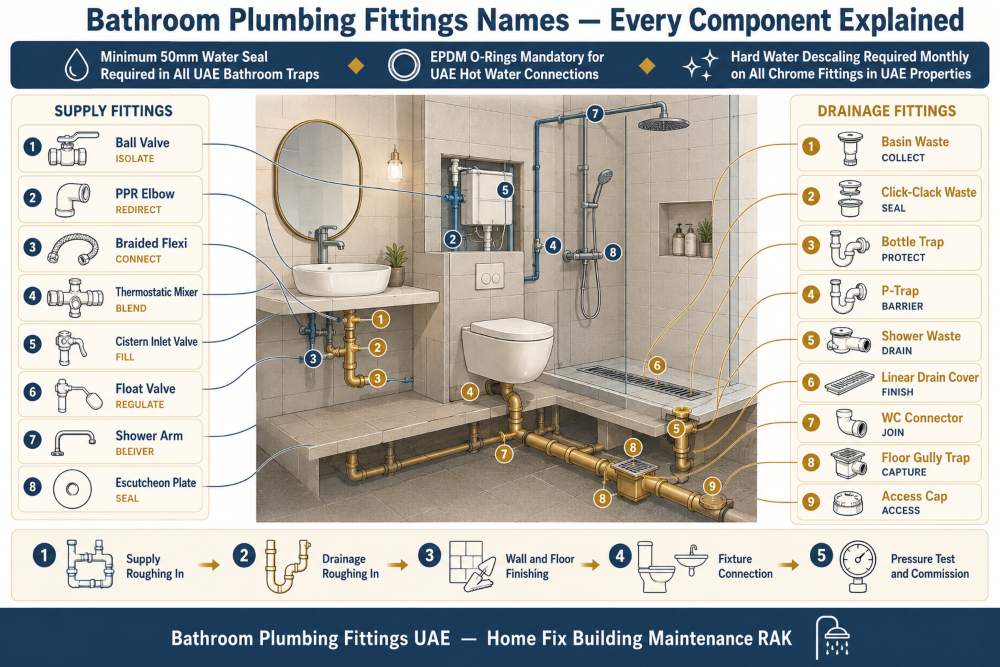
Bathroom Plumbing Fittings Names: Every Component Explained
The bathroom is the most intensive room in any UAE property. The following names cover all plumbing fittings in a standard UAE bathroom installation, from the supply connection at the isolation valve to the drainage connection at the soil stack.
The basin waste is the outlet fitting assembled through the washbasin waste hole. It includes the chrome waste body, a Rubber sealing washer beneath the basin, and a back nut. The click-clack waste has an integrated pop-up mechanism operated by pressing the waste cover, as standard in UAE mid- to high-range bathroom installations. The slotted waste allows water to drain even when the pop-up is in the closed position, via slots in the waste body the correct specification for the basin with an overflow.
The bottle trap is the water-seal fitting beneath the washbasin that connects the waste outlet to the drainage pipe while maintaining the sewer gas barrier. It consists of a bottle-shaped chamber that retains standing water and a lower outlet pipe. The deep-seal bottle trap retains a greater water column and is the correct specification in UAE bathrooms, where the trap may be subject to siphonage.
The P-trap is an alternative water-seal fitting to the bottle trap, shaped like the letter P in profile, used where the drainage pipe exits the wall horizontally rather than vertically through the floor.
The S-trap is shaped like the letter S in profile and is used where the drainage pipe exits vertically through the floor, common in older UAE properties built before horizontal-drainage bathroom design became standard.
The shower waste is the drain fitting installed in the shower floor, consisting of a body fixed to the drainage pipe below the floor screed, a water-seal trap, and a removable cover plate. The linear shower drain uses an elongated body and slot cover rather than a circular point drain, which is the standard specification in contemporary UAE bathroom renovations.
The toilet connector is the short, flexible, or rigid pipe that connects the toilet pan outlet to the soil pipe in the floor or wall. In UAE properties, the toilet connector includes a rubber gasket seal between the pan outlet and the connector body that must be replaced whenever the toilet is removed and reinstalled.
The cistern inlet valve is the float-operated or pressure-sensitive valve inside the toilet cistern that refills the cistern after each flush. The cistern flush valve is the outlet fitting at the base of the cistern that releases water into the pan when the flush is operated. Both require periodic replacement in UAE properties due to the combined effect of hard water scale buildup and chlorine content in the UAE municipal supply.
The shower valve body is the mixer fitting that controls the blended temperature and flow rate of the shower supply, as described in the fitting types section. The shower arm is the short, bent pipe that connects the shower valve outlet to the shower head, and it is fixed to the wall with an escutcheon plate that seals the wall penetration. The shower head is the terminal fitting that distributes water into the shower spray pattern.
PVC Fittings Names and Pictures Visual Reference Guide
PVC plumbing fittings are named consistently across the UAE market. Every UAE plumbing materials supplier and contractor uses the following standard names for PVC drainage fittings found throughout residential and commercial properties in the UAE.
The 90-degree socket bend is a quarter-turn directional fitting, the most commonly used fitting in any drainage system in the UAE. It changes a vertical soil pipe to a horizontal drainage direction at the base of the stack, routes a horizontal waste pipe around a structural column, and connects a basin waste to a wall-outlet drainage pipe.
The 45-degree socket bend is a directional fitting used where a gentler change of direction is required, typically at the top of a soil stack where the stack transitions from vertical to a slight offset, and in waste pipe runs where the 45-degree entry reduces turbulence and maintains better flow than a 90-degree entry.
The equal socket tee creates a 90-degree branch from a straight pipe run. The swept entry tee has a curved branch entry that introduces less turbulence into the drainage flow. The swept tee is the correct fitting at every branch entry point in a UAE soil stack.
The double-socket pipe is a standard length of PVC drainage pipe with a socket at each end, the connection component to which all fittings connect.
The boss pipe is a plain pipe length with a pre-formed saddle boss on the pipe body, used where a branch connection needs to be made to an existing straight run without cutting in a tee fitting.
The access cap is a threaded plug fitted into an access socket on the drainage system, allowing a drain cleaning rod or inspection camera to be inserted into the drainage run for maintenance. Access caps must be installed at every change of direction and at intervals of no more than 12 metres in UAE drainage systems to comply with building authority requirements.
The reducer socket connects a larger-diameter drainage pipe to a smaller-diameter pipe at the connection point between the main soil stack and the smaller-diameter branch waste pipes.
The pipe clip is the support fitting that secures the drainage pipe to the structure at regular intervals. PVC drainage pipe must be supported at maximum 500mm intervals on horizontal runs and maximum 1,200mm intervals on vertical runs to prevent sagging and joint stress.
Plumbing Pipe Fitting Names, Supply and Drainage Components
The table below provides a comprehensive reference of plumbing pipe fitting names for both supply and drainage systems, as used in UAE construction and maintenance projects.
| Fitting Name | System Function | Description |
|---|---|---|
| Elbow 90° | Supply and drainage | Direction change — quarter turn |
| Elbow 45° | Supply and drainage | Direction change — eighth turn |
| Equal Tee | Supply and drainage | Branch connection — same diameter |
| Reducing Tee | Supply and drainage | Branch connection — smaller branch |
| Swept Tee | Drainage | Low-turbulence branch at soil stack |
| Equal Coupling | Supply and drainage | Straight pipe extension |
| Reducing Coupling | Supply | Pipe diameter transition |
| End Cap | Supply | Pipe termination |
| Union | Supply | Demountable pipe connection |
| Nipple | Supply | Short threaded connector |
| Bushing | Supply | Internal thread reducer |
| Plug | Supply and drainage | Port seal |
| Flange | Supply | Bolted demountable connection |
| Access Cap | Drainage | Cleanout point access |
| Boss Pipe | Drainage | Site-formed branch connection |
| Reducer Socket | Drainage | Diameter transition |
| P-Trap | Drainage | Water seal — horizontal outlet |
| S-Trap | Drainage | Water seal — vertical outlet |
| Bottle Trap | Drainage | Water seal — basin below |
| Floor Gully | Drainage | Floor drainage water seal |
| Pipe Clip | Supply and drainage | Structural pipe support |
| Escutcheon Plate | Supply | Wall penetration cover fitting |
Sanitary Plumbing Fittings Names and Applications in UAE Bathrooms
Sanitary plumbing fittings are the specific term for all fittings used in the sanitary toilet and human waste section of the UAE drainage system. These fittings operate under conditions different from those of general waste fittings. They carry both solid and liquid waste, and they must maintain a complete odour seal at all times. They connect directly to the soil stack, which carries gases generated by the sewage system below.
The WC connector is the fitting that connects the toilet pan outlet to the soil pipe entry in UAE properties. It is typically a flexible rubber push-fit connector with a spigot end for the pan outlet and a socket end for the soil pipe, allowing small positional adjustments needed when replacing a toilet in an existing UAE bathroom, where the pan position rarely aligns precisely with the soil pipe position.
The soil pipe is the large-bore drainage pipe, typically 110mm in diameter, in UAE residential properties that carries toilet waste from all floors of the building to the underground drain at the base of the stack. Every fitting in the soil pipe system must maintain an airtight seal, as soil pipes carry both liquid waste and the gases generated by sewage decomposition below.
The vent cowl is the terminal fitting at the top of the soil stack vent pipe. It allows air to enter the drainage system to equalise pressure, but prevents birds and debris from entering the open pipe end. In UAE properties, the vent cowl must be rated for UV exposure and roof-level temperature extremes; standard plastic cowls not UV-stabilised crack and fail within two to three years on an exposed UAE rooftop.
The access junction is a tee fitting with a large screwed access cap on the branch port used at the base of the soil stack, where it transitions from vertical to horizontal to provide access for drain-clearing equipment. This fitting must be installed at every UAE soil stack base. It must remain accessible throughout the life of the building; enclosing it behind permanent finishes without providing an access panel is a building defect that prevents essential maintenance and violates UAE building code requirements.
Plumbing Materials and Fittings in the UAE: What Everything Costs
Plumbing materials in the UAE range from under AED 1 for a standard PVC pipe clip to over AED 2,000 for a commercial-grade pressure-reducing valve, and understanding what each component should cost protects property owners from overpriced quotations and substandard material substitutions. The prices below reflect the UAE market in 2026 across Dubai and Ras Al Khaimah.
Plumbing Materials Prices in Dubai and RAK 2026 Guide
Plumbing material costs in the UAE are influenced by four factors: material type, brand origin, purchase quantity, and supplier location. European- and Japanese-branded fittings command a 30 to 60 percent premium over equivalent Chinese-manufactured fittings of the same specification. That premium is justified for high-stress components, valve bodies, pressure-reducing valves, thermostatic mixers, and soft-close hinge hardware, where failure has serious consequences. It is less justified for standard pipe fittings in concealed supply runs where the material specification matters more than the brand name on the fitting body.
The table below provides indicative retail prices for the most common plumbing materials purchased in the UAE market in 2026. Contractor purchase prices are typically 20 to 35 percent below these retail figures, depending on volume and supplier relationships.
Plumbing Material Price List (AED)
| Plumbing Material | Unit | Indicative Price Range (AED) |
|---|---|---|
| PPR pipe 20mm per metre | Metre | 4 – 9 |
| PPR pipe 25mm per metre | Metre | 6 – 14 |
| PPR pipe 32mm per metre | Metre | 9 – 20 |
| PPR elbow 20mm | Each | 2 – 6 |
| PPR tee 20mm | Each | 3 – 8 |
| PPR union 20mm | Each | 8 – 18 |
| PPR ball valve 20mm | Each | 15 – 45 |
| UPVC drainage pipe 50mm per metre | Metre | 8 – 18 |
| UPVC drainage pipe 110mm per metre | Metre | 22 – 45 |
| UPVC 90-degree bend 110mm | Each | 12 – 28 |
| UPVC equal tee 110mm | Each | 18 – 40 |
| Copper pipe 15mm per metre | Metre | 18 – 35 |
| Copper pipe 22mm per metre | Metre | 28 – 55 |
| Brass ball valve 15mm | Each | 25 – 80 |
| Brass compression elbow 15mm | Each | 8 – 22 |
| DZR brass union 15mm | Each | 35 – 90 |
| Pressure reducing valve 15mm | Each | 80 – 350 |
| Thermostatic mixing valve | Each | 150 – 800 |
| Float valve rooftop tank | Each | 25 – 120 |
| Flexible braided hose 300mm | Each | 12 – 45 |
| PTFE thread seal tape | Roll | 2 – 8 |
| Pipe clip 20mm per piece | Each | 1 – 4 |
| Solvent cement UPVC 500ml | Tin | 18 – 40 |
| Bottle trap chrome | Each | 25 – 120 |
| Floor gully trap 110mm | Each | 35 – 120 |
PVC Pipe and Fittings Prices in the UAE
PVC pipe and fittings are the most price-competitive plumbing materials in the UAE market because they are manufactured locally and regionally in high volumes. Several UAE-based manufacturers produce UPVC drainage pipes and fittings that meet the relevant BS and ISO standards at significantly lower cost than equivalent European imports.
Standard UPVC drainage pipe in 110mm diameter, the main soil stack size in UAE residential properties, costs between AED 22 and AED 45 per metre at retail, depending on wall thickness and brand. The lighter Class B wall thickness is adequate for above-ground drainage in residential properties in the UAE. The heavier Class D wall thickness is required for below-ground and buried drainage applications where soil loads and ground movement place additional stress on the pipe body.
PVC pipe fittings prices follow the pipe price in their range of variation. A standard 110mm 90-degree socket bend costs between AED 12 and AED 28. A 110mm equal socket tee costs between AED 18 and AED 40. A 110mm access cap costs between AED 15 and AED 35. These price variations reflect the difference between locally manufactured and European-imported fittings, both of which meet the required standard for UAE residential drainage applications when purchased from a reputable supplier.
The one area where the lower-cost, locally manufactured option should be avoided is the access cap and cleanout fitting. These components are removed and replaced regularly during maintenance. The thread quality of budget fittings deteriorates after the first two to three removal cycles, eventually making the cap impossible to remove without destruction.
Plastic Pipe Prices in the UAE Market
Plastic pipe in the UAE market covers four distinct material types, each with its own price point, performance profile, and correct application.
PPR pipe is priced at AED 4 to AED 9 per metre for 20mm diameter and AED 9 to AED 20 per metre for 32mm diameter at retail. PPR pipe prices vary significantly between the entry-level, locally manufactured product and the premium, European-manufactured product. The performance difference between these two price points is most significant in sustained high-temperature applications. UAE hot water supply running continuously at 80 to 85°C for years reveals quality differences that a short-term pressure test at installation will not detect. For the UAE hot water supply, mid- to upper-range PPR pipe from an established manufacturer with verifiable pressure and temperature test certification is the correct specification.
UPVC drainage pipe is priced as described in the PVC section above, as the lowest-cost plastic pipe type in the UAE market for its size.
PEX pipe for manifold supply systems costs between AED 8 and AED 18 per metre for a 16mm diameter at retail, higher than PPR for the equivalent supply pipe size, but justified by the elimination of intermediate fittings in the run, which significantly reduces total system fitting cost in manifold-fed installations.
HDPE pipe for underground applications costs between AED 12 and AED 30 per metre for a 25mm diameter. At retail, the price premium over UPVC is justified by its superior flexibility and resistance to ground movement in UAE soil conditions.
Where to Source Plumbing Supplies in Dubai and Ras Al Khaimah
Plumbing supplies in Dubai are available from a concentrated cluster of plumbing material suppliers and shops located in the Deira building materials district, the Al Quoz industrial area, and the Ras Al Khor industrial zone, the three primary plumbing supply districts in Dubai where the majority of contractors and trade buyers source materials for UAE projects.
Plumbing supplies in Ras Al Khaimah are available from building material suppliers concentrated along the Al Nakheel Road industrial strip, in the Al Hamra Industrial Zone, and in the RAK City commercial district. The RAK plumbing supply market is smaller than Dubai’s. Still, it covers all standard materials for residential and commercial projects, with the added advantage that locally sourced materials avoid the transport costs and lead times associated with sourcing everything from Dubai for RAK-based projects.
For property owners sourcing specific fittings for maintenance or repair rather than bulk project materials, plumbing fittings near me searches in both Dubai and RAK return a range of hardware stores and building material shops that stock standard residential fittings, PVC drainage fittings, PPR supply fittings, brass ball valves, flexible connectors, and standard trap assemblies. For non-standard sizes, specialist dimensions, or commercial-grade components, a trade plumbing supplier or pipe fittings supplier with a full catalogue and import capability is the correct source.
For branded European fittings, Geberit drainage systems, Viega press-fit systems, Watts pressure equipment, and equivalent premium brands, the correct source is an authorised distributor with a UAE stockist agreement rather than a general hardware store. Authorised distributors provide genuine products with manufacturer warranty support, technical data sheets, and the installation training that these systems require. Purchasing branded fittings from non-authorised sources in the UAE market carries a significant risk of counterfeit products, a problem documented across multiple fitting categories in the UAE building materials market.
Plumbing Fit Out Materials and Fittings for Complete UAE Installations
A plumbing fit-out is the complete Supply and installation of all plumbing materials and fittings for a new or renovated UAE property, from the municipal connection point to the final fixture connection at every tap, shower, toilet, and appliance in the building.
The materials and fittings required for a complete plumbing fit-out of a standard three-bedroom UAE villa, including all supply pipework, drainage, sanitary fittings, valve assemblies, rooftop tank fittings, and water heater connections, are estimated to cost between AED 18,000 and AED 45,000 in materials alone at 2026 UAE market prices, depending on the specification level and the brand origin of the fittings. This figure excludes sanitary fixtures, the washbasins, toilets, showers, and baths themselves, which are typically specified and supplied separately by the client or interior designer.
A complete plumbing fit-out materials list for a UAE villa includes the following main categories: Supply PPR or copper supply pipework and fittings, including elbows, tees, reducers, unions, and end caps, for the complete hot and cold distribution system. Drainage pipework and fittings UPVC soil and waste pipes with all bends, tees, access caps, and floor gullies for the complete drainage system. Valve assemblies, ball valves, pressure reducing valves, check valves, and thermostatic mixing valves at all specified positions in the system. Rooftop tank fittings, float valve, tank connectors, isolation valves, overflow fitting, and drain fitting for the storage tank installation. Flexible connectors, isolation valves, a pressure relief valve, and an expansion vessel for the water heater installation. Sanitary fittings: all trap assemblies, waste fittings, cistern valves, WC connectors, and shower wastes for the complete bathroom and kitchen fit-out. Support and fixing materials, pipe clips, brackets, wall plugs, and screws for the complete pipe support system throughout the building.
The labour cost for a complete plumbing fit-out of a three-bedroom villa in Ras Al Khaimah is estimated at AED 15,000 to AED 35,000, depending on the complexity of the system, the accessibility of the pipe routes, and the specification of the fixtures being connected. Combined materials and labour for a complete villa plumbing fit-out in RAK in 2026 range from AED 33,000 to AED 80,000, a significant investment that underlines why correct material specification from the outset matters so much for the long-term performance and maintenance costs of the system.
How to Choose the Right Plumbing Fittings for UAE Properties
Choosing the right plumbing fitting for a UAE property means matching three variables simultaneously: material, type, and size, to the specific application, the operating conditions, and the pipe system it connects to. Getting any one of these three wrong results in a premature failure of the fitting in the Gulf climate, regardless of how well it was installed.
How the UAE Climate Affects Plumbing Fitting Material Choice
The UAE climate attacks plumbing fittings through four simultaneous mechanisms that do not occur together anywhere else in the world. Understanding these mechanisms is the foundation for selecting the correct fitting for any UAE plumbing application.
The first mechanism is sustained heat. UAE supply pipe surface temperatures in uninsulated ceiling voids and wall chases regularly reach 55 to 65°C in summer, well above the operating limit of standard PVC fittings rated to 60°C. A fitting operating continuously at or near its rated temperature limit degrades faster than one operating well within its rating. The correct response is to specify fittings with a temperature rating at least 30°C above the maximum expected operating temperature, which rules out standard PVC for any UAE hot-water application and makes PPR the default for supply fittings.
The second mechanism is thermal cycling. UAE properties cycle between air-conditioned interior temperatures of 20 to 24°C and ambient temperatures of 45°C or above multiple times daily. Every thermal cycle expands and then contracts the pipe and fitting body. Over thousands of cycles across a UAE service life, this movement fatigues the joint between the fitting and the pipe, loosening compression ring grips, stressing solvent-weld joints, and opening gaps at push-fit O-ring seals if the O-ring compound is not rated for the temperature range. The correct response is to use fusion-welded PPR for all concealed UAE supply connections where thermal cycling cannot be monitored, and to specify EPDM O-rings for all push-fit and valve-seat applications.
The third mechanism is hard water mineral deposition. UAE municipal water has a total dissolved solids content that regularly exceeds 500 milligrams per litre, which is classified as very hard water by international standards. At elevated supply temperatures, these minerals precipitate out of solution and deposit on the internal surfaces of pipe fittings as calcium carbonate scales. Over time, scale reduces the internal bore of the fitting, increases flow resistance, and eventually blocks narrow-bore components, such as strainer meshes, thermostatic cartridges, and float valve seats. The correct response is to install a whole-property water softener or scale inhibitor upstream of the distribution system, and to specify fitting types with accessible and replaceable internal components at high-scale-risk locations.
The fourth mechanism is UV degradation. UAE solar radiation levels are among the highest in the world, and the UV index regularly reaches 11-12 in summer, which is classified as extreme. Any polymer fitting exposed to direct sunlight without UV stabilisation becomes brittle within two to three years. The correct response is to use only UV-stabilised polymer fittings in any exposed outdoor or rooftop application, and to protect all external supply pipes with either UV-resistant insulation or a physical cover that excludes direct sunlight.
PPR vs Copper vs PVC: Which Fitting Material Is Correct for Your UAE Application?
The answer depends entirely on where in the plumbing system the fitting is located and what it is carrying. No single material is correct for every application in a UAE property. The correct approach is to specify each material for the specific conditions it will face.
PPR fittings are suitable for all concealed hot- and cold-water supply connections in residential and commercial properties in the UAE. The heat-fusion joint eliminates the mechanical connection that is the weakest point in all other fitting types. The 95°C temperature rating provides the required margin above UAE hot water operating temperatures. The 50-year rated service life at design conditions matches the expected building service life. PPR is the correct default specification for every concealed UAE supply fitting where the connection cannot be easily accessed for future maintenance.
Copper fittings are correct for high-specification UAE residential and commercial supply systems where the premium cost is justified by the client’s specification requirements, where natural antimicrobial properties are a priority in the water supply context, or where the existing supply system is copper and maintaining material consistency avoids the galvanic corrosion risk that occurs at a direct junction between copper pipe and PPR or PVC fittings. Copper is also appropriate for short, exposed supply pipe runs between the wall isolation valve and the fixture inlet in visible bathroom applications, where its clean appearance and durability are appropriate for an exposed location.
Brass fittings are correct at every transition point between the plastic supply system and a metal component valve bodies, appliance inlets, fixture connections, and equipment ports. Brass provides the threaded connection strength that plastic cannot match, the corrosion resistance that mild steel lacks in UAE water conditions, and the mechanical durability that chrome-plated zinc alloy fittings do not deliver in sustained use in the UAE. DZR brass is correct for all UAE potable water applications; standard brass is not.
PVC fittings are correct for all UAE drainage, waste, and soil pipe applications above ground, and for cold water supply in applications where the temperature will not exceed 40°C. PVC is not suitable for hot-water Supply, outdoor UV-exposed applications, or buried drainage in traffic-bearing areas, where ABS or HDPE provides the required impact and load resistance.
Appliance and tap connections, Braided stainless steel flexi, Flexible, pressure and temperature rated
How to Match Fitting Size and Type to UAE Pipe Systems
The nominal pipe size specifies fitting size in UAE plumbing systems, the standardised designation that corresponds to the pipe’s external or internal diameter, depending on the applicable pipe standard. PPR pipe complies with ISO 15874 and is sized by external diameter. 20mm, 25mm, 32mm, 40mm, and 50mm are the most common residential supply sizes. UPVC drainage pipes follow BS EN 1329 and are sized by external diameter: 32mm, 40mm, 50mm, 75mm, and 110mm are the residential drainage sizes.
The fitting must match the pipe in all three dimensions: nominal size, connection type, and pressure class. A PPR elbow fitting for a 20mm pipe matches the 20mm external diameter of the pipe and is fusion-welded using a 20mm socket fusion tool. If a 25mm fitting is used on a 20mm pipe, a common site substitution when the correct size is not immediately available, the fusion joint is mechanically unsound and will fail under UAE operating pressure. There are no acceptable size substitutions in pressure-rated supply systems.
Pressure class matching is equally critical. PPR pipe and fittings are manufactured in PN10, PN16, and PN20 pressure classes rated to 10, 16, and 20 bar operating pressure, respectively. The fitting pressure class must match or exceed the pipe pressure class. Using a PN10 fitting in a PN16 system creates a weak point at the fitting, limiting the system’s operating pressure to the lower rating and increasing the risk of failure in UAE properties where mains pressure surges above 10 bar are common without a pressure-reducing valve upstream.
For drainage systems, fitting size matching follows a simpler rule: the fitting socket diameter must match the pipe external diameter exactly, and the fitting type must match the drainage function at that location. A 110mm soil stack requires 110mm fittings throughout. A 50mm basin waste pipe requires 50mm fittings for its connection to the soil stack via a 50mm-to-110mm boss or a swept-entry tee. Reducing the drainage pipe size at any point in the run by using a smaller fitting to connect two larger pipes creates a restriction that blocks solid waste and causes drainage problems, among the most frequent maintenance calls in UAE residential properties.
Common Plumbing Fitting Mistakes in UAE Properties and How to Avoid Them
The following fitting mistakes are the most frequently identified causes of premature plumbing failure in residential and commercial properties in the UAE. Each is avoidable with correct specification at the design and procurement stage.
Using standard MDF instead of a moisture-resistant specification for plumbing is equivalent to using standard PVC fittings for the hot water supply. It is the most common material specification error in plumbing installations in the UAE. Standard PVC softens above 60°C. UAE hot water supply regularly exceeds this temperature. The result is deformation at the fitting socket, loss of joint integrity, and a leak inside a wall or ceiling, causing water damage disproportionate to the cost of the correct PPR fitting that should have been used. Prevention is straightforward: any fitting on any pipe carrying water above 60°C must be PPR, copper, or brass. No exceptions.
Using standard brass rather than DZR brass in potable water systems in the UAE. Standard brass with a high zinc content dezincifies in UAE hard water over 3 to 7 years, crumbling internally while maintaining its external appearance. The fitting appears intact until it suddenly fails under pressure. DZR brass costs marginally more, typically 10 to 20 percent, and eliminates this failure mode. Every brass fitting in a UAE potable water system should be DZR specified.
Installing push-fit fittings with standard O-rings on the hot water supply. Standard nitrile O-rings rated to 80°C fail prematurely in UAE hot water supply applications where sustained temperatures regularly approach or exceed this limit. The O-ring loses its elasticity, the seal relaxes, and the fitting begins to weep at the push-fit interface, typically inside a ceiling void, where the leak is not discovered until the ceiling below shows water damage. Prevention is to specify only push-fit fittings with EPDM O-rings rated to 95°C for any UAE hot water supply application.
Omitting union fittings from serviceable components. A UAE plumbing installation without union fittings at the water heater, pump, pressure-reducing valve, and water meter requires the contractor to cut live pipework whenever any of these components need servicing or replacement. Over the service life of a UAE property, this omission costs significantly more in maintenance labour than the union fittings themselves. Every serviceable component in a UAE plumbing system requires a union fitting on at least one side of its connection, and two unions when the component needs to be completely removed from the system.
Using non-UV-stabilised polymer fittings in exposed outdoor or rooftop locations. UAE solar radiation causes non-UV-stabilised polymer fittings to become brittle within two to three seasons of outdoor exposure. Float valves on rooftop tanks, pipe clips on external supply runs, and hose fittings on outdoor tap connections made from standard polymer fail consistently in UAE outdoor conditions. UV-stabilised alternatives are available at a marginal cost premium and deliver the expected service life in outdoor applications in the UAE. Prevention requires specifying UV stabilisation as a mandatory requirement for every polymer fitting used in any outdoor, rooftop, or exposed UAE plumbing application, without exception.
Conclusion
Plumbing fittings are the most consequential components in any UAE property’s water system, more consequential than the pipes themselves, because the fittings are where the system is most vulnerable and where the UAE climate applies the most concentrated stress. A pipe run fails along its length. A fitting failure at its joint, or joint failure within a wall, ceiling, or floor screed, in a UAE property, can cause disproportionate water damage, given the cost of the fitting.
The UAE climate does not forgive specification errors. Standard PVC on a hot water supply line, standard brass in UAE hard water, standard O-rings on a UAE hot water push-fit connection, and non-UV-stabilised polymer on a RAK rooftop tank. Each of these errors produces a predictable failure within a predictable timeframe. The errors are not discovered at installation because every incorrect fitting passes a standard pressure test when new. They are discovered two to five years later, when the fitting degrades to the point of failure under the sustained conditions imposed by the UAE’s relentless climate.
The correct approach is straightforward. Specify PPR for all concealed supply connections. Specify DZR brass at all valve bodies and transition points. Specify EPDM O-rings for all push-fit and valve-seat applications. Specify UV-stabilised polymer for all outdoor and rooftop fittings. Specify UPVC for all above-ground drainage and HDPE for all below-ground drainage. Match every fitting to its pipe on nominal size, connection type, and pressure class without substitution. Install union fittings at every serviceable component.
These are not premium specifications; they are correct specifications for the UAE environment. The cost difference between correct and incorrect fitting specifications at the time of installation is small. The cost difference between a plumbing system that performs reliably for 20 years and one that requires emergency repairs every 3 to 5 years is very large.
Home Fix Building Maintenance provides professional plumbing works in Ras Al Khaimah, covering new installations, maintenance programmes, emergency repairs, and complete plumbing fit-out projects for residential and commercial properties throughout Mina Al Arab, Al Marjan Island, Pacific Al Marjan Island, Bab Al Bahr, Al Riffa, Al Jazeera Al Hamra, and Qaryat Al Hamra. Our team specifies only climate-appropriate fittings and materials, provides fully itemised written quotations before any work begins, and backs all artistry with a clear warranty.
Contact Home Fix today to discuss your plumbing project or request a free site visit and quotation.
Frequently Asked Questions (FAQs)
What Are the Most Common Types of Plumbing Fittings Used in UAE Homes?
The most common plumbing fittings in UAE residential properties are PPR elbows and tees for hot and cold supply connections, UPVC bends and tees for drainage and soil systems, brass ball valves at every isolation point, bottle traps and P-traps beneath every sanitary fixture, flexible braided hose connectors at tap and appliance inlets, float valves on rooftop storage tanks, and pressure reducing valves on the main supply inlet. These fittings are found in every UAE villa and apartment, regardless of age, specification level, or location across the Emirates.
What Is the Difference Between a Union Fitting and a Coupling?
A coupling is a permanent straight connector that joins two pipes of the same diameter end-to-end. Once installed, it cannot be separated without cutting the pipe. A union fitting is a three-piece demountable connector that joins two pipes and allows them to be disconnected and reconnected without cutting. In UAE plumbing systems, couplings are used throughout concealed pipe runs where permanent connections are correct. Union fittings are used on serviceable components, such as water heaters, pumps, pressure-reducing valves, and water meters, where the component needs to be removed periodically for maintenance or replacement without dismantling the surrounding pipework.
What is a push-fit plumbing fitting, and is it reliable in UAE Conditions?
A push-fit plumbing fitting creates an instant pipe connection by inserting the pipe end into the fitting body until it locks into an internal grab ring, with an O-ring providing the water seal. Push-fit fittings are reliable in UAE conditions when correctly specified; the critical requirement is that the O-ring compound must be EPDM-rated to 95°C for hot-water applications. Standard push-fit fittings with nitrile O-rings rated to 80°C are not reliable in UAE hot-water supply conditions, where sustained operating temperatures regularly approach or exceed that limit. For cold-water Supply and drainage applications, standard push-fit fittings perform reliably in UAE conditions throughout their rated service life.
Which Plumbing Fittings Are Best for Hot Water Supply Systems in the UAE?
PPR heat-fusion fittings are the best plumbing fittings for hot water supply systems in the UAE. The heat-fusion joint creates a monolithic connection with no mechanical interface, no sealant, and no potential leak path. It is structurally stronger than the pipe body itself when correctly made. PPR fittings are rated for continuous operation at 95 °C and 20 bar, providing the required margin above UAE hot water supply conditions. At the connection point between the PPR supply system and the hot water fixture, the tap, shower valve, or appliance inlet, DZR brass compression or threaded fittings are the correct transition specification. Copper fittings with solder-joint connections are the correct premium alternative to PPR where the project specification requires a metal supply system throughout.
Where Can I Buy Plumbing Fittings and Materials in Dubai and RAK?
Plumbing supplies in Dubai are sourced from trade suppliers concentrated in the Deira building materials district, the Al Quoz industrial area, and the Ras Al Khor industrial zone. These suppliers offer the full range of PPR, UPVC, copper, and brass fittings for residential and commercial projects in the UAE at trade prices. For retail purchase of standard fittings, replacement traps, ball valves, and standard UPVC drainage fittings, hardware stores throughout Dubai stock the most common sizes and specifications. Plumbing fittings near me searches in Dubai return both trade suppliers and retail hardware outlets, depending on the quantity and specification required. In Ras Al Khaimah, plumbing supplies are available from building material suppliers along the Al Nakheel Road industrial strip and in the RAK City commercial district. For specialist or non-standard fittings, large-bore valves, marine-grade components, or branded European systems, a pipe fittings supplier with import capability and a full product catalogue is the correct source in both Dubai and RAK.
What Is the Difference Between PVC and PPR Fittings for UAE Plumbing?
PVC and PPR fittings serve different systems in UAE properties and are not interchangeable. PVC fittings correctly specified as UPVC in UAE drainage applications are solvent-weld connectors used for drainage, waste, and soil pipe systems. They are not rated for hot water supply temperatures and are not used in pressurised supply systems. PPR fittings are heat-fusion welded connectors used for pressurised hot and cold water supply systems. They are rated for 95°C and 20 bar conditions, which are similar to the hot-water supply conditions in the UAE. The fundamental difference is the joining method and the temperature rating. Solvent-weld PVC joints bond at ambient temperature and are adequate for drainage. Heat-fusion PPR joints create a monolithic polymer connection rated for sustained high-temperature, pressurised service. Supply the correct specification for all concealed UAE supply connections.
What Plumbing Fittings Are Used for Bathroom Installations in UAE Properties?
A complete UAE bathroom plumbing installation uses the following fittings across the supply and drainage systems. On the supply side, PPR or copper elbows and tees to route supply pipes to each fixture position, brass ball valves as isolation valves beneath each fixture, and flexible braided hose connectors linking the rigid supply pipes to the tap or mixer valve inlets. On the drainage side, basin waste outlets and bottle traps beneath washbasins; shower waste assemblies with integrated traps beneath shower floors; bath trap and overflow assemblies connecting the bath to the drainage pipe; WC connectors linking the toilet pan outlet to the soil pipe; and floor gully traps in wet room floor areas. All bathroom drainage fittings must maintain a water seal of at least 50mm depth to prevent sewer gas from entering the bathroom, a requirement that applies regardless of the fixture type or the fitting specification used.
How Do I Know If a Plumbing Fitting Is the Correct Size for My Pipe?
Match the fitting to the pipe in three dimensions: nominal size, connection type, and pressure class. The nominal size is marked on both the pipe and the fitting body: 20mm, 25mm, 32mm for PPR supply pipe, and 50mm, 75mm, 110mm for UPVC drainage pipe in UAE residential applications. The fitting nominal size must match the pipe nominal size exactly; there are no acceptable size substitutions in pressurised supply systems. The connection type must match the pipe end: a socket fusion PPR fitting requires a plain pipe end prepared to the correct insertion depth; a solvent-weld UPVC fitting requires a plain pipe end cleaned and primed before cementing; and a compression fitting requires a plain pipe end cut square and deburred. The pressure class marked on the fitting PN10, PN16, or PN20 for PPR must match or exceed the pressure class of the pipe. If any of these three dimensions do not match, the fitting is the wrong specification for the application, regardless of how it looks or how it fits on the pipe end.