Epoxy Flooring Ras Al Khaimah | Cost and Colours 2026
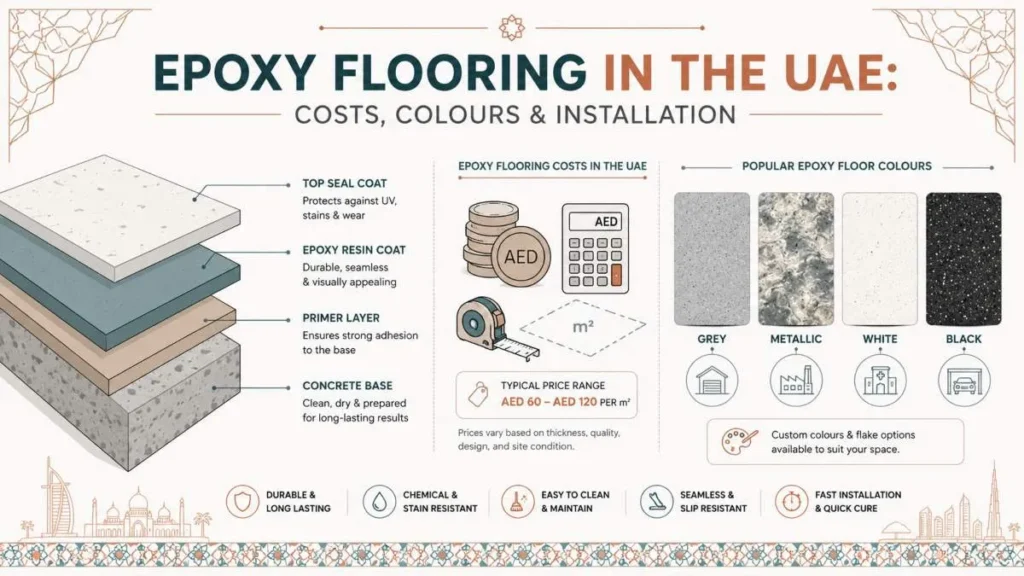
Epoxy flooring is a durable resin coating applied over concrete to create a seamless, high-gloss surface that resists heat, moisture, and heavy wear. In the UAE, it has become one of the most popular flooring choices for garages, warehouses, and even homes, thanks to its ability to withstand extreme summer temperatures without cracking or fading. This guide covers everything you need to know: how much epoxy flooring costs in Ras Al Khaimah, the different types and colours available, where it works best, and how to keep it looking new for years. Whether you’re flooring a villa garage or a commercial unit in Ras Al Khaimah, you’ll find clear, practical answers below.
What Is Epoxy Flooring?
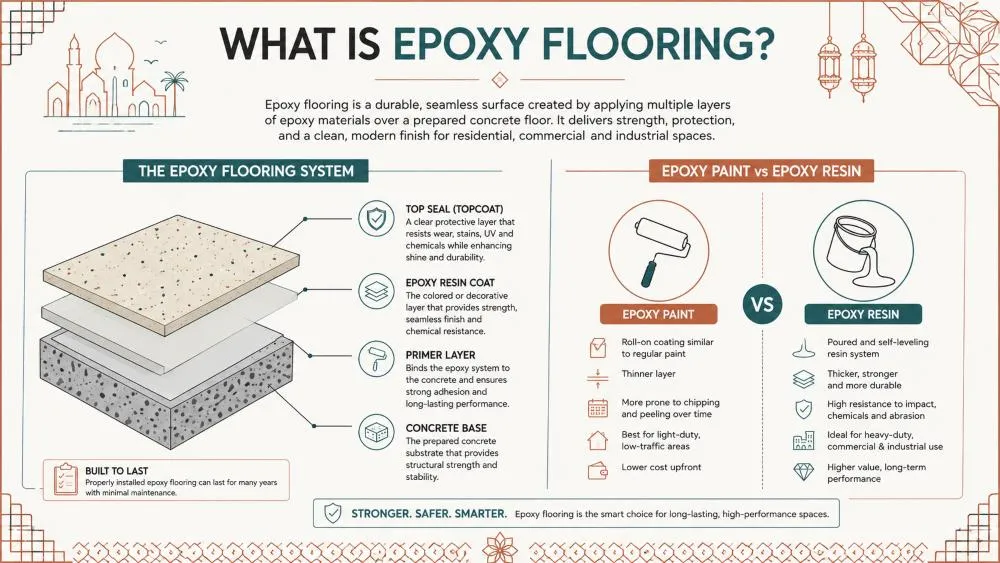
Epoxy flooring is a two-part resin system that hardens into a solid, glass-like surface when applied over concrete. It combines a resin and a hardener that chemically react to form a tough, plastic-like coating. Unlike a simple coat of paint, epoxy bonds to concrete at the molecular level, which is why it can withstand heavy foot traffic, vehicle loads, and chemical spills without wearing away.
Once cured, epoxy flooring is seamless, easy to clean, and highly resistant to the heat and humidity common across the UAE. It’s used in homes, garages, warehouses, and commercial spaces where standard flooring would wear out quickly.
Epoxy Resin vs Epoxy Paint
Epoxy resin and epoxy paint are often confused, but they are not the same product. Epoxy resin is a thick, multi-layer coating system that cures into a hard, durable surface several millimetres thick. Epoxy paint is a thinner, single-coat product with some epoxy content mixed in, but it lacks the strength and lifespan of true epoxy resin flooring.
Epoxy paint is cheaper and easier to apply, making it suitable for light-use areas or quick refreshes. Epoxy resin flooring costs more upfront but lasts far longer, resists heavier wear, and holds up better against the intense UAE heat.
How Epoxy Flooring Is Made
Epoxy flooring is built up in layers on top of a properly prepared concrete base. The process starts with grinding or shot-blasting the concrete to open its pores, which helps the epoxy bond properly. A primer coat is applied first to seal the surface, followed by one or more base coats of the epoxy resin mixture.
Depending on the type chosen, additional layers such as coloured flakes, metallic pigments, or anti-slip additives are added at this stage. A clear top coat is applied last to protect the surface and give it its final finish, whether matte or glossy. The floor is then left to cure for 24 to 72 hours before it can take light foot traffic.
Benefits of Epoxy Flooring for Ras Al Khaimah Homes
Epoxy flooring offers a combination of durability, low maintenance, and heat resistance that makes it well suited to Ras Al Khaimah homes. It doesn’t crack under temperature swings, resists staining from oil or chemicals, and cleans easily with just soap and water. For homeowners dealing with sand, dust, and high humidity, epoxy also creates a sealed surface that keeps moisture from seeping into the concrete below.
Beyond practicality, epoxy flooring gives homeowners a wide range of colours and finishes, from sleek metallic looks to marble-effect designs, without the ongoing upkeep that natural stone requires.
Heat & Humidity Resistance in the Gulf Climate
Epoxy flooring holds up well in the UAE’s extreme summer heat, which regularly pushes surface temperatures on unshaded floors above 50°C. Unlike some flooring materials that expand, warp, or discolour under heat stress, cured epoxy remains stable and doesn’t develop cracks from thermal expansion.
The seamless, non-porous surface also resists the humidity common in coastal areas like Ras Al Khaimah. Because there are no grout lines or seams, moisture can’t collect underneath the flooring, which helps prevent mould and mildew buildup over time.
Durability vs Tiles and Marble
Epoxy flooring outlasts standard tiles and marble in high-traffic or heavy-use areas. Tiles can crack under heavy furniture or dropped objects, and their grout lines wear down and stain over time. Marble, while attractive, is porous and prone to scratching, etching from acidic spills, and gradual dulling, all of which require periodic polishing.
Epoxy avoids these issues entirely. Its seamless surface has no grout to clean or reseal, and it resists scratches, impacts, and chemical spills far better than either tiles or marble. For homeowners who want a long-lasting floor with minimal maintenance, epoxy typically outperforms over a 10- to 15-year lifespan.
Types of Epoxy Flooring
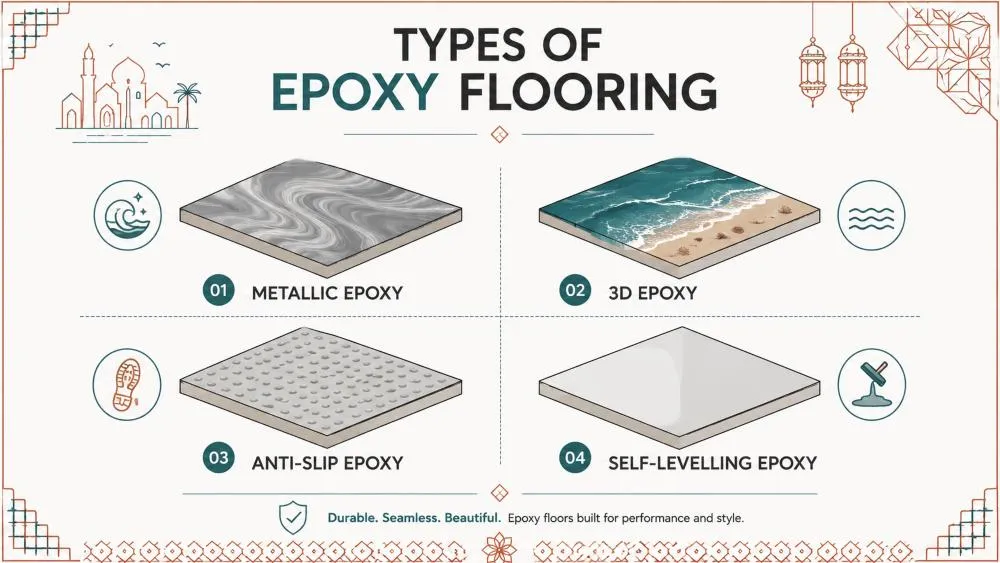
Epoxy flooring comes in several distinct types, each suited to different spaces and priorities. Some focus on visual impact, while others are built for safety or specialised functional needs. Choosing the right type depends on where the floor will go and how it will be used, whether that’s a showroom garage, a busy kitchen, or an industrial unit.
Metallic Epoxy
Metallic epoxy flooring uses specialised pigments that create a swirling, three-dimensional effect similar to marble or flowing water. The metallic particles react with the resin during curing, producing a unique, glossy pattern that’s never exactly repeated from one floor to the next. This type is popular for statement spaces such as living rooms, showrooms, and feature garages, where the floor itself becomes a design centrepiece.
3D Epoxy
3D epoxy flooring uses printed graphics or images sealed beneath a thick, transparent resin layer to create the illusion of depth. The image can be anything from an ocean scene to abstract art, and the clear top coat gives it a realistic, almost holographic appearance underfoot. It’s a striking option for feature areas but works best in low-traffic zones, since very high foot traffic over time can dull the visual clarity.
Anti-Slip / Anti-Static Epoxy
Anti-slip epoxy flooring incorporates a textured additive, such as fine aggregate, into the top coat to improve grip in wet or high-traffic areas like bathrooms, kitchens, and pool decks. Anti-static epoxy, by contrast, is formulated to dissipate static electricity and is typically used in server rooms, labs, or workshops with sensitive electronic equipment. Both types trade some of the glossy finish for added safety, making them practical choices where slip risk or static buildup is a concern.
Self-Leveling Epoxy
Self-leveling epoxy is a fluid resin system that spreads evenly across the floor to fill in minor cracks, dips, and imperfections, creating a perfectly smooth, level surface. It’s the go-to choice for garages, warehouses, and commercial units where the existing concrete isn’t perfectly flat. Because it flows naturally into low spots, it requires less manual labour to achieve an even finish compared to other epoxy application methods.
Epoxy Flooring Cost in Ras Al Khaimah
Epoxy flooring in Ras Al Khaimah typically costs between AED 8 and AED 45 per square foot, depending on the type, thickness, and level of surface preparation required. Basic solid-colour coatings sit at the lower end of that range, while decorative finishes like metallic or 3D epoxy cost significantly more due to specialised materials and labour. Standard residential coatings typically range from AED 40 to AED 60 per square metre, while decorative finishes such as metallic or 3D designs can reach roughly AED 200 per square metre.
Epoxy Flooring Price Guide (Ras Al Khaimah)
| Epoxy Type | Price (AED per sq ft) | Best For |
|---|---|---|
| Basic Solid-Colour Coating | 8 – 12 | Garages, Storage Rooms |
| Self-Leveling Epoxy | 10 – 16 | Uneven Concrete, Warehouses |
| Anti-Slip / Anti-Static Epoxy | 14 – 20 | Bathrooms, Kitchens, Workshops |
| Metallic Epoxy | 20 – 30 | Living Rooms, Showrooms |
| 3D Epoxy | 30 – 45+ | Feature Floors, Statement Spaces |
Prices are estimates based on current UAE market rates and vary by contractor, substrate condition, and project size. Contact Home Fix for an accurate quote based on your space.
What Affects Epoxy Flooring Price
Several factors determine the final cost of an epoxy flooring project. Surface preparation is the most critical factor, and cracked or uneven concrete that requires grinding and levelling can add AED 15-30 per square metre to the total. The thickness of the coating also plays a major role: a thin recoat costs far less than a heavy-duty layer several millimetres thick built for industrial machinery.
The type of epoxy chosen matters too. Self-leveling, quartz-filled, epoxy flake, and epoxy mortar systems each carry different price points based on materials and installation complexity. Larger projects often work out cheaper per square foot due to economies of scale, while custom colours, patterns, or metallic effects add to the overall cost.
Epoxy vs Tile Cost Comparison
Epoxy flooring is generally cheaper than tile flooring overall, though the exact comparison depends on the finish chosen. A basic epoxy coating usually costs less than mid-range ceramic or porcelain tiles once installation labour is factored in, and epoxy avoids the added cost of grout, sealing, and tile replacement over time.
Higher-quality tiles such as porcelain or clay can cost over AED 70 per square foot, well above even premium decorative epoxy finishes. For homeowners prioritizing long-term value over installation price, epoxy’s durability and low maintenance often make it the more cost-effective option over a 10- to 15-year period.
A note on the pricing: sources vary quite a bit (some quote per sq ft, others per sq m, and industrial vs residential framing shifts the numbers), so I built a consolidated, UAE-market-consistent range rather than picking one source. Worth double-checking these figures against a current supplier quote before publishing, since epoxy material costs can shift.
Epoxy Flooring Colours & Design Options
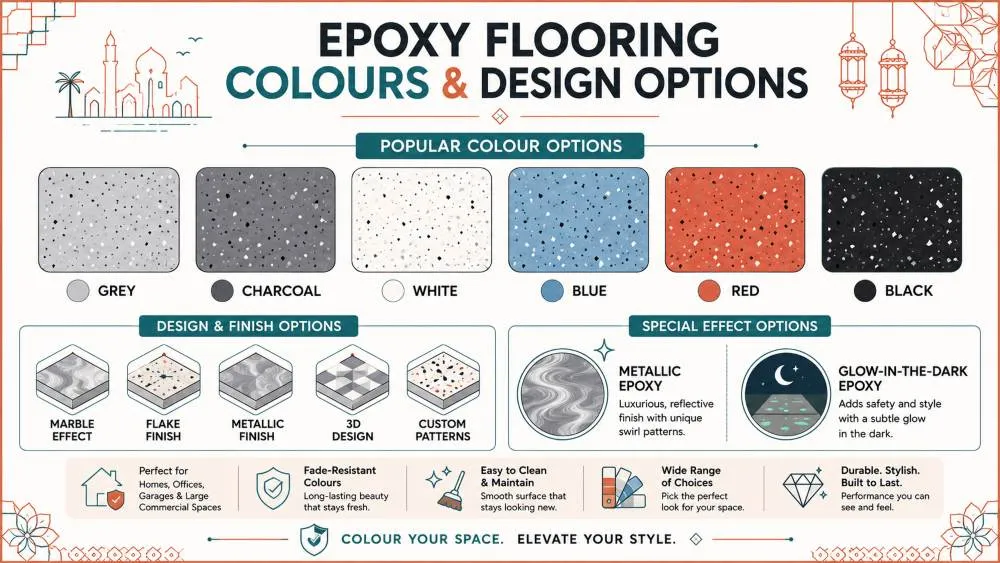
Epoxy flooring comes in a wide range of colours and finishes, giving homeowners far more design flexibility than standard tiles or marble. Because the resin is mixed before application, colours can be solid, blended, or layered with decorative elements like flakes or metallic pigments. The finish can also be adjusted from a high-gloss shine to a softer matte look, depending on the space and the mood you’re going for.
Popular Colour Trends
Grey remains the most requested epoxy colour in Ras Al Khaimah, valued for its neutral tone that suits both modern and industrial-style interiors. Light grey works well in living areas and showrooms, while darker charcoal tones are popular for garages and commercial units where practicality matters more than brightness.
White and off-white epoxy floors are favoured in villas and retail spaces for their clean, spacious feel, though they show dust more easily and may slightly yellow over time when exposed to direct sunlight. Bold colours like blue and red are common in workshops, playrooms, and commercial branding, where a strong visual identity matters more than subtlety. Black epoxy is often chosen for garages and warehouses for its sleek look and ability to hide stains.
Metallic & Glow-in-the-Dark Finishes
Metallic epoxy is one of the most sought-after design options, using specialised pigments that create a swirling, marble-like pattern with real depth and movement. No two metallic floors look exactly alike, since the pattern forms naturally as the resin cures, making it a popular choice for feature garages, living rooms, and high-end showrooms across Ras Al Khaimah.
Glow-in-the-dark epoxy takes design a step further by embedding photoluminescent particles into the resin. These absorb light during the day and release a soft glow at night, creating a striking effect in pool decks, outdoor entertaining areas, or statement interior spaces. While less common than metallic finishes, it’s growing in popularity among homeowners seeking something distinctive and modern.
Best Use Cases: Garage, Bathroom, Kitchen, Outdoor, Commercial
Epoxy flooring adapts well to almost any space, but the right type and finish depend heavily on how the area is used. High-traffic zones need thicker, more durable systems, while wet areas call for anti-slip additives and outdoor spaces need UV-stable formulas to prevent yellowing in direct sunlight. Matching the epoxy type to the use case is the difference between a floor that lasts 15 years and one that needs redoing within a few years.
Residential Applications
n garages, epoxy flooring is one of the most popular upgrades in Ras Al Khaimah, offering a durable surface that resists oil stains, tyre marks, and heat damage from parked vehicles. A self-leveling or metallic finish works well here, combining strength with a showroom-quality look.
Bathrooms and kitchens benefit from anti-slip epoxy, which reduces the risk of slipping on wet surfaces while remaining fully waterproof and easy to wipe clean. In kitchens specifically, epoxy resists oil splatters and food stains better than grouted tile, with no seams for spills to collect in.
Outdoor spaces such as terraces, pool decks, and driveways need a UV-resistant epoxy formula, since standard resin can yellow or fade when exposed to direct UAE sunlight for extended periods. Textured or anti-slip finishes are recommended here as well, particularly around pool areas, where the surface is often wet.
Living rooms and other indoor feature areas are where metallic and 3D epoxy shine, since these low-traffic spaces can showcase decorative finishes without the wear concerns of a garage or kitchen floor.
Commercial & Warehouse Applications
Warehouses and industrial units require heavy-duty epoxy systems built to withstand forklift traffic, dropped equipment, and constant foot and vehicle movement. Thicker self-leveling epoxy, often several millimetres deep, is standard here, sometimes paired with anti-static properties for spaces housing sensitive electronics.
Commercial spaces like showrooms, retail units, and offices tend to prioritise appearance alongside durability, making metallic or solid-colour epoxy popular choices that project a polished, professional image to customers and clients.
Car parks and multi-storey parking structures benefit from anti-slip epoxy coatings that handle constant vehicle traffic while resisting oil leaks and tyre wear, with line-marking often built directly into the final coat for parking bay demarcation.
The Installation Process (Thickness, Primer, Sealing, Curing)
Installing epoxy flooring is a multi-step process that determines how long the finished floor will last, and skipping steps is the most common reason epoxy fails early. The process starts with preparing the concrete, then builds up in layers to reach the required thickness before finishing with a protective top coat.
The first step is surface preparation, usually done by grinding or shot-blasting the concrete to open its pores and remove any existing coatings, oil stains, or loose material. Any cracks or uneven patches are repaired at this stage, since epoxy will highlight rather than hide flaws in the base surface.
Once the concrete is ready, a primer coat is applied to seal the surface and help the epoxy bond properly. Skipping the primer is one of the most common causes of peeling or bubbling later on. After the primer cures, one or more base coats of the epoxy resin are applied, with the number of layers depending on the required thickness, typically anywhere from 250 microns for a light recoat to several millimetres for heavy-duty industrial floors.
Any decorative elements, such as coloured flakes, metallic pigments, or anti-slip aggregate, are broadcast into the base coat while it’s still wet. Finally, a clear sealing top coat is applied to protect the floor, lock in the design, and give it the desired finish, whether matte, satin, or high-gloss.
How Long Does Installation Take
A standard residential epoxy floor typically takes two to four days from start to finish, factoring in surface preparation, primer curing, base coat application, and the final seal. Larger commercial or industrial projects can take a week or more, depending on the area size and the thickness of the system being installed.
The floor is usually walkable within 24 hours of the final coat, but it needs longer to fully cure before it can handle heavy use. Light foot traffic is generally safe after 24 to 48 hours, while vehicles, heavy furniture, or industrial equipment should be kept off the floor for at least 5 to 7 days to allow the epoxy to reach full hardness.
Maintenance & Repair
Epoxy flooring is one of the lowest-maintenance options available, especially compared to grouted tile or natural stone, which require regular sealing and polishing. Its seamless, non-porous surface means there’s nowhere for dirt or moisture to collect, but a few simple habits go a long way toward keeping it looking new for well over a decade.
Cleaning Epoxy Floors
Day-to-day care just needs sweeping or a soft-bristle vacuum to clear away dust and grit, since gritty debris can gradually scratch the glossy surface if it’s dragged across underfoot. A weekly mop with warm water and a mild, pH-neutral cleaner is usually enough to keep the floor looking fresh.
It’s best to steer clear of ammonia-based or acidic cleaners and abrasive pads, as these can wear down the protective top coat over time and leave the surface looking dull. In garages or workspaces, oil, fuel, and chemical spills should be cleaned up as soon as possible, and for busy commercial floors, reapplying a clear top coat every few years helps refresh the shine and rebuild wear resistance.
Fixing Cracks, Peeling & Yellowing
Cracking in an epoxy floor almost always traces back to movement in the concrete slab beneath it, not a fault in the epoxy itself. Hairline cracks can typically be filled with a matching epoxy patch, while wider structural cracks require grinding out the damaged section and reapplying a fresh coating.
Peeling or bubbling is usually a sign that something went wrong during installation, most often trapped moisture or a skipped primer step. It rarely resolves on its own and tends to worsen, so the affected patch needs to be ground back to bare concrete and redone properly.
Yellowing mainly appears in clear or light-coloured epoxy that’s been exposed to prolonged sunlight, as UV exposure slowly degrades the resin’s clarity. Choosing a UV-stable epoxy for outdoor or bright rooms from the outset avoids this altogether; once it’s happened, there’s no cleaning fix, only grinding the surface down and recoating with a UV-resistant product.
Epoxy Flooring Brands Available in the UAE
Several established manufacturers supply epoxy flooring systems across the UAE, ranging from global chemical companies to regional specialists. Choosing a recognised brand generally means better quality control, more consistent curing performance in high heat, and easier access to warranties and technical support.
Jotun is one of the most widely used names in the UAE epoxy market, offering a broad range of floor coatings with an extensive colour chart, making it a popular choice for both residential and commercial projects.
Sika is well known for its industrial-grade epoxy systems, often specified for warehouses, factories, and heavy-traffic commercial floors where chemical resistance and load-bearing strength are priorities.
Fosroc supplies self-leveling epoxy systems that are commonly used where the existing concrete needs correction before a smooth, even top coat can be applied, making it a common choice for renovation projects.
Mapei offers epoxy flooring products for both decorative and functional applications, with formulations suited to residential interiors and commercial spaces.
National Paints, a regional manufacturer with a strong UAE presence, provides epoxy coatings tailored to the local climate, often at a more accessible price point than international brands.
Flowcrete specialises in seamless resin flooring systems, including options built for food-grade, hygienic, and anti-static environments, making it a common choice for hospitals, labs, and commercial kitchens.
BASF rounds out the market with high-performance epoxy and polyurethane flooring systems, typically used on larger industrial and infrastructure projects.
At Home Fix, we work with trusted suppliers to match the right brand and formulation to your project, whether that’s a budget-conscious garage coating or a premium decorative floor for a villa interior.
Why Choose Home Fix for Epoxy Flooring in Ras Al Khaimah
Home Fix Building Maintenance brings licensed, hands-on experience installing epoxy flooring across homes and businesses in Ras Al Khaimah. Every project starts with a proper site assessment, since correct surface preparation is what determines whether an epoxy floor lasts 15 years or fails within two. Our team handles the full process in-house, from concrete grinding and primer application through to the final decorative or protective top coat.
We work with a range of epoxy systems, from basic solid-colour coatings for garages and storage areas to metallic and 3D finishes for feature spaces, all formulated to withstand the UAE’s extreme heat and humidity without cracking or yellowing prematurely. Whether it’s a villa garage in Al Riffa, a commercial unit in Bab Al Bahr, or a warehouse floor anywhere across RAK, Home Fix delivers a floor built for the local climate, not a generic import job.
Beyond installation, we offer ongoing maintenance support through our Annual Maintenance Contracts (AMC), so your epoxy floor stays protected well after the initial job is done.
Get a free epoxy flooring quote:
+971 52 511 2254 | info@homefix-uae.com
Building 2, 1st Floor Office #38, Al Jazeera Business Center, RAK, UAE
Frequently Asked Questions (FAQs)
How long does epoxy flooring last in Ras Al Khaimah?
A properly installed epoxy floor typically lasts 10 to 15 years, even in the UAE’s harsh heat, provided the correct surface preparation and UV-stable formula are used for sun-exposed areas.
Is epoxy flooring suitable for Ras Al Khaimah villas and homes?
Yes. Epoxy flooring works well in villas, particularly in garages, kitchens, and outdoor terraces, and is increasingly used in living rooms for its decorative metallic and 3D finishes.
Does epoxy flooring crack in extreme heat?
Properly cured epoxy remains stable under UAE summer temperatures and doesn’t crack from heat alone. Cracking is almost always linked to movement in the concrete slab underneath, not the epoxy itself.
How much does epoxy flooring cost in Ras Al Khaimah?
Prices generally range from AED 8 to AED 45 per square foot, depending on the type of epoxy, the condition of the existing concrete, and whether a decorative finish like metallic or 3D is chosen.
Can epoxy flooring be installed over old tiles?
In some cases, yes, provided the tiles are structurally sound, properly cleaned, and mechanically prepared to help the epoxy bond. A site inspection is the best way to confirm suitability.
Is epoxy flooring slippery when wet?
Standard epoxy can be slippery when wet, which is why anti-slip additives are recommended for bathrooms, kitchens, and pool decks to improve grip and reduce slip risk.