
Wood Flooring in Ras Al Khaimah | 2026 Cost Guide
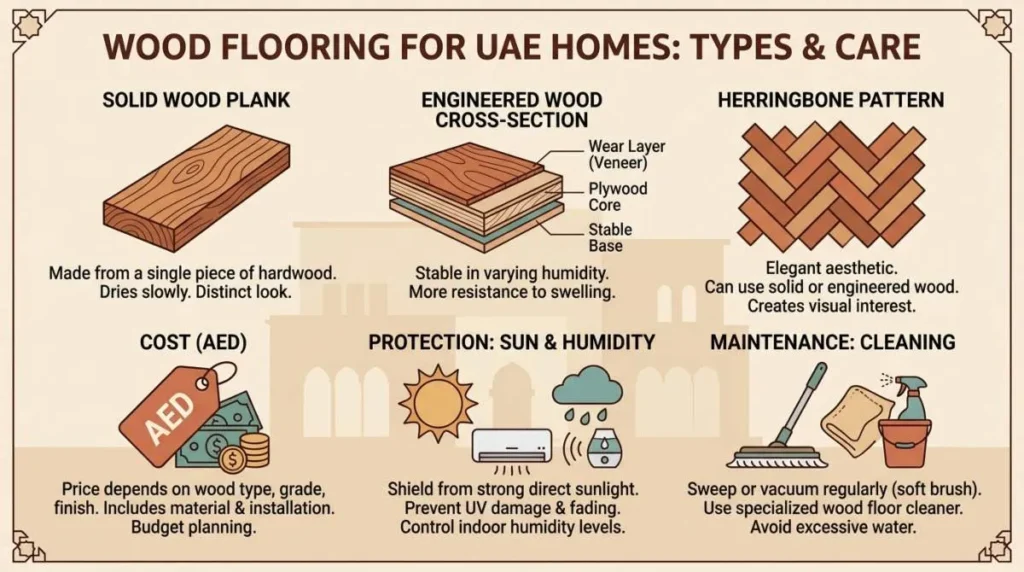
Wood flooring is one of the most searched home upgrades in the UAE, and for good reason. It brings warmth and texture that tile and marble cannot match, and it works in almost every room of a modern UAE home. But choosing wood flooring here is different from choosing it in Europe or North America. UAE homes deal with intense heat, high humidity, and long dry spells that stress natural Wood in ways cooler climates never do. Getting the wrong type or skipping proper installation and care can lead to warped boards, gaps, or costly repairs within a year or two.
This guide answers the questions Ras Al Khaimah homeowners ask most: which wood types actually hold up in this climate, how much wood flooring costs installed in AED, how installation works over tile or concrete, and how to clean and maintain wood floors so they last. Whether you are renovating a villa or an apartment in Ras Al Khaimah, you will find clear, practical answers here, not just theory.
By the end of this guide, you will know exactly which wood flooring option suits your home, your budget, and the UAE’s demanding climate, as well as what it takes to keep it looking new for years.
What Is Wood Flooring?
Wood flooring is any flooring material made wholly or partly from timber, installed as planks, tiles, or panels across a floor surface. It ranges from solid hardwood boards cut straight from a tree trunk to engineered planks, laminate sheets, and modern composites like SPC and WPC that only imitate the look of Wood. Each type differs in cost, durability, and how well it copes with heat and humidity, which matters a great deal in theRas Al Khaimah homes.
Solid Wood vs Engineered vs Laminate vs SPC/WPC — What’s the Difference?
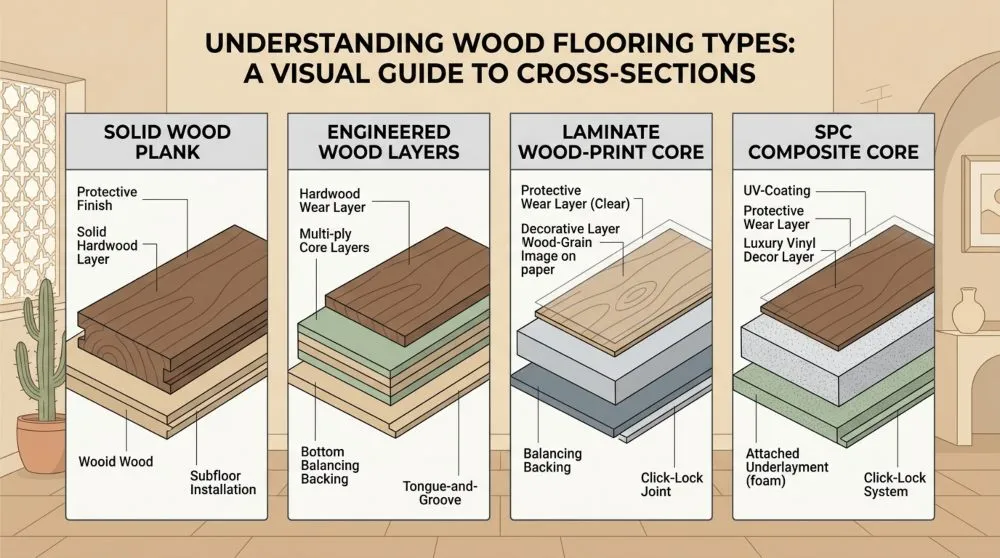
The main difference lies beneath the surface. Solid Wood is 100% timber through the full thickness of the plank. Engineered Wood has a thin real-wood top layer bonded to layers of plywood beneath it. Laminate has no real wood at all; it uses a high-resolution wood-print image under a protective wear layer, on top of a fibreboard core. SPC (stone-plastic composite) and WPC (wood-plastic composite) go a step further by using a rigid plastic-based core, making them fully waterproof.
Wood Flooring Types Comparison
| Type | Real Wood Content | Moisture Resistance | Typical Lifespan | Best For |
|---|---|---|---|---|
| Solid Wood | 100% | Low | 20–30+ Years (With Refinishing) | Living Rooms, Bedrooms |
| Engineered Wood | Wood Top Layer Only | Moderate | 20–30 Years | Most Rooms, Over Concrete |
| Laminate | None (Printed Surface) | Low–Moderate | 10–20 Years | Budget Renovations |
| SPC / WPC | None or Minimal | High (Waterproof) | 15–25 Years | Kitchens, Bathrooms, Humid Areas |
For UAE homes, engineered Wood and SPC/WPC generally perform better than solid WoodWood, since they resist the expansion and contraction caused by RAK’s heat and coastal humidity far more reliably.
Real Wood vs Wood Look Tile (Pros and Cons for Ras Al Khaimah Homes)
Real Wood (solid or engineered) offers a natural look, feel, and warmth underfoot that no imitation can fully replicate. Still, it requires climate control and regular maintenance to avoid warping, cupping, or fading in direct sunlight. Wood-look tile, usually porcelain or ceramic with a wood-grain pattern, gives a similar appearance without any of that risk. It is scratch-resistant, waterproof, and heat-resistant, making it a common choice for Ras Al Khaimah kitchens, bathrooms, and balconies.
Resale appeal High (authentic material) Good, but seen as a substitute
The right choice depends on the room. Real wood suits living rooms and bedrooms where humidity is controlled by air conditioning. Wood-look tile is the safer, lower-maintenance option for kitchens, bathrooms, and outdoor-facing areas exposed to moisture and direct heat.
Best Wood Species for Ras Al Khaimah Homes
The best Wood Species for Ras Al Khaimah Homes are teak, engineered oak, and iroko, since they naturally resist moisture, heat, and insect damage better than softer woods like pine or beech. Species choice matters more in the UAE than in cooler climates because the wrong Wood expands, contracts, or cracks under daily temperature swings between air-conditioned interiors and outdoor heat.
Oak, Walnut, Teak, and Other Popular Choices
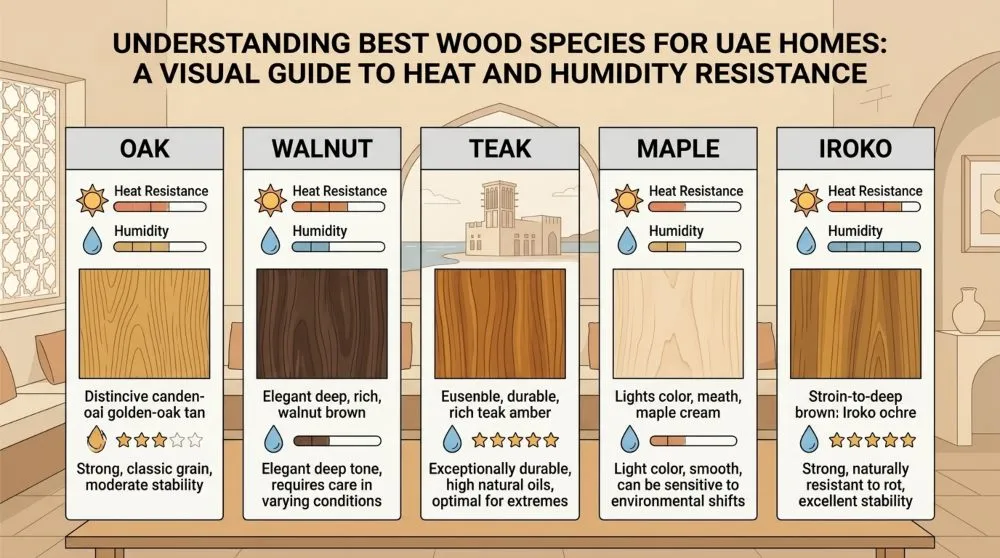
Oak is the most widely used wood flooring species in the UAE, valued for its strength, classic grain pattern, and wide availability in both solid and engineered formats. Walnut offers a richer, darker tone and a more luxurious finish, but it is softer than oak and shows scratches more easily. Teak is naturally oily and dense, which gives it strong built-in resistance to moisture and pests, making it a popular choice for humid coastal areas like RAK. Other species used in the region include maple, known for its light, even tone and hardness, and iroko, sometimes called “African teak,” which offers similar durability to teak at a lower cost.
Real Wood vs Wood-Look Tile Comparison
| Factor | Real Wood | Wood-Look Tile |
|---|---|---|
| Heat / Humidity Resistance | Moderate to Low | Excellent |
| Feel Underfoot | Warm, Natural | Cool, Harder |
| Maintenance | Regular (Polishing, Resealing) | Minimal |
| Water Resistance | Poor to Moderate | Excellent |
| Cost | Higher | Generally Lower |
Iroko High Excellent Golden-brown, ages darker Budget alternative to teak
Which Wood Handles Heat and Humidity Best?
Teak and iroko handle UAE heat and humidity best because their natural oils and tight grain structure resist moisture absorption, warping, and pest damage far more effectively than oak, walnut, or maple. Engineered versions of any species also outperform solid WoodWood in this climate, since their layered construction is more dimensionally stable and less likely to expand or contract with changes in humidity. For homes near the coast, such as Mina Al Arab or Al Marjan Island, teak or engineered oak are generally the safer long-term choices over solid walnut or maple.
Wood Flooring Styles, Colours and Patterns
Wood flooring style is not just about the species; the way the boards are laid and the chosen colour tone have just as much impact on how a room feels. In the UAE, homeowners typically choose between classic straight-plank layouts and more decorative patterns like herringbone or chevron, paired with a colour that suits the room’s light levels and overall design theme.
Herringbone, Chevron, and Parquet Explained
Herringbone is a laying pattern where rectangular planks are arranged at a 90-degree angle to each other, creating a zigzag effect without any mitred edges. Chevron looks similar but uses planks cut at an angle so the ends meet in a continuous, uninterrupted “V” shape, giving a sharper, more tailored appearance than herringbone. Parquet is a broader term for any geometric wood flooring pattern, including herringbone and chevron. Still, it also covers other designs, such as basket-weave or block patterns made from smaller pieces of Wood.
Wood Flooring Pattern Comparison
| Pattern | Visual Effect | Installation Difficulty | Best Suited For |
|---|---|---|---|
| Herringbone | Zigzag, Classic | Moderate to High | Living Rooms, Entryways |
| Chevron | Sharp, Continuous “V” | High | Formal Spaces, Feature Areas |
| Straight Plank | Simple, Linear | Low | Most Rooms, Budget-Friendly |
| Parquet (Block) | Geometric, Decorative | High | Statement Floors, Smaller Rooms |
Herringbone and chevron patterns cost more to install because of the extra cutting and precision required, but they are popular in RAK villas and Dubai apartments, where a feature floor adds resale value.
Light vs Dark Wood — Choosing a Colour for Your Space
Light wood tones such as pale oak or maple make small or low-light rooms feel more open and airy, and they show less dust than darker finishes, which is a practical advantage in the UAE’s sandy climate. Dark wood tones such as walnut or dark-stained oak create a warmer, more formal look and pair well with larger, brighter rooms where natural light balances the depth of colour. Grey and beige wood tones sit between the two, offering a neutral, modern look that works with most interior colour schemes and is currently one of the most requested finishes in UAE renovations.
As a general rule, match the wood tone to the room’s natural light: darker tones for bright, sunlit spaces, and lighter tones for rooms with less natural light or smaller footprints.
Wood Flooring Cost in Ras Al Khaimah
Wood flooring costs in the UAE vary widely depending on the material type, wood species, and installation method, generally ranging from AED 25 per square foot for laminate to over AED 180 per square foot for fully installed premium solid hardwood. Current market data show engineered wood flooring in Dubai typically starts at around AED 290 per square metre. At the same time, basic domestic hardwood such as oak or maple ranges from AED 150 to AED 300 per square metre, while premium species like teak or walnut can reach AED 300 to AED 600 per square metre.
Parquet flooring sits in a similar bracket, with quality parquet supply and installation generally budgeted between AED 80 and AED 300 per square metre, and installers noting that custom or high-end designs can push parquet above AED 300 per square metre, while simpler patterns using cheaper wood alternatives can run as low as AED 150. On the budget end, laminate flooring installation in Dubai averages roughly AED 20 to AED 40 per square metre before materials are added.
Cost per Square Foot by Wood Type
| Wood / Material Type | AED per Sq Ft (Installed) | Notes |
|---|---|---|
| Laminate Wood Flooring | AED 25 – 45 | Cheapest wood-look option; no real wood |
| SPC / WPC Composite | AED 35 – 65 | Waterproof; good for kitchens and bathrooms |
| Engineered Oak / Maple | AED 45 – 90 | Most common choice for UAE homes |
| Solid Oak / Maple | AED 60 – 130 | Higher-end option; requires climate control |
| Premium Teak / Walnut | AED 90 – 180 | Best moisture resistance (teak) or luxury finish (walnut) |
| Herringbone / Chevron Pattern | AED 100 – 220 | Pattern surcharge on top of the base material cost |
These are approximate market ranges; final pricing depends on supplier, subfloor condition, and project size.
Installation Cost vs Material Cost — What’s Included
Material cost covers the wood planks or tiles themselves and typically makes up 50–70% of the total project cost, with species, thickness, and finish quality driving most of the variation. Installation cost covers labour, adhesives or underlayment, and basic finishing, and this is where subfloor condition matters most. As one UAE flooring cost breakdown notes, extensive subfloor preparation can add AED 50 to AED 150 per square foot to the base installation cost, particularly when old flooring needs to be removed or the concrete slab needs levelling before the Wood can go down.
For budgeting purposes, a mid-sized project provides a clearer picture: installing 500 square feet of hardwood flooring in Ras Al Khaimah typically costs between AED 18,000 and AED 30,000, depending on wood type, installation complexity, and subfloor prep, while a 1,000-square-foot project runs AED 37,000 to AED 60,000. Homeowners should always request an itemised quote that separates material costs, labour, and any subfloor prep, since these three line items are the most common causes of budget overruns in wood flooring projects.
How Wood Flooring Is Installed
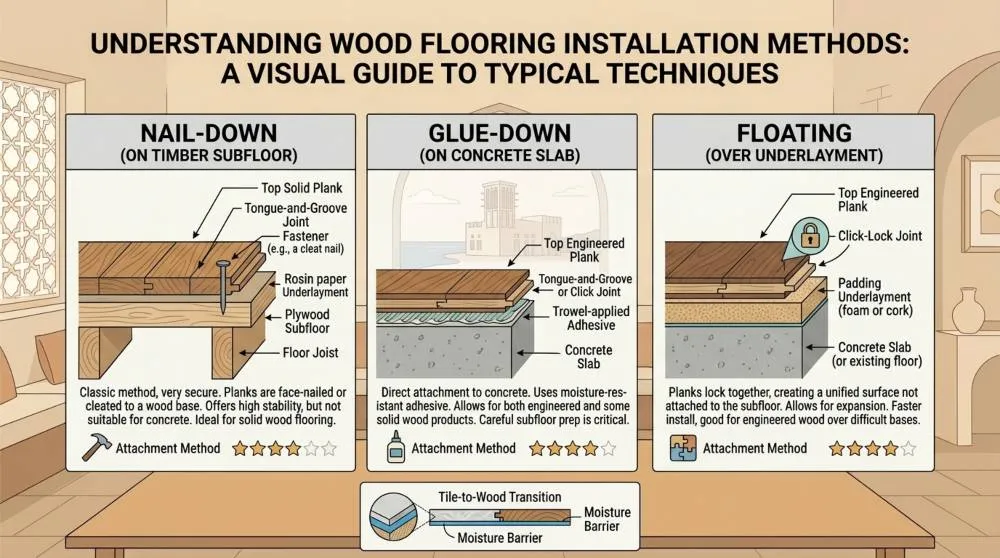
Wood flooring installation generally follows one of three methods: nail-down, glue-down, or floating, with the right choice depending on the wood type, the subfloor, and the room. In the UAE, where most homes are built on concrete slabs rather than timber subfloors, glue-down and floating installations are far more common than traditional nail-down methods used in older Western-style homes.
Can You Install Wood Flooring Over Tile or Concrete?
Yes, wood flooring can be installed over both tile and concrete, provided the existing surface is flat, stable, and properly prepared beforehand. Concrete subfloors need to be checked for moisture levels and levelled with a self-leveling compound if uneven, since UAE concrete slabs often retain residual moisture that can damage wood flooring if not addressed first. Installing over existing tile is also possible in most cases, as long as the tile is firmly bonded with no loose or cracked sections. However, a thin underlayment is usually added to smooth out grout lines and prevent them from showing through.
Can the Existing Surface Be Installed Over?
| Existing Surface | Can Install Over? | Preparation Needed |
|---|---|---|
| Bare Concrete | Yes | Moisture check and levelling compound if the surface is uneven. |
| Tiled Floor | Yes (If Stable) | Use an underlayment to smooth grout lines. |
| Old Wood / Laminate | Case-by-Case | Surface must be flat and firmly secured. |
| Damaged / Loose Tile | No | Remove damaged tiles and repair the subfloor before installation. |
Skipping subfloor preparation is one of the most common causes of early wood floor failure in Ras Al Khaimah, as trapped moisture beneath the boards can lead to warping or mold within the first year.
Glue-Down vs Floating Installation
Glue-down installation bonds the wood planks directly to the subfloor using a strong adhesive, creating a solid, stable floor that resists movement and is well-suited to larger open areas. Floating installation, by contrast, clicks planks together without fastening them to the subfloor, so the entire FloorFloor sits as a single connected layer resting on an underlayment. Floating installation is faster, generally cheaper, and easier to replace if damaged. Still, it can feel slightly less solid underfoot and may develop a hollow sound in high-traffic areas over time.
| Factor | Glue-Down | Floating |
|---|---|---|
| Stability | Very High | Good |
| Installation Speed | Slower | Faster |
| Cost | Higher (Adhesive + Labour) | Lower |
| Suitable Subfloors | Concrete, Tile | Concrete, Tile, Existing Floors |
| Repair / Replacement | Difficult | Easier (Plank by Plank) |
| Sound Underfoot | Solid | Can Sound Slightly Hollow |
For Ras Al Khaimah homes, engineered Wood in a floating installation is often the practical choice for most rooms, since it balances speed, cost, and stability well over concrete slabs. At the same time, glue-down is generally reserved for solid Wood or larger commercial-style spaces where maximum stability is the priority.
Where to Use Wood Flooring in Your Home
Not every room in a Ras Al Khaimah home suits wood flooring equally. The right choice depends on how much moisture, heat, and foot traffic a space sees day to day, so matching the wood type to the room is just as important as choosing the right species or finish.
Living Rooms, Bedrooms, and Stairs
Living rooms, bedrooms, and stairs are the best-suited spaces for wood flooring in any Ras Al Khaimah home., since these areas stay climate-controlled and see far less direct moisture exposure than kitchens or bathrooms. Living rooms benefit from wood flooring’s warmth and visual appeal, and since these are usually the largest open spaces in a home, engineered Wood in a floating installation works well for both cost and stability. Bedrooms suit either solid or engineered Wood, and lighter tones are often preferred here to keep the space feeling calm and airy. Stairs need extra care regardless of wood type, since they see concentrated foot traffic on a narrow surface; a harder species like oak, finished with a slip-resistant coating, holds up best.
Recommended Wood Flooring by Room
| Room | Recommended Flooring | Reason |
|---|---|---|
| Living Room | Engineered Wood (Floating) | Balances cost, comfort, and durability for large living spaces. |
| Bedroom | Solid or Engineered Wood | Lighter wood tones create a calm, warm, and relaxing atmosphere. |
| Stairs | Solid Oak or Hardwood | Provides excellent wear resistance and supports a slip-resistant finish for safety. |
Is Wood Flooring Safe for Kitchens, Bathrooms, and Balconies?
Real wood flooring is not recommended for bathrooms. It is only cautiously suitable for kitchens and balconies, since these spaces face regular water exposure, spills, or direct outdoor heat that natural Wood cannot handle over the long term. Kitchens can work with water-resistant engineered Wood or SPC/WPC composite flooring, provided spills are cleaned up quickly and the flooring has a sealed, moisture-resistant finish. Bathrooms are best avoided for real Wood altogether; SPC or WPC composite or wood-look porcelain tile gives the same visual warmth without the risk of water damage. Balconies and other outdoor-facing areas need fully weather-rated decking-grade Wood or composite decking, since standard indoor wood flooring will warp and degrade quickly under direct sun and rain exposure.
Wood Flooring Suitability by Room
| Room | Real Wood Suitable? | Recommended Alternative |
|---|---|---|
| Kitchen | Only with Sealed Engineered Wood | SPC / WPC Composite |
| Bathroom | No | SPC / WPC Composite or Wood-Look Tile |
| Balcony (Outdoor) | No (Standard Wood) | Weather-Rated Decking or Composite |
As a general rule, keep real wood flooring inside climate-controlled living spaces and rely on composite or wood-look tile anywhere water or direct outdoor exposure is a regular factor.
Caring for Wood Floors in RAK’s Climate
Wood floors in Ras Al Khaimah face a tougher environment than most guides account for, with high coastal humidity, intense summer heat, and fine dust that settles quickly indoors. Regular, climate-appropriate care matters more here than in cooler regions, since Wood reacts to moisture and temperature fluctuations far more quickly in this environment.
Best Cleaning Methods and Products
The best way to clean wood floors is to sweep or vacuum daily to remove sand and dust, then damp-mop weekly using a well-wrung microfibre mop and a pH-neutral, wood-specific cleaner, avoiding excess water at all times. Standing water is the single biggest risk to wood flooring, since even a small amount left on the surface can seep into seams and cause swelling or discolouration. Steam mops should be avoided on realWood, as the heat and moisture they release can damage the finish and loosen glued joints over time; they are, however, safe to use on SPC or WPC composite flooring. For deeper cleaning, a wood floor cleaner formulated for the specific finish (oiled, lacquered, or waxed) should be used, since the wrong product can strip protective coatings or leave a dull residue.
Wood Floor Maintenance Schedule
| Task | Frequency | Recommended Method |
|---|---|---|
| Sweeping / Vacuuming | Daily | Use a soft-bristle broom or a vacuum with a hard-floor setting. |
| Damp Mopping | Weekly | Use a well-wrung microfibre mop with a pH-neutral cleaner. |
| Deep Cleaning | Monthly | Clean using a finish-specific wood floor cleaner. |
| Polishing / Waxing | Every 6–12 Months | Use a product that matches the floor’s original finish. |
Avoid vinegar, ammonia-based cleaners, and generic all-purpose sprays on real wood floors, as these can break down the finish and dull the surface over repeated use.
Protecting Wood Floors from Humidity and Sun Damage
Protecting wood floors from RAK’s humidity starts with maintaining consistent indoor temperature and humidity levels, since stable temperature and humidity levels prevent the constant expansion and contraction that cause gaps, warping, or cupping over time. A room humidifier or dehumidifier can help maintain ideal indoor humidity levels, particularly during the more humid summer months near the coast, keeping conditions closer to what theWood was manufactured and acclimatised for. Sun damage is another major concern in the UAE, since direct sunlight through windows can fade and dry out wood flooring unevenly over time; UV-filtering window film or curtains during peak sun hours can significantly slow this fading. Furniture pads under heavy items and doormats at entry points also help by reducing scratching from grit and sand tracked in from outside, which is one of the most common causes of visible wear on Ras Al Khaimah wood floors.
Wood Floor Protection Tips
| Risk Factor | Protective Measure |
|---|---|
| Humidity Swings | Maintain consistent air conditioning and use a humidifier or dehumidifier when needed. |
| Direct Sunlight | Install UV window film and keep curtains or blinds closed during peak sunlight hours. |
| Sand / Grit Scratching | Place entry mats at doorways and sweep or vacuum regularly. |
| Heavy Furniture | Attach felt pads under furniture legs and feet to prevent scratches. |
Consistent indoor climate control is the single most effective way to protect wood flooring in RAK as it directly addresses the root cause of most wood-floor problems in this region: humidity and temperature instability.
Common Wood Floor Problems and Fixes
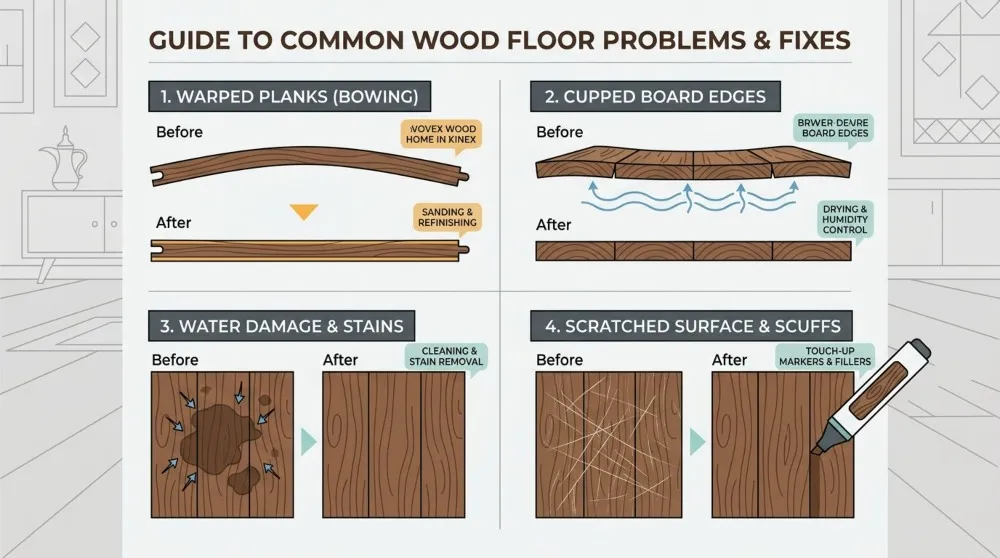
Even well-maintained wood floors develop problems over time, especially in the UAE’s demanding climate. Most issues fall into two categories: moisture-related damage and surface wear, and knowing which is which determines whether a homeowner can fix it themselves or needs a professional.
Warping, Cupping, and Water Damage
Warping happens when wood boards absorb moisture unevenly and bend out of their flat shape, usually caused by prolonged exposure to humidity, spills left unattended, or a subfloor that was not properly moisture-checked before installation. Cupping is a specific type of warping in which the edges of each plank rise higher than the centre, giving the FloorFloor a slightly concave, wavy appearance; it is almost always a sign that Moisture is entering from beneath the Floor rather than from spills on top. Water damage from a burst pipe, an AC condensation leak, or a major spill can cause more severe problems, including staining, swelling, and, in some cases, mold growth beneath the boards if the water is not dried out quickly.Common Wood Flooring Problems and Solutions
| Problem | Common Cause | Fixable? |
|---|---|---|
| Warping | Uneven moisture absorption or poor subfloor preparation. | Sometimes (localised boards can often be replaced). |
| Cupping | Moisture rising from beneath the floor. | Often reversible once the moisture source is fixed and the floor dries completely. |
| Water Damage / Mould | Leaks, spills, or flooding. | Requires professional assessment; damaged boards often need replacement. |
If cupping appears, the priority is to find and stop the moisture source, such as a leak or rising damp, before attempting any repair, since replacing boards without fixing the root cause simply leads to the same problem recurring.
Scratches, Refinishing, and When to Call a Professional
Light scratches on real wood floors can usually be treated at home with a wood floor scratch-repair kit or a colour-matched touch-up marker, which fills and blends minor surface marks without needing to sand the whole FloorFloor. Deeper scratches, dullness across large areas, or visible wear patterns in high-traffic zones typically call for sanding and refinishing, a process that strips back the top layer of the Wood and reapplies a fresh coat of stain and sealant. Solid wood floors can generally be sanded and refinished multiple times over their lifespan, while engineered Wood has a thinner top layer and can usually only be refinished once or twice before the veneer wears through.
A professional should be called when the damage goes beyond surface level, specifically:
- Cupping or warping that does not flatten once the room’s humidity is stabilised
- Water damage affecting more than a small, isolated area
- Boards that have separated, lifted, or show signs of rot
- Any refinishing job on solid Wood, since incorrect sanding can permanently damage the veneer on engineered boards
Wood Floor Damage Repair Guide
| Damage Type | DIY Fix | Professional Needed |
|---|---|---|
| Light Surface Scratches | Touch-up marker or scratch repair kit. | No |
| Deep Scratches / Dull Finish | Not recommended for DIY. | Yes (Sanding and Refinishing) |
| Cupping / Warping | Not recommended for DIY. | Yes, especially if the moisture source is unresolved. |
| Water Damage / Mould | Not recommended for DIY. | Yes, always |
For any wood flooring issue tied to moisture, humidity, or structural subfloor problems, it’s worth getting a professional inspection early, since catching the issue before it spreads usually costs far less than replacing an entire section of flooring later.
Wood Flooring vs Other Flooring Types
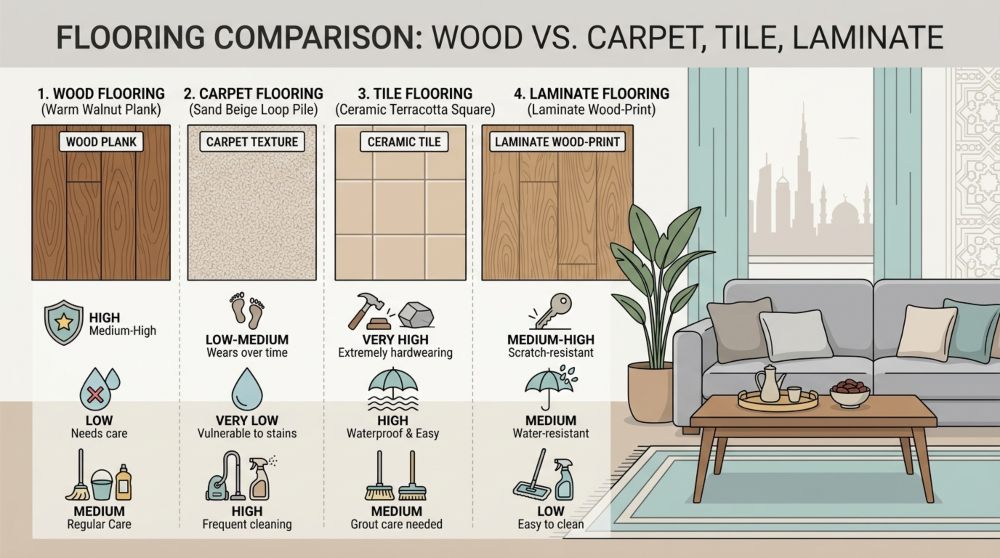
Choosing between wood flooring and other options often comes down to lifestyle, budget, and how a room is used day to day. Comparing Wood directly against carpet, tile, and laminate helps homeowners see which trade-offs matter most for their specific space.
Wood vs Carpet
Wood flooring is far more durable and easier to clean than carpet, since it does not trap dust, allergens, or sand the way carpet fibres do, making it a better fit for the UAE’s naturally dusty outdoor environment. Carpet offers more warmth and sound absorption underfoot, which some homeowners prefer in bedrooms, but it requires more frequent deep cleaning and tends to show wear, staining, and odor build-up faster in a hot, humid climate. Wood flooring also holds its value and resale appeal better over time, while carpet typically needs full replacement every 5–10 years depending on foot traffic.
Wood Flooring vs Carpet Comparison
| Factor | Wood Flooring | Carpet |
|---|---|---|
| Durability | High | Moderate |
| Cleaning Effort | Low | High (Requires Regular Deep Cleaning) |
| Allergen / Dust Trapping | Low | High |
| Comfort Underfoot | Moderate | High |
| Lifespan | 15–30+ Years | 5–10 Years |
| Resale Appeal | High | Lower |
For Ras Al Khaimah homes, wood flooring is generally the stronger long-term choice in living areas and hallways, while carpet is sometimes still preferred in bedrooms purely for warmth and sound comfort.
Wood vs Tile/Laminate
Tile is more moisture-resistant and easier to maintain than real Wood, making it the safer choice for kitchens, bathrooms, and high-humidity areas. At the same time, wood flooring offers a warmer look and feel better suited to living rooms and bedrooms. Laminate sits between the two: it mimics the appearance of Wood at a lower cost and with better moisture tolerance than solid Wood, but it lacks the authentic texture, resale value, and refinishing ability of real wood flooring. Tile also tends to feel cooler underfoot, which some homeowners appreciate during UAE summers, while Wood retains a naturally warmer surface temperature year-round.
Wood Flooring vs Tile vs Laminate
| Factor | Wood Flooring | Tile | Laminate |
|---|---|---|---|
| Moisture Resistance | Low–Moderate | Excellent | Moderate |
| Cost | Higher | Moderate | Lower |
| Feel Underfoot | Warm | Cool | Warm (Synthetic) |
| Refinishing Possible | Yes (Real Wood) | No | No |
| Resale Value | High | Moderate | Lower |
Best Rooms Living rooms, bedrooms Kitchens, bathrooms Budget renovations
The most practical approach for many Ras Al Khaimah homes is a mixed strategy: real or engineered WoodWood in living rooms and bedrooms, and tile or wood-look composite in kitchens, bathrooms, and other moisture-prone areas.
Styling Your Home Around Wood Floors
Once wood flooring is installed, the right wall colours and furniture choices make the biggest difference in how the space actually looks and feels day to day. Styling around wood floors is mostly about intentionally creating contrast or harmony, rather than leaving it to chance.
Wall Colours and Furniture That Pair Well with Wood Floors
Light wood floors pair well with a wide range of wall colours, from crisp whites and soft greys to warmer neutrals like beige or sand tones, since the pale flooring keeps the room feeling open regardless of wall depth. Dark wood floors work best with lighter wall colours such as off-white, soft grey, or pale blue, which balance the visual weight of the FloorFloor and prevent the room from feeling closed in; pairing dark floors with equally dark walls can make a space feel heavy, especially in smaller rooms. Grey and beige wood tones are the most flexible of all, working comfortably with both warm and cool wall palettes, which is part of why they’ve become a popular default choice in Ras Al Khaimah renovations.
Wood Floor Tone and Wall Colour Guide
| Wood Floor Tone | Best Wall Colours | Effect |
|---|---|---|
| Light Wood | White, Soft Grey, Warm Beige | Open and Airy |
| Dark Wood | Off-White, Pale Grey, Soft Blue | Balanced, Not Heavy |
| Grey / Beige Wood | Most Neutral Colours (Warm or Cool) | Flexible and Modern |
Furniture choices follow a similar contrast principle. Light wood floors pair well with darker or richly upholstered furniture, such as navy, charcoal, or deep green sofas, which stand out clearly against the pale flooring and add visual depth to the room. Dark wood floors suit lighter furniture and fabrics, including cream, tan, or pastel upholstery, since this prevents the lower half of the room from visually overwhelming the space. Rugs are worth adding regardless of floor tone, both to define seating areas and to protect the Wood from scuffing under frequently moved furniture like dining chairs.
As a general styling rule, let the wood floor set the room’s undertone, and choose walls and furniture that either contrast for definition or stay neutral for a calmer, more cohesive look. Avoid matching wood-toned furniture directly to a wood-toned floor, which can flatten the room visually.
Frequently Asked Questions (FAQs)
How much does wood flooring cost when installed in Ras Al Khaimah?
Wood flooring installed in Ras Al Khaimah typically costs between AED 25 and AED 180 per square foot, depending on the material. Laminate sits at the lower end, around AED 25–45 per square foot; engineered Wood falls in the AED 45–90 range; and premium solid hardwood like teak or walnut can reach AED 90–180 per square foot. Subfloor preparation, pattern choice (like herringbone), and project size also affect the final price.
Is real wood flooring suitable for the UAE climate?
Real wood flooring can work in the UAE, but it needs careful management. Solid Wood is more prone to warping and cupping in high humidity and heat, so engineered Wood is generally the safer choice, since its layered construction resists expansion and contraction better. Consistent air conditioning and avoiding direct sun exposure are essential for real Wood to last in this climate.
How do I clean wood floors without damaging them?
Sweep or vacuum daily to remove dust and sand, then damp-mop weekly with a well-wrung microfibre mop and a pH-neutral, wood-specific cleaner. Avoid standing water, steam mops, and vinegar- or ammonia-based cleaners, as these can damage the finish and cause long-term swelling or dullness.
Can wood flooring be installed over existing tile?
Yes, wood flooring can be installed over tile as long as the tile is stable, firmly bonded, and free of cracks or loose sections. A thin underlayment is usually added first to smooth out grout lines so they don’t show or create uneven pressure points beneath the new flooring.