Electrical Work Explained | Complete UAE Homeowner’s Guide (2026)
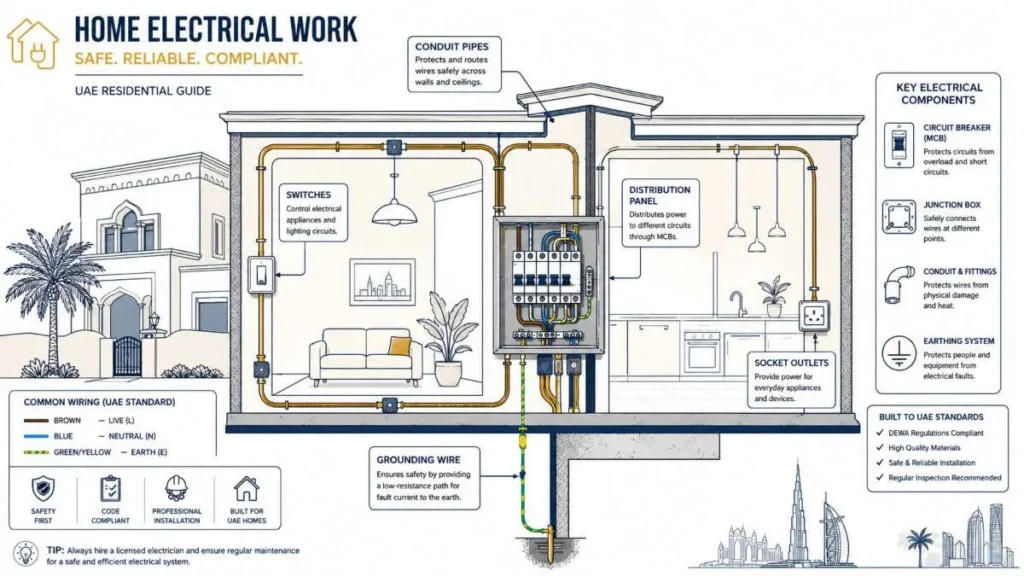
Electrical work touches almost everything in your home, from the light switch by your front door to the panel that keeps your whole house running safely. Yet most homeowners in the UAE only think about it when something stops working.
This guide changes that. It walks you through what electrical work actually means, how the wiring, circuits, and panels behind your walls function, and how everyday appliances like your electric fan, iron, or fireplace draw and use power. You’ll also learn how to recognise common problems, like a socket that’s suddenly gone dead, and understand what typically drives the cost of a repair or installation.
Whether you’re renovating a villa, troubleshooting a tripped switch, or simply curious about how electricity gets from the grid into your living room, this guide breaks it down in plain, practical language. No jargon, no guesswork, just a clear picture of how electrical systems work and when it’s time to call a licensed electrician instead of reaching for a screwdriver yourself.
Electrical work touches almost everything in your home, from the light switch by your front door to the panel that keeps your whole house running safely. Yet most homeowners in the UAE only think about it when something stops working.
What Is Electrical Work?
Electrical work involves installing, repairing, maintaining, or replacing a home’s wiring, circuits, panels, and electrical fixtures. It covers everything from fitting a single light switch to wiring an entire villa from the ground up.
In the UAE, electrical work is a licensed trade. This means it must follow local building codes and safety standards, and in most cases, it should be carried out by a qualified electrician rather than attempted as a DIY project. Improper wiring is one of the leading causes of home fires and equipment damage, so even small jobs carry real risk if done incorrectly.
Electrical work generally falls into three categories:
- Installation work – setting up new wiring, panels, or fixtures, typically during construction or renovation
- Maintenance work – routine checks and upkeep to keep an existing system safe and efficient
- Repair work – fixing faults, such as a socket that’s stopped working or a circuit that keeps tripping
Understanding these categories helps you know exactly what to ask for when you contact an electrician, and it sets the foundation for everything covered in this guide.
Residential vs. Commercial Electrical Work
Residential electrical work covers homes, apartments, and villas. It typically involves lighter loads, simpler wiring layouts, and fixtures like sockets, switches, ceiling fans, and lighting circuits designed for everyday household use.
Commercial electrical work, by contrast, deals with larger buildings such as offices, retail spaces, and warehouses. These properties need higher-capacity panels, three-phase power in many cases, and wiring built to support heavier equipment, extended operating hours, and stricter safety compliance.
The core principles are the same in both settings, but commercial jobs usually demand more planning, larger materials, and closer coordination with building management or facility teams.
Types of Electrical Work in Home Construction
Home construction and renovation projects usually involve several distinct types of electrical work, often carried out in stages:
- Conduit and containment work – laying the protective piping and channels that wiring runs through, usually done before walls are finished
- Wiring and cabling – running the actual electrical cables from the main panel to each room and fixture
- Panel work – installing or upgrading the distribution board that controls and protects the home’s entire electrical supply
- Slab work – embedding conduits and cabling within concrete floors before they’re poured, common in new builds
- Socket and switch installation – fitting the visible fixtures homeowners interact with daily
- Termination work – safely connecting wires to outlets, switches, and appliances at the final stage
Core Components of Electrical Work in a Home
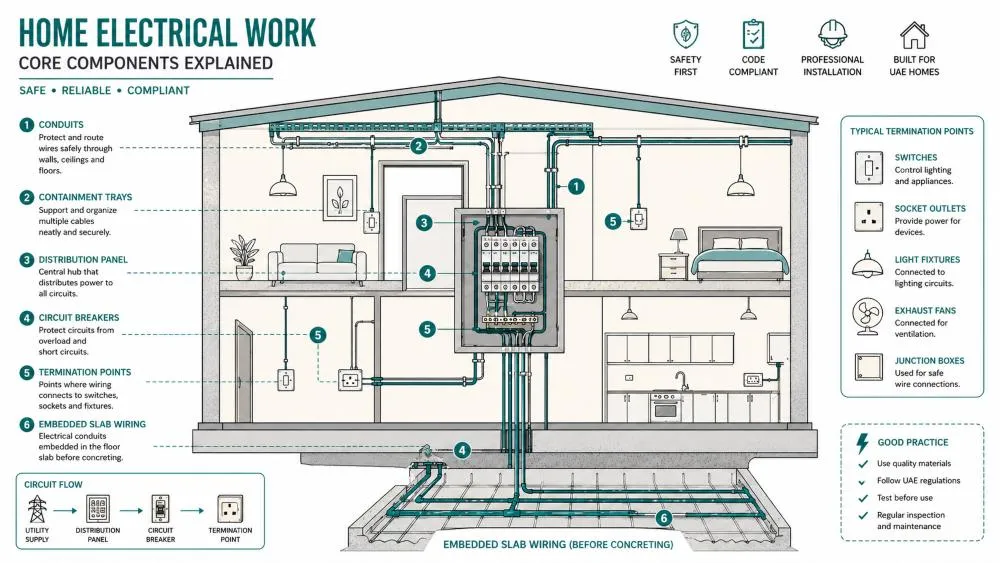
Every home’s electrical system is built from a handful of core components that work together to deliver power safely from the main supply to every switch, socket, and appliance. Understanding these parts makes it much easier to describe a problem accurately to an electrician or to know what you’re paying for when you receive a quote.
Wiring, Conduits & Containment Explained
Wiring is the network of insulated cables that actually carries electricity through your home. But wiring rarely runs exposed. It’s protected inside conduits, rigid or flexible tubing that shields cables from damage, moisture, and heat, especially important in the UAE’s climate.
Containment refers to the broader system of trays, trunking, and channels that organise and protect multiple cables as they run through walls, ceilings, and floors. In larger homes or villas, good containment keeps wiring tidy, makes future repairs easier, and reduces the risk of overheating from cables bunched too closely together.
Together, wiring, conduits, and containment form the hidden backbone of a home’s electrical system, most of it never seen once walls and ceilings are finished.
Panels, Termination Points & Load Distribution
The distribution panel (sometimes called the electrical panel or breaker board) is the control centre of a home’s entire electrical supply. It takes incoming power and splits it into individual circuits for different areas of the house, such as lighting, kitchen appliances, and air conditioning.
A breaker protects each circuit by automatically cutting power if it detects an overload or fault, preventing wiring from overheating.
Termination points are where wiring finally connects to a usable device, such as a socket, switch, light fitting, or appliance. This is the last and most safety-critical stage of any electrical job, since a poor termination is a common cause of sparking, loose connections, or intermittent faults.
Load distribution describes how evenly electrical demand is spread across circuits. A well-planned home avoids overloading a single circuit with too many high-draw appliances (like AC units, ovens, and water heaters) running off the same line.
Electrical Slab & Tray Work (New Builds vs. Renovations)
Slab work happens early in new construction, before concrete floors are poured. Conduits and cabling are laid out and embedded in the slab, so once the concrete sets, that wiring path is permanent. This makes accurate planning essential, since correcting a mistake later means breaking into finished concrete.
Tray work involves installing metal or plastic trays, usually overhead or along walls, that support and organise multiple cables as they run between rooms or floors. Trays are common in larger homes, villas, and any property with a higher volume of wiring to manage.
The key difference between new builds and renovations comes down to access:
- New builds allow slab and tray work to be planned and installed cleanly before walls and floors are finished, giving electricians full access to plan optimal routing.
- Renovations often require working around existing structures, meaning conduits may need to be surface-mounted, walls chased (cut into) for wiring, or trays added in ceiling voids rather than laid from scratch.
This is why renovation electrical work often costs more per metre of wiring than new construction. It typically involves more labour to retrofit safely around a home that’s already built.
How Electricity Actually Works (Homeowner-Friendly Explainer)
Understanding the basics of how electricity moves through your home makes it far easier to spot when something’s wrong and to have a more informed conversation with your electrician. Here’s how the core concepts work, explained without the technical jargon.
How an Electric Circuit Works
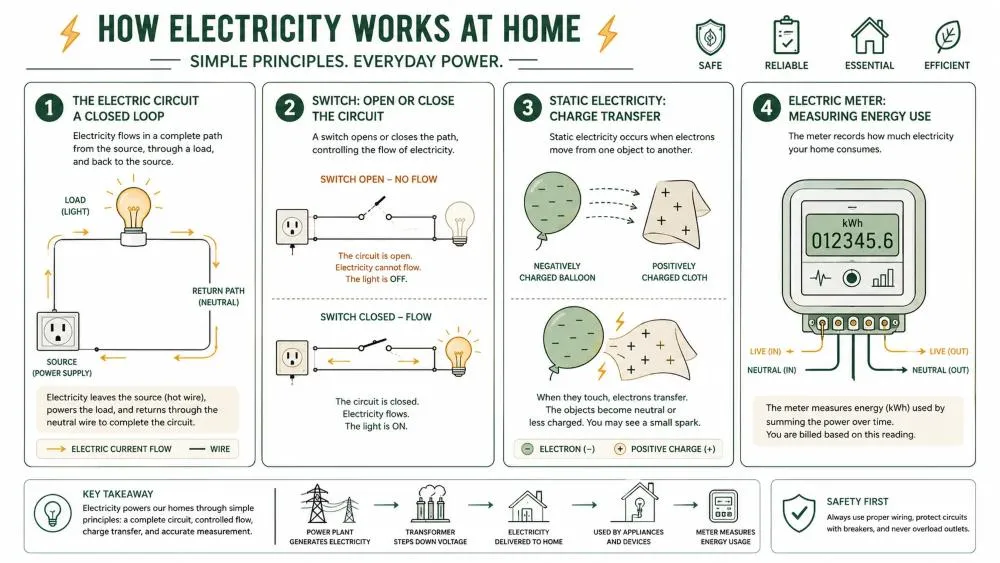
An electric circuit is simply a closed loop that allows electricity to flow from a power source, through a device, and back to the power source. Electricity leaves the distribution panel, travels through wiring to power something like a light or appliance, and then returns along a separate path to complete the loop.
If that loop is broken at any point, whether by a switch, a fault, or a disconnected wire, the flow stops immediately. This is why a single loose connection can cause an entire circuit to stop working, even if every other component is fine.
Most homes have multiple circuits rather than one continuous loop. This way, a fault in one area (say, a kitchen socket) doesn’t cut power to the whole house.
How Switches Control an Electric Circuit
A switch is essentially a gap in the circuit that you control. When the switch is off, that gap breaks the loop and stops electricity from flowing, which is why the light stays off. When you flip it on, the switch closes the gap, completing the circuit and allowing electricity to flow to the light or appliance.
This simple on/off mechanism is the foundation of nearly every electrical fixture in your home, from wall switches to the internal switches inside appliances like fans and water heaters.
What Is Static Electricity?
Static electricity is a build-up of electrical charge on the surface of an object, rather than electricity flowing through a circuit. It happens when two materials rub together, with electrons transferring from one to the other, leaving one surface slightly positive and the other slightly negative.
You’ve likely felt this as a small shock after walking across a carpet and touching a metal door handle. While static electricity is generally harmless in the home, it’s a completely different phenomenon from the electrical current running through your wiring and appliances.
How a Digital Electric Meter Works
A digital electric meter measures how much electricity your home consumes and records it in kilowatt-hours (kWh). Unlike older analogue meters with spinning dials, digital meters track usage electronically and display it directly on a screen.
Many digital meters used across the UAE also automatically transmit this data to your utility provider, which enables more accurate billing and, in some cases, real-time usage tracking through an app. Understanding your meter reading is the first step toward estimating your monthly electricity cost, which we’ll cover later in this guide.
How Common Household Electrical Items Work
Beyond wiring and panels, most homeowners interact with electricity through everyday appliances. Here’s a simple breakdown of how ten of the most common household electrical items actually work.
How an Electric Bell Works
An electric bell uses an electromagnet to create repeated motion. When you press the button, it completes a circuit that energises a coil of wire, turning it into a magnet. This magnet pulls a metal striker toward the bell, where it strikes the bell and makes a sound. The strike also breaks the circuit momentarily, switching off the magnet and releasing the striker, which then springs back and repeats the process rapidly, creating the familiar ringing sound.
How an Electric Bulb Works
Inside a traditional incandescent bulb, electricity flows through a thin metal filament. The filament resists the flow of current, and that resistance generates heat, enough to make the filament glow and produce light. Modern LED bulbs work differently: electricity passes through a semiconductor material that emits light directly, using far less energy and producing far less heat.
How an Electric Fireplace Works
An electric fireplace doesn’t burn anything. It uses an internal heating element, similar to a space heater, to warm the surrounding air, while a fan circulates it into the room. Many models also include LED lights or a rotating reflective drum to create a realistic flickering flame effect, purely for visual ambiance rather than actual combustion.
How an Electric Blanket Works
An electric blanket contains thin, insulated heating wires woven throughout the fabric. When plugged in, low-voltage electricity passes through these wires, generating gentle, even heat. A built-in control unit lets you adjust the temperature, and most modern blankets include automatic shut-off features and overheat protection for safety.
How an Electric Doorbell Works
A doorbell works much like an electric bell but is typically wired to a transformer that reduces household voltage to a safer, lower level. Pressing the button completes a low-voltage circuit, which activates a chime unit or electromagnetic striker inside the doorbell mechanism, producing the ring or chime sound you hear.
How an Electric Iron Works
An electric iron uses a heating element inside its metal soleplate. When plugged in, electricity flows through this element, generating heat through resistance, the same basic principle as a bulb’s filament. A built-in thermostat regulates temperature by cutting power once the iron reaches your selected heat setting, then reactivating it as the iron cools slightly, maintaining a steady temperature throughout use.
How an Electric Fan Works
An electric fan uses a motor to convert electrical energy into rotational motion. Electricity flowing through the motor’s coils creates a magnetic field, which spins the motor’s shaft and, in turn, the fan blades. This spinning motion pushes air forward, creating the airflow that helps cool a room, particularly useful during the UAE’s hotter months.
How an Electric Torch Works
A torch, or flashlight, uses a battery as its power source. When switched on, the circuit closes, and electricity flows from the battery to a small bulb or LED, lighting it. A reflector behind the bulb focuses the light into a concentrated beam, while the switch simply opens or closes the circuit to turn the torch on and off.
How a Backup Electric Generator Works
A backup generator converts fuel, typically diesel or petrol, into electrical energy using an internal combustion engine connected to an alternator. As the engine runs, it spins the alternator, which generates electrical current. This power can then be routed into a home’s electrical panel, either manually or automatically through a transfer switch, keeping essential circuits running during a grid outage.
How EV Home Charging Stations Work
An EV home charging station, often called a wallbox, connects directly to a home’s electrical supply and delivers power to an electric vehicle’s battery through a charging cable. Unlike a standard socket, a dedicated charging station manages voltage and current more efficiently, communicating with the vehicle to safely regulate charging speed. Most UAE homes with EVs use Level 2 chargers, which charge significantly faster than a standard household outlet.
Electrical Grounding & the Grid — Why They Matter for Safety
Two concepts sit quietly behind every safe electrical system: grounding and the grid. Most homeowners never think about either until something goes wrong, but understanding them helps explain why proper electrical work matters so much for safety, not just function.
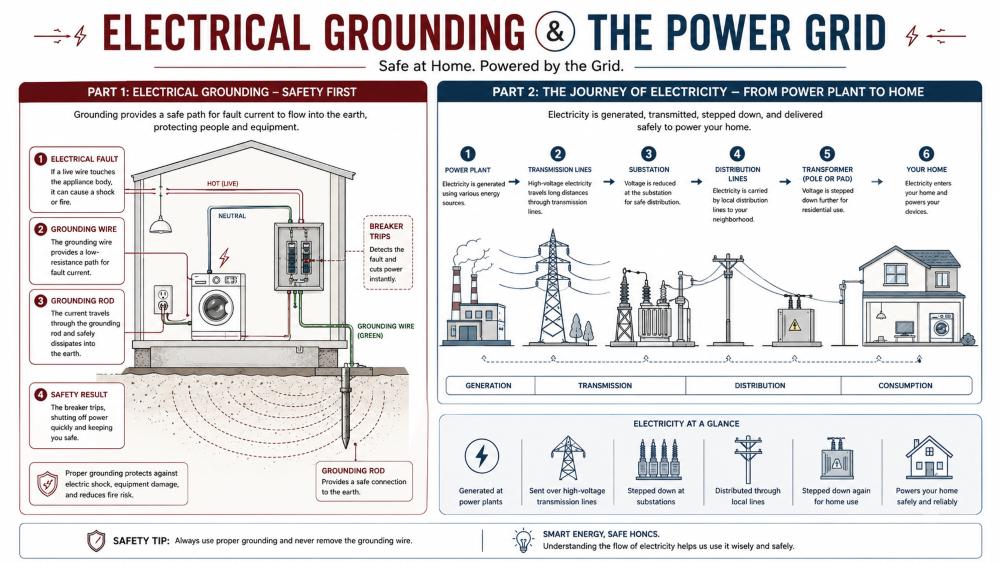
How Electrical Grounding Protects Your Home
Grounding (also called earthing) provides a safe path for electricity to travel if something goes wrong, such as a fault in an appliance or a damaged wire making unintended contact with a metal surface. Instead of stray electricity building up and potentially causing a shock or fire, a properly grounded system safely redirects it to ground through a dedicated grounding wire and rod.
Without grounding, a fault in an appliance could energise its metal casing. If someone touches it, electricity could pass through their body instead of safely into the ground. This is why grounding is mandatory for electrical installations in the UAE, and why sockets, panels, and major appliances are all connected to a home’s grounding system.
A properly grounded home also protects sensitive electronics from voltage spikes and reduces the risk of electrical fires caused by undetected faults.
How the Electrical Grid Delivers Power to Your Property
The electrical grid is the vast network that carries power from generation stations to individual homes and buildings. In the UAE, electricity typically originates at a power plant, where it’s generated at very high voltage for efficient long-distance transmission.
That high-voltage power travels through transmission lines to regional substations, where it’s stepped down to a lower, safer voltage. From there, distribution lines carry it toward your neighbourhood, where a final transformer reduces the voltage once more to the standard level used in homes.
Power then enters your property through a service connection, passes through your utility meter (which records your usage), and finally reaches your home’s distribution panel, where it’s split into the individual circuits that power your lights, sockets, and appliances.
This entire journey, from power plant to light switch, happens in a fraction of a second, and it’s why even a small disruption at the grid level can affect electricity supply across an entire area.
How Much Does Electrical Work Cost in the UAE?
Electrical costs generally fall into two categories: what you pay to run your home’s electricity day to day, and what you pay for professional electrical work, such as repairs, installations, or upgrades. Here’s how to think about both.
How to Work Out Your Electricity Cost
Your monthly electricity bill is calculated based on how much energy you consume, measured in kilowatt-hours (kWh). To estimate the cost of running a specific appliance, use this simple formula:
Power (kW) × Hours Used × Tariff Rate (AED per kWh) = Cost
For example, a 2kW air conditioning unit running for 8 hours a day at a typical residential tariff gives you a rough daily running cost you can multiply by 30 to get a monthly total. Your digital electric meter tracks this automatically, and most UAE utility providers offer an app or online portal to monitor real-time usage, rather than waiting for your monthly bill.
Checking your meter reading regularly is also one of the easiest ways to catch unusually high consumption early, which can sometimes signal a fault, an inefficient appliance, or a wiring issue worth having inspected.
What Affects Electrical Work Pricing (AED Table)
The cost of hiring an electrician in the UAE depends on the scope of the job, the materials required, and whether it’s a repair, installation, or full renovation. Below is a general pricing guide for common electrical work:
Electrical Services Price List UAE (AED)
| Service Type | Estimated Cost (AED) |
|---|---|
| Socket or Switch Repair / Replacement | 80 – 200 |
| Light Fixture Installation | 100 – 300 |
| Ceiling Fan Installation | 150 – 350 |
| Distribution Panel Inspection | 200 – 400 |
| Panel Upgrade / Replacement | 800 – 2,500 |
| Full Home Rewiring (Per Room) | 500 – 1,200 |
| New Villa Wiring (Full Project) | 15,000 – 40,000+ |
| EV Home Charger Installation | 1,500 – 4,000 |
| Emergency Callout (After Hours) | 150 – 300 (Plus Parts) |
Troubleshooting Common Electrical Work Issues
Electrical problems can range from a single dead socket to a full power outage. Here’s how to recognise the most common issues, what typically causes them, and when it’s time to call a professional rather than troubleshoot further yourself.
Why Is My Electrical Socket Not Working?
A socket that’s stopped working usually points to one of a few common causes:
- A tripped breaker – the most frequent cause. Check your distribution panel for a switch that’s flipped to the “off” position or is between “on” and “off”.
- A loose or faulty termination point – wiring inside the socket may have come loose over time, especially in older homes
- An overloaded circuit – too many high-draw appliances on one circuit can cause it to shut off automatically as a safety measure
- A faulty socket itself – wear and tear, moisture exposure, or age can cause internal components to fail
- A GFCI/RCD trip – sockets in kitchens and bathrooms often have built-in safety devices that cut power if they detect a fault, and these need to be manually reset
If resetting the breaker or RCD doesn’t restore power, avoid testing the socket further yourself. A loose termination or internal fault can pose a shock risk, and it’s a job for a licensed electrician.
Electricity Not Working? Quick Diagnostic Checklist
If your electricity has gone out entirely, work through this checklist before assuming the worst:
- Check if it’s just your property – look at neighbouring homes or ask neighbours if they’ve also lost power.
- Inspect your distribution panel – look for tripped breakers and reset any that have flipped.
- Check for a blown main fuse – older properties may still use fuses rather than breakers.
- Confirm your utility account is active – an unpaid bill can result in disconnection.
- Look for visible damage – exposed wiring, burn marks, or a burning smell near the panel- and stop and call an electrician immediately.
- Check with your utility provider – a planned or unplanned outage in your area may be the actual cause, unrelated to your home’s wiring.
If power is out only in part of your home while the rest works fine, that’s usually a sign of a tripped circuit or localised fault, rather than a grid-level issue.
Does CCTV Work Without Electricity? (Backup Power Explained)
Standard CCTV systems rely on mains electricity to function, so a power outage will typically stop them from recording. However, many home security setups in the UAE include backup options that keep cameras running during an outage:
- Battery backup units – small UPS devices that power cameras and recorders for a limited time during an outage
- Solar-powered cameras – increasingly common for outdoor use, these charge during the day and can operate independently of mains power
- Generator backup – for larger properties, a backup generator can keep an entire security system running, along with other essential circuits.
If uninterrupted security coverage matters to you, it’s worth asking your electrician or security installer whether your system includes battery backup, since many standard installations don’t include this by default.
When to DIY vs. When to Call a Licensed Electrician
Some electrical tasks are safe for a confident homeowner to handle. Others should never be attempted without proper training. Knowing the difference isn’t just about saving money; it’s about avoiding serious safety risks.
Generally safe for a homeowner to handle:
- Replacing a light bulb
- Resetting a tripped breaker or RCD
- Replacing batteries in a torch or smoke detector
- Cleaning dust from a fan or fixture (with power off)
Best left to a licensed electrician:
- Anything involving the distribution panel
- Wiring, rewiring, or adding new circuits
- Socket or switch replacement where wiring is exposed
- Any repair involving exposed or damaged cables
- Installing an EV charger, generator, or major appliance circuit
- Any work where you can smell burning or see scorch marks
The general rule: if a task only involves what’s visible on the surface, like a bulb or a plug, it’s usually low risk. If it involves opening a panel, touching wiring, or working near water, it’s a job for a professional. In the UAE, electrical installation and repair work is a licensed trade, and getting it done properly also protects your home insurance coverage, which can be voided by unlicensed DIY electrical work.
Electrical Work Checklist Before You Call a Professional
Before your electrician arrives, a little preparation helps them diagnose the issue faster and gives you a clearer picture of what to expect:
- Note exactly what’s happening – which socket, switch, or circuit is affected, and when the issue started.
- Check the distribution panel – note whether any breakers are tripped, and avoid resetting them repeatedly if they keep tripping.
- List any recent changes – new appliances, recent renovations, or storms can all be relevant clues.
- Take photos if safe to do so – visible damage, scorch marks, or exposed wiring help an electrician assess the job remotely first.
- Clear access to the area – move furniture or storage away from panels, sockets, or fixtures that need attention
- Ask for a written quote – confirm labour and material costs are itemised before work begins.
- Confirm licensing – ask for the electrician’s trade licence, especially for larger jobs like rewiring or panel upgrades.
Signs You Need Emergency Electrical Work
Most electrical issues can wait for a scheduled appointment. But a few signs mean you should call an electrician immediately, and in some cases, switch off power at the panel first:
- Burning smell with no obvious source, especially near sockets, switches, or the panel
- Scorch marks or discolouration around outlets, switches, or the distribution panel
- Sparking from a socket, switch, or appliance when plugged in or turned on
- Buzzing or crackling sounds coming from outlets, panels, or fixtures
- Frequent breaker trips with no clear cause, especially if it’s the same circuit repeatedly
- Warm or hot sockets and switch plates to the touch
- Flickering lights across multiple rooms, which can indicate a wiring or panel-level fault rather than a single bulb issue
- Exposed or damaged wiring, particularly anywhere near water or high-traffic areas
If you notice any of these signs, switch off the affected circuit at the distribution panel if it’s safe to do so, avoid using the area, and contact a licensed electrician immediately. These symptoms are often early warnings of a fire hazard, not just an inconvenience.
When to DIY vs. When to Call a Licensed Electrician
Some electrical tasks are safe for a confident homeowner to handle. Others should never be attempted without proper training. Knowing the difference isn’t just about saving money; it’s about avoiding serious safety risks.
Generally safe for a homeowner to handle:
- Replacing a light bulb
- Resetting a tripped breaker or RCD
- Replacing batteries in a torch or smoke detector
- Cleaning dust from a fan or fixture (with power off)
Best left to a licensed electrician:
- Anything involving the distribution panel
- Wiring, rewiring, or adding new circuits
- Socket or switch replacement where wiring is exposed
- Any repair involving exposed or damaged cables
- Installing an EV charger, generator, or major appliance circuit
- Any work where you can smell burning or see scorch marks
The general rule: if a task only involves what’s visible on the surface, like a bulb or a plug, it’s usually low risk. If it involves opening a panel, touching wiring, or working near water, it’s a job for a professional. In the UAE, electrical installation and repair work is a licensed trade, and getting it done properly also protects your home insurance coverage, which can be voided by unlicensed DIY electrical work.
Electrical Work Checklist Before You Call a Professional
Before your electrician arrives, a little preparation helps them diagnose the issue faster and gives you a clearer picture of what to expect:
- Note exactly what’s happening – which socket, switch, or circuit is affected, and when the issue started.
- Check the distribution panel – note whether any breakers are tripped, and avoid resetting them repeatedly if they keep tripping.
- List any recent changes – new appliances, recent renovations, or storms can all be relevant clues.
- Take photos if safe to do so – visible damage, scorch marks, or exposed wiring help an electrician assess the job remotely first.
- Clear access to the area – move furniture or storage away from panels, sockets, or fixtures that need attention
- Ask for a written quote – confirm labour and material costs are itemised before work begins.
- Confirm licensing – ask for the electrician’s trade licence, especially for larger jobs like rewiring or panel upgrades.
Signs You Need Emergency Electrical Work
Most electrical issues can wait for a scheduled appointment. But a few signs mean you should call an electrician immediately, and in some cases, switch off power at the panel first:
- Burning smell with no obvious source, especially near sockets, switches, or the panel
- Scorch marks or discolouration around outlets, switches, or the distribution panel
- Sparking from a socket, switch, or appliance when plugged in or turned on
- Buzzing or crackling sounds coming from outlets, panels, or fixtures
- Frequent breaker trips with no clear cause, especially if it’s the same circuit repeatedly
- Warm or hot sockets and switch plates to the touch
- Flickering lights across multiple rooms, which can indicate a wiring or panel-level fault rather than a single bulb issue
- Exposed or damaged wiring, particularly anywhere near water or high-traffic areas
If you notice any of these signs, switch off the affected circuit at the distribution panel if it’s safe to do so, avoid using the area, and contact a licensed electrician immediately. These symptoms are often early warnings of a fire hazard, not just an inconvenience.
Get a Professional Electrical Work Quote
Understanding how electrical work functions is a great first step, but some jobs are best left to a licensed professional. Whether you’re dealing with a socket that’s stopped working, planning a full home rewiring project, or simply want a system health check before an issue turns into an emergency, getting expert eyes on it early can save you time, money, and risk down the line.
If you’re ready to move from research to action, our team handles the full range of residential and commercial electrical work covered in this guide, from panel upgrades and troubleshooting to complete installations. Visit our Electrical Services page to see what’s included and request a written quote.
Conclusion
Electrical work covers far more than most homeowners realise, from the hidden wiring and conduits behind your walls to the everyday appliances you rely on without a second thought. Understanding the basics, how circuits and panels work, what grounding actually protects against, and which warning signs demand immediate attention puts you in a much stronger position as a homeowner in the UAE.
The line between a simple fix and a job for a licensed electrician isn’t always obvious at first glance. But as a general rule, anything beyond a bulb, a plug, or a reset breaker is worth having assessed by a professional, both for your safety and for the long-term reliability of your home’s electrical system.
If you take one thing away from this guide, let it be this: small warning signs, a warm socket, a flickering light, a breaker that keeps tripping, are rarely worth ignoring. Catching electrical issues early is almost always safer and more affordable than waiting for them to become emergencies.
For anything beyond routine troubleshooting, our Electrical Services team is ready to help, whether that’s a single repair, a full rewiring project, or a system check for peace of mind.
Frequently Asked Questions (FAQs)
What counts as electrical work in a home?
Electrical work covers any installation, repair, or maintenance task involving a home’s wiring, panels, sockets, switches, or fixtures. This includes everything from replacing a light switch to full-villa rewiring, panel upgrades, and installing new circuits for appliances such as AC units or EV chargers.
Is it safe to do basic electrical work myself?
Simple tasks like replacing a bulb or resetting a tripped breaker are generally safe. However, anything involving the distribution panel, exposed wiring, or socket and switch replacement should be left to a licensed electrician. Electrical work is a regulated trade in the UAE, and unlicensed DIY work can also void home insurance coverage.
How do I get a quote for electrical work?
Contact a licensed electrician and describe the issue or project in detail, including which circuits or areas are affected. Most electricians will ask for photos or a brief site visit for larger jobs. A proper quote should itemise labour and material costs separately, so you know exactly what you’re paying for before work begins.
What’s the difference between electrical maintenance and installation work?
Installation work involves setting up new wiring, panels, or fixtures, typically during construction or renovation. Maintenance work involves routine checks and upkeep on an existing electrical system to keep it safe and functioning properly. Repair work, a third category, addresses specific faults, such as a dead socket or a tripped breaker.