
AC Compressor | Faults, Signs and Repair Cost for RAK Homes
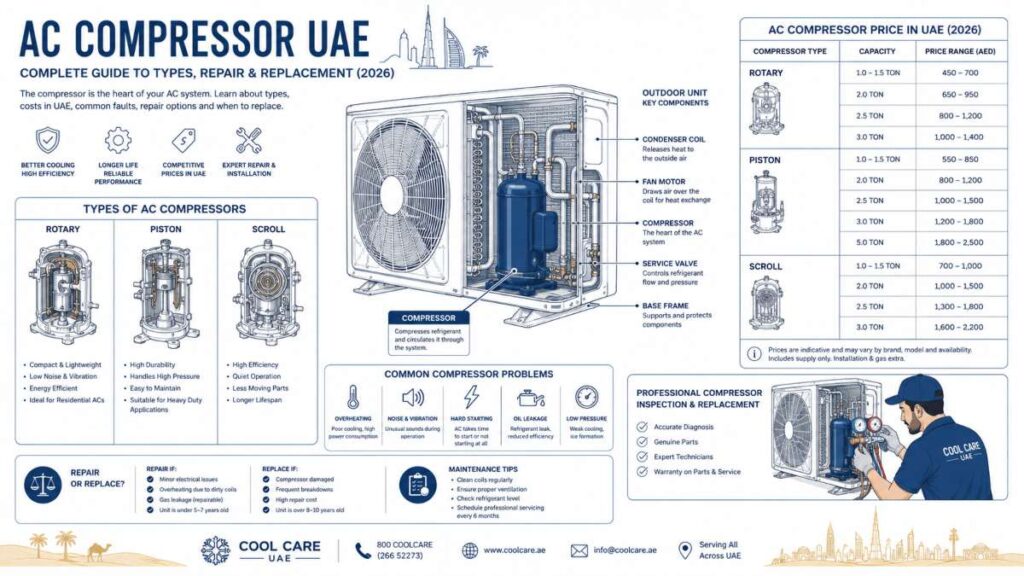
An AC compressor is the heart of every air conditioning system, the component responsible for pressurising refrigerant and driving the entire cooling cycle. In the UAE, where air conditioners run for up to fourteen hours a day during peak summer, understanding your AC compressor is not optional knowledge; it is essential maintenance intelligence that protects one of the most expensive components in your home or office.
It covers everything you need to know about AC compressors: what they are, how they work, which types are found in residential and commercial units, how to recognise failure before it becomes catastrophic, and what repair and replacement costs look like in Ras Al Khaimah in 2026.
What Is an AC Compressor and What Does It Do?
The AC compressor is a motor-driven pump housed in the outdoor unit of a split AC or inside the casing of a window AC. Its job is to compress low-pressure refrigerant gas into high-pressure gas, which then flows through the system to release heat and produce cooling. Without a functioning compressor, an AC unit cannot cool, the fan may still run, the display may still light up, but no meaningful temperature reduction will occur.
How an AC Compressor Works The Simple Explanation
The refrigeration cycle has four stages: compression, condensation, expansion, and evaporation. The compressor handles the first stage. It draws in low-pressure refrigerant vapour from the evaporator coil inside the indoor unit and compresses it into a hot, high-pressure gas. That gas travels to the condenser coil in the outdoor unit, where it releases its heat to the outside air and becomes a liquid. The liquid then passes through an expansion valve, drops in pressure and temperature, and enters the indoor evaporator coil where it absorbs heat from the room air and turns back into vapour. The cycle then repeats. The compressor is what keeps this loop moving continuously.
Key Components of an AC Compressor
A compressor contains several internal components that work together under significant mechanical stress. The motor windings generate the electromagnetic force that drives the compression mechanism. The pistons, scrolls, or rotary vanes depending on compressor type do the actual compression work. The crankshaft or eccentric bearing converts rotational motion into compression movement. The valve assembly controls the direction of refrigerant flow. The oil sump lubricates all moving parts. Each of these components is a potential failure point, and understanding which has failed determines whether repair or replacement is the right call.
The Role of the Compressor in the Refrigeration Cycle
The compressor does not create cold air it creates the pressure differential that enables heat transfer. By compressing refrigerant, it raises the gas to a temperature and pressure high enough that the outdoor condenser can reject heat to the ambient air even when that ambient air is 45°C, as it routinely is across Ras Al Khaimah and Dubai in July and August. This is why compressor quality and capacity matching matter so much in UAE conditions: an undersized or poorly matched compressor will work harder, run hotter, and fail sooner than one correctly specified for the environment.
Types of AC Compressor: Which One Is in Your Unit?
There are five main types of compressors used in residential and commercial AC systems in the UAE. Each has distinct operating characteristics, efficiency profiles, and suitability for different applications. Knowing which type is in your unit helps you interpret service recommendations, compare replacement quotes, and understand why your system behaves the way it does.
Rotary Compressor Most Common in UAE Split ACs
The rotary compressor uses one or two cylindrical rollers that rotate eccentrically within a circular chamber, compressing refrigerant as the rollers sweep around the chamber wall. It is the most widely used compressor type in residential split ACs in the UAE. Rotary compressors are compact, relatively quiet, mechanically simple, and well-suited to the continuous high-load operation that UAE summers demand. Most 1-ton, 1.5-ton, and 2-ton split ACs from LG, Daikin, Gree, O General, and Midea use rotary compressors. LG’s Dual Inverter technology, which uses twin rotary compressors operating at different frequencies, is a refinement of this base technology.
Piston (Reciprocating) Compressor Found in Window ACs
The piston compressor also called a reciprocating compressor uses a piston moving inside a cylinder to compress refrigerant, in the same mechanical principle as a car engine. It is the traditional compressor type and is still commonly found in window AC units and older split systems. Piston compressors are robust and repairable, but they are less efficient than rotary or scroll compressors and considerably noisier. In the UAE window AC market, brands such as Super General, Gree, and Midea continue to offer piston-compressor models at budget price points, alongside rotary-compressor alternatives.
Scroll Compressor Premium and Commercial Units
A scroll compressor uses two interleaved spiral-shaped scrolls one fixed, one orbiting to progressively compress refrigerant as it moves toward the spiral’s centre. Scroll compressors are significantly more efficient than rotary or piston types, produce very low vibration and noise, and handle the high ambient temperatures of the UAE exceptionally well. They are the standard compressor type in premium residential split ACs, ducted systems, and most commercial package units from brands such as Carrier, Trane, and Daikin’s commercial range.
Screw Compressor Large Commercial Applications
Screw compressors use two helical rotors that mesh to compress refrigerant continuously. They are not found in residential or light-commercial AC units; their application is in large central plant chillers, central AC systems for commercial buildings, and district cooling infrastructure. In the UAE’s commercial real estate market, screw compressors are the workhorse of large hotel, mall, and office building cooling systems. Replacement and repair of screw compressors are specialist operations that require industrial-grade equipment.
Variable Speed Compressor Inverter Technology Explained
A variable speed compressor is not a separate mechanical type but rather a control technology applied to rotary or scroll compressors. In a standard fixed-speed system, the compressor runs at 100% or not at all. An inverter-driven variable-speed compressor continuously adjusts its rotational speed to match the exact cooling demand in the space. At partial load, which is most of the time in a well-insulated UAE room, the compressor runs at 40–70% speed, consuming proportionally less electricity. The International Energy Agency estimates that inverter-controlled compressors consume 30–50% less electricity than fixed-speed equivalents, a saving that compounds significantly over an eight-month UAE cooling season.
Rotary vs Piston Compressor: Which Is Better for UAE Conditions?
For split AC applications in the UAE, the rotary compressor is the better choice in virtually every scenario. It is more energy-efficient, quieter in operation, lighter, and better suited to continuous high-duty-cycle running. The piston compressor’s advantage repairability is less relevant in an era when compressor replacement costs have fallen, and labour rates make deep compressor rebuilds uneconomical. For window ACs where cost is the primary concern, a piston compressor remains a viable and durable option, but for any split-system installation, specify a rotary or scroll compressor.
AC Compressor Failure: Symptoms, Causes & Warning Signs
Compressor failure is the most expensive AC repair a homeowner or facility manager faces in Ras Al Khaimah. Catching the warning signs early before total failure is the difference between a manageable repair bill and a full compressor replacement.
8 Signs Your AC Compressor Is Failing
The clearest warning signs that an AC compressor is approaching failure are: the AC runs but produces warm or only slightly cool air; the outdoor unit makes a grinding, rattling, or high-pitched squealing noise it did not previously make; the circuit breaker trips repeatedly when the AC starts; the outdoor unit vibrates noticeably more than usual on startup; the compressor starts and stops in short cycles rather than running continuously; the unit takes significantly longer than usual to reach the set temperature; visible oil stains appear around the compressor or refrigerant lines on the outdoor unit; and the electricity bill increases without any change in usage patterns.
Why AC Compressor Stops Working Common Causes in UAE
The UAE operating environment creates specific failure patterns not commonly seen in temperate climates. The most common cause of compressor failure in UAE residential AC units is refrigerant undercharge, usually the result of a slow leak that went undetected and unrectified. When refrigerant level drops, the compressor runs hotter than designed, the oil loses viscosity, and bearing surfaces wear rapidly. The second most common cause is dirty condenser coils: dust, sand, and airborne debris accumulate on the outdoor unit’s coil fins, reducing heat rejection efficiency and forcing the compressor to work against higher condensing pressures. Over- and under-voltage events during power outages are the third-leading cause of damage to motor windings and starting capacitors. Finally, incorrect AC installation, particularly an insufficient refrigerant charge at commissioning or improperly sized systems sets compressors up for premature failure from day one.
AC Compressor Not Turning On Diagnosis Checklist
When an AC runs, but the compressor does not engage, the fault is rarely the compressor. The starting capacitor, a small cylindrical component in the outdoor unit fails far more commonly than the compressor motor and produces identical symptoms: the fan runs, but the compressor does not start. Before assuming compressor failure, a qualified technician should test the capacitor, check the contactor relay, verify that the refrigerant pressure is within operating range, and confirm that the thermostat is calling for cooling. Only after these components are ruled out should the compressor motor windings be tested for continuity faults.
AC Compressor Overheating Causes and Fixes
A compressor that overheats will trip its internal thermal protection switch, shutting down and restarting repeatedlya pattern sometimes mistaken for an electrical fault. In the UAE, compressor overheating is most commonly caused by blocked condenser coils restricting airflow around the outdoor unit, inadequate clearance around the outdoor unit preventing heat dissipation, low refrigerant charge forcing the compressor to run under abnormal pressure conditions, or a failing condenser fan motor that is not moving enough air across the coil. The fix begins with a condenser coil clean and airflow assessment before any compressor work is attempted.
AC Compressor Short Cycling What It Means and Why It Matters
Short cycling is the condition in which the compressor starts, runs for 1 to 3 minutes, shuts off, and then restarts in rapid succession rather than completing a normal cooling cycle of 10 to 20 minutes. It is damaging because each compressor startup draws three to six times the normal running current, a high-current event that stresses motor windings and accelerates bearing wear. In UAE conditions, short cycling is commonly caused by an oversized system that cools the space too quickly, a refrigerant overcharge, a failing thermostat or temperature sensor giving false readings, or early-stage compressor valve wear that prevents the unit from building adequate pressure.
AC Compressor Blast What Causes It and How to Prevent It
An AC compressor blast the sudden catastrophic rupture of the compressor casing is rare but not unheard of in UAE conditions, particularly in units that have been running with undetected faults for extended periods. It occurs when internal pressure builds to a level the casing cannot contain, typically due to a blocked refrigerant circuit, liquid slugging (liquid refrigerant entering the compressor rather than gas), or a severely overcharged system. Prevention is straightforward: annual servicing that includes refrigerant pressure checks, condenser coil cleaning, and refrigerant line inspection eliminates the conditions that lead to blast events.
AC Compressor Repair: What Can Be Fixed and What Cannot
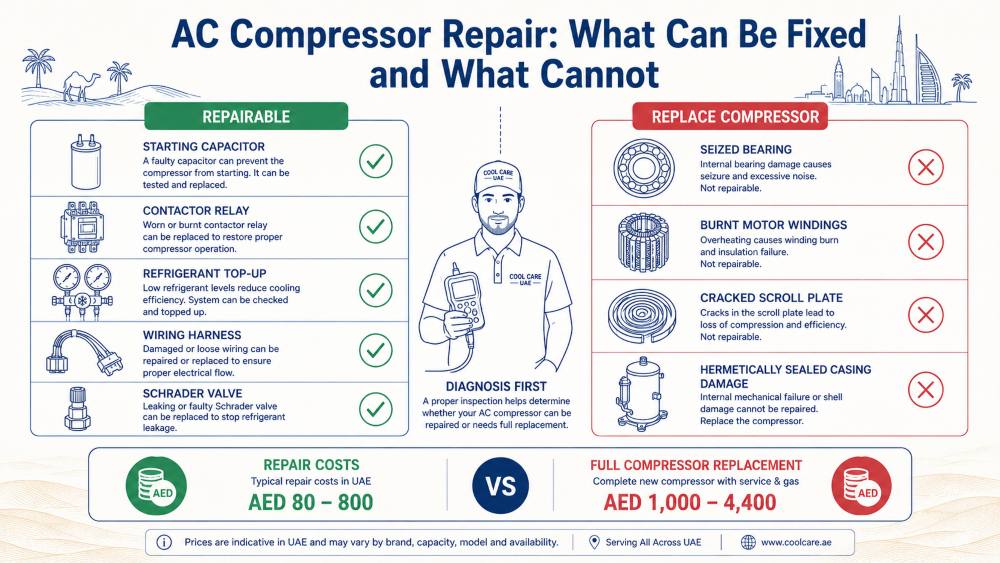
Not every compressor fault requires replacement. Understanding which faults are repairable and which are not allows you to evaluate technician recommendations with confidence.
Can an AC Compressor Be Repaired?
The honest answer is: sometimes. Minor electrical faults, a failed starting capacitor, a faulty contactor, or a damaged wiring connection are fully repairable and inexpensive. A qualified refrigerant technician can repair refrigerant leaks at the compressor’s Schrader valve or at flare connections. However, internal mechanical failure worn pistons, damaged scroll plates, seized bearings, or burnt motor windings is generally not economically repairable in residential compressors. The cost of disassembly, parts, and reassembly typically approaches or exceeds the cost of a new compressor, and the repaired unit carries no warranty. For compressors still within the manufacturer’s warranty period typically 10 years for inverter compressors the correct course is always to file a warranty claim rather than a third-party repair.
AC Compressor Oil Type, Capacity, and How to Change It
Compressor oil lubricates all moving parts inside the sealed compressor casing and circulates with the refrigerant through the system. The correct oil type depends on the refrigerant used: R-22 systems use mineral oil; R-410A and R-32 systems which account for the vast majority of units installed in the UAE from 2015 onward require POE (polyolester) synthetic oil. Using the wrong oil type causes seal degradation and accelerated wear. Oil capacity varies by compressor model, typically ranging from 200ml to 500ml for residential rotary compressors. Oil does not need routine changing in a sealed system; it is checked and topped up only when the system is opened for refrigerant work or after a compressor failure, where contaminated oil must be flushed before a new compressor is installed.
AC Compressor Gas Name, Pressure, and How to Recharge
The refrigerant gas in UAE residential AC systems is most commonly R-410A in units manufactured from approximately 2010 onward, and R-32 in units manufactured from 2018 onward. R-22 (Freon) is found in older systems and is now heavily restricted under UAE environmental regulations aligned with the Montreal Protocol. Operating pressure for R-410A is approximately 118–130 PSI on the low side and 400–420 PSI on the high side under normal UAE operating conditions. Recharging correctly called refrigerant recharge or top-up must be performed by a licensed technician with calibrated gauges and a valid refrigerant handling certification. Overcharging is as damaging as undercharging, and both will shorten compressor life.
AC Compressor Seal and Shaft Seal Replacement
The shaft seal on semi-hermetic compressors can be replaced without replacing the entire compressor. However, residential split AC and window AC compressors in the UAE are almost universally hermetically sealed welded shut during manufacture making shaft seal replacement impractical without specialist equipment. If a hermetic compressor is leaking refrigerant from the casing rather than from a line connection, replacing the compressor is the correct course of action.
How to Flush the AC System After Compressor Failure
When a compressor fails catastrophically particularly if it has seized or burnt out contaminants including metal particles, burnt oil, and acid byproducts enter the refrigerant circuit. If a new compressor is installed without flushing the system, these contaminants will destroy it within weeks. Proper flushing involves removing all refrigerant, purging the line set and heat exchangers with an approved flushing agent, replacing the filter drier, and recharging with fresh refrigerant and oil. Any technician recommending a compressor replacement without also recommending a system flush should be questioned about this.
AC Compressor Repair Cost in Ras Al Khaimah (2026)
| Repair Type | Estimated Cost (AED) |
|---|---|
| Starting Capacitor Replacement | 80 – 180 |
| Contactor Relay Replacement | 120 – 250 |
| Refrigerant Top-up (R-410A / R-32) | 200 – 450 |
| Compressor Oil Top-up | 150 – 300 |
| Shaft Seal Repair (Semi-Hermetic) | 400 – 800 |
| Electrical Wiring Fault Repair | 150 – 350 |
| System Flush (After Compressor Failure) | 300 – 600 |
AC Compressor Replacement: When, How & How Much
Repair vs Replace How to Decide
The repair-versus-replace decision for an AC compressor follows a straightforward logic. If the compressor is within its manufacturer warranty period, replacement under warranty is always the first option. If it is out of warranty and the fault is internal mechanical failure, replacement is almost always more economical than repair for hermetic residential compressors. The commonly used rule of thumb is: if the repair cost exceeds 50% of the cost of a new compressor or if the unit is more than 8 years old, replacement is the better investment. In UAE conditions, where a failed compressor in July means days without cooling, the speed and certainty of replacement often justifies the cost even in borderline cases.
AC Compressor Replacement Procedure Step by Step
A proper compressor replacement in a UAE residential split AC follows this sequence: the system refrigerant is recovered using certified recovery equipment (venting to atmosphere is illegal under UAE environmental regulations); the electrical connections and refrigerant lines are disconnected; the failed compressor is removed from the outdoor unit; the system is inspected for contamination and flushed if required; the new compressor is installed and oil charged if not pre-charged; the filter drier is replaced; the system is pressure-tested with dry nitrogen; a vacuum is pulled to remove moisture and non-condensables; fresh refrigerant is charged to the manufacturer’s specified weight; operating pressures and temperatures are verified; and the system is run through a full operational check. Any replacement procedure that skips the vacuum or pressure test stages is substandard and risks premature failure of the new unit.
How Long Does an AC Compressor Last in the UAE?
A well-maintained AC compressor in the UAE should last 8–12 years under typical residential operating conditions. Units running in poorly ventilated outdoor spaces, in areas with heavy dust or salt air exposure (such as coastal RAK locations like Al Marjan Island and Mina Al Arab), or in systems that have never received professional servicing tend to fail at the lower end of this range. Inverter compressors, which avoid the high-current restart stress of fixed-speed units, consistently demonstrate longer operational life in the UAE market.
AC Compressor Replacement Cost in Ras Al Khaimah (2026)
Capacity Replacement Compressor Cost (AED)Labour & Refrigerant (AED)Total Estimate (AED)
| Capacity | Replacement Compressor Cost (AED) | Labour & Refrigerant (AED) | Total Estimate (AED) |
|---|---|---|---|
| 1 Ton | 600 – 1,000 | 400 – 600 | 1,000 – 1,600 |
| 1.5 Ton | 800 – 1,400 | 450 – 650 | 1,250 – 2,050 |
| 2 Ton | 1,100 – 1,900 | 500 – 700 | 1,600 – 2,600 |
| 2.5 Ton | 1,500 – 2,500 | 550 – 750 | 2,050 – 3,250 |
| 3 Ton | 2,000 – 3,500 | 600 – 900 | 2,600 – 4,400 |
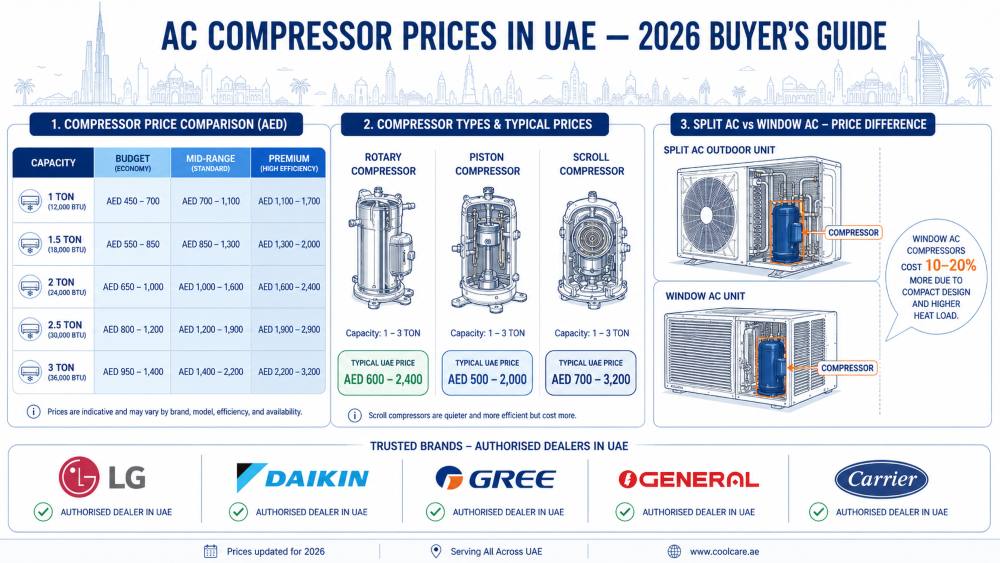
1.5 Ton, 2 Ton, 2.5 Ton & 3 Ton Compressor Price Table
Compressor unit prices in the UAE vary significantly by brand tier, compressor type, and refrigerant compatibility. The table below covers supply-only prices for new replacement compressors available through UAE distributors and specialist AC parts suppliers.
| Capacity | Budget Range (AED) | Mid Range (AED) | Premium Range (AED) |
|---|---|---|---|
| 1.5 Ton | 500 – 800 | 850 – 1,200 | 1,300 – 1,800 |
| 2 Ton | 700 – 1,100 | 1,200 – 1,700 | 1,800 – 2,500 |
| 2.5 Ton | 1,000 – 1,600 | 1,700 – 2,300 | 2,400 – 3,200 |
| 3 Ton | 1,400 – 2,200 | 2,300 – 3,200 | 3,300 – 4,500 |
| 5 Ton | 2,500 – 4,000 | 4,100 – 6,000 | 6,100 – 9,000 |
Split AC vs Window AC Compressor Prices in UAE
Split AC compressors predominantly rotary type carry a price premium over window AC compressors due to higher efficiency ratings and the dominance of inverter-compatible models. A replacement rotary compressor for a 1.5-ton split AC typically costs AED 800–1,400 in the UAE market. A piston compressor for a 1.5-ton1.5-ton window AC of equivalent capacity typically costs AED 400–700, reflecting its simpler mechanical design and lower material costs.
Best AC Compressor Brands Available in UAE
The brands with the strongest authorised distribution and after-sales support in the UAE AC compressor market are LG (dominant in residential rotary inverter compressors), Daikin (preferred for premium residential and light commercial scroll compressors), Gree (strong mid-tier rotary compressor range with competitive UAE pricing), O General and Carrier (well-supported for mid-to-large commercial applications), and Samsung (Digital Inverter compressor technology with a growing UAE authorised service network). For replacement compressors, always specify OEM (original equipment manufacturer) or authorised-equivalent parts aftermarket compressors from unverified suppliers in Sharjah’s industrial areas may be attractive but often lack the pressure ratings and oil compatibility required for UAE operating conditions.
Where to Buy AC Compressor in UAE Dubai, Sharjah & RAK
Authorised compressor parts are available through brand service centres in Dubai and Abu Dhabi. Sharjah Industrial Area (particularly the areas around Sajaa) hosts a dense concentration of AC wholesale and parts suppliers, making it the primary sourcing point for independent technicians across the UAE. In Ras Al Khaimah, specialist AC parts suppliers are available in the RAK Industrial Area. Online procurement through authorised UAE distributors is also an option for facilities managers sourcing compressors for multiple units. For homeowners, the most straightforward route is to engage a reputable maintenance company such as Home Fix Building Maintenance that sources compressors directly from authorised channels, handles installation, and backs the work with a service guarantee.
AC Compressor Maintenance: Extend the Life of Your Unit
Compressor failure is largely preventable. The conditions that destroy compressors, refrigerant undercharge, coil contamination, overheating, and voltage stress all develop gradually and are detectable long before they cause irreversible damage.
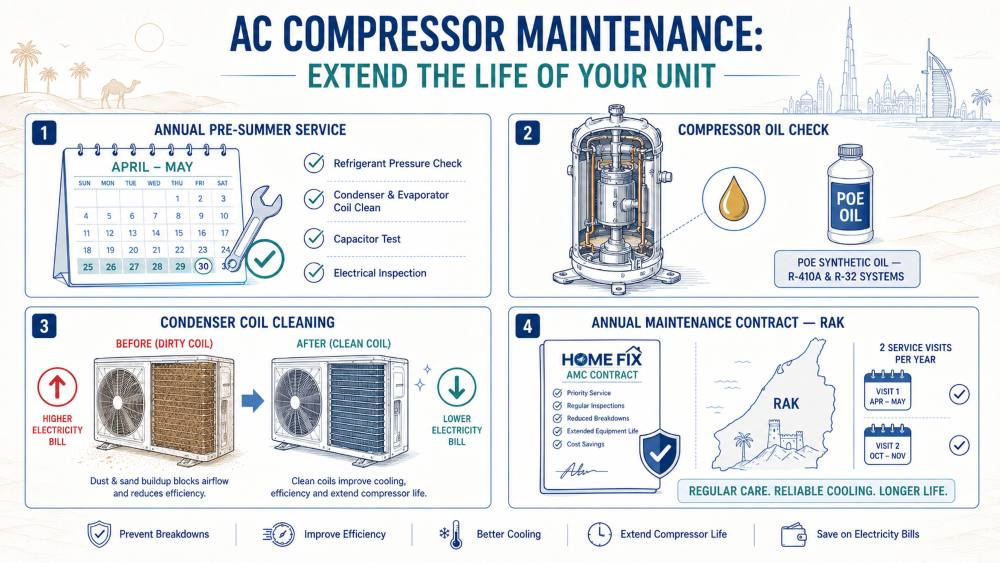
How Often Should an AC Compressor Be Serviced in the UAE?
In UAE conditions, AC systems should receive a professional service inspection at minimum once per year, ideally before the peak summer season in April or May. Units in coastal locations Al Marjan Island, Mina Al Arab, Bab Al Bahr benefit from twice-yearly servicing due to salt air, which accelerates coil corrosion and filter contamination. A proper compressor health check includes refrigerant pressure measurement, comparison of operating current draw to the nameplate amperage, condenser coil cleaning, electrical connection inspection, and capacitor testing. These checks cost a fraction of a compressor replacement and reliably catch developing faults before they escalate.
AC Compressor Oil Check and Top-Up
In a sealed hermetic compressor which covers virtually all residential split and window AC units the oil is not accessible for routine checking without opening the refrigerant circuit. Oil level and condition are assessed indirectly: correct refrigerant pressure, normal operating temperatures, and the absence of unusual noise are all indicators that the oil charge is adequate. Oil top-up is performed only when the system has been opened for refrigerant work or after a compressor change. Using the correct POE oil grade specified by the compressor manufacturer is non-negotiable; the wrong viscosity or chemistry will degrade seals and reduce lubrication film strength under the high-pressure operating conditions in the UAE.
Keeping the Condenser Coil Clean Why It Matters
The condenser coil in the outdoor unit is the compressor’s primary heat rejection mechanism. When coil fins are blocked with dust, sand, cottonwood seeds, or airborne construction debris all common in UAE environments the compressor must work against elevated condensing pressure to push heat out. A 10°C rise in condensing temperature due to a dirty coil increases compressor power consumption by approximately 3–5% and raises internal compressor temperatures by a corresponding amount. Over a UAE summer, a consistently dirty condenser coil can shorten the compressor’s lifespan by 2 to 3 years. Condenser coil cleaning with a low-pressure wash is a ten-minute service task that delivers disproportionate long-term benefit.
Annual Maintenance Contracts for AC in Ras Al Khaimah
An Annual Maintenance Contract with Home Fix Building Maintenance provides the systematic, scheduled care that keeps AC compressors running through UAE summers without unplanned failure. Our AMC for AC systems in Ras Al Khaimah covering Al Riffa, Al Jazeera Al Hamra, Mina Al Arab, Bab Al Bahr, Al Marjan Island, and surrounding areas includes pre-summer full inspection, refrigerant pressure check, condenser coil clean, electrical component testing, and priority emergency response with discounted parts if a compressor fault does develop.
Conclusion
An AC compressor is not a component you can afford to ignore in Ras Al Khaimah. With cooling systems running at full load for eight months of the year and outdoor temperatures pushing well past 45°C in summer, the compressor is under more sustained stress here than almost anywhere else in the world.
Rotary and scroll compressors are the right technology for UAE conditions. Most failures are preceded by detectable warning signs, unusual noise, short cycling, warm air, rising bills that give you time to act before the situation becomes critical. Minor electrical faults are repairable; internal mechanical failure almost always warrants full replacement. In every case, annual professional servicing is the single most effective way to extend compressor life.
If your system has not been serviced in the past twelve months, the right time to act is before peak summer not during it.
Contact Home Fix Building Maintenance at info@homefix-uae.com or call +971 52 511 2254 to discuss an AMC tailored to your property.
Frequently Asked Questions (FAQs)
What is an AC compressor?
An AC compressor is the motor-driven pump in the outdoor unit of a split AC or inside a window AC that compresses refrigerant gas, driving the refrigeration cycle that produces cooling. It is the most mechanically complex and expensive component in any air conditioning system.
What does an AC compressor do?
It draws in low-pressure refrigerant vapour, compresses it into high-pressure hot gas, and pushes it to the condenser coil where heat is rejected to the outside air. This pressure difference is what enables the cooling cycle.
How long does an AC compressor last in the UAE?
A well-maintained compressor in a UAE residential split AC typically lasts 8–12 years. Annual servicing and clean condenser coils are the two most effective factors in reaching the upper end of that range.
What are the signs of AC compressor failure?
Warm air from the indoor unit despite the system running, unusual noise from the outdoor unit, repeated circuit breaker trips, short cycling, visible oil around the outdoor unit, and higher electricity bills without changed usage are the primary warning signs.
Can an AC compressor be repaired?
Minor electrical faults such as capacitors, contacts, and wiring are repairable. Internal mechanical failure in a hermetically sealed residential compressor is generally not economically repairable; replacement is the correct course of action.
What refrigerant gas does an AC compressor use in UAE?
Most residential AC units manufactured in the UAE since 2010 use R-410A. Units manufactured from 2018 onward increasingly use R-32. Older units may use R-22, which is now restricted under UAE environmental regulations.
What is the cost of AC compressor replacement in Ras Al Khaimah?
Total replacement cost including the new compressor, labour, system flush, and refrigerant recharge ranges from approximately AED 1,000–1,600 for a 1-ton unit to AED 2,600–4,400 for a 3-ton unit, depending on the brand and site conditions.
Which type of compressor is best for a split AC in the UAE?
A rotary inverter compressor is the best choice for residential split ACs in UAE conditions, offering the best balance of efficiency, reliability, noise, and long-term running cost. Scroll compressors are the preferred choice for premium and commercial applications.
Does an AC compressor need oil?
Yes. Compressor oil lubricates all internal moving parts. In sealed, hermetic compressors which cover virtually all residential units the oil is factory-sealed inside the compressor. It does not require routine changing unless the system is opened for major repairs.
Why is my AC compressor not turning on?
The most common cause is a failed starting capacitor, not the compressor itself. A qualified technician should test the capacitor, contactor, and refrigerant pressure before concluding the compressor motor has failed.