How to Do Kitchen Cabinet Repair in Ras Al Khaimah

Most kitchen cabinet repair in Ras Al Khaimah is a quick fix, not a full replacement. A loose hinge, a stuck drawer runner, a swollen panel or peeling laminate can usually be repaired on site by a skilled carpenter, often in a single visit.
Cabinets in RAK work harder than most. Coastal humidity often climbs above 80 per cent in summer and steam, sink leaks and daily use add to the strain. Over time, MDF swells, laminate lifts at the edges and hinges lose their grip. Fixing the fault early stops a small problem from ruining the whole cabinet.
Home Fix Building Maintenance repairs kitchen cabinets in villas and apartments across Ras Al Khaimah, as part of our wider carpentry works. Below, you will find what each fault means, how it is fixed and when replacing is the smarter choice.
Our Kitchen Cabinet Repair Services in RAK
Home Fix Building Maintenance repairs kitchen cabinets across Ras Al Khaimah, from loose hinges and stuck drawers to swollen panels and peeling laminate. Our carpenters handle most faults on site and take only the damaged parts to the workshop.
Kitchen carpenter for villas and apartments
A kitchen carpenter in Ras Al Khaimah repairs, adjusts and rebuilds cabinet parts without replacing the whole kitchen. Home Fix Building Maintenance sends carpenters to villas in Al Hamra and Al Riffa and to apartments on Al Marjan Island, Mina Al Arab and Bab Al Bahr. Villa kitchens often have long runs of cabinets and heavier doors, so we check every hinge and runner in one visit. Apartment kitchens are more compact, with fewer panels but more wear on each one. In both, we match the repair to the cabinet material, whether MDF, laminate, wood, acrylic or aluminium.
What a repair visit includes
Every visit starts with an inspection. The carpenter opens each door and drawer, checks for moisture under the sink and finds the cause of the fault, not just the symptom. A sagging door, for example, may come from a worn hinge or from a swollen side panel that has loosened the screws.
You then get a clear quote before any work begins. Once you approve it, the carpenter repairs the fault, aligns the doors, tests every moving part and cleans up the work area. Most hinge, runner and alignment jobs take only a couple of hours, though this depends on how many cabinets are affected.
Same visit fixes vs workshop repairs
Same visit fixes cover faults that need only tools and replacement fittings. These include hinge replacement, door alignment, drawer runner swaps, small chip repairs and edge banding touch ups. They are finished at your home, with no need to empty the kitchen.
Workshop repairs are for damage that needs controlled drying, cutting or re finishing. Examples are badly swollen MDF panels, large sections of lifted laminate and warped doors. The carpenter removes only the affected parts, repairs them in the workshop and refits them. If the wood has been weakened by insects, our guide to termite damage wood repair explains how affected timber is treated and restored.
Cabinet Door and Hinge Repair
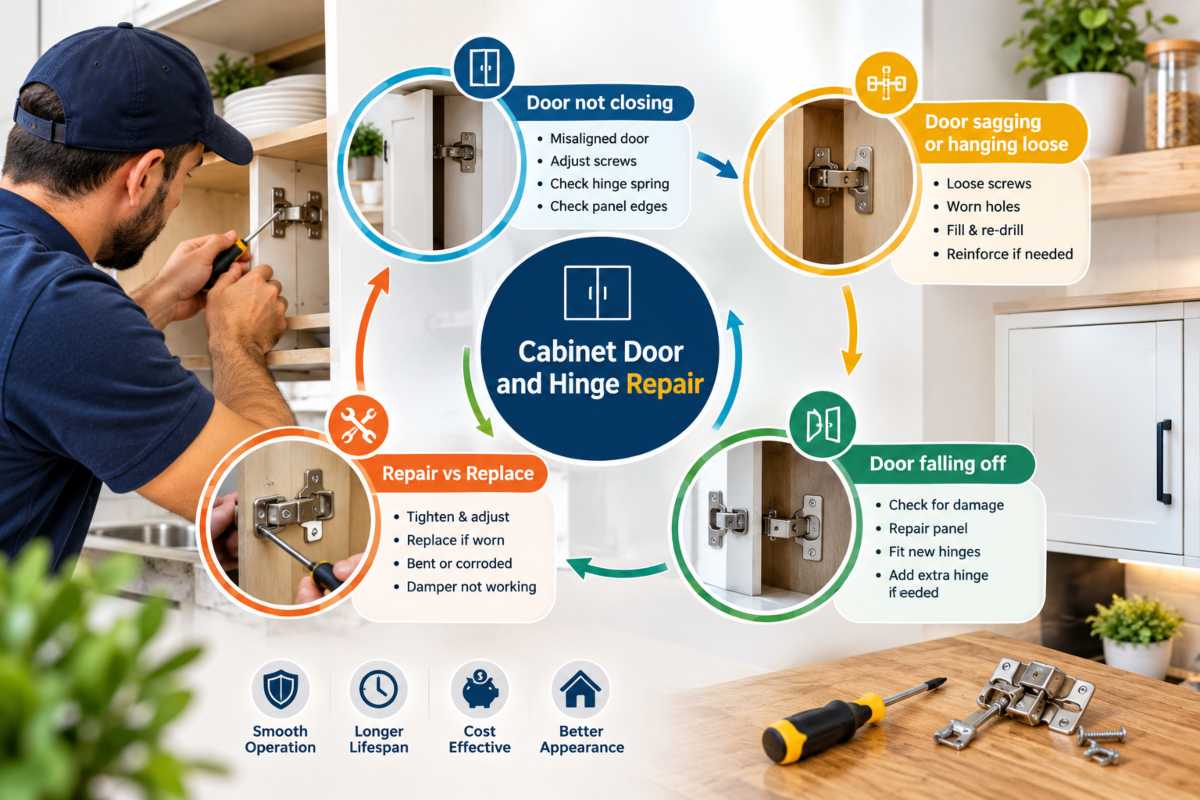
Kitchen cabinet doors rarely fail because of the door itself. In most cases the hinge has loosened, drifted out of alignment or worn out and a carpenter can correct it in a few minutes per door without replacing the cabinet.
Door not closing (hinge or alignment fault)
A cabinet door that won’t close is usually misaligned, not damaged. Most modern kitchens use concealed hinges with adjustment screws that move the door in three directions, forwards and back, left and right and up and down. A few turns of these screws normally brings the door flush with its neighbours and evens out the gaps. If the door still pops open, the hinge spring may be tired or the panel may have swollen slightly in RAK’s humid air and no longer fits its opening. A good carpenter checks both the hardware and the panel edges before choosing the fix.
Door sagging or hanging loose
A sagging door tells you the hinge has lost its grip. Over time, the screws work loose or the holes in the cabinet side widen, especially in MDF and chipboard. The lasting repair is to fill the worn holes with wood filler or dowels, re drill them and fix the hinge plate with new screws. Where the board has crumbled, the plate is moved to solid material or the panel is reinforced first. Acting early matters, because a door hanging on one weak hinge tears out the screws further every time it opens.
Door falling off
A door that has come off needs checking before it is rehung. A snapped hinge arm, a hinge cup torn out of the door or a split cabinet side will not hold if the door is simply screwed back on. The carpenter repairs the damaged board, fits new hinges and rebalances the load across them. Heavy doors, such as solid wood or large glossy panels, often need an extra hinge to stay secure. If a door keeps falling off, the fault is almost always in the panel holding the hinge, not in the door.
Hinge repair vs hinge replacement
Repair is enough when the hinge is sound but loose or out of line. Tightening and adjusting it restores the door at the lowest cost. Replacement is the better choice when the arm is bent, the spring is weak, the metal has corroded or a soft close damper has failed. Because hinges cost far less than a new door, replacing a worn set is usually wiser than adjusting it again and again. For wider guidance on diagnosing hinge faults, see our page on door hinge repair.
Drawer Repair, Runners and Slides
A kitchen drawer that sticks, won’t close or rattles is almost always a runner problem and runners can be adjusted, repaired or replaced without changing the cabinet. Most faults trace back to dirt, wear, a loose fixing or a drawer box that has shifted out of square.
Drawer not closing or stuck
A drawer that won’t close fully is usually blocked, misaligned or running on worn slides. Start with the simple causes: a fallen item behind the drawer, grit in the runner track or a loose screw holding the slide to the cabinet side. If the drawer still drags, the runners may have shifted out of parallel, so the drawer binds on one side as it moves. A carpenter removes the drawer, re fixes the slides level and square and checks that the drawer box itself hasn’t swollen. In RAK kitchens, humidity can expand MDF drawer sides just enough to jam them, so the box edges are checked as well as the hardware.
Runner and slide replacement
Runners should be replaced when they are bent, rusted, cracked or no longer roll smoothly. Cleaning and tightening only helps while the metal is sound. Once the ball bearings are worn or the rails are warped, the drawer will keep dropping, tilting or grinding no matter how often it is adjusted. Replacement is a quick job when the new slides match the old size and fixing points. The carpenter measures the drawer length and the load it carries, then fits matching full extension or standard slides. Heavy drawers holding pots, pans or crockery need slides with a higher load rating, so it is worth choosing for the contents, not just the size.
Soft close upgrades
Soft close upgrades turn an ordinary drawer into one that glides shut quietly and they can usually be added during a runner replacement. Most soft close slides have a built in damper that slows the drawer over its final few centimetres. This reduces slamming, protects the drawer front and eases wear on the cabinet frame. Some existing slides can be fitted with add on dampers, but replacing worn runners with soft close ones is normally the neater and longer lasting option. The upgrade works best on drawers in good condition. If the drawer box is damaged or swollen, repair that first so the new slides sit true.
Humidity, Swelling and Water Damage
Kitchen cabinets swell when their boards absorb moisture and in Ras Al Khaimah the cause is usually humid coastal air, steam or a slow leak under the sink. Swollen cabinets can often be repaired if the moisture source is stopped first and the damaged boards are dried, rebuilt or replaced.

Why cabinets swell in RAK humid climate
Cabinets swell in RAK because MDF and chipboard soak up moisture from the air and the coast is humid for much of the year. These boards are constructed from compressed wood fibres bonded with resin. Once moisture gets past the surface, the fibres expand and do not shrink back to their original size. Air conditioned kitchens add to the problem. Cool surfaces meet warm, moist air and form condensation, especially around the sink, dishwasher and kettle. Unsealed edges and cut outs are the first places to swell, which is why the bottom edges of doors and the base of sink units usually show damage first.
Sink and leak related damage
The cabinet under the sink is the most exposed part of any kitchen, because even a small drip can soak the base panel for weeks before anyone notices. Early signs include a musty smell, bubbling laminate, dark staining and a base board that feels soft when pressed. Damage often starts at the back and underside, so the visible surface may look fine while the board behind it is failing. Dishwasher hoses, tap connectors and waste pipe joints are the usual sources. Left alone, a persistent leak will rot the base, loosen hinges and spread to neighbouring units.
Swollen cabinet repair
Swollen cabinet repair depends on how far the moisture has travelled. Light swelling on a door edge or a panel that has only just been exposed can sometimes be dried out, sanded back, sealed and refinished. If the board has crumbled, lost its strength or stays puffy after drying, the affected part must be replaced. A carpenter cuts out the damaged section or makes a new panel, then seals every edge so water cannot get in again. Replacing only the failed panel is usually far cheaper than replacing the whole cabinet and it works well when the rest of the unit is still sound.
When to fix the plumbing leak first
Always fix the leak before repairing the cabinet. A new panel or fresh laminate will swell and peel again if water is still reaching it. If you can see active dripping, a wet base or a pipe joint that is weeping, stop the water and have the source repaired first. Our plumbing services cover leak detection and pipe repair and regular checks through plumbing maintenance help catch slow drips before they reach the cabinets. Once the area is dry and the leak is sealed, the carpenter can repair the damaged boards with a lasting result.
Peeling Laminate, Scratches and Edge Banding
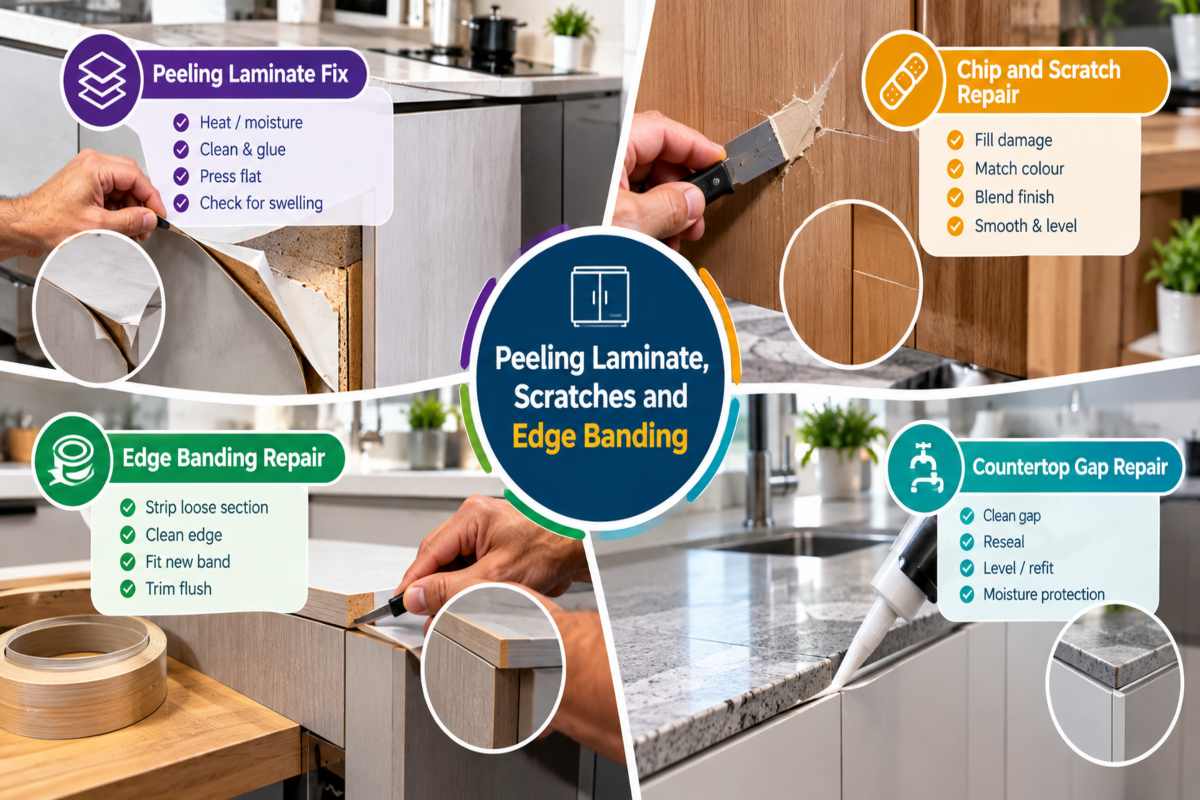
Peeling laminate, chips, scratches and loose edge banding are surface faults and most can be repaired without replacing the cabinet. The key is to treat the cause first, whether that is heat, moisture or impact, so the repair lasts.
Peeling laminate fix
Laminate peels when its adhesive bond fails, usually because of heat, steam or moisture reaching the board beneath. Corners and edges near the cooker, kettle, dishwasher and sink lift first. If the board underneath is still firm and dry, a carpenter cleans both surfaces, applies a suitable contact adhesive and presses the laminate flat until it bonds. Where the board has swollen or crumbled, gluing alone will not hold, so the panel is repaired or replaced before the laminate is refitted. In RAK’s humid kitchens, peeling often signals moisture inside the board, so the cause is checked before any glue is used.
Chip and scratch repair
Chips and scratches can be repaired by filling the damage and matching the finish and the result is often hard to spot. Shallow scratches on laminate or acrylic can be blended with a colour matched filler or polish. Deeper chips are packed with a hard filler, levelled and coloured to match the surrounding surface. Glossy acrylic needs extra care, because even a small mismatch shows in the light. If a door has several deep marks or the finish has faded unevenly, replacing that single door front is often neater than patching it repeatedly.
Edge banding repair
Edge banding is the thin strip that seals the cut edge of a panel and when it lifts, moisture and wear get straight into the board. Bands loosen through heat, steam and daily knocks and the exposed edge then swells quickly in humid air. A carpenter strips back the failed section, cleans the edge and fits a new strip in a matching colour and thickness, then trims it flush. Repairing a lifted band early is worth the small effort, because it stops a cosmetic fault turning into swollen board that needs replacing.
Countertop gap repair
A gap between the cabinet and the countertop lets water, crumbs and steam slip behind the units, so it is worth closing properly. Gaps appear when the worktop shifts, the cabinets settle or old sealant dries and cracks. Narrow gaps are cleaned and resealed with a flexible, moisture resistant sealant. Wider gaps may need the cabinet levelled, a filler strip fitted or the worktop refixed first. Sealing matters most around the sink, where a small opening can send water straight into the cabinet base below.
Repair by Cabinet Material
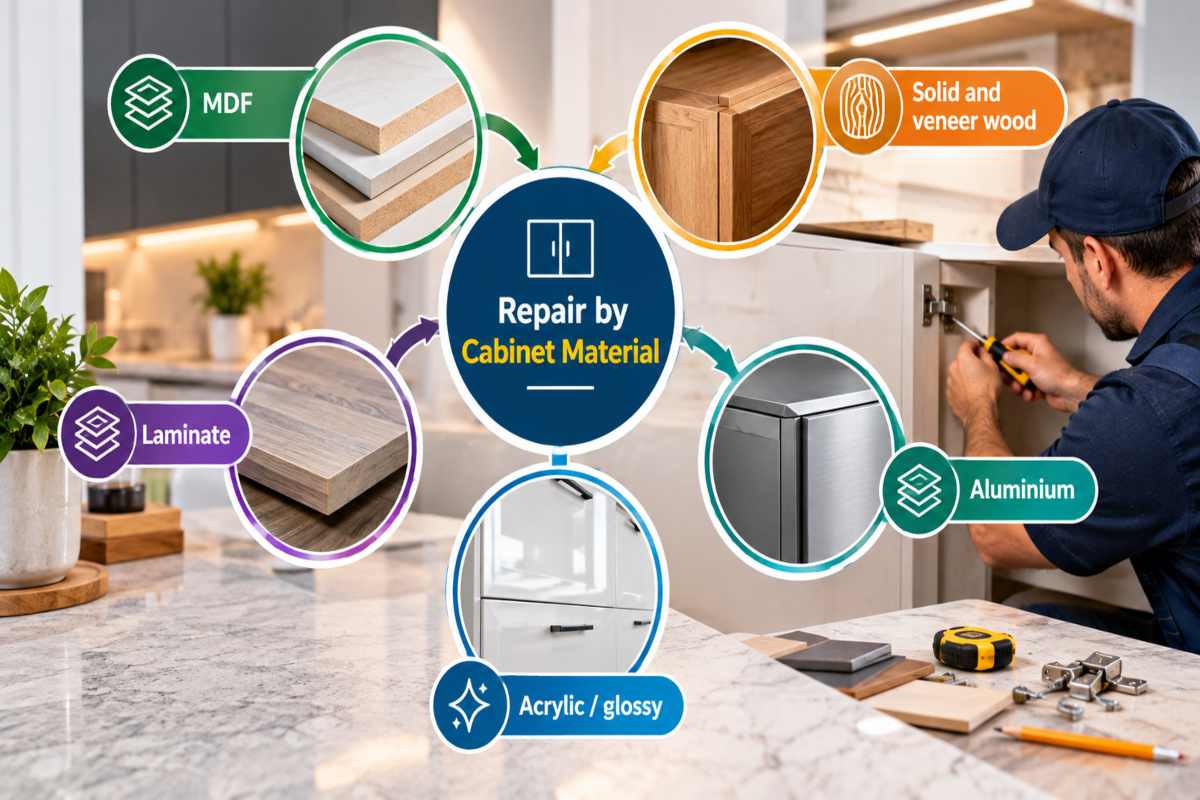
The right kitchen cabinet repair depends on what the cabinet is made of, because each material fails in a different way. MDF swells, wood warps, laminate peels, acrylic scratches and aluminium dents, so a carpenter chooses the method to suit the material.
MDF
MDF is the most common cabinet material in UAE kitchens and its main weakness is moisture. The board is made from compressed wood fibres, so once water gets in, it swells and loses strength. Light damage can be dried, sanded, sealed and refinished. Crumbling or permanently puffed sections are cut out and replaced with new board, with every edge sealed afterwards. Hinge and screw holes also wear out quickly in MDF, so reinforcing them is a routine part of the job.
Solid and veneer wood
Solid wood and veneer can be repaired more often than most materials, because they hold fixings well and can be sanded and refinished. Solid wood may warp or split as humidity changes and a carpenter can often realign, fill or re join the affected area. Veneer is a thin wood layer over a board, so it can lift or bubble when moisture reaches the core. Small lifted areas are re bonded and damaged patches are replaced with matching veneer. Stain and finish are matched carefully so the repair blends in.
Laminate
Laminate cabinets suffer mainly at the edges and corners, where heat and steam weaken the adhesive. Peeling sections are cleaned, re glued and pressed flat and chipped corners are filled and colour matched. Laminate itself is tough, so most problems come from the board below it. If that board is damaged, it is repaired before the laminate goes back on. When the surface is worn across a whole door, replacing the door front is usually tidier than patching.
Acrylic / glossy
Glossy acrylic cabinets look sharp but show every mark. Light scratches and dull patches can often be polished out, while deeper scratches may need filling and re finishing. The challenge is matching the shine, because a small mismatch is obvious under kitchen lighting. If the gloss has faded unevenly or several doors are heavily marked, replacing the affected door fronts gives a cleaner result than repeated patching. For a full change of look across the kitchen, our home renovation services are the better route.
Aluminium
Aluminium cabinets do not swell or rot, which makes them a practical choice for humid kitchens, so their faults are usually mechanical. Common repairs include replacing worn hinges and runners, fixing loose joints and removing dents from doors and panels. Corrosion is rare, but it can appear at joins or screw points if water sits there. Because aluminium cannot be sanded and refinished like wood, damaged panels are normally replaced instead of rebuilt.
Repair or Replace? How to Decide
Repair is the better choice when the cabinet structure is sound and the fault is limited to a hinge, runner, panel or surface. Replacement makes sense only when the boards have failed throughout or when repair costs would climb close to the price of new units.
When repair is enough
Repair is enough when the cabinet box is solid and the damage is local. Loose or worn hinges, stuck drawers, lifted edge banding, peeling laminate, chips and a single swollen door all fall into this group. In each case the carpenter replaces or rebuilds the failed part and the rest of the cabinet carries on as before. A useful test is to press the base and side panels firmly. If they feel hard and dry, with no crumbling, musty smell or soft spots, the structure is likely sound and repair will last. Repair is also the sensible route when the layout and style still suit you, because you keep the cabinets you already have and avoid the disruption of a kitchen strip out.
When replacement saves money
Replacement saves money when damage is widespread and repeated repairs would cost more than starting fresh. This usually means MDF that has swollen across several base units, cabinet boxes that crumble when touched or a long running leak that has rotted the floor of the sink unit and spread to its neighbours.
The same applies when many drawers and doors are failing at once, since the repair bills can add up quickly. As a rough rule, if the repair cost approaches half the price of new cabinets, replacement deserves a serious look. Often the answer is a middle path, replace only the worst units or door fronts and repair the rest. If you are considering a full kitchen change, a carpenter can assess which parts are worth keeping before you decide.
Kitchen Cabinet Repair Cost in RAK (AED)
Kitchen cabinet repair in Ras Al Khaimah typically costs from about AED 50 for a simple hinge adjustment to AED 1,500 or more for a water damaged base unit. The final price depends on the fault, the cabinet material and how many units are affected.
Pricing table by fault type
The ranges below are indicative starting guides for common repairs. A carpenter confirms the exact price after inspecting your kitchen.
| Repair | Typical cost (AED) |
|---|---|
| Hinge adjustment or alignment, per door | 50 – 100 |
| Hinge replacement, per door | 80 – 180 |
| Drawer runner or slide replacement, per drawer | 120 – 300 |
| Soft-close upgrade, per drawer | 180 – 400 |
| Peeling laminate re-bonding, per door or section | 150 – 400 |
| Chip or scratch repair, per door | 100 – 250 |
| Edge banding repair, per section | 80 – 200 |
| Countertop gap sealing or filler strip | 150 – 350 |
| Swollen panel repair or replacement, per panel | 250 – 700 |
| Water-damaged base unit repair | 600 – 1,500+ |
Hinge, runner and alignment jobs sit at the lower end, because they need fittings and a short visit rather than workshop time. Moisture repairs cost more, since the damaged board must be dried, rebuilt or replaced and then sealed.
What changes the price
Four things move the price most: the extent of the damage, the material, the fittings and the number of units. Light, local damage costs far less than swelling that has spread through a board. MDF and laminate are generally cheaper to repair than solid wood, veneer or glossy acrylic, which need careful finishing to match. Premium hardware, such as soft close hinges and full extension runners, adds to the cost of parts.
Booking several repairs in one visit is usually more economical than separate trips, because the carpenter’s travel and set up time is shared. Workshop repairs also cost more than same visit fixes, since panels have to be removed, repaired and refitted. If the repair cost starts to approach the price of new units, replacing the worst cabinets may be the smarter option.
Areas We Cover in Ras Al Khaimah
Home Fix Building Maintenance repairs kitchen cabinets in six main areas of Ras Al Khaimah, Al Marjan Island, Mina Al Arab, Bab Al Bahr, Al Hamra, Al Riffa and Al Jazeera Al Hamra. Our carpenters travel to your home with common hinges, runners, edge banding and sealants, so most repairs can start during the first visit.
Al Marjan Island, Mina Al Arab, Bab Al Bahr, Al Hamra, Al Riffa, Al Jazeera Al Hamra
Waterfront homes need cabinet repair more often than most, because sea air keeps humidity high and speeds up swelling in MDF and laminate. That is why we focus on the coastal communities where this problem is most common.
On Al Marjan Island, we repair cabinets in beachfront apartments and holiday homes, where kitchens may sit unused for weeks and moisture builds up unnoticed. In Mina Al Arab and Bab Al Bahr, we handle apartment and townhouse kitchens, where fixes tend to involve hinges, drawer runners, edge banding and swollen base units under sinks.
In Al Hamra and Al Riffa, villa kitchens usually have longer cabinet runs and heavier doors, so we check every hinge and runner during the same visit. In Al Jazeera Al Hamra, we repair older kitchens where years of steam, heat and leaks have loosened fittings and lifted laminate.
If your home is nearby but not listed, reach out us and we will confirm whether we can reach you. Our team can also advise whether a repair is worthwhile or whether the cabinet needs replacing.
How Our Repair Process Works
Our kitchen cabinet repair follows three steps, inspection and quote, repair, then finish and clean up. You see the price before any work begins and most hinge, runner and alignment jobs are completed in a single visit.
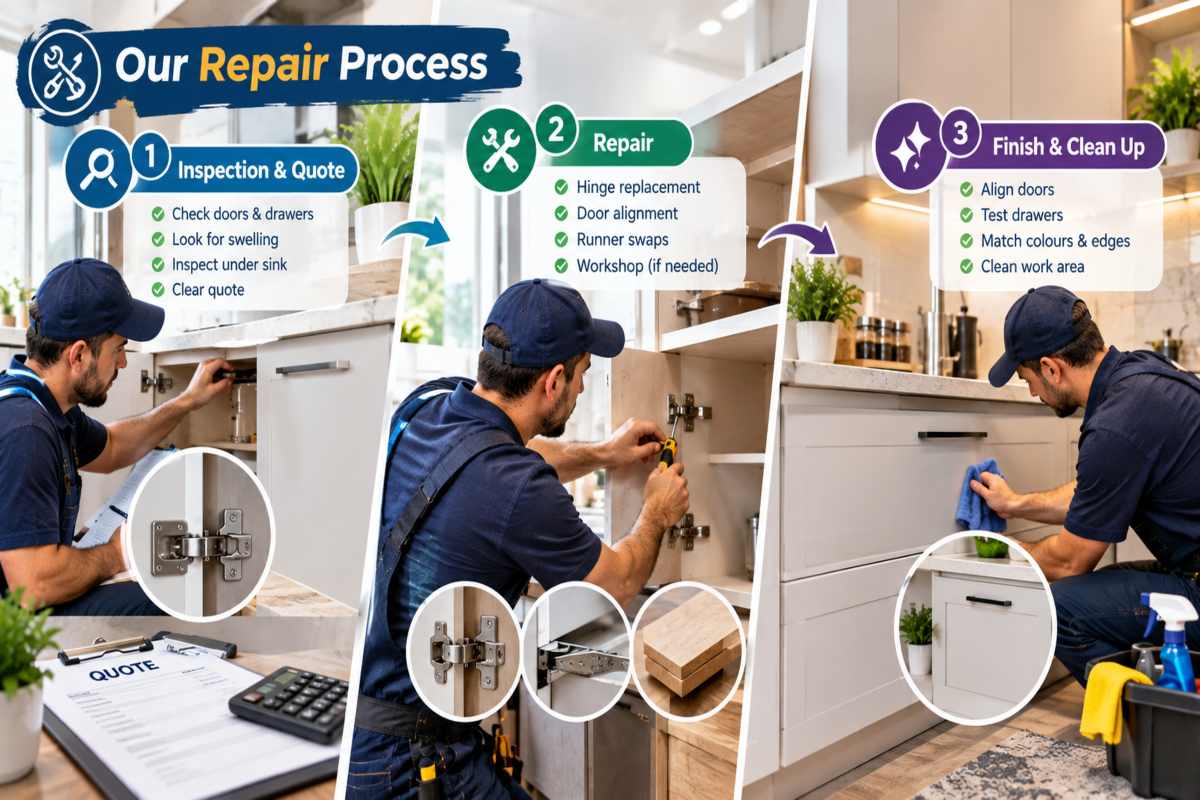
Inspection and quote, repair, finish and clean up
Inspection and quote. The carpenter opens every door and drawer, checks the boards for softness or swelling and looks under the sink for moisture. The aim is to find the cause of the fault, not just the visible symptom. You then receive a clear quote covering the repair, any replacement parts and whether the work can be done on site or needs the workshop. Nothing starts until you approve it.
Repair. Same visit fixes, such as hinge replacement, door alignment and runner swaps, are done at your home. Panels with deeper damage, such as swollen MDF or large areas of lifted laminate, are taken to the workshop, repaired and refitted. Where a leak is behind the damage, we advise fixing it first so the repair lasts.
Finish and clean up. Before leaving, the carpenter aligns each door, tests every drawer and checks that colours, edges and sealing match the surrounding cabinets. The work area is then cleaned and any removed parts are cleared away. We repair kitchens in homes and in business premises alike, as part of our residential and commercial services.
Conclusion
Kitchen cabinet repair in Ras Al Khaimah is usually faster and cheaper than replacement, as long as the structure is sound and the cause of the damage is dealt with first. Loose hinges, stuck drawers, peeling laminate and swollen panels can nearly always be fixed by a skilled carpenter, often in a single visit. The most important step is acting early. A sagging door or a lifted edge band costs little to fix today, but in RAK’s humid climate it can turn into swollen, crumbling board within months. If a leak is involved, stop it first so the repair lasts. Home Fix Building Maintenance repairs kitchen cabinets in villas and apartments across Ras Al Khaimah, with a clear quote before any work begins. Call +971 52 511 2254 or send us a message to book an inspection.
Frequently Asked Questions (FAQs)
Can kitchen cabinets be repaired or do they need replacing?
Most kitchen cabinets can be repaired if the box is solid and the damage is limited to hinges, runners, panels or surfaces. Replacement is only worth considering when the boards crumble or repair costs approach the price of new units.
Why do cabinet doors keep falling off?
Doors keep falling off because the hinge screws have worn out the board around them, which is common in MDF and chipboard. Fixing the damaged panel and fitting new hinges stops the problem for good.
Can swollen cabinets be fixed?
Light swelling can be dried, sanded, sealed and refinished, while badly swollen boards need the damaged panel replaced. Always stop the moisture source first or the swelling will return.
Can peeling laminate be repaired?
Yes, if the board underneath is still firm and dry. The carpenter cleans the surface, re bonds the laminate with suitable adhesive and presses it flat until it sets.
Is DIY repair worth it or should I call a professional?
DIY works for tightening a loose screw or adjusting a hinge. For swollen boards, water damage, runner replacement or finish matching, a professional gives a longer lasting result and avoids making the damage worse.
How long does a cabinet repair take?
Hinge, runner and alignment repairs usually take a couple of hours in one visit. Swollen panels and large laminate repairs may need workshop time, so the carpenter confirms the timeline in your quote.