
Property Maintenance in Ras Al Khaimah | What Does It Cover
Most homes in Ras Al Khaimah are not ruined by one dramatic failure. They wear down slowly, a worn door seal, a small drip behind a wall, an AC filter left a season too long. July highs average around 40°C, so every system in the house works harder here than it would in a milder climate and small neglect shows up sooner.
Property maintenance is the habit of catching those problems early. This guide describes what it covers, how it varies from repairs and renovation and how to build a simple plan around the seasons. It is written for owners, landlords and tenants who want to know what needs attention, how often and who is responsible, before anything breaks.
What is property maintenance in Ras Al Khaimah? Property maintenance in Ras Al Khaimah is the regular upkeep of a home’s systems and structure, including air conditioning, plumbing, electrical, joinery, floors and finishes. It prevents small faults from becoming costly failures, and it is planned around the local climate instead of waiting for something to break.
What Is Property Maintenance?
Property maintenance in plain terms
Property maintenance is the planned, ongoing care of a building so that its systems keep working and its structure stays sound. It covers what a home relies on every day, such as cooling, water supply, drainage, wiring, doors, floors, roofs and painted surfaces and it focuses on checking, cleaning, adjusting and replacing worn parts before they fail.
A simple comparison is servicing a car on schedule rather than waiting for the engine to stop. Changing an AC filter, checking a pipe joint during a routine visit or tightening a loose door hinge all count as maintenance. None of them change how the home looks, which is why they are easy to put off. In Ras Al Khaimah, where air conditioning works for many months of the year, jobs that are put off tend to cost more later. Good maintenance also leaves a record of what was checked, found and replaced, which helps owners plan ahead and gives landlords and tenants a clear history.
Maintenance vs repair vs renovation
Maintenance prevents problems, repair fixes a problem that has already happened and renovation changes or upgrades the property. The three are often mixed up because the same tradesperson may carry out all of them, but they differ in timing, purpose and scale.
Maintenance is planned and recurring. Cleaning AC filters through the cooling season, flushing a slow drain or testing the trip switches on the distribution board are typical examples. Repair is reactive, replacing a failed compressor, stopping a leaking pipe or re hanging a door that no longer closes. Swapping a worn tap for the same type is a repair, while replacing every fitting in a bathroom to a new design is renovation.
Larger projects that change a layout, finishes or fittings fall under full renovation work, which needs its own planning, budget and approvals where required. The link between the three is practical. A property that is maintained well needs fewer repairs and one that needs fewer repairs usually delays renovation for longer.
Property maintenance vs property management vs facility management
Property maintenance looks after the physical condition of a building, property management runs the building as an asset and facility management coordinates the wider services that keep a building working for the people inside it. These roles overlap, but they are not the same job.
Property management usually covers rent collection, tenancy paperwork, tenant communication and, often, arranging maintenance on the owner’s behalf. Facility management is the broader discipline, most often seen in offices, hotels, hospitals and large communities, where security, cleaning, energy use, space planning and maintenance sit under one plan. Maintenance is one part of both.
For a homeowner or landlord in Ras Al Khaimah, the practical point is simple, maintenance can happen without a manager, but a manager still depends on it being done. Knowing which role is being paid for avoids gaps, such as assuming a managing agent also schedules preventive checks when its contract covers only rent and tenancy matters.
What Property Maintenance Services Include

Air conditioning and cooling
Air conditioning is the system most worth looking after, because it carries much of a home’s electricity load and works for many months of the year. Air conditioning accounts for roughly 60% to 70% of electricity use in UAE buildings, so a unit that has quietly lost efficiency costs money every day. A routine visit covers the parts that decline unnoticed, dusty filters and coils, blocked condensate drains, refrigerant level, fan and motor condition, thermostat accuracy and the outdoor unit, which in coastal parts of Ras Al Khaimah faces salt and dust.
Catching these early keeps rooms cooling evenly and stops a tired unit from working harder than it should. If a unit still struggles after the basics, a technician is needed for ac troubleshooting and any decision on repair or replacement of the unit depends on its age, condition and how often it has needed attention.
Plumbing, water and drainage
Plumbing checks look for what is hidden, slow leaks, worn seals, corroded joints, weak water pressure and drains that are starting to run slowly. A small leak behind a wall or under a basin can go on for weeks with no visible sign, so staining, a damp smell or a rising water bill are often the first clues. A routine visit tests taps, valves and flush mechanisms, looks under sinks and around toilets, inspects the water heater and clears early blockages before they back up.
Stored water is checked for leaks or odd smells in the same visit. Fittings that collect mineral scale and older metal pipework tend to show wear sooner. In a villa, the outdoor drainage, water tanks and pumps deserve the same attention as the bathrooms. This is where hidden leaks and drainage checks earn their keep, a small cost that prevents water damage to walls, floors and ceilings, which is far more disruptive to fix.
Electrical systems and safety checks
Electrical checks confirm that wiring, sockets and the distribution board are still safe for the load a home now carries. That means testing trip switches and earth leakage protection and looking for warm or discoloured sockets, loose connections, damaged cable insulation and overloaded extension leads. Homes gain more devices and heavier appliances over time, often without any change to the original circuit layout, so a circuit that was adequate at handover can become strained.
Flickering lights, a breaker that trips repeatedly or a faint burning smell are signs that should not wait for the next visit. Periodic electrical safety inspections let a qualified electrician test, measure and record what is safe and what is not, instead of relying on guesswork. Because faults in wiring are hard to see and can lead to fire, this is the one area where a regular professional check is worth more than a casual look.
Carpentry, doors and joinery
Carpentry upkeep protects the wood and fittings people use every day, doors, frames, wardrobes, kitchen cabinets, shelves and skirting. Wood reacts to heat, dry indoor air and coastal humidity, so a visit checks hinges, handles, runners and soft close mechanisms, door alignment, edge sealing, joint cracks and any sign of swelling or moisture damage. Small adjustments, such as tightening a loose hinge screw or resealing an exposed edge, are quick, while ignoring them usually ends in a repair.
A visit also records which items are showing early wear, so planned work can be scheduled before they fail. Problems that have already developed, such as warped wooden door, door hinge repair or kitchen cabinet repair, each have their own step by step guide. For routine carpentry works, the aim is simply to keep moving parts aligned, surfaces sealed and fixings tight, so that wear stays slow and predictable.
Flooring, roof and waterproofing
Floors and roofs both protect the building from the elements, but in different ways. A floor check looks for loose or hollow sounding tiles, cracked grout, lifting planks, worn finishes and moisture near wet areas. Grout and sealant around bathrooms and kitchens are worth a look at the same time. On the roof, the focus is waterproofing, cracked or peeling membranes, blocked drains and outlets, damaged flashing and pools of standing water.
Rain is rare in Ras Al Khaimah, but a roof that has been baked by summer sun can leak at its weakest point when heavy rain does arrive. Looking before the cooler months leaves time to fix small defects first. Planning flooring and roof services as part of a routine is simpler than reacting to a stain on the ceiling or a tile that has already lifted, because by then water has usually travelled further than it appears.
Walls, paint and finishes
Paint and finishes are a building’s first layer of protection as well as its appearance. Walls and ceilings show early warning signs, such as bubbling or peeling paint, hairline cracks, patchy discolouration, mould spots and damp stains, that point to moisture or movement behind the surface. A routine visit notes these, works out whether they are cosmetic or the symptom of a leak and touches up or recoats what needs it.
Sealant around windows and the joints between walls and ceilings is also checked, since gaps let moisture in. Exterior walls and balconies take the brunt of sun and salt, so coatings fade and chalk faster than indoor paint does. Treating a small area promptly costs far less than repainting a full wall later and it stops moisture reaching the plaster underneath. Repainting on a regular cycle, instead of only when the surface looks tired, also keeps the finish consistent and the protection intact.
Why Property Maintenance Matters in Ras Al Khaimah
Summer heat and AC load
Summer heat matters because it keeps cooling and electrical equipment working near its limit for months at a time. Summer in Ras Al Khaimah is long and energy consultancy Enerdata estimates that each 1°C rise in temperature lifts the energy needed for cooling by around 15%. That means a small fault, such as a dirty coil, a weak fan or a loose electrical connection, becomes a bigger problem when the weather is at its worst.
Compressors run longer, breakers carry heavier loads and hot roofs and walls pass more heat indoors. Units that coped in spring can fail in July, usually at the moment they are needed most. The practical answer is timing, looking at cooling and electrical systems before peak heat arrives, instead of during it, gives time to fix weak points while a home is still comfortable and a technician’s diary is not full.
Coastal humidity and salt air (Al Marjan Island, Mina Al Arab, Al Hamra)
Homes close to the sea, such as those on Al Marjan Island, in Mina Al Arab and around Al Hamra, face damp, salt laden air that attacks metal and finishes faster than inland conditions do. Salt settles on outdoor air conditioning units, balcony railings, window and door hardware, external light fittings and outdoor electrical enclosures, where it speeds up corrosion and can leave fixings stiff or rusted.
Humidity also swells timber, lifts paint and encourages mould in rooms that are kept closed, especially when a property is empty for weeks at a time. None of this happens overnight, which is why it is easy to overlook until a hinge seizes or a coil leaks. Coastal properties benefit from shorter gaps between checks, with extra attention to exterior metalwork, outdoor units, sealants and any room with poor airflow.
Dust, sun exposure and ageing finishes
Strong sun and fine dust wear a property down slowly and the damage is often visible only when it has already advanced. Ultraviolet light breaks down paint, sealants, plastics, rubber gaskets and roof coatings, so surfaces fade, chalk, crack and become brittle. Dust, carried in on dry winds, clogs filters and fans, settles in door and window tracks and works its way into locks and runners, adding friction to every moving part.
Because both effects build up gradually, a home can look acceptable while its protective layers are already thin. Sun facing walls, balconies, roofs and external doors age fastest and they are the first places to inspect. Renewing a failing sealant or coating while it still holds is simple. Waiting until water gets behind it is what turns a minor job into a major one.
Protecting safety and property value
Property maintenance protects two things at once, the safety of the people living in a home and the value of the asset. On the safety side, regular checks find faults that are not obvious, such as overheating sockets, hidden leaks that weaken floors, loose balcony railings, mould in damp rooms or a door that no longer closes properly. Each of these can cause injury or damage if it is left to develop.
On the value side, a property with a clear record of upkeep is easier to rent, easier to sell and less likely to need a large unplanned repair at an awkward moment. For landlords, steady upkeep also reduces disputes about conditions at the end of a tenancy. For owner occupiers, it spreads costs across the year instead of concentrating them in one emergency, which makes budgeting far more predictable.
UAE wide context climate and building standards
The UAE as a whole has a hot desert climate with very warm summers and coastal areas add humidity, so the pressures described above apply broadly, not only in Ras Al Khaimah. Building standards also operate at national level. The UAE Fire and Life Safety Code of Practice was introduced to cut the likelihood of fires through regulations, procedures, regular maintenance and inspections and owners of many buildings must renew a Civil Defence no objection certificate each year.
Minimum performance standards for new air conditioners have also existed for more than a decade. Requirements differ by emirate, building type and community and they often weigh more heavily on towers and multi unit buildings than on private homes. Owners and landlords should confirm what applies to their own property with their building management or the relevant local authority. This is general background, not legal advice.
Property Maintenance by Property Type
Apartments
Apartment upkeep is split in two, the owner or tenant looks after what is inside the unit and building management looks after what is shared. Inside the unit, the main items are the air conditioning unit and its condensate drain, the water heater, taps, valves and wet area sealant, the distribution board, window and balcony door seals and balcony drainage.
Shared items, such as risers, façades, lifts, pumps and common area wiring, belong to the building’s management, but a fault there often shows up first inside a flat as a damp patch or a pressure drop. Because one apartment’s leak can damage the unit below, quick reporting and access for inspection matter more than they do in a detached home. Tenancy contracts and building rules decide who pays for what, so read them first. Changes that go beyond upkeep, such as a new layout or finishes, are the territory of a full apartment renovation.
Villas and townhouses
A villa or townhouse owner is usually responsible for the whole building and its plot, so there are more systems to look after and more of them are exposed to weather. Beyond the interior systems, the checklist includes the roof and its waterproofing, external walls and boundary walls, drainage and gullies, water tanks and pumps, outdoor air conditioning units and pipework, external lighting, gates, driveways and any irrigation.
Villas also tend to have more doors, windows and joinery to keep aligned and sealed. Townhouses share walls and sometimes roofs with neighbours, so a leak or a crack can involve more than one household and community rules may set out what each owner must keep in order. The sensible approach is to treat inside and outside as two separate routines, with the exterior checked before summer and after it. When defects accumulate faster than upkeep can handle, a wider villa renovation becomes the better option.
Older homes vs newer builds
Newer homes usually need less attention in the first years, while older homes need closer and more frequent checks, but both benefit from a plan. A new build starts with a handover period in which the developer or contractor is expected to correct defects and that period is typically around 12 months, though the length depends on the contract. Beyond that, federal civil law imposes a ten year liability period on contractors for defects that compromise a building’s structural integrity or safety and that protection concerns serious structural problems rather than ordinary snagging, cosmetic defects or routine upkeep.
Keeping dated notes and photos from handover therefore helps if something needs to be reported. Older homes carry different risks, ageing pipework, wiring designed for lighter loads, tired waterproofing, worn seals and finishes that have lost their protection. Age alone is not the problem, but a lack of records is. If repairs keep recurring in the same place, a broader house renovation may be more sensible than another patch.
Residential vs Commercial Property Maintenance Key Differences
Residential maintenance is smaller in scale and arranged around a household, while commercial maintenance is larger, more formally documented and scheduled around business hours. The checks themselves are often the same, what changes is how often they happen, who needs access and what a delay costs.
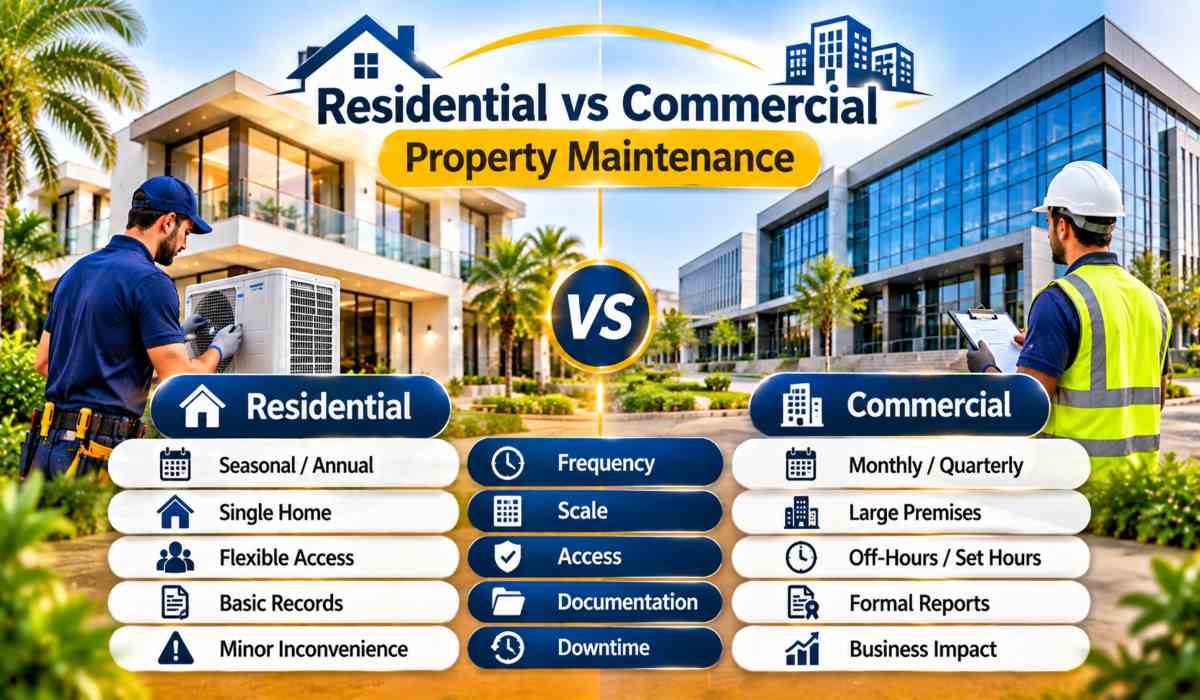
| Factor | Residential | Commercial |
| Frequency | Seasonal or annual checks, with extra attention before summer | Fixed monthly or quarterly schedules, often tied to usage and safety rules |
| Scale | One household and a limited number of systems | Larger floor areas, shared plant and many more fittings |
| Access | Flexible, agreed with the occupant | Often out of hours or in set windows, to avoid disrupting trade |
| Documentation | Useful notes and photos | Formal logs, inspection reports and certificates |
| Downtime | An inconvenience for a family | Lost trade or productivity, so faults are prioritised |
In practice, a home and a shop might need the same air conditioning check, but the plan around it differs. Owners who look after both a home and a business unit can find support through residential and commercial services, while this guide stays focused on homes in Ras Al Khaimah.
Property Maintenance Checklist and Schedule
A property maintenance schedule works best when tasks are grouped by frequency, quick checks every month, system checks every quarter, seasonal preparation either side of summer and a full review once a year.
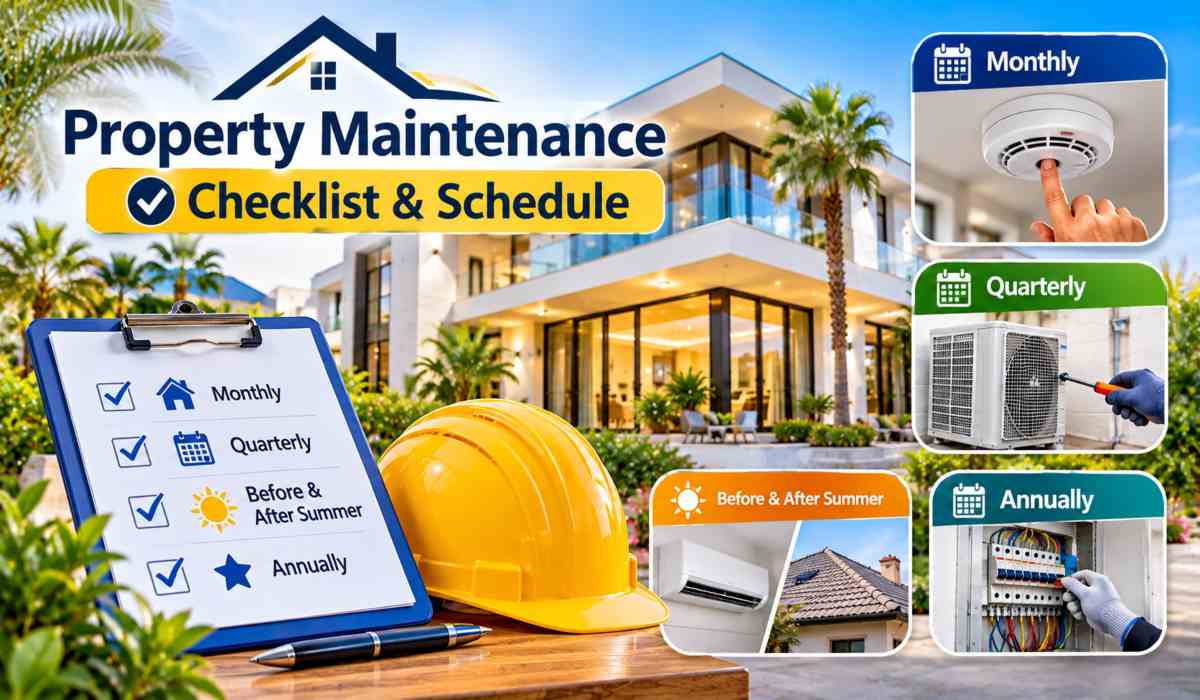
Monthly
A monthly check is a short walk through that catches the problems that appear fastest. NFPA suggests testing smoke alarms at least once a month and replacing them at least every 10 years, so that is the first item on the list.
- Test every smoke alarm and check its age
- Look at air conditioning filters and note any that are dusty
- Check under sinks, around toilets and near the water heater for drips or damp
- Run taps and flush toilets in rooms that are rarely used
- Scan ceilings and walls for new stains, cracks or peeling paint
Quarterly
A quarterly check covers the parts that wear more slowly, seals, hinges, drains and protective devices.
- Test trip switches and earth leakage devices, following the manufacturer’s instructions
- Check door and window seals, hinges and handles
- Inspect sealant around sinks, baths and showers
- Clear balcony, terrace and floor drains of dust and debris
- Look over outdoor units, gates and railings for dust, damage or corrosion
Before summer and after summer
Before summer, the priority is cooling, roof and water systems, because they carry the heaviest load. Have air conditioning units checked, clear dust from outdoor units, look at terrace and roof drains, inspect window seals and check that water tanks and pumps are working.
After summer, the aim is to find heat and dust damage while it is still minor, cracked sealant, faded or peeling paint, warped timber, hairline cracks in roof coatings and any signs of leaks around units that ran hard for months. Properties near the coast benefit from shorter gaps between these checks.
Annual
Once a year, a full review combines a professional inspection of the main systems with a look at records and budget.
- Have a qualified electrician inspect wiring and the distribution board
- Check the whole plumbing system, including the water heater and tanks
- Review the roof, waterproofing and external walls
- Touch up exterior paint and re seal exposed joinery
- Update the maintenance log and plan next year’s work and budget
Who Is Responsible for Property Maintenance?
Owner occupiers
Owner occupiers are responsible for maintaining everything they own, the interior systems, finishes and fittings of the home and, for a villa, the whole building and plot. There is no landlord or tenant to share the work, so planning falls entirely on the owner. In an apartment building, the owner also pays towards shared areas through service charges, but the unit itself remains the owner’s job.
Neglect can cost more than repairs, because some insurance policies limit cover for damage that results from poor upkeep, so it is worth reading the policy wording. A simple log of checks and repairs helps with budgeting, insurance conversations and resale, since it shows buyers how the home has been looked after. Where responsibility for a boundary item such as a balcony, façade or roof terrace is unclear, check the title documents and community rules before assuming it is yours.
Landlords and tenants
The tenancy contract decides who is responsible for what and many contracts divide repairs into major maintenance and minor maintenance for the landlord and tenant respectively. Ras Al Khaimah’s published lease contract terms say that Ras Al Khaimah law applies to anything the contract does not regulate and that the terms agreed between landlord and tenant apply once attached and ratified. That makes the contract wording the first thing to read.
In practice, landlords usually deal with structural problems and major systems, while tenants use the property with reasonable care, handle small routine items and report defects quickly. Some contracts set a cost limit for what counts as minor, so check yours. Before moving in, photograph the condition of the property and note any existing faults and get written approval before making alterations. Clear records prevent most disputes at the end of a tenancy.
Community or building management
Community or building management is responsible for the shared parts of a property, such as the roof of an apartment block, lifts, common pipework, façades, parking areas, landscaping and shared services and it funds this work through service charges paid by owners. The dividing line between private and shared areas is set by the community rules, the title documents and any management agreement, so it differs from one development to another.
A fault on the boundary, such as a leak from a shared riser into a flat or a damaged balcony edge, should be reported to management in writing as well as to the owner or landlord. Management that looks after common areas does not necessarily check the inside of individual units, so owners and tenants should not assume that anything behind their front door is covered. Ask for the written scope of what management handles and keep a copy.
How Professional Property Maintenance Works
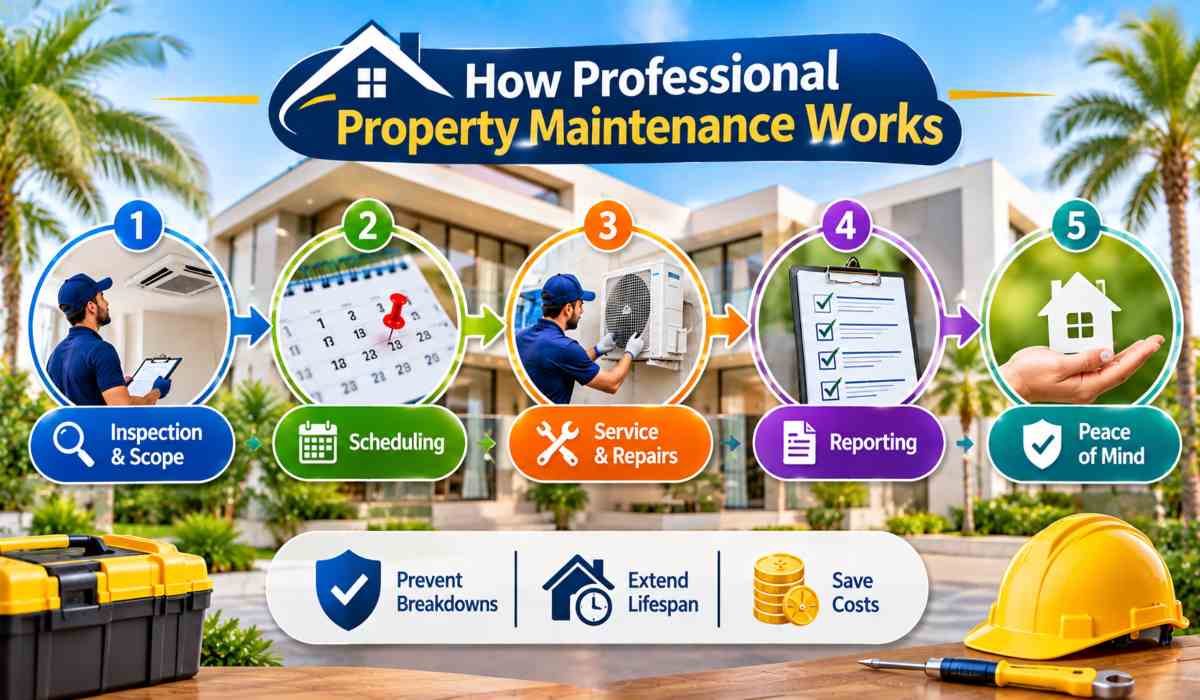
Inspection and scope
Professional property maintenance starts with an inspection that decides what will be checked, how often and in what order. A technician or team walks through the property, looks at each major system, notes its age and condition and records what needs immediate attention, what can wait and what simply needs monitoring.
The result is a written scope, a list of systems and tasks with agreed frequencies that both sides can refer to later. Good scoping also sets limits. It states what routine visits include, what counts as a repair that needs separate approval and which areas, such as shared building services or items still under warranty, fall outside the work. Local conditions shape the scope too, outdoor units, roofs and exterior metalwork on coastal properties in Ras Al Khaimah are often listed for more frequent attention than interior fittings.
Scheduling and reporting
Scheduling turns the scope into a calendar and reporting shows what happened at each visit. Visits are fixed in advance, usually with a seasonal peak before summer and arranged with the occupant so that access is smooth. After each visit, a short report should say what was checked, what was found, what was fixed on the spot and what is recommended next, ideally with photos of anything that has changed.
Reporting matters as much as the work, because it turns a series of visits into a trackable history. Urgent faults found during a visit should be flagged straight away instead of waiting for the next report. Emergencies outside the schedule, such as a burst pipe or a total loss of cooling, are normally handled separately from planned visits, so it helps to know in advance how to report one and what response to expect.
What a maintenance plan typically covers
A maintenance plan typically covers scheduled inspections of the main systems, routine servicing tasks, minor adjustments and a defined way of handling repairs and emergencies. Putting this on a fixed footing, such as an annual maintenance contract, means visits happen on time without anyone having to remember to ask.
The logic is that planned work prevents expensive failures, the US Department of Energy’s maintenance guide estimates preventive programmes save around 12% to 18% compared with waiting for equipment to fail, although that figure comes from facility studies rather than homes. Plans differ in which systems they include, how many visits they allow, whether parts and labour for repairs are covered, what response times apply and what is excluded, such as damage from misuse or major replacements. The written inclusions and exclusions are what count, so read them closely.
Keeping service records
Service records are the documented history of every inspection, repair and replacement and they are the most valuable by product of professional maintenance. A useful record lists the date, the system, the work done, the parts replaced, the technician’s findings and any recommendation, with photos where helpful. It helps owners see patterns, such as a unit that needs attention every summer and decide whether to repair or replace. For landlords it shows that responsibilities were met, for tenants it shows the condition in which they kept the property and for buyers it signals care. Warranties often depend on proof that servicing was done on schedule, so keep invoices and reports together. Store copies digitally and ask for them in a form you can keep, so the history stays with the property even if the service arrangement changes.
Conclusion
Property maintenance in Ras Al Khaimah works best as a simple, repeating plan, short regular checks, preparation either side of summer, a professional review once a year and a written record of everything that is done. The heat, coastal humidity, salt air and dust here wear on homes faster than in milder climates, so small faults that are left alone tend to grow. A good starting point is to confirm who is responsible for what under your tenancy contract or community rules, then put the pre summer checks in the calendar and begin a basic log of inspections and repairs. Those three steps cover most of what separates a well kept property from one that is always reacting to problems. For owners and landlords who would like help putting a plan into practice, Home Fix Building Maintenance is based in Ras Al Khaimah and looks after homes and properties there.
Frequently Asked Questions (FAQs)
1. What is property maintenance?
Property maintenance is the planned, regular upkeep of a building’s systems and structure, including cooling, plumbing, electrical, joinery, floors, roofs and finishes, to keep it safe and working. It focuses on checking and caring for parts before they fail, instead of fixing them afterwards.
2. What do property maintenance services include?
Property maintenance services typically include scheduled inspections and routine care of air conditioning, plumbing and drainage, electrical systems, doors and joinery, floors, roofs and waterproofing and paint and finishes, plus a report on what was found. The exact inclusions depend on the written scope, so parts, repairs and emergency callouts may be covered or charged separately.
3. What is the difference between property maintenance and repairs?
Maintenance is planned work that prevents problems, while repair fixes something that has already failed or been damaged. Checking a filter or tightening a hinge is maintenance, replacing a failed compressor or stopping a burst pipe is repair. Good maintenance reduces how often repairs are needed.
4. How often should a villa or apartment be maintained?
Most villas and apartments in Ras Al Khaimah suit quick monthly checks, system checks every quarter, seasonal preparation before and after summer and a full professional review once a year. Villas, older homes and coastal properties may need shorter gaps because they have more exposed parts and more wear.
5. What counts as an emergency?
An emergency is a fault that threatens safety or is causing damage right now, such as a burst pipe, flooding, sparking or a burning smell from electricity or a complete loss of cooling in extreme heat. A dripping tap, a noisy fan or a small paint crack can wait for a scheduled visit. If there is fire or risk to life, contact the emergency services first.
6. Who is responsible for maintenance, the landlord or the tenant?
It depends on the property type and the tenancy contract. Owner occupiers look after their own home, landlords usually handle structural problems and major systems, tenants handle day to day upkeep and report defects promptly and building management looks after shared areas. Ras Al Khaimah’s published lease terms say that Ras Al Khaimah law applies to anything the contract does not regulate, so check your contract and community rules.
7. Does Ras Al Khaimah’s climate change need maintaining?
Yes. Long hot summers, coastal humidity and salt air, strong sun and dust put extra load on air conditioning, outdoor units, roofs, sealants, paint and metal fittings, so these need earlier and more frequent attention than they would in a milder climate. Properties near the sea benefit most from shorter gaps between checks.
8. What is preventive maintenance?
Preventive maintenance is planned work carried out at set intervals to stop faults before they happen, such as cleaning, testing, adjusting and replacing worn parts on a schedule. It differs from corrective maintenance, which responds after something fails. The main benefits are fewer breakdowns and a longer life for equipment.