Electrical Inspection Frequency in Ras Al Khaimah
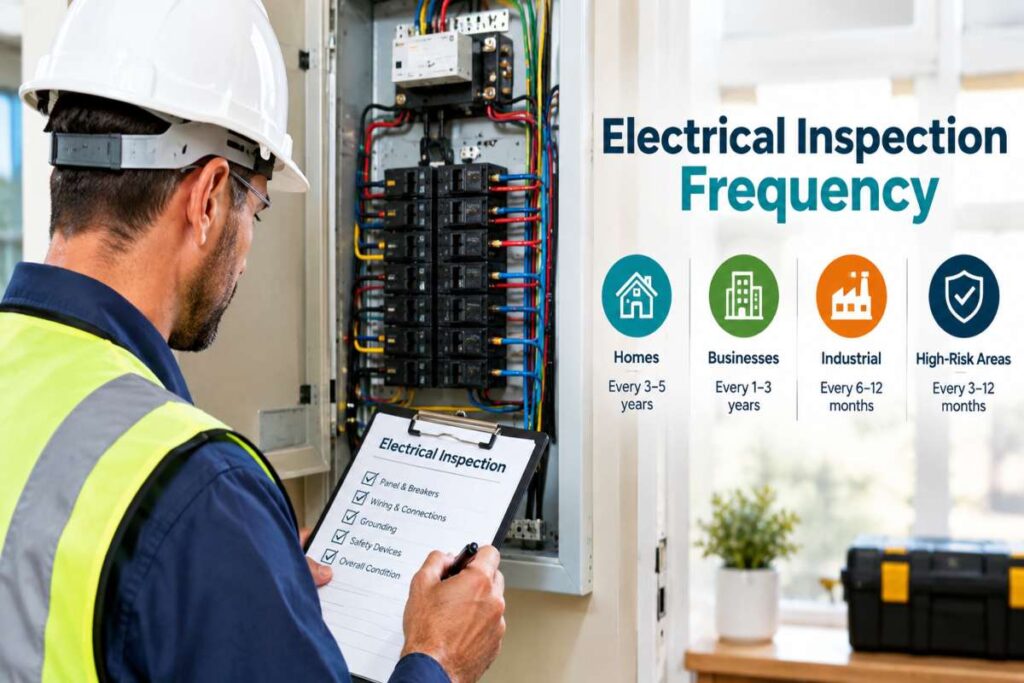
Electrical Inspection Frequency in Ras Al Khaimah depends on the property’s age, electrical condition and usage. Most homes benefit from a full electrical inspection every three to five years, with earlier checks recommended for properties over ten years old, recently rented homes, or systems showing warning signs such as tripping breakers or warm sockets. Regular inspections can identify ageing insulation, loose connections and overloaded circuits before they develop into costly or serious electrical problems. As homes add air conditioners, chargers and kitchen appliances, periodic checks also help confirm that the existing wiring and circuits can safely handle the increased electrical load.
One UAE wide electrical safety survey found that close to 70% of residents had already noticed a fault, a burnt socket, a shock from an appliance or a breaker tripping for no clear reason, yet fewer than three in ten had actually had it checked by a professional electrician. In a market like Ras Al Khaimah, where air conditioning runs for most of the year and puts constant strain on home wiring, that gap between noticing a problem and doing something about it is the gap where real damage happens.
This guide walks through exactly how often an inspection is due, what an electrician actually checks and the specific situations, buying a home, renewing insurance or handing a property over to a new tenant, that call for one outside your regular schedule. If you’d rather book one than read about it, Home Fix Electrical Services team covers inspections across Ras Al Khaimah.
What Is an Electrical Inspection?
An electrical inspection is a professional electrician assessment of a property’s wiring, distribution board, sockets and safety devices to confirm everything is working safely and meets current standards. It is a diagnostic check, not a repair, the electrician tests, measures and visually examines the system, then flags anything that is worn, overloaded, incorrectly installed or at risk of failing.
The inspection typically covers the main distribution board and circuit breakers, the condition and rating of the wiring itself, earthing and bonding, socket outlets and any signs of overheating such as scorch marks or discoloured switches. In older properties or homes that have gone through a Home Renovation Services project without an accompanying electrical upgrade, the inspection often reveals wiring that was adequate for the original layout but is now undersized for the appliances and circuits added since.
Types of Electrical Inspections
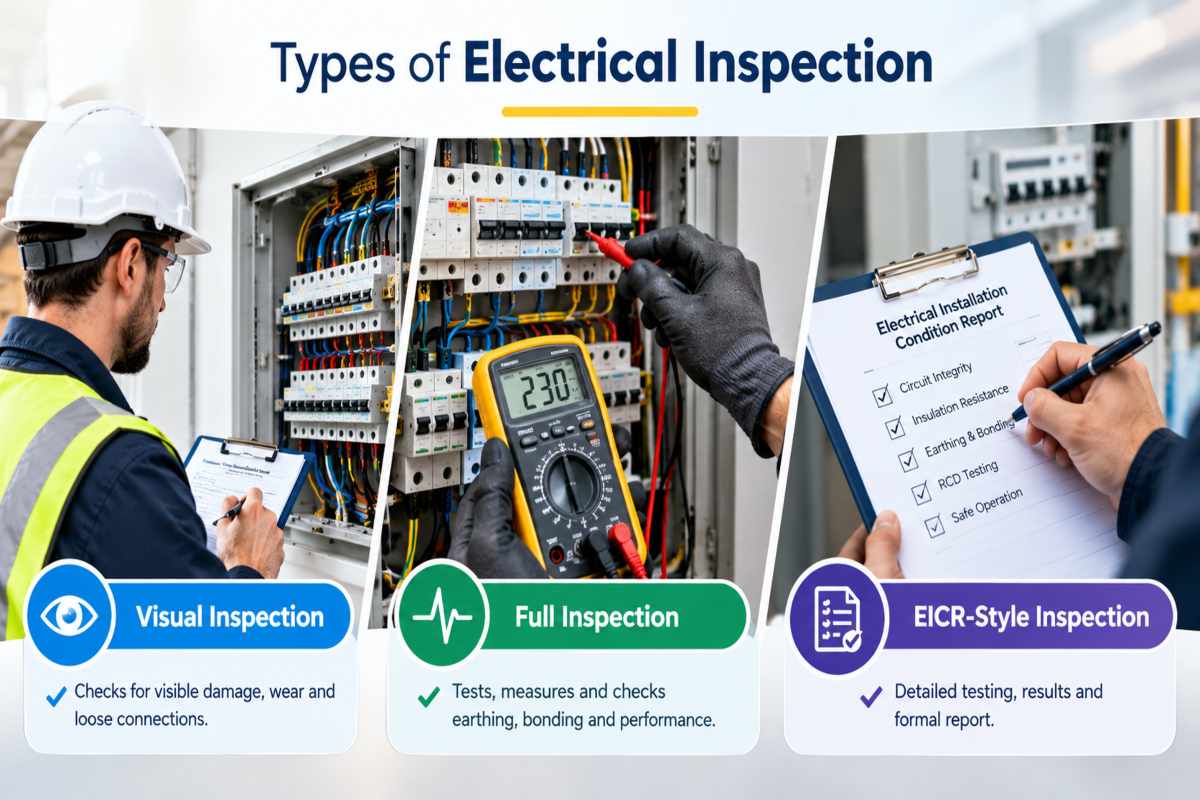
Electrical inspections can vary depending on the property condition, age and purpose of the assessment. Common types include visual inspections, full electrical inspections and EICR style inspections, each providing a different level of detail and testing.
Visual inspection
Not every inspection is the same depth of check and knowing the difference helps you ask for the right one. A visual inspection is a quick, surface level review, the electrician looks at sockets, switches and the distribution board for obvious damage, overheating or incorrect wiring, but does not test the circuits themselves. It is useful as a routine check between fuller inspections, but it won’t catch problems hidden inside the walls.
Full inspection
A full inspection goes further, the electrician tests circuits for insulation resistance, earth continuity and correct polarity, in addition to the visual checks. This is the standard recommended for pre purchase inspections, insurance requirements and any home due for its scheduled inspection.
EICR style inspection
An EICR style inspection, modelled on the UK Electrical Installation Condition Report, is the most thorough option. It follows a structured checklist, tests every circuit against current safety codes and produces a formal report with each finding graded by risk (from “requires improvement” to “danger present, immediate action required”). While the UAE does not mandate an EICR by name, many landlords, insurers and property managers in Ras Al Khaimah request this level of documentation because it gives a clear, gradable record of the property electrical condition.
How Often Do You Need an Electrical Inspection?
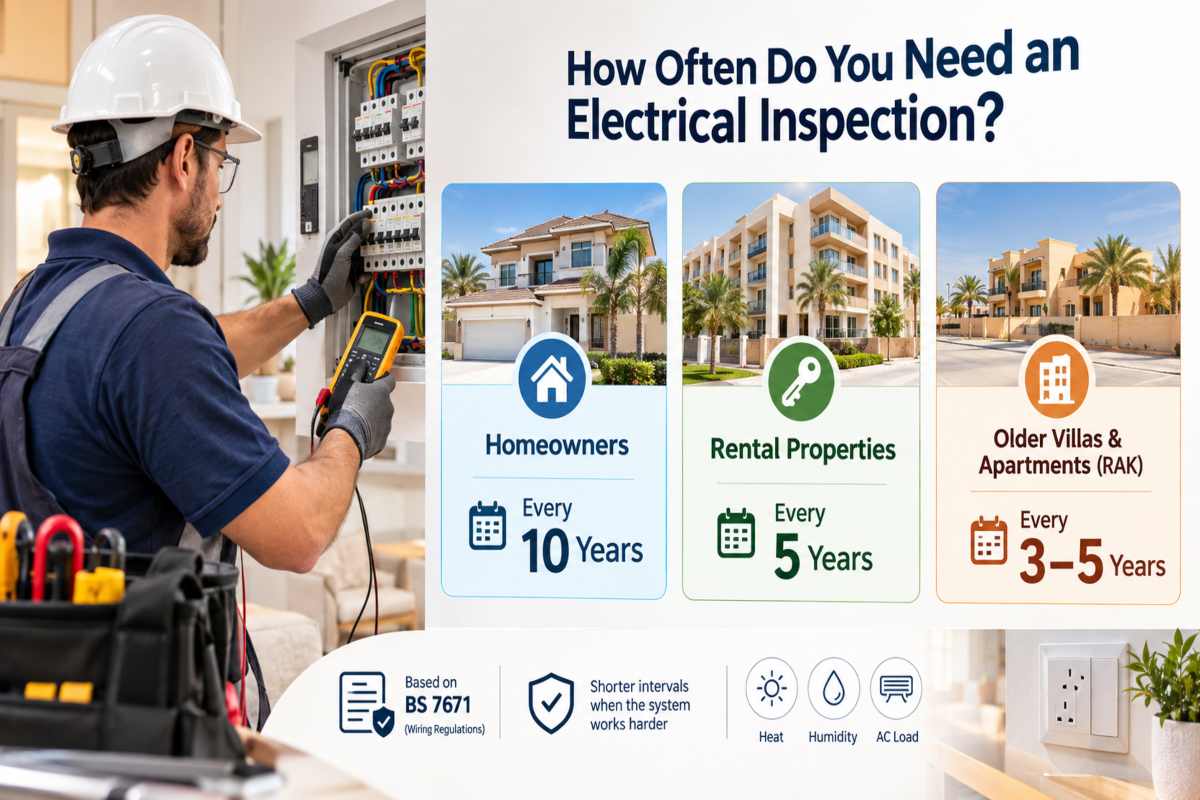
Most owner occupied homes need a full electrical inspection every 10 years, rented properties every 5 years and older villas or ground floor apartments in Ras Al Khaimah closer to every 3–5 years given the heat, humidity and near constant AC load they carry. These intervals are not arbitrary, they come from BS 7671, the internationally recognised wiring regulations that UAE electricians commonly use as their benchmark in the absence of a dedicated domestic inspection law and they shift shorter the harder a property electrical system works.
Homeowners
If you own the property you live in, a full inspection every 10 years is the standard recommendation, provided nothing unusual has come up in between. That said, the 10 year mark is a ceiling, not a target, it assumes the wiring is in good condition, was installed to a proper standard and has not been altered by unprofessional work since. Any sign that shortens that trust, like a renovation that touched the electrics, a strange smell near an outlet or lights that flicker for no clear reason, should move the inspection up regardless of how recently the last one happened. Running through Home Fix Electrical Safety Checklist once a year is a good way to catch those signs early, between full inspections.
Rental Properties
Landlords should have a full inspection carried out at least every 5 years and again at every change of tenancy, whichever comes first. This shorter interval reflects the simple reality that a landlord does not control how a property is used day to day and a system that was fine for one tenant habits and appliance load can be under real strain by the time the next one moves in. In Ras Al Khaimah rental market, where properties often turn over annually, that “change of tenancy” trigger ends up being the more frequent of the two in practice and it is worth budgeting for as a standard part of preparing a unit for a new tenant.
Older Villas and Apartments in RAK
Properties over 10–15 years old, particularly villas and ground floor units in areas like Al Nakheel or Al Dhait, deserve a shorter cycle, closer to every 3–5 years, because their wiring was sized for a lighter electrical load than modern households actually draw. The original circuits in many older RAK homes were designed before split AC units, multiple chargers and kitchen appliances became standard in every room, so the system is often working harder than it was built for. Combined with the region heat and humidity, which accelerate the wear on insulation and connections, that gap between original design and current demand is exactly where faults tend to surface first.
What Happens During an Electrical Inspection
An electrical inspection involves a professional electrician visually examining your wiring, distribution board and outlets, then running a series of tests to measure whether the system is performing safely within its rated limits. The whole process typically takes one to three hours for an average villa or apartment, depending on the number of circuits and how easily they can be accessed.
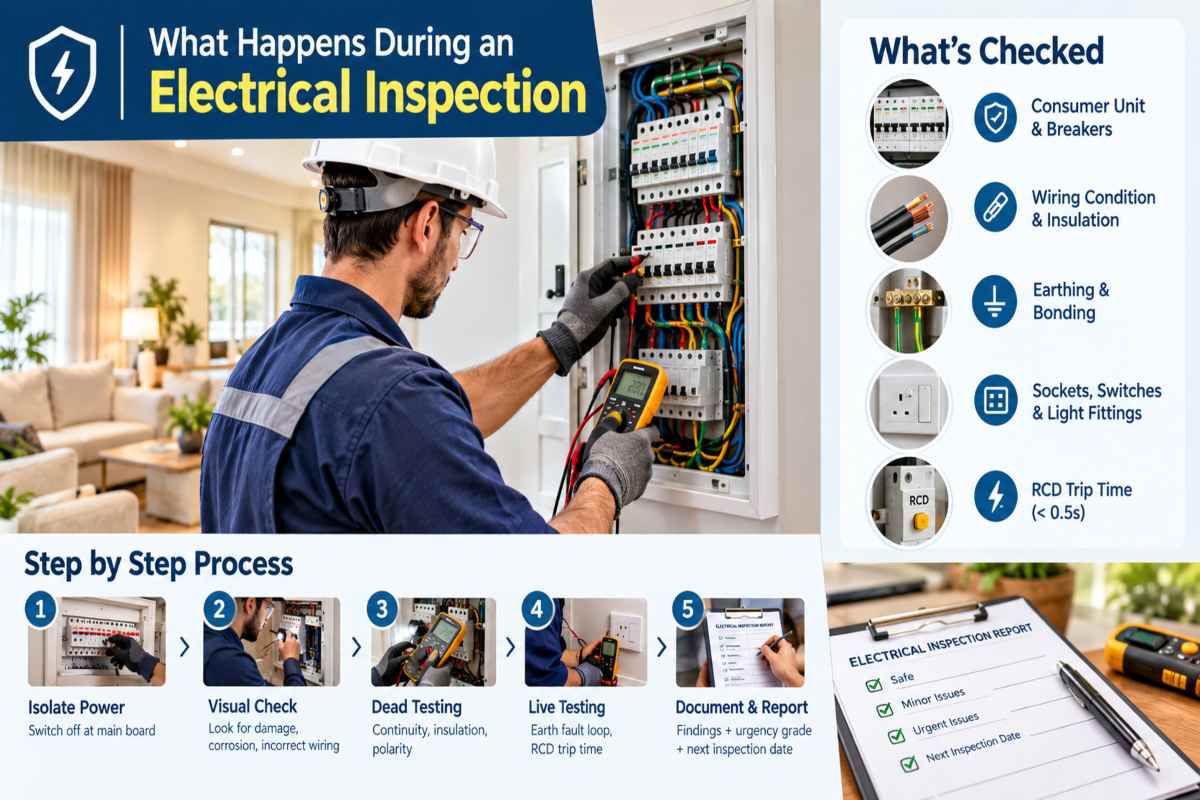
Step by Step Process
The inspection starts with the electrician switching off power at the main board and carrying out a visual check of the consumer unit, cabling and accessible connections for obvious damage, corrosion or incorrect wiring work. From there, they move into dead testing, checking continuity, insulation resistance and polarity on each circuit while the power is still off, which reveals faults that wouldn’t show up under normal use.
Once dead testing is complete, power is restored and the electrician runs live tests, including earth fault loop impedance and RCD trip times, to confirm the safety devices actually respond fast enough in a real fault. The inspection finishes with the electrician recording every finding against a standard checklist and issuing a report that grades any issues by urgency, along with a recommended date for the next inspection.
What Inspectors Check
An inspector checklist covers every part of the fixed electrical installation, not just the visible fittings. That includes the condition and capacity of the consumer unit and circuit breakers, the age and insulation condition of the wiring itself, earthing and bonding at every connection point and the condition of sockets, switches and light fittings for scorch marks or looseness.
They also test that RCDs (residual current devices) trip within the required time, a device that trips too slowly or not at all, is one of the most common findings that separates a home that looks fine from one that’s actually protected. According to industry testing standards, an RCD is expected to trip in well under half a second under fault conditions, anything slower is flagged as a safety risk that needs immediate attention, regardless of how the rest of the inspection came back.
Signs You Need an Inspection Sooner
If you notice flickering lights, breakers that trip repeatedly or a burning smell near an outlet, don’t wait for your next scheduled inspection, these are the electrical system clearest way of signalling that something is already wrong, not something that is about to go wrong. Any one of them on its own is worth calling an electrician for, together, they usually mean the issue has been building for a while.
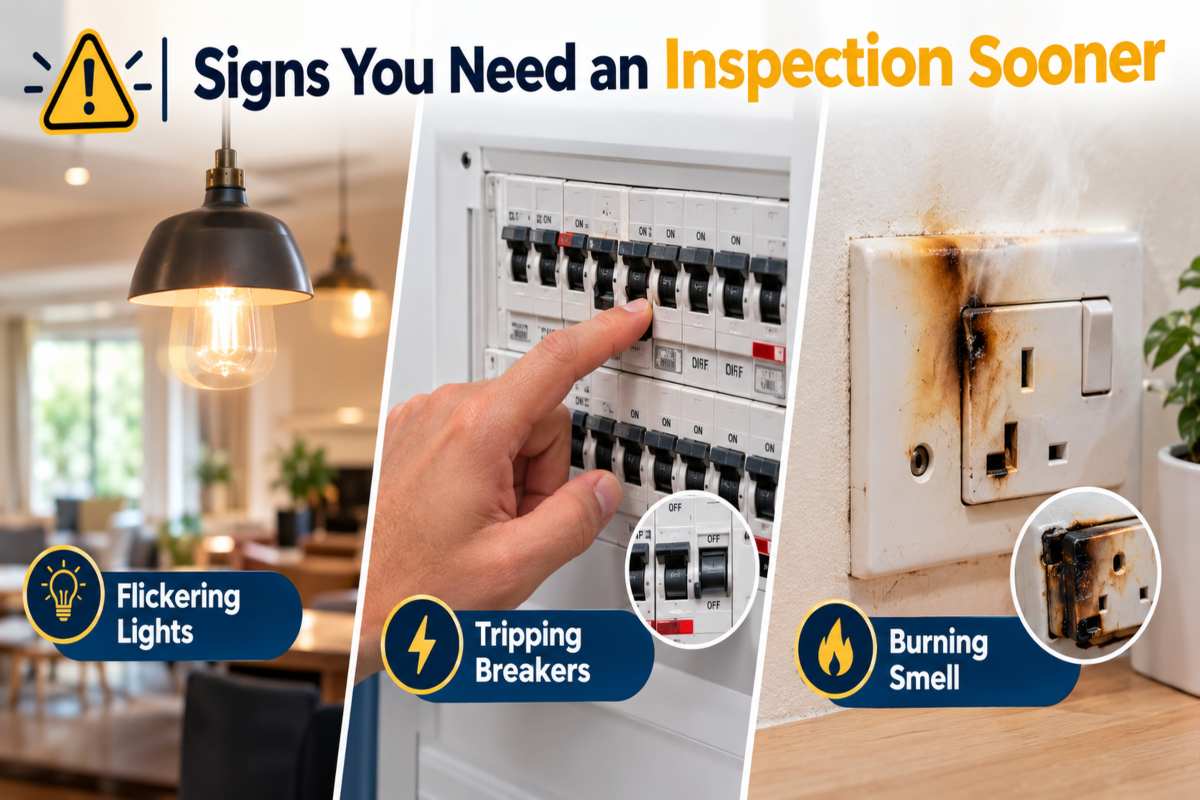
Flickering Lights, Tripping Breakers and Burning Smell
Flickering lights are often dismissed as a bulb problem, but persistent flickering, especially across multiple fixtures at once, usually points to a loose connection, an overloaded circuit or voltage fluctuation somewhere upstream in the wiring. It is worth reading through Why Do Lights Flicker to rule out the simple causes before assuming it needs an inspection, but if the flickering is widespread or gets worse when you switch on the AC or a kitchen appliance, that is a sign the circuit is genuinely struggling under load.
A breaker that trips once in a while, especially during a power surge, is not unusual. A breaker that trips repeatedly or trips the moment you plug in a specific appliance, is the panel doing its job of protecting the circuit from a fault it is detected and it is telling you to have that circuit checked rather than just resetting it and moving on. A burning smell near a socket, switch or the distribution board is the most urgent of the three, it usually means insulation or a connection has already overheated and it warrants cutting power to that circuit and calling an electrician immediately rather than scheduling a routine visit.
These three signs are not rare. A regional survey on home electrical safety found that 46% of residents had experienced burnt sockets or unexplained breaker tripping, yet most had never had the underlying cause checked by a professional electrician, meaning the fault was still sitting there, unresolved, well after the symptom first appeared.
Electrical Inspections for Property Purchases and Rentals
A property changing hands, whether it is being bought or newly let, is one of the clearest triggers for an electrical inspection outside your regular schedule, because it is the one moment when nobody involved actually knows the current condition of the wiring. Buyers inherit whatever the previous owner did or did not maintain and landlords are handing a system over to someone whose usage habits and appliance load they can not predict.
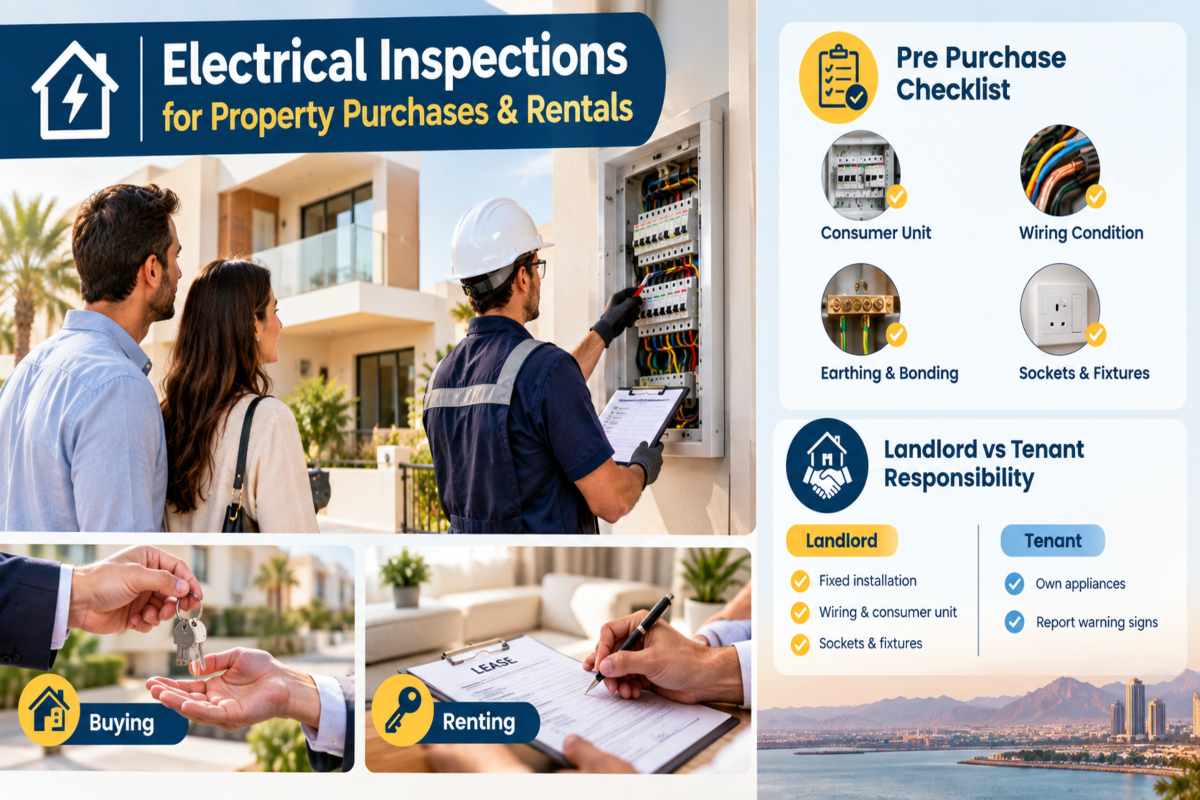
Pre Purchase Checklist
Before finalising a property purchase in Ras Al Khaimah, a full electrical inspection should confirm the condition of the consumer unit, the age and state of the wiring, earthing and bonding and whether any past electrical work was carried out to a proper standard rather than patched together informally. This matters more in older villas and resale apartments, where previous owners may have added circuits, extensions or AC units over the years without involving a professional electrician each time. Treat the inspection report as leverage as much as information, a report flagging outdated wiring or an undersized consumer unit is a legitimate basis for negotiating repairs or a price adjustment before you commit, not just a box to tick after the sale is final.
Landlord vs Tenant Responsibility
In a rental arrangement, the landlord carries the legal and practical responsibility for the property electrical safety, which means the inspection and any resulting repairs, falls on them, not the tenant. That responsibility typically covers the fixed installation, wiring, the consumer unit, sockets and permanently connected fixtures.
It does not usually extend to a tenant own appliances, which remain the tenant concern unless a fault in the property wiring is what caused the appliance to fail. A tenant who notices warning signs, such as flickering lights or a breaker that trips repeatedly, should report it to the landlord in writing rather than attempting a fix themselves, from there, arranging the inspection and covering the cost sits with whoever holds the tenancy contract, which in almost every case in Ras Al Khaimah is the landlord.
Electrical Inspections and Home Insurance in the UAE
An up to date electrical inspection can directly affect whether a home insurance claim gets paid, because most UAE policies exclude fire damage caused by negligence or poor maintenance and an unmaintained electrical system is one of the easiest exclusions for an insurer to apply. Some insurers also ask for proof of inspection as a condition of cover, particularly for older properties or higher value villas.
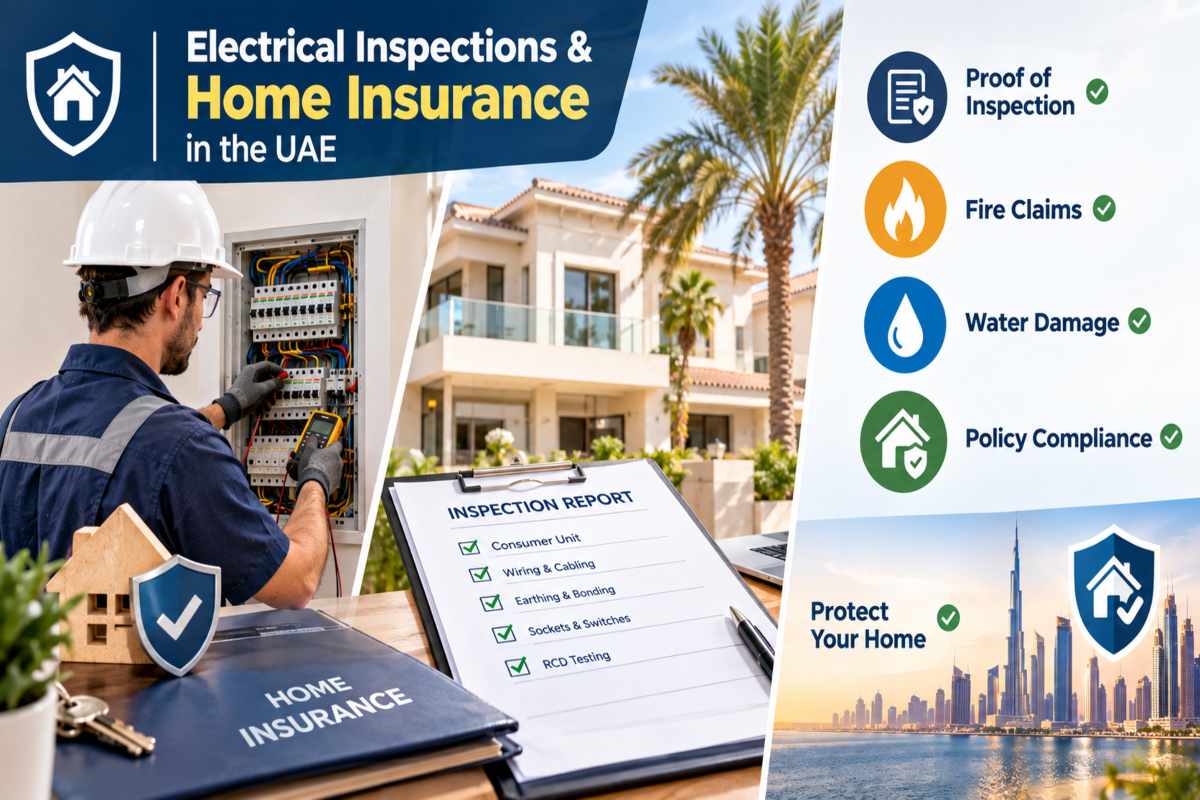
Fire is one of the most common reasons UAE homeowners file a claim in the first place. Insurers in the UAE report that fire and water damage top the list of causes behind most claims and a faulty or overloaded electrical system is a frequent contributor to both, a wiring fault can start a fire directly or an undetected leak near old wiring can trigger the kind of damage insurers scrutinise closely before paying out. Claims tend to become complicated when inspections have been skipped, since the insurer investigation will often ask when the electrics were last checked and by whom.
In practice, this means an inspection report is worth keeping on file even when your insurer does not explicitly request one. It gives you a documented baseline of the property condition, which matters if you ever need to demonstrate that a fire resulted from an unforeseeable fault rather than years of unaddressed wear. For homeowners renovating or maintaining a property across several trades at once, Home Fix Residential and Commercial Services team can coordinate the electrical inspection alongside other maintenance work, so the documentation stays current without needing a separate call out every time something else in the home is serviced.
Cost of an Electrical Inspection in RAK
A standalone electrical inspection in Ras Al Khaimah generally costs between AED 300 and AED 800 for an apartment and AED 600 to AED 1,500 for a villa, depending on the number of circuits and how much of the wiring is easily accessible. That is noticeably less than a full multi system property inspection, comprehensive checks that also cover plumbing, structure and HVAC in the UAE typically run AED 1,000 to AED 3,000, because an electrical only inspection is narrower in scope and usually quicker to complete.
What Affects the Price
The size of the property and the number of circuits it runs are the biggest factors, since each circuit needs to be tested individually rather than checked as a group. A villa with a larger distribution board, multiple AC units and outbuildings will always cost more to inspect thoroughly than a one bedroom apartment with a single consumer unit. The depth of inspection matters too, a basic visual check costs less than a full inspection with live and dead testing and an EICR style report with a formal, risk graded write up sits at the top of the range because of the documentation involved.
Accessibility plays a real role as well. Older villas with wiring buried behind finished walls, false ceilings or built in cabinetry take longer to inspect properly than a newer property with an open, well labelled distribution board and that extra time is reflected in the quote. Finally, urgency affects price the same way it does with most trades, a same day call out after a burning smell or a repeatedly tripping breaker will typically cost more than booking a routine inspection a week or two in advance.
Who Can Perform an Electrical Inspection in RAK
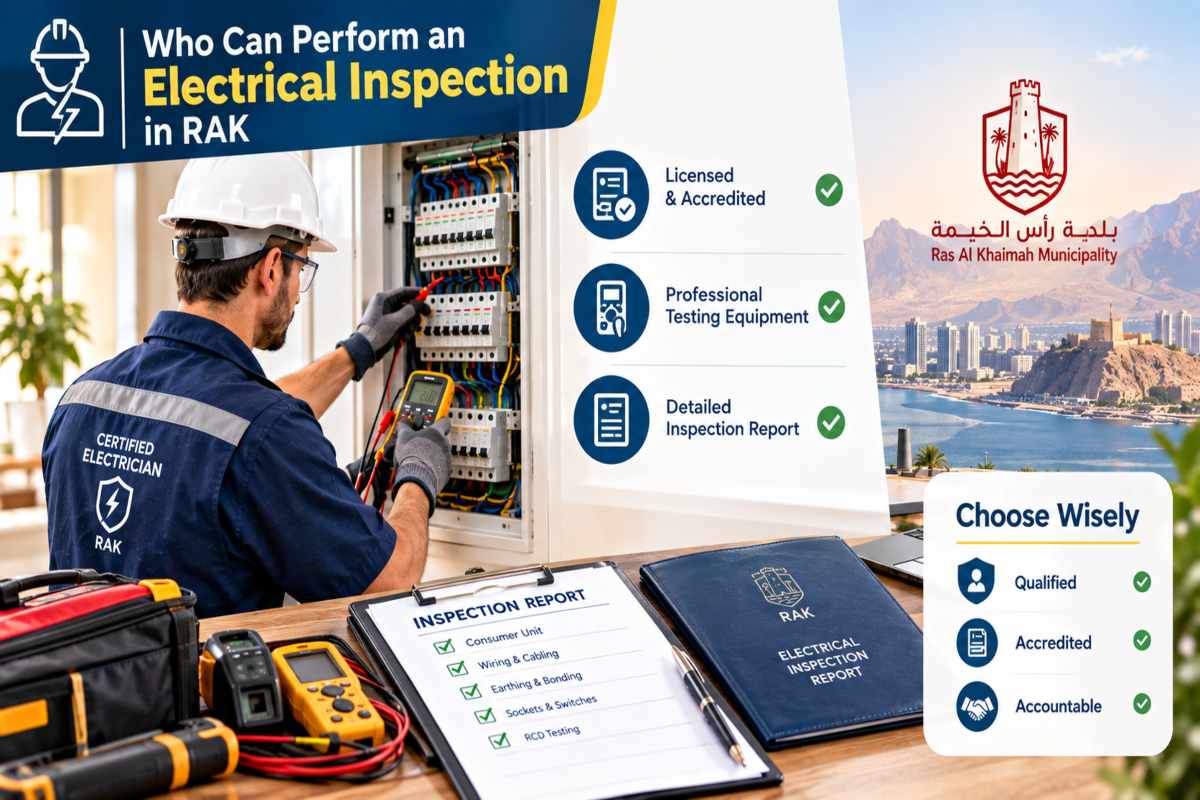
An electrical inspection in Ras Al Khaimah should only be carried out by a professional electrician registered with the relevant municipal authority, not a handyman or general maintenance worker without electrical accreditation. Licensing matters here specifically because an inspection is a safety judgment call, it requires someone qualified to interpret test readings correctly and know when a reading that looks borderline is actually a serious risk.
Choosing a Professional Electrician
A properly professional electrician in RAK will hold accreditation recognised by Ras Al Khaimah Municipality and carry the testing equipment needed to measure insulation resistance, earth continuity and RCD trip times rather than relying on a visual check alone. Ask to see their licence and, ideally, a sample of a previous inspection report before booking, a legitimate report should be itemised, dated and specific about what was tested, not a vague one line summary saying the property “passed.”
This is also the point where a lot of UAE homeowners fall short in practice. The same regional survey on electrical safety found that fewer than 30% of residents who’d already noticed signs of a fault, burnt sockets, shocks, unexplained tripping, had gone on to have it checked by a certified professional, the rest either ignored it or attempted a fix themselves. That gap is exactly what a professional inspection closes and it is worth choosing an electrician who’s accountable for their findings on paper, not just someone willing to take a quick look.
For homeowners who’d rather not track inspection dates manually, bundling the inspection into Home Fix AMC Services keeps it on a fixed schedule alongside the rest of the property maintenance, so it is handled by the same professional team each time rather than re vetted from scratch every few years.
Conclusion
The right electrical inspection frequency comes down to a simple rule, every 10 years for owner occupied homes, every 5 years for rented properties and closer to every 3–5 years for older villas and apartments across Ras Al Khaimah, sooner than that whenever flickering lights, repeated tripping or a burning smell show up in between.
Sticking to that schedule is less about ticking a compliance box and more about closing the exact gap this guide has pointed to throughout, most UAE homeowners already notice the warning signs of an electrical fault, yet only a small share ever get it checked by someone professional to act on it. Whether you are buying a property, preparing a rental for a new tenant or simply due for your next check, that inspection is what turns a vague sense that “the electrics seem fine” into an actual, documented answer.
If you are in Ras Al Khaimah and it is time to book one, Home Fix can help, from a single inspection to ongoing maintenance that keeps your property’s electrical system checked on schedule, not just when something has already gone wrong.
Frequently Asked Questions (FAQs)
Who inspects electrical work in Ras Al Khaimah?
Only a professional electrician registered with the relevant municipal authority should carry out an electrical inspection. They are qualified to interpret test readings correctly and issue a report you can rely on for insurance, sale or tenancy purposes.
Does electrical work need to be inspected after a renovation?
Yes, any renovation that touches wiring, sockets or the distribution board should be followed by an inspection to confirm the work was done to standard. This is especially important if the work was not carried out by a professional electrician.
Does a general building inspection include the electrics?
A standard pre purchase building inspection usually includes a basic visual check of visible wiring, sockets and the distribution board, but it is not the same as a full electrical inspection with live testing. For a property purchase, it is worth requesting the electrical component separately if it is not already thorough.
Can a tenant request an electrical inspection while renting?
Yes and if you notice warning signs like flickering lights or a breaker that trips repeatedly, you should ask your landlord in writing. Arranging and paying for the inspection is the landlord responsibility, not the tenant.
How do you book an electrical inspection in RAK?
Contact a professional electrical contractor directly and confirm they are accredited to work in Ras Al Khaimah before booking. Most inspections can be scheduled within a few days, though a same day visit is usually available if you are dealing with an active warning sign.
Who is responsible for paying for an inspection, landlord or tenant?
The landlord is responsible for the property fixed electrical installation, which includes arranging and paying for inspections. A tenant is generally only responsible for their own appliances, not the building wiring or consumer unit.