
Carpentry Works in the UAE | Complete Expert Guide (2026)
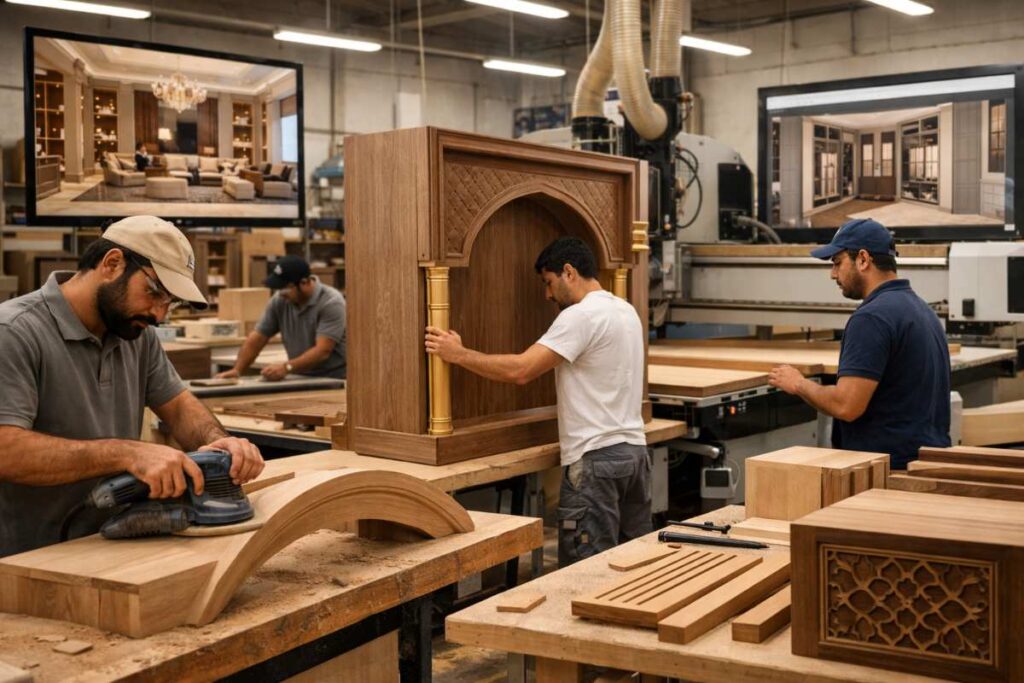
Carpentry works in the UAE have transformed far beyond basic woodwork. Today, they represent a sophisticated blend of craftsmanship, design, and technology that shapes some of the most stunning interiors and outdoor spaces across Dubai, Abu Dhabi, and beyond.
Whether you are a homeowner looking for custom furniture, a business owner planning a full commercial fit-out, or a developer sourcing quality joinery for a large project, understanding carpentry works in the UAE is essential before making any decisions.
From choosing the right wood materials and finishes to finding a licensed contractor and understanding current design trends, this complete guide walks you through everything you need to know about carpentry work in the UAE in 2026, helping you make smarter choices, avoid costly mistakes, and get the best possible results for your project.
What Are Carpentry Works in the UAE?
Carpentry works in the UAE refer to the full process of designing, manufacturing, and installing wooden structures and components across residential, commercial, and outdoor environments. This includes everything from custom furniture and modular kitchens to full commercial fit-outs, pergolas, wooden cladding, and decorative millwork.
In the UAE, carpentry is deeply integrated with joinery, fit-out contracting, and interior design services making it a cornerstone of the country’s thriving construction sector.
Market Context: The UAE construction market reached USD 42.75 billion in 2025 and is projected to grow at a CAGR of 4.20%, reaching USD 52.66 billion by 2030. Carpentry and joinery form a critical and growing sub-sector within this landscape.
Modern carpentry in the UAE is no longer purely manual. Today’s workshops use CNC machines, BIM (Building Information Modeling), digital design software, and precision engineering toolsto deliver high-accuracy, scalable results that meet the demands of luxury villas, branded hotels, and grade-A commercial offices.
Why Carpentry Is a High-Demand Trade in the UAE
The demand for carpentry services across Dubai, Abu Dhabi, Sharjah, and the Northern Emirates is fueled by several converging forces:
- Rapid residential construction: Government housing programs and private developer activity continue to expand the housing stock at scale.
- Hotel and hospitality boom: Record tourism figures post-pandemic have triggered major hotel refurbishments and new hospitality fit-outs across all Emirates.
- Flight-to-quality in commercial real estate: Businesses are relocating to Grade-A office spaces, driving demand for premium interior fit-outs.
- Homeowner customization: UAE residents increasingly reject off-the-shelf furniture in favor of bespoke, custom-built solutions tailored to their space and lifestyle.
- Sustainability push: The UAE’s Net Zero 2050 strategy is shifting preferences toward certified sustainable timber and eco-friendly finishes.
Types of Carpentry Works in the UAE
1. Residential Carpentry
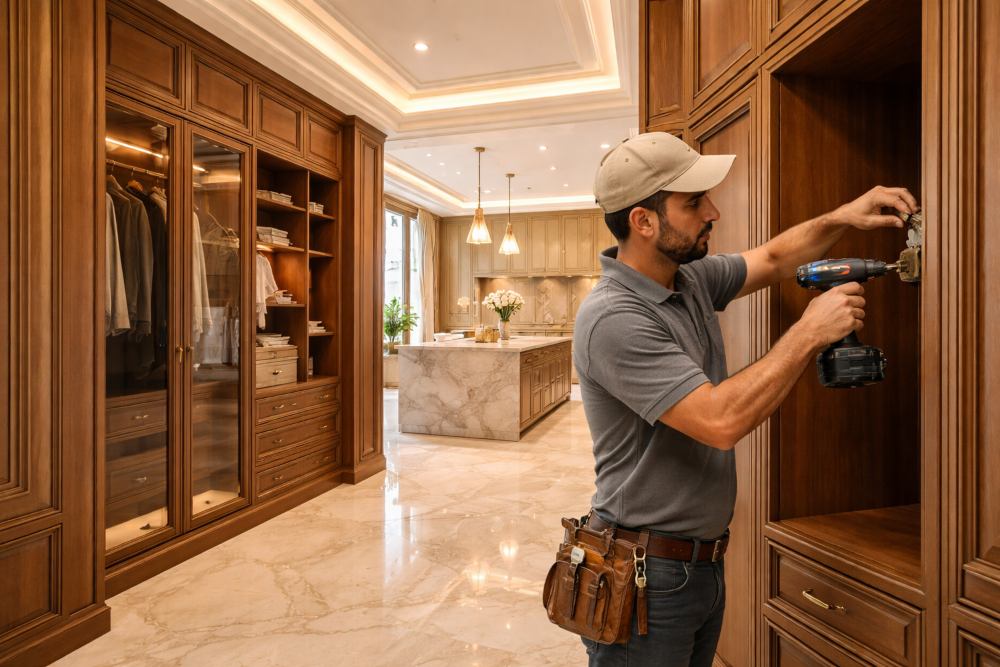
Residential carpentry in the UAE covers all interior woodwork inside villas, apartments, townhouses, and penthouses. This is the most customisation-intensive category.
Common residential applications include:
- Custom wardrobes and walk-in closets floor-to-ceiling designs with integrated lighting, pull-out drawers, and mirror panels
- Modular and bespoke kitchen cabinetry including handleless designs, soft-close mechanisms, and lacquered or veneer finishes
- TV units and entertainment consoles wall-mounted floating designs are highly popular in 2026
- Home office fit-outs a growing category driven by hybrid work culture
- Bedroom furniture sets custom headboards, side tables, and built-in storage
- False ceilings with wooden elements decorative coffered or slatted ceiling panels
- Internal doors and door frames solid wood or engineered wood options
- Staircase balustrades and handrails using hardwood species for luxury aesthetics
2. Commercial Carpentry
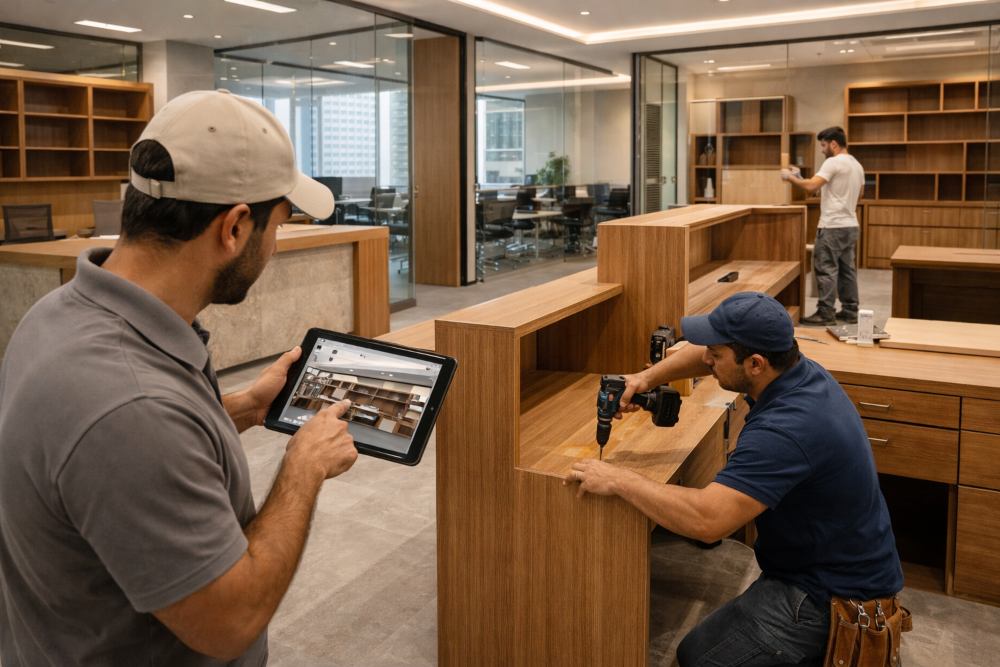
Commercial carpentry demands a higher standard of durability, fire compliance, and precision finishing. Projects are typically large-scale with tighter timelines.
Common commercial applications include:
- Reception counters and front desks custom branded millwork for hotels, clinics, and offices
- Retail fit-outs and shop interiors display shelving, product fixtures, and branded joinery
- Restaurant and café interiors booth seating, bar counters, wall paneling, and custom tables
- Office partitioning systems wooden partitions, acoustic panels, and executive office furniture
- Hotel room furniture FF&E (furniture, fixtures, and equipment) packages for hospitality projects
- Gym and leisure fit-outs lockers, changing room joinery, and reception elements
- Exhibition stands and event structures temporary but precision-made installations
3. Outdoor Carpentry
The UAE’s climate characterised by intense heat, UV radiation, and coastal humidity creates specific challenges for outdoor wood structures. Only treated, weather-resistant materials are suitable for long-term exterior applications.
Common outdoor applications include:
- Pergolas and shade structures increasingly popular in residential gardens and hotel pool areas
- Wooden decking WPC (Wood Plastic Composite) and hardwood decking for terraces, rooftops, and marina walkways
- Gazebos and outdoor cabanas bespoke timber structures for luxury villas and resorts
- Wooden cladding and facades exterior wall treatment using thermally modified or composite wood
- Garden furniture and built-in seating teak, ipe, and WPC are preferred species
- Privacy screens and fencing slatted timber or WPC panels used in villa gardens
Wood Materials Used in UAE Carpentry: Detailed Guide
Material selection is one of the most consequential decisions in any carpentry project. The UAE’s climate, combined with the diverse demands of residential and commercial applications, requires careful material matching.
Hardwoods
Hardwoods are prized for strength, longevity, and premium visual appeal. They are the material of choice for luxury furniture and high-traffic applications.
| Wood Species | Key Properties | Best Applications |
|---|---|---|
| Oak | High density, prominent grain, stable | Flooring, cabinetry, furniture |
| Walnut | Dark tone, fine grain, impact-resistant | Executive furniture, decorative panels |
| Mahogany | Reddish-brown, moisture-resistant | Doors, exterior joinery |
| Teak | Naturally oily, highly weather-resistant | Outdoor decking, marine applications |
| Maple | Light colour, hard-wearing | Countertops, flooring |
| Ash | Flexible yet strong, attractive grain | Furniture frames, sports/gym equipment |
Softwoods
Softwoods are lighter, more affordable, and easier to shape making them appropriate for structural elements, framing, and painted finishes.
- Pine widely used for furniture frames, shelving, and doors
- Cedar naturally aromatic and insect-resistant, used in wardrobes and outdoor structures
- Fir structural framing and carcassing for built-in furniture
Engineered Wood Products
Engineered wood dominates volume usage in UAE carpentry due to its cost efficiency, dimensional stability, and compatibility with modern manufacturing techniques.
| Product | Full Name | Common Uses |
|---|---|---|
| MDF | Medium Density Fibreboard | Cabinet doors, skirting, routed profiles |
| HDF | High Density Fibreboard | Flooring, high-stress panels |
| Plywood | Multiple veneer layers | Cabinet carcasses, structural panels |
| Particle Board | Compressed wood chips | Flat-pack furniture, interior panels |
| WPC | Wood Plastic Composite | Outdoor decking, cladding, pergolas |
| Veneer | Thin real wood over substrate | Premium cabinetry surfaces |
Thermally Modified Wood
An emerging material in the UAE market, thermally modified timber undergoes heat treatment that reduces moisture content, improves stability, and increases resistance to decay without chemical treatments. Ideal for outdoor cladding and decking in the Gulf climate.
FSC-Certified and Sustainable Timber
With the UAE’s commitment to sustainability and the growing ESG requirements of commercial clients, FSC (Forest Stewardship Council) certified timber is increasingly specified in project briefs. Architects and interior designers working on LEED or Estidama-rated projects now frequently mandate sustainable sourcing.
Tools and Technology in Modern UAE Carpentry
Traditional Hand and Power Tools
Professional carpenters in the UAE equip their workshops with high-quality tools from established brands:
- Cutting tools: Miter saws, circular saws, jigsaws, band saws, table saws
- Shaping tools: Routers, planers, chisels, rasps
- Measuring and marking tools: Digital measuring tapes, try squares, sliding bevels, spirit levels
- Joining tools: Pocket hole jigs (Kreg), biscuit jointers, doweling jigs, clamps
- Finishing tools: Random orbital sanders, belt sanders, spray guns
- Popular brands: DeWalt, Makita, Bosch, Festool, Milwaukee, Metabo
CNC (Computer Numerical Control) Machining
CNC technology has transformed carpentry production in the UAE. CNC routers and cutting machines use digital files (typically DXF or DWG format) to execute precise cuts, engravings, and profiles automatically.
Benefits of CNC in carpentry:
- Extremely high dimensional accuracy (tolerances within ±0.1mm)
- Ability to reproduce complex profiles and decorative patterns at scale
- Faster production cycle times for batch manufacturing
- Reduced material waste through optimised nesting software
Applications: Custom cabinet doors, decorative wall panels, Arabic geometric lattice screens (mashrabiya), signage, and furniture components.
Panel Saws and Edge Banders
Large-format panel saws allow precise cutting of full sheets of MDF and plywood. Edge banding machines apply PVC, ABS, or real wood veneer tape to exposed panel edges, delivering a clean professional finish on engineered wood products.
3D Design and Visualisation Software
Leading carpentry firms in the UAE now offer 3D rendered visualisations before any material is cut. Common software includes:
- AutoCAD / AutoCAD Cabinet technical drawings and cut lists
- SketchUp / 3ds Max photorealistic design visualisations
- Cabinet Vision / Polyboard specialist joinery design and manufacturing software
This capability is a significant client-facing differentiator and directly addresses the UAE consumer’s demand for confidence before committing to a project.
BIM Integration
For larger commercial fit-out projects, carpentry contractors increasingly work within a BIM (Building Information Modelling) workflow, coordinating their millwork shop drawings with structural, MEP, and architectural models to avoid clashes and ensure accurate installation.
Key Carpentry Joinery Techniques
The structural integrity of any carpentry work depends on the quality of the joints used to connect components. Key techniques include:
- Dovetail joint interlocking trapezoidal cuts used in drawer construction; extremely strong in tension, widely recognised as a mark of quality furniture making
- Mortise and tenon joint a classic joint where a projecting tenon fits into a corresponding mortise; used in chair frames, door frames, and timber structures
- Biscuit joint uses elliptical compressed wood biscuits and glue; fast and strong, commonly used in panel alignment
- Pocket hole joint (Kreg system) popular in modern production carpentry for cabinet assembly; fast, hidden, and reliable
- Box joint / finger joint interlocking rectangular cuts used in box and drawer construction
- Dado and rabbet joints recessed grooves cut into panels for shelving and cabinet backs
- Dowel joint wooden cylindrical pegs used to align and reinforce butt joints
The Carpentry Project Process: Step by Step
Understanding the standard project workflow helps set expectations and ensures quality outcomes.
Step 1: Consultation and Site Survey
An experienced carpenter or project manager visits the site, takes accurate measurements, assesses existing conditions, and discusses the client’s functional and aesthetic requirements. For commercial projects, this involves reviewing architectural drawings.
Step 2: Design and 3D Visualisation
The design team produces technical drawings and 3D rendered visuals showing the proposed solution. Clients review and approve the design, and revisions are made at this stage before any manufacturing begins.
Step 3: Material Selection and Approval
Samples of timber species, veneers, laminates, hardware, and finishes are presented for client approval. This stage locks in the material specification and finalises the Bill of Quantities (BOQ).
Step 4: Workshop Manufacturing
Approved designs are transferred to the workshop as cutting files. CNC machines, panel saws, and edge banders are used to produce components. Joinery is assembled, sanded, and pre-finished in the workshop where quality control is easier to manage.
Step 5: Surface Finishing
Finishing is applied in a controlled workshop environment before delivery wherever possible. Finishing options include spray lacquer, PU coating, veneer, laminate wrapping, staining, and wax or oil treatments.
Step 6: Site Installation
Finished components are transported to site and installed by skilled carpenters. Installation involves precise levelling, scribing to uneven walls, fixing, and hardware fitting (hinges, handles, drawer runners, soft-close mechanisms).
Step 7: Snagging and Quality Inspection
A detailed inspection is conducted upon completion. Any gaps, alignment issues, or finish defects are addressed before final handover. A reputable contractor will provide a documented snagging resolution process.
Wood Finishing Options Explained
Finishing protects the wood, enhances its appearance, and determines how it will perform over time in the UAE’s conditions. Choosing the wrong finish can lead to premature deterioration.
| Finish Type | Appearance | Durability | Best For |
|---|---|---|---|
| 2-Pack PU Lacquer | High gloss or matt | Excellent | Kitchen doors, lacquered furniture |
| NC Lacquer | Variable sheen | Good | Interior furniture and cabinetry |
| PU Coating | Semi-gloss | Very good, moisture resistant | Kitchens, bathrooms, high-traffic surfaces |
| Wood Stain + Varnish | Enhances grain, natural tones | Good | Solid wood furniture, floors |
| Veneer | Realistic wood appearance | Very good | Premium cabinetry and panel surfaces |
| Laminate (HPL/LPL) | Wide colour range | Excellent, scratch-resistant | Commercial cabinetry, worktops |
| Natural Oil / Wax | Matte, organic | Moderate | Feature pieces, eco-friendly interiors |
| Melamine | Smooth, flat | Good | Budget cabinetry interiors |
Note for UAE conditions: Due to extreme heat and humidity, especially in coastal areas, moisture-resistant finishes (PU, HPL laminate) are strongly recommended for kitchens, bathrooms, and any outdoor or semi-outdoor carpentry.
Carpentry Works Cost Guide for the UAE (2026)
Cost is one of the most searched-for topics in carpentry-related queries, yet most content fails to provide real guidance. Below is a practical overview note: prices vary significantly based on materials, design complexity, hardware brand, and contractor.
Indicative Price Ranges
Indicative Price Ranges
| Work Type | Budget (AED) | Mid-Range (AED) | Premium (AED) |
|---|---|---|---|
| Modular kitchen (per linear metre) | 800–1,200 | 1,500–2,500 | 3,000–6,000+ |
| Custom wardrobe (per linear metre) | 600–900 | 1,000–1,800 | 2,500–5,000+ |
| TV unit (custom, per unit) | 1,500–3,000 | 3,500–6,000 | 7,000–15,000+ |
| Office fit-out (per sq.m.) | 300–500 | 600–1,000 | 1,200–2,500+ |
| Wooden pergola (per sq.m.) | 400–600 | 700–1,200 | 1,500–3,000+ |
| Composite decking (per sq.m.) | 200–350 | 400–600 | 700–1,200+ |
| Interior wooden door (supply & install) | 800–1,200 | 1,500–2,500 | 3,000–8,000+ |
Important: These ranges are indicative only. Always obtain a detailed, itemised quotation from at least 2-3 reputable contractors before committing to a project. Prices in Dubai and Abu Dhabi tend to be higher than other Emirates.
What Drives the Cost?
- Material choice: solid hardwood vs. MDF vs. engineered products
- Hardware quality Blum, Hettich, and Häfele hardware commands premium pricing vs. generic alternatives
- Design complexity profiles, curves, and intricate details increase CNC and labor time
- Finishes 2-pack lacquer or real veneer add high cost over standard laminate
- Contractor’s workshop capability established workshops with CNC equipment to deliver better quality and consistency
Carpentry Trends in the UAE (2026)
1. Minimalist and Japandi Aesthetics
Clean lines, hidden handles, flat-front cabinet doors, and a neutral palette of white, warm grey, and natural wood tones dominate UAE interior design in 2026. Japandi (Japanese-Scandinavian fusion) has become a major influence in high-end villa fit-outs.
2. Fluted and Reeded Wood Panels
Vertical fluted panels on walls, kitchen islands, and TV units are among the most in-demand design features of 2026. These textured profiles are typically CNC-routed in MDF and finished in paint or veneer.
3. Biophilic Design and Natural Materials
The use of visible wood grain, natural oak veneer, and raw timber accents reflects the UAE’s growing interest in biophilic design connecting interior spaces with nature. Open-grain textures and light wood tones are displacing the high-gloss white aesthetic of the 2010s.
4. Smart and Multifunctional Furniture
Space optimization drives demand for furniture that does more: beds with integrated storage, sofas with pull-out tables, modular units that transform from workspace to entertainment centre. Smart lighting integration inside wardrobes and cabinets is also increasingly standard in premium projects.
5. Sustainable and Certified Wood
Clients specifying luxury projects are increasingly requesting FSC-certified timber and low-VOC finishes. This aligns with the UAE’s national sustainability agenda and resonates with a growing base of environmentally conscious high-net-worth clients.
6. Arabic Design Motifs in Modern Carpentry
Mashrabiya-inspired geometric screens, Arabic calligraphy carved panels, and Arabesque inlay patterns are being reinterpreted in contemporary interiors blending cultural identity with modern minimalism.
7. Outdoor Living Spaces
The growth of luxury residential developments with private gardens, rooftop terraces, and resort-style pools has created sustained demand for pergolas, decking, outdoor kitchens, and bespoke garden structures.
8. Prefabricated and Modular Joinery
For large projects, prefabricated joinery manufactured off-site and assembled on-site reduces disruption, improves quality control, and shortens installation time, a key priority in the UAE’s fast-paced construction environment.
Carpentry Regulations and Compliance in the UAE
This is one of the most overlooked sections in most carpentry guides yet it is critically important for commercial projects.
Fire Safety Requirements
UAE Civil Defence regulations require that wood used in commercial interiors must either be inherently fire-resistant or treated with fire-retardant coatings. MDF and plywood used in commercial applications often require Class B or Class C fire-retardant treatment depending on the building type. False ceilings in hotels, hospitals, and educational buildings are subject to stricter standards.
Estidama Pearl Rating (Abu Dhabi)
Commercial projects in Abu Dhabi pursuing Estidama Pearl certification must demonstrate sustainable material sourcing, including evidence of responsible forest management for all timber products.
LEED Certification (Dubai and Commercial Projects)
Dubai’s commitment to green building standards means many commercial clients require carpentry contractors to provide Material Safety Data Sheets (MSDS) and proof of low-VOC finishes and sustainably sourced materials.
Dubai Building Code
Carpentry installations must comply with Dubai’s Building Code requirements for structural integrity, particularly for elements like mezzanine flooring, staircase balustrades, and ceiling structures.
Contractor Licensing
Carpentry and joinery contractors operating in the UAE must hold a valid trade licence issued by the relevant authority (DED in Dubai, ADBC in Abu Dhabi, etc.) and appropriate civil works classification under CBUAE regulations.
How to Choose a Carpentry Contractor in the UAE
With hundreds of carpentry firms operating across the UAE, selecting the right partner is critical. Here is a practical framework.
Key Evaluation Criteria
- Workshop Facility Visit or request photos of the actual workshop. A serious carpentry firm will have dedicated machinery, CNC equipment, finishing booths, and organised production. Avoid contractors who outsource all manufacturing.
- Portfolio and Track Record Ask for a project portfolio with completed work that matches your project type and quality level. Request references from recent residential or commercial clients.
- Technical Expertise The firm should employ or have access to a qualified interior designer or draughtsperson who can produce shop drawings and 3D visuals. A purely labour-based approach without design support is a risk for complex projects.
- Material Transparency Request a fully itemised quotation that specifies: material brand/grade, thickness, finish type, hardware brand, and warranty. Generic BOQs without specifications are a common source of disputes.
- Warranty and After-Sales Service Reputable contractors offer a minimum 1-year warranty on materials and workmanship. For kitchens and wardrobes, mechanisms (hinges, drawer runners) should carry the manufacturer’s warranty (typically 5–10 years for quality brands like Blum or Hettich).
- Timeline Commitment: Get a written project timeline with milestones. Delays in carpentry installation have a knock-on effect on other trades and handover dates.
Carpentry vs. Joinery: What Is the Difference?
This is one of the most frequently searched questions in the UAE carpentry space.
| Aspect | Carpentry | Joinery |
|---|---|---|
| Location of work | Primarily on-site | Primarily in a workshop |
| Scope | Site installation, fixing, fitting | Manufacturing of wood components |
| Examples | Installing doors, laying floors, fixing skirting | Making kitchen cabinets, doors, staircases |
| Skill focus | Fixing, finishing, scribing to existing conditions | Precision machining, fine joinery, finishing |
| In UAE context | Often the same contractor handles both | Integrated carpentry/joinery firms are common |
In practice, most UAE carpentry companies offer integrated carpentry and joinery services manufacturing in their workshop and installing on-site. When evaluating a contractor, confirming they control both stages in-house is a quality assurance advantage.
Maintenance and Care for Wood in the UAE Climate
The UAE’s climate presents specific challenges for wooden structures and furniture. Understanding maintenance needs helps protect your investment.
Interior Wood Care
- Avoid prolonged direct sunlight UV exposure fades finishes and can crack solid wood
- Maintaining consistent indoor humidity air conditioning dries air significantly; solid wood may crack in very dry conditions. A humidifier in winter months (when AC is used heavily) can help
- Clean with appropriate products use pH-neutral wood cleaners; avoid abrasive pads or harsh chemicals on lacquered surfaces
- Periodic re-waxing or re-oiling for oil or wax-finished surfaces, annual reapplication maintains protection
Exterior and Outdoor Wood Care
- Annual inspection for cracks and delamination heat cycling causes expansion and contraction
- Re-sealing or re-staining every 1–2 years for timber pergolas, decking, and outdoor furniture
- WPC decking lower maintenance than real wood; annual cleaning with a deck wash is typically sufficient
- Check fixings for corrosion use stainless steel fixings in coastal environments
How Carpentry Adds Value to UAE Property
High-quality carpentry is one of the highest-ROI upgrades an owner can make to a UAE property.
Residential Resale and Rental Value
Properties with bespoke, high-quality kitchens, fitted wardrobes, and custom-built-ins consistently attract stronger rental demand and higher asking prices in the UAE market. In luxury segments, premium carpentry is expected by buyers and is a standard differentiator.
Commercial Return on Investment
For retail, hospitality, and F&B operators, the quality of interior woodwork directly influences customer perception and brand experience. A well-executed fit-out communicates quality, which translates to higher customer spend and repeat business.
Property Staging and Resale
When selling a property, premium fitted kitchens and wardrobes are among the most-cited features in UAE real estate listings and significantly reduce time-on-market.
Common Mistakes to Avoid in Carpentry Projects
- Prioritising price over quality on materials Cheap MDF will absorb moisture and swell, cheap laminates will peel, and generic hardware will fail within 2–3 years. The cost difference between budget and mid-range materials is often small relative to total project cost but the quality difference is significant.
- Skipping the 3D visualisation stage Approving a design from a flat 2D sketch is risky. Insist on a 3D rendered visual before approving for production. Changes after manufacturing has started are expensive.
- Ignoring moisture and climate requirements, selecting a finish or material appropriate for a temperate climate but unsuitable for the UAE’s heat and humidity is a common mistake especially for kitchens, bathrooms, and any semi-outdoor application.
- Not specifying hardware brands in the quotation Hardware is often where contractors reduce cost invisibly. Insist on specifying Blum, Häfele, or Hettich hardware by name in the contract if quality is a priority.
- Underestimating installation time, Carpentry installation is typically the longest trade on a fit-out project. Rushing the timeline leads to poor alignment, unfinished edges, and snagging problems.
- Failure to check contractor licence and experience In the UAE, unlicensed carpentry work can create legal complications with property developers and building management. Always verify the contractor holds a valid UAE trade licence.
Conclusion
Carpentry works in the UAE represent one of the most dynamic and demand-driven sectors within the broader construction and interior design industry. With the UAE construction market projected to exceed AED 189 billion in 2026, carpentry and joinery services are positioned for sustained growth across residential, commercial, and hospitality segments.
Making the right decisions from material selection and contractor vetting to understanding finish options, climate requirements, and regulatory obligations is what separates a carpentry investment that adds lasting value from one that leads to costly problems.
Whether you are furnishing a luxury villa in Dubai, fitting out a restaurant in Abu Dhabi, or adding a pergola to your garden in Sharjah, the principles remain the same: invest in quality materials, work with an experienced and licensed contractor, specify everything in writing, and insist on seeing a 3D visual before production begins.
Frequently Asked Questions (FAQs)
What are carpentry works in the UAE?
Carpentry works in the UAE include the design, manufacture, and installation of all wooden structures and elements used in construction from modular kitchen cabinets and custom wardrobes to hotel fit-outs, outdoor pergolas, and wooden wall cladding.
Which wood is best for carpentry in the UAE?
For indoor furniture, MDF with lacquer or veneer finish offers the best balance of quality and value. For hardwood pieces requiring durability, oak or walnut are premium choices. For outdoor applications in the UAE's climate, teak, ipe, or WPC (Wood Plastic Composite) are the most resistant options.
How much does carpentry work cost in the UAE?
Costs vary widely by material, design, and contractor. As a rough guide: custom kitchens range from AED 800–6,000+ per linear metre; custom wardrobes from AED 600–5,000+ per linear metre; and commercial office fit-out carpentry from AED 300–2,500+ per square metre. Always obtain itemised quotations from multiple contractors.
What is the difference between carpentry and joinery?
Carpentry refers to on-site installation and fixing work. Joinery refers to the workshop-based manufacturing of wooden components. In the UAE, most contractors offer both services under one roof.
Why is CNC used in carpentry?
CNC machines deliver precision cuts and complex profiles that are impossible or impractical to achieve by hand. They enable faster production, consistent repeatability, and minimal material waste all of which improve quality and reduce cost at scale.
Do I need permits for carpentry works in UAE?
For structural carpentry work (e.g., mezzanines, raised platforms, major structural fit-outs), a permit from the relevant municipality or developer may be required. Standard interior carpentry (furniture, cabinetry) typically does not require a permit, but always check with your building management.
What fire safety requirements apply to carpentry in UAE?
Commercial projects must comply with UAE Civil Defence fire safety standards. Wood products used in commercial interiors may require fire-retardant treatment, and the specific requirements vary by building type, occupancy, and floor level. A qualified contractor or fire safety consultant should be engaged to confirm requirements.
How long does a carpentry project take in the UAE?
A standard 3-bedroom apartment fit-out (kitchen, wardrobes, and joinery) typically takes 4–8 weeks from design sign-off to installation completion. Large commercial projects may take 3–6 months or longer depending on scope and site access.
What warranty should I expect from a carpentry contractor?
Reputable contractors in the UAE typically offer a minimum 1-year workmanship warranty. Hardware from premium brands (Blum, Hettich, Häfele) carries separate manufacturer warranties of 5–10 years. Get warranty terms in writing before signing any contract.