
Plumbing Installation in RAK | Complete Guide and Costs 2026
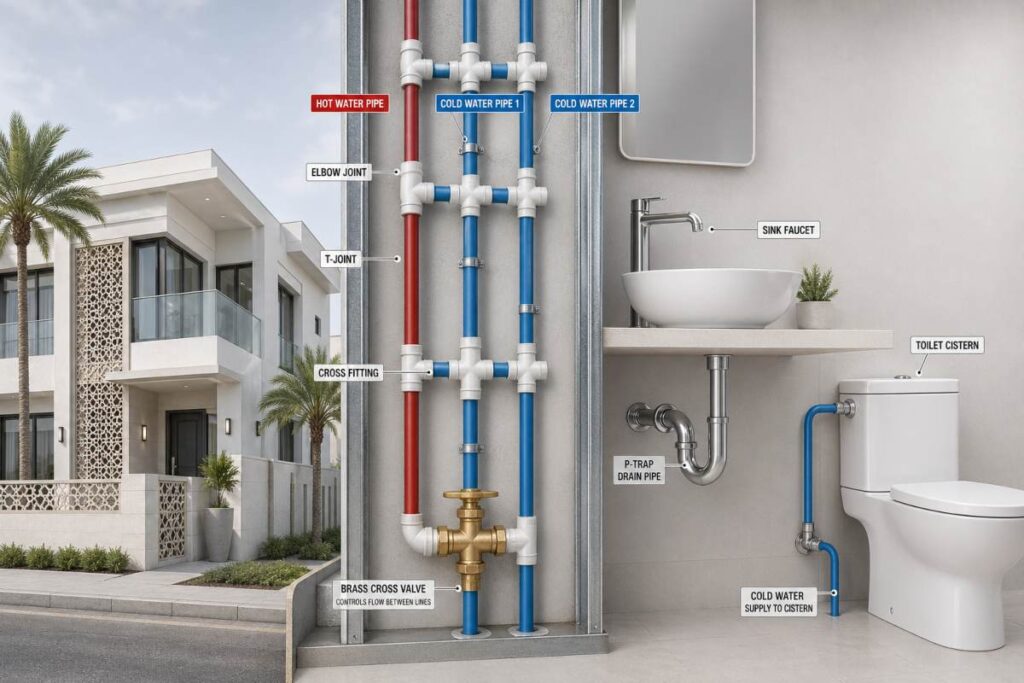
Plumbing installation is the process of designing, fitting, and connecting the pipes, fixtures, and drainage systems that deliver clean water into a building and remove wastewater from it. In the UAE where water comes entirely from desalination plants, summer temperatures push pipe materials to their limits, and RAK Municipality and EtihadWE enforce strict compliance standards getting plumbing installation right is not optional. It affects your health, your property value, and your legal standing.
Whether you are building a new villa in Al Hamra, renovating an apartment in Mina Al Arab, or replacing aging pipes in a commercial fit-out in Al Marjan Islan, this article walks you through every stage of the process clearly and completely.
What Is a Plumbing System?
A plumbing system is a network of supply lines, drain pipes, vent stacks, and fixtures working together across three distinct subsystems.
The water supply system delivers pressurized, treated water sourced entirely from desalination in the UAE from the municipal main to every faucet, toilet, and appliance in the building. The drain-waste-vent (DWV) system uses gravity to carry wastewater to the municipal sewer network, while vent stacks safely release sewer gases through the building envelope. The fixture and appliance set includes sinks, toilets, showers, bathtubs, water heaters, washing machines, and dishwashers all connected to both the supply and drainage lines.
When all three work correctly, you never notice your plumbing. When one fails, the problems of leaks behind walls, sewage backups, contaminated water, and structural moisture damage are immediate and expensive. In the UAE’s climate, where ambient temperatures regularly exceed 45°C and water pressure from district systems can spike unpredictably, a well-installed system is the only kind worth having.
Plumbing Regulations in Ras Al Khaimah
Before covering the installation itself, it is important to understand the regulatory framework governing all plumbing work in the UAE. This is one of the most underserved areas in general plumbing content, yet it is the first thing a contractor or homeowner in the UAE must understand.
Dubai
Plumbing in Dubai is governed by the Dubai Building Code (2021 Edition) and enforced jointly by Dubai Municipality (DM) and DEWA (Dubai Electricity and Water Authority). Before any significant plumbing project begins, your contractor must obtain a No Objection Certificate (NOC) from DEWA confirming the design meets their network standards. Dubai Municipality then governs everything inside the property boundary.
The Al Sa’fat sustainable building rating system Dubai’s mandatory green building framework requires water-efficient fixtures with verified Water Efficiency Label (WELS) ratings, greywater recycling systems in larger developments, and advanced leak detection systems across the building’s life. For permitted work, a Major Works permit costs between AED 2,000 and AED 15,000. A Minor Works permit covering most internal plumbing modifications costs AED 500 to AED 2,000. Processing typically takes 15 to 30 days for standard permits.
Abu Dhabi
Abu Dhabi operates under the Abu Dhabi International Plumbing Code, which aligns with the International Plumbing Code (IPC) adapted for local conditions. The Abu Dhabi Department of Urban Planning and Municipalities oversees compliance. Abu Dhabi’s Estidama sustainability program, mandatory for all new builds, drives requirements for low-flow fixtures, greywater system integration, and efficient irrigation. MEP permits in Abu Dhabi typically cost AED 500-5,000, depending on the scope.
Sharjah
Sharjah follows its own building regulations, administered by Sharjah Municipality, with cultural heritage and structural preservation requirements that add a layer to renovation work in older districts. The plumbing framework aligns with UAE national standards, but with stricter scrutiny on drainage in heritage zones.
UAE-Wide Plumbing Standards
Across all emirates, the following technical standards apply to all plumbing installations:
- Minimum water pressure at fixtures: 2 bar
- Maximum water pressure at fixtures: 6 bar
- Required pressure-reducing valves where the mains pressure exceeds 6 bar
- Corrosion-resistant pipe materials are mandatory (critical given the high chloride content in UAE desalinated water)
- Backflow prevention devices are compulsory at all potable water connection points
- Low-flow fixtures and efficient irrigation are required under conservation regulations
- Greywater systems are encouraged and, in larger developments, mandatory
Plumbing Installation Phases in the UAE
The installation sequence in the UAE follows the same fundamental phases as international best practice, but with inspection checkpoints tied specifically to Dubai Municipality, DEWA, and other local authorities.
Phase 1: Design and NOC
The project begins with a detailed MEP (Mechanical, Electrical, Plumbing) design drawing, prepared by a licensed consultant and submitted for authority approval. In Ras Al Khaimah, EtihadWE issues the NOC before site work starts. This design covers water supply routing, drain line slopes, fixture positions, pipe sizing calculations, and integration with the building’s fire suppression and HVAC systems where applicable.
Phase 2: Permits
Permits are mandatory for all new plumbing installations and significant modifications. Your licensed contractor handles the submission. In Ras Al Khaimah, the approval process for standard residential projects typically takes 15 to 30 days. Working without a valid permit in the UAE results in stop-work orders, fines, and the requirement to demolish and redo non-compliant work at the owner’s cost.
Phase 3: Rough-In
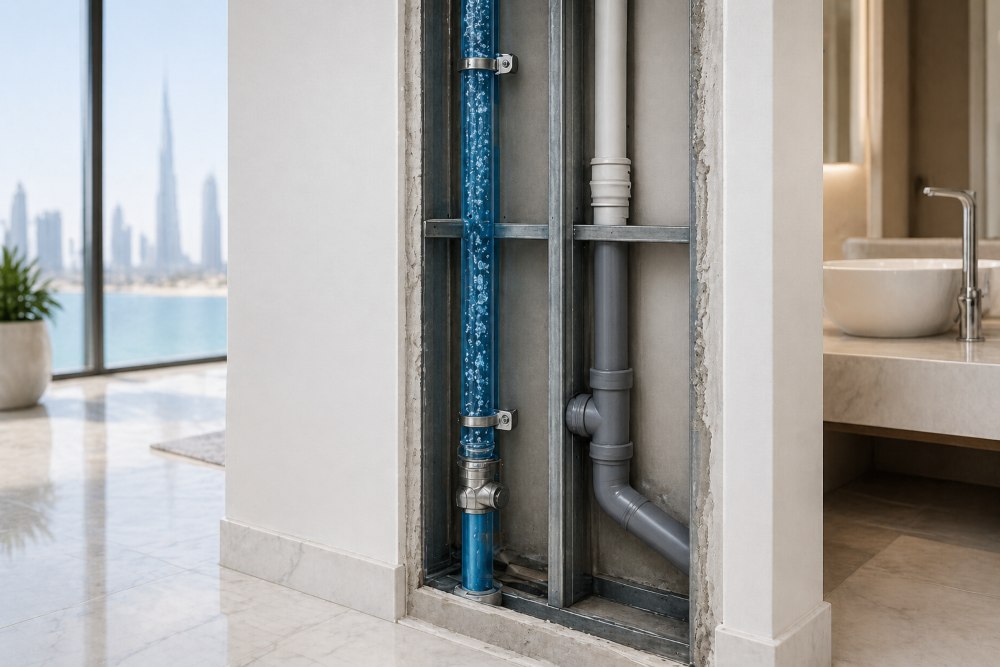
This is the core phase of all pipework hidden behind walls, under slabs, and inside ceilings and shafts.Plumbing work In UAE construction, rough-in typically includes the main cold-water supply from the EtihadWE connection point into the building, hot-water distribution from a central or point-of-use heater, drainage and vent stack installation, and below-slab drain lines in villas and low-rise buildings. The MEP rough-in inspection by the relevant authority must be passed before walls are closed or concrete is poured over buried lines.
Phase 4: Trim-Out (Fixture Installation)
After finishes are complete tiles, wall cladding, flooring the plumber returns for trim-out. This includes installing toilets, basins, and faucets, showerheads and bath fillers, water heaters (storage or instant), kitchen appliances, and isolation valves at every fixture. In high-end UAE residential projects, trim-out also includes smart faucets, sensor-operated fixtures, and digital shower systems.
Phase 5: Final Inspection and Completion Certificate
The authority inspector verifies the complete system before the water connection is made live. In Ras Al Khaimah, this results in a completion certificate issued by RAK Municipality, the official sign-off required before occupancy. The contractor also provides as-built drawings, warranties, and system documentation at handover.
Pipe Materials in the UAE: What Is Actually Used Here
Pipe material selection in the UAE is driven by three factors that do not apply in most other markets: extreme ambient heat, highly chlorinated desalinated water, and strict authority-approved materials lists. Not every material used internationally is permitted or practical here.
PPR (Polypropylene Random Copolymer) Most Common for Hot and Cold Supply
PPR is the dominant supply pipe material across residential and commercial construction in the UAE. It is heat-fused (butt-welded), creating a joint stronger than the pipe itself with zero leak points. It handles water temperatures up to 95°C, resists the chloride content in UAE desalinated water, and has a smooth internal bore that maintains flow rates over time. EtihadWE and RAK Municipality both accept PPR on approved materials lists.
CPVC (Chlorinated Polyvinyl Chloride) Hot Water Applications
CPVC is widely used for hot water supply lines in the UAE. It handles continuous temperatures up to 93°C, is more affordable than PPR in some project specifications, and is fully corrosion-resistant. It is joined with solvent cement, making installation fast, but joints require careful preparation in high-temperature environments.
uPVC Drainage and Cold Water
uPVC (unplasticized PVC) is the standard for all drain, waste, and vent piping in UAE buildings. It is lightweight, chemically resistant, easy to cut and join with solvent cement, and performs well in the drainage temperatures generated by UAE buildings. uPVC should not be used for a hot water supply; it softens above 60°C.
HDPE (High-Density Polyethylene) Underground and Large-Diameter Lines
HDPE is used for underground supply lines, sewer mains, and large-diameter infrastructure connections. It is butt-fused or electrofusion-welded, creating a fully continuous pipe without mechanical joints critical for buried lines where excavation for leak repair is expensive and disruptive.
Copper High-End Residential and Export Fittings
Copper is used in premium UAE residential projects, particularly for visible supply connections and fixture tails. It is corrosion-resistant in the UAE’s desalinated water and has a proven long lifespan. It is more expensive than PPR and requires skilled soldering, which increases labor cost in a market where PPR fusion is faster and cheaper at scale.
Pipe Material Comparison for UAE Conditions
| Material | Best Use | Max Temperature | UAE Approval | Cost Level | Lifespan |
|---|---|---|---|---|---|
| PPR | Hot & cold supply | 95°C | DEWA / DM approved | Medium | 50+ years |
| CPVC | Hot water supply | 93°C | Widely accepted | Medium | 25–40 years |
| uPVC | Drain & vent lines | 60°C (drain only) | Standard | Low | 25–40 years |
| HDPE | Underground mains | 60°C | Authority approved | Medium–High | 50+ years |
| Copper | Premium supply | 100°C+ | Accepted | High | 50+ years |
| Galvanized steel | Legacy replace | Corrosion risk | Not recommended | — | Replace now |
How Much Does Plumbing Installation Cost in the UAE?
Plumbing costs in Ras Al Khaimah vary by project type, building size, and material specification. The following ranges reflect current market conditions in Ras Al Khaimah.
For new villa construction, complete plumbing installation from the DEWA connection point through all supply, drainage, and fixture installation typically costs between AED 35,000 and AED 90,000 for a three-to-five-bedroom villa, depending on the number of bathrooms, specified materials, and whether smart fixtures are included.
For apartment fit-outs and renovations, a full bathroom wet-area repipe, and fixture replacement costs AED 3,500 to AED 8,000. A complete apartment repipe for a two-bedroom unit typically costs AED 8,000 to AED 18,000. Water heater replacement (storage unit) costs AED 800 to AED 2,500, while an instant water heater installation runs AED 1,200 to AED 3,500.
Permit and NOC costs range from AED 500 to AED 5,000, depending on the emirate and the scope of the submission. Always factor these into your project budget; they are not optional.
Three written quotes from licensed, authority-registered contractors are the minimum before committing to any significant plumbing project in the UAE.
Plumbing Fixtures: What the UAE Market Requires
Plumbing fixtures in the UAE must satisfy both functional requirements and, increasingly, regulatory sustainability standards. Toilets must meet low-flush standards; dual-flush models with a 3/4.5 litre split are the typical specification in compliant UAE projects. Pre-2000 single-flush toilets using 9 to 13 litres per flush are being progressively replaced across the UAE’s aging residential stock. Upgrading to a dual-flush WC is one of the fastest ways to reduce water consumption in a market where water costs are rising, and conservation mandates are tightening.
For basins and showers, aerating faucets and low-flow showerheads rated at 6 litres per minute or less are the benchmark in WELS-compliant specifications. Touchless sensor taps in bathrooms and kitchens are increasingly specified in UAE projects to improve hygiene (particularly relevant in a market conscious of water quality) and reduce consumption by 30 to 50 percent compared to manual taps left running.
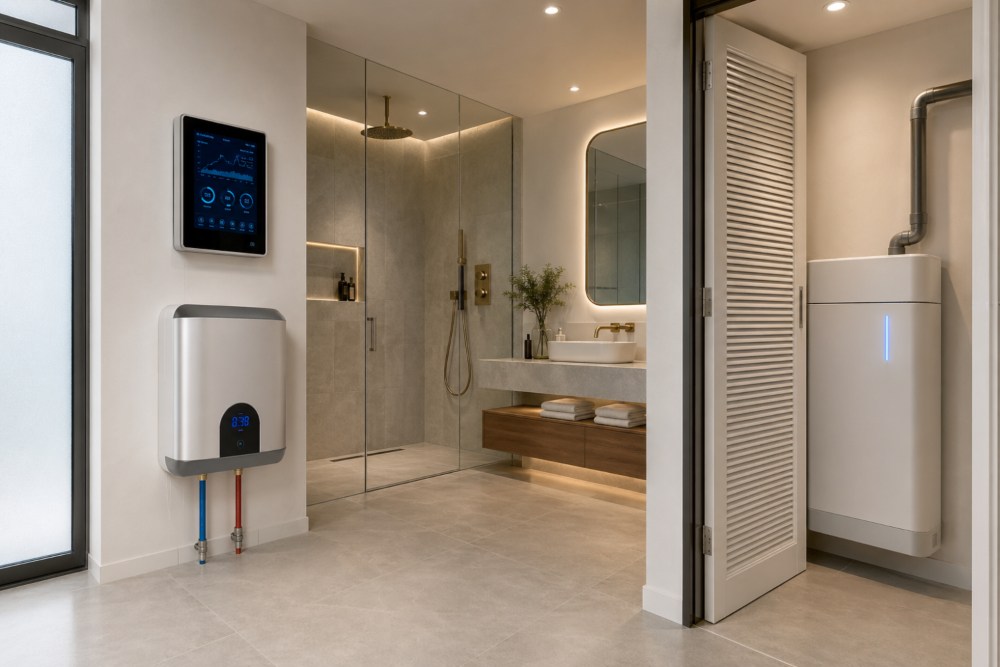
Water heaters in residential buildings in the UAE are predominantly storage-tank units; centralized hot-water systems are preferred for greater efficiency in larger buildings. Instant water heaters (point-of-use) are widely used in UAE apartments for bathrooms distant from the central heater, eliminating the delay and wasted water of a long hot water run. Heat pump water heaters are gaining traction as electricity costs rise, offering three to four times the efficiency of conventional electric storage units.
Plumbing Repairs: What Goes Wrong in UAE Buildings
The UAE’s climate and water supply characteristics create specific failure patterns that differ from cooler, lower-pressure markets.
Pipe joint failures are the most common issue in older buildings in the UAE. The thermal cycling between UAE summer heat (45°C+ externally, pipes in direct sun or uncooled risers reaching 70°C+) and air-conditioned interiors stresses solvent-cemented joints over time. PPR heat-fused joints are significantly more resistant to this than older solvent-cement uPVC supply joints.
Calcium and mineral buildup inside faucets, showerheads, and appliance inlets is a routine maintenance issue in the UAE. Desalinated water is re-mineralized before distribution, and the resulting mineral content, combined with UAE water temperatures, creates accelerated scale buildup. Aerator screens and showerhead diffusers should be descaled or replaced every 12 to 18 months in most UAE households.
Water pressure fluctuations cause joint stress and fixture failures in buildings without properly calibrated pressure-reducing valves. UAE district supply pressure can vary significantly particularly during peak summer demand and a PRV that is not maintaining pressure in the 3 to 4 bar range is a source of ongoing leak risk.
Water heater failures are common in UAE apartments, where storage units are consistently pushed hard by high ambient temperatures and heavy usage. A storage unit over eight years old that shows discolored water, reduced capacity, or sediment buildup is ready for replacement, not repair.
Slow or blocked drains in UAE buildings are frequently caused by a combination of hair, soap scum, and the mineral scale that accumulates on drain walls over time. Kitchen grease blockages are also common particularly in UAE households with high cooking volumes. Hydro jetting at 2,000 to 4,000 PSI is the most effective cleaning method for UAE conditions, removing both organic blockages and mineral scale in a single service.
Plumbing Leaks in the UAE Detection and Prevention
Undetected plumbing leaks are particularly damaging in the UAE’s high-rise, basement-free construction environment, where a leak inside a wall or ceiling slab can go unnoticed for months before structural damage becomes visible. The combination of high water pressure and thermal stress on joints makes the UAE market one where leak prevention deserves active investment.
The water meter test is the simplest starting point. Shut off all water inside the unit or building, then observe the EtihadWE meter. Any movement indicates an active leak in the system.
Thermal imaging cameras now standard equipment for professional plumbers in the UAE detect temperature differences behind wall finishes and under floor tiles caused by active leaks, without any destructive investigation. This is particularly valuable in UAE buildings where marble and porcelain tile finishes make any exploratory opening expensive to restore.
Smart leak detection devices are becoming standard specifications in premium residential and commercial projects in the UAE. Systems that continuously monitor flow and trigger automatic shutoffs when abnormal patterns are detected prevent the escalating damage that hidden leaks can cause in multi-story buildings.
The most consistent leak prevention measures for UAE buildings are: installing and maintaining a correctly calibrated pressure-reducing valve (keeping pressure at 3 to 4 bar at the fixture), replacing washing machine hoses with braided stainless steel every five years, installing isolation valves at every fixture for rapid response to any failure, and scheduling annual plumbing inspections through a licensed contractor rather than waiting for a problem to appear.
Drain Cleaning in the UAE: Keeping Lines Clear in a Hot Climate
Drain cleaning is overlooked in most UAE maintenance schedules until a blockage forces the issue. The UAE climate accelerates the conditions that create blockages: grease solidifies faster in hot water that cools rapidly inside air-conditioned building service ducts. Mineral scale builds on the drain walls throughout the system.
A manual drain snake handles most localized sink and shower clogs within reach of the drain opening. For building mainlines, an electric drum machine is the professional standard for clearing blockages up to 30 metres. Hydro jetting is the most thorough option for UAE conditions; high-pressure water removes both the blockage and the scale layer from pipe walls, restoring full bore and extending the interval before the next service is needed.
For maintenance scheduling in UAE buildings: descale and clear kitchen drain traps every three to six months in active households. Snake floor drains and laundry lines annually. Schedule hydro jetting of the kitchen mainlines every 2 to 3 years. Having a CCTV drain camera survey run on the main sewer connection every five to seven years root intrusion from date palms and ornamental trees is a documented issue in UAE villa developments, and catching it early is far less expensive than an emergency excavation.
Never pour cooking grease, oil, or fat down drains in UAE buildings. It solidifies rapidly in the short run between the hot kitchen and the cooler drain stack, creating blockages that are difficult and expensive to clear. Coffee grounds, food debris, and wet wipes regardless of what the packaging claims also cause persistent drain problems.
Plumbing Maintenance in the UAE: Annual and Seasonal Checklist
Consistent maintenance prevents the majority of emergency plumbing calls in UAE buildings. Most checks take under 30 minutes and require no specialist tools.
For water heaters, flush the storage tank annually to remove the sediment layer that accumulates from minerals in desalinated water in the UAE. Test the temperature and pressure relief valve. Set the thermostat to 60°C for storage units. This is the UAE standard that prevents Legionella risk while avoiding unnecessary energy consumption. Inspect the external condition of the unit and the supply connections for any corrosion or weeping at joints.
For the supply system, test all isolation valves under basins and behind toilets by turning them fully off and back on. Valves that are never exercised seize in the UAE heat and become useless in an emergency. Check faucet aerator screens and showerhead diffusers for scale descale or replace them. Confirm the pressure-reducing valve setting with a pressure gauge at a hose point should be reading 3 to 4 bar under static conditions.
For fixtures, check all faucets for drips. In the UAE, even a slow drip wastes thousands of litres over a billing cycle particularly significant given water tariffs and the environmental cost of desalination. A running toilet is equally wasteful. The dye test food coloring in the cistern, observed in the bowl without flushing reveals silent flapper failures that can waste hundreds of litres per day.
For drainage, pour water into any floor drain not regularly used P-traps dry out quickly in UAE air-conditioned environments, allowing sewer gas to enter. Inspect washing machine hose connections for bulging or cracking, as the UAE heat accelerates this.
Summer preparation is particularly important in the UAE. Before the peak summer period, check that all roof-level pipe lagging and trace heating on any exposed supply lines are intact. Ensure cold-water storage tanks (common in UAE buildings as pressure buffers) are clean, covered, and free of biological growth; warm, stagnant water in uncovered tanks poses a Legionella risk.
Modern Plumbing Technology in UAE Buildings
The UAE’s construction market is among the world’s fastest adopters of building technology, and plumbing is no exception. Several technologies are moving from premium specification to standard practice across the market.
Smart water management systems are increasingly mandated or incentivized, these systems monitor real-time water consumption by zone, detect abnormal flow patterns indicating leaks, and generate usage data for EtihadWE compliance reportin. In commercial and large residential developments, they are becoming a standard MEP specification item.
Trenchless pipe repair is gaining significant traction in UAE villa communities, where established landscaping mature date palms, ornamental gardens, hardscaped driveways makes traditional excavation for underground pipe repair prohibitively expensive and disruptive. Pipe relining (epoxy liner insertion) and pipe bursting can replace underground supply and drainage lines at 30 to 50 percent of the cost of open excavation, with minimal surface disruption.
Instant and heat pump water heaters are progressively replacing conventional storage units in UAE retrofits. As EtihadWE tariffs have increased, the 300-400% efficiency advantage of heat pump water heaters over conventional electric storage units creates meaningful monthly savings particularly in larger UAE households with high hot water demand.
Greywater recycling systems collecting lightly used shower and basin water for toilet flushing and irrigation are mandated in larger UAE developments and are increasingly viable for villa-scale projects as system costs have dropped. In a country entirely dependent on desalination for fresh water, greywater reuse is not an optional sustainability gesture, it is a practical water security measure.
DIY vs Licensed Plumber: What UAE Law and Practicality Both Say
In the UAE, plumbing work is regulated under the MEP (Mechanical, Electrical, Plumbing) trade, and any permitted work must be carried out by a licensed contractor registered with the relevant authority, RAK Municipality.
Simple maintenance tasks replacing a faucet aerator, fixing a running toilet flapper, descaling a showerhead are reasonable for a competent homeowner to handle without professional involvement. No permit is required for like-for-like fixture maintenance.
Everything else belongs with a licensed plumber. In the UAE specifically, the regulatory exposure of doing permitted work without a licensed contractor is significant stop-work orders, fines, and mandatory demolition of non-compliant work. Beyond the legal risk, the practical risk of DIY on UAE-specific systems PPR pipe fusion, EtihadWE-metered connections, high-pressure municipal supply lines is equally serious.
When selecting a contractor in Ras Al Khaimah, confirm that they hold valid RAK Economic Zone / DED registration and RAK Municipality approval as a licensed MEP contractor, plus professional indemnity insurance. The same principle applies in Abu Dhabi and Sharjah authority registration is the minimum standard, not an optional credential.
Hidden Plumbing Issues UAE Homeowners Should Know
Beyond the standard installation and maintenance plumbing work, several areas have very high search demand in the UAE market but almost no dedicated coverage of existing issues.
Lead-free fitting compliance is a growing procurement concern in the UAE as international standards tighten. DEWA’s approved materials list specifies lead-free brass and copper fittings for all potable water connections. Homeowners renovating older buildings should ask their contractor to confirm that all fittings being installed or replaced are lead-free certified, an informational-to-transactional topic that most guides skip.
Water tank cleaning in UAE buildings is a legally mandated maintenance activity. UAE buildings with rooftop or basement cold water storage tanks are required to have them professionally cleaned and inspected at regular intervals, typically every six months, under RAK Municipality requirements. Uncleaned tanks in warm UAE conditions pose a genuine risk of Legionella and microbial contamination. This is an informational topic with strong transactional intent for homeowners searching for a tank cleaning contractor.
DEWA smart meter integration affects any UAE property where plumbing modifications could alter the supply connection. DEWA smart meters record consumption by zone and automatically flag anomalies. Contractors working near or modifying DEWA supply connections must coordinate directly with DEWA and document all changes, a step that non-specialist contractors sometimes skip, which can create complications at the next meter reading or during a property transaction.
Condensate drain management is unique to buildings in the UAE. The volume of condensate produced by UAE air conditioning systems, which run continuously for 6 to 8 months of the year, creates drainage loads that must be accounted for in the building’s drainage system design. Blocked or improperly terminated condensate drains are a leading cause of water damage in ceilings and walls in the UAE, yet they are almost absent from general plumbing problems.
Conclusion
A correctly designed and installed plumbing system in the UAE using authority-approved materials, compliant with EtihadWE and RAK Municipality requirements, installed by a licensed MEP contractor, and maintained annually will perform reliably for decades in conditions that would stress a poorly installed system within a few years.
The UAE is a market where the stakes of getting plumbing wrong are higher than average. You are working with desalinated water with specific chemistry, in a climate that tests every joint and fitting, under regulatory frameworks with real enforcement teeth. The combination of proper planning, the right materials for the local environment, legitimate permits, and consistent maintenance is not ideal; it is the practical minimum for a system that protects your property and your household.
When the work goes beyond a faucet cartridge or a running toilet, bring in a licensed, authority-registered plumber. The cost of professional installation is always less than the cost of repairing the damage a shortcut eventually causes.